Bali Land Zoning: Zones, Investor Mistakes | DDA Real Estate
Bali
EN
$
ft²
Other articles

Why land classification on Bali matters: Investor mistakes and expert advice

Ekaterina Bocharova The author of the article, the Broker
#Blog DDA
10 September 5607 views

Bali's zoning system determines what can be built on any given plot and whether a property can be legally operated as a rental. Many foreign buyers discover only after purchase that their villa sits on land where construction or commercial activity is prohibited. Understanding land classification is not optional – it is the foundation of any secure property purchase on the island.

How Bali's zoning system works

Every parcel of land on Bali is assigned a colour-coded zone through Indonesia's spatial planning framework, which operates at two levels: the provincial RTRW (Rencana Tata Ruang Wilayah) and the more detailed regency-level RDTR (Rencana Detail Tata Ruang). Since 2025, the RDTR has been integrated directly with the OSS (Online Single Submission) system, meaning that when a business permit is applied for, the system automatically checks the property's location against the zoning map. If the property sits in the wrong zone, the application is rejected automatically. This integration has made zoning compliance more critical than ever – perfect building permits and a registered company offer no protection if the land itself is not correctly classified. The system uses six colour-coded categories, each with specific permitted uses and restrictions.

The six main zone categories on Bali

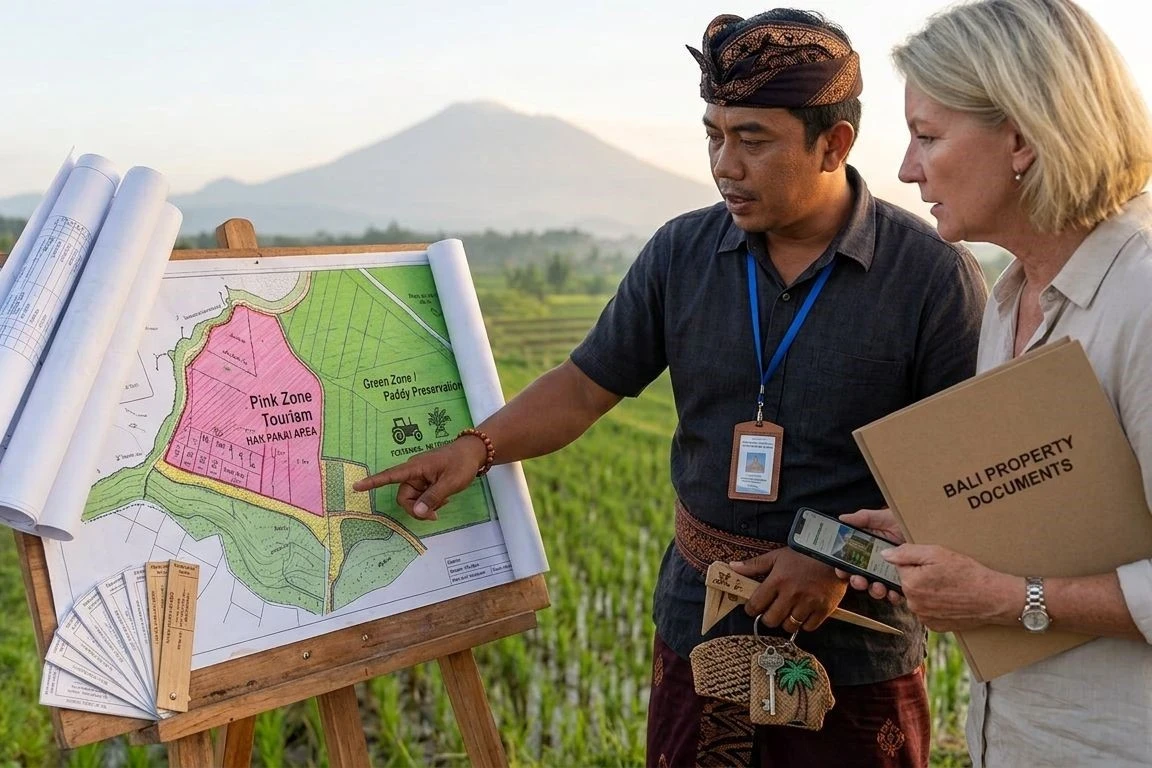
The zoning system uses six colour-coded categories, each with specific permitted uses and restrictions:

  • Green zone (agricultural). Land designated for farming and agriculture. Construction of any kind is prohibited. Buying land in this zone at a discount is a common trap – building is illegal and can lead to demolition.
  • Yellow zone (residential). Permits housing and villa construction for private use. Commercial hospitality activities such as short-term rentals are generally prohibited for foreign owners and PT PMA companies.
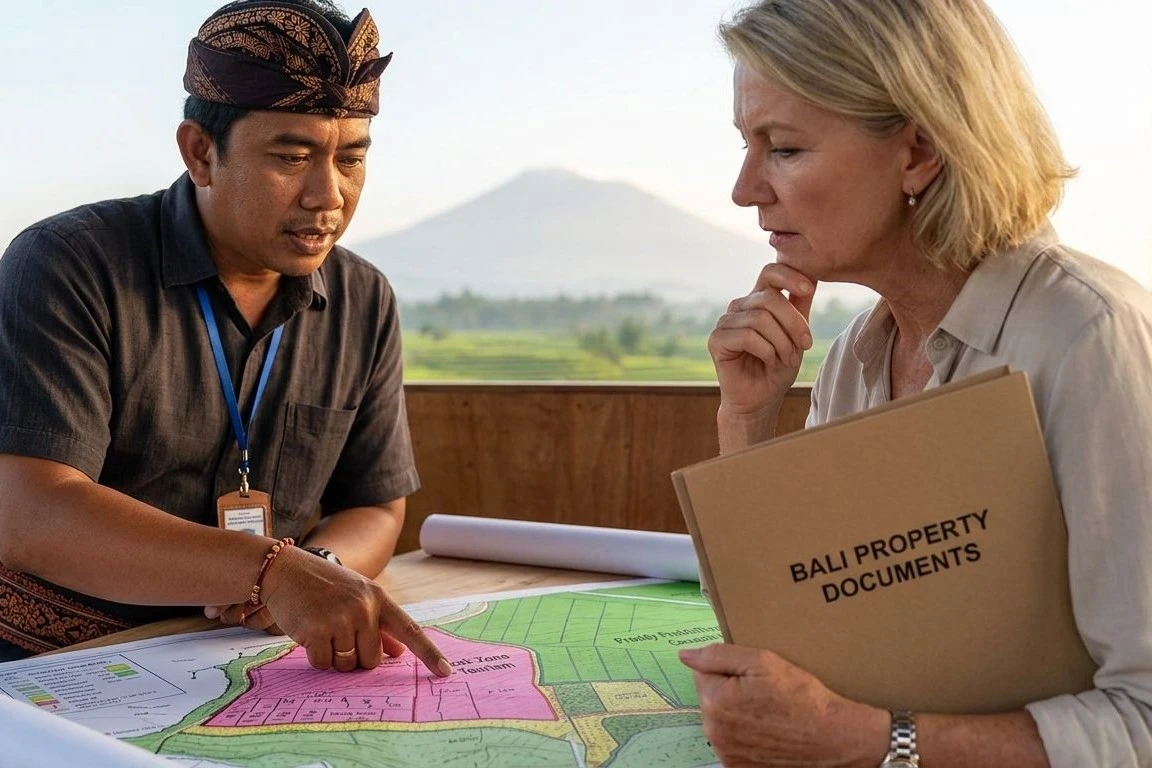
  • Pink zone (tourism). The only zone where short-term rentals, hotels, resorts, and tourism-related businesses are permitted with proper licensing.
  • Red zone (commercial). Permits commercial buildings such as shops, restaurants, and offices.
  • Orange zone (mixed-use). Allows both residential and commercial development.
  • Conservation zone (brown). Protected areas where construction is strictly prohibited.

The most common mistakes buyers make

Many foreign buyers discover the true cost of ignoring zoning only after they have already purchased land or a villa. The most frequent errors include purchasing land without verifying its official zoning classification, buying in a green zone expecting to build, and assuming that a yellow zone permits commercial villa rentals. These mistakes are costly and entirely avoidable with proper due diligence.

Other common mistakes include:

  • Relying only on verbal assurances from sellers or agents. Zone colour stated verbally is never sufficient – official verification through the KKPR (Kesesuaian Kegiatan Pemanfaatan Ruang) process is required.
  • Confusing «feeling like a tourist area» with actual zoning. Approximately 80% of Canggu villas are estimated to sit in zones where short-term rentals are prohibited, despite the area's busy streets and numerous villas.
  • Assuming the pink zone automatically permits any tourism activity. Pink zone designation does not automatically include the necessary business licence – separate permits such as NIB and Sertifikat Standar Pariwisata are still required.
  • Overlooking setbacks and other physical constraints. A pink-zone plot can still be largely unbuildable if it sits within a mandatory setback from beaches, rivers, cliffs, or temples.

Yellow zone trap and why residential land is not for commercial villas

The yellow zone is the most misunderstood category among foreign buyers. While it allows residential construction, it does not permit commercial hospitality activities – and this distinction is enforced through the OSS system. PT PMA companies cannot obtain short-term rental permits in yellow zones. The only exception is Pondok Wisata – a homestay licence available exclusively to Indonesian citizens for renting out part of their primary residence, limited to a small number of rooms. This permit is not available to PT PMA companies or foreign individuals.

Buyers who purchase villas in yellow zones expecting to operate them commercially face a cascade of problems: building permits may be rejected, tourism licences cannot be obtained, and the property cannot be legally rented out on platforms such as Airbnb. The value of such a property collapses because it cannot generate the expected income.

Green zone trap – the discount that costs everything

Green zone land is often offered at significant discounts and for good reason. Construction is strictly prohibited in agricultural zones. Recent enforcement actions on Bali have resulted in demolitions of illegal structures in zones where building was never permitted. A cheap plot in a green zone is not a bargain; it is a liability. Without the ability to build, the land has little to no value for a foreign buyer. Under Bali Provincial Regulation No. 4/2026, agricultural land protection has been tightened, and conversion permits have effectively stopped.

How to verify zoning before purchase

Verifying land classification is a non-negotiable step in the due diligence process. Professional real estate advisors conduct zoning verification (ITR) and check Banjar approvals before presenting any offer; this is a core part of proper due diligence. The verification process is straightforward if you follow the correct steps.

Recommended verification steps:

  • Check the official zoning maps. The Ministry of Agrarian Affairs provides free public map tools: GISTARU (gistaru.atrbpn.go.id) for province-level plans and RDTR Interaktif for detailed parcel-level zoning where a gazetted RDTR exists.
  • Verify coverage in your regency. Coverage is uneven – Badung and Denpasar are fully covered, while some regencies have effectively no RDTR.
  • Apply for KKPR. This official zoning conformity approval can be requested through the OSS portal or from the regency's Dinas Tata Ruang.
  • Request written confirmation. Never rely on verbal assurances – obtain official documentation of the zoning classification.
  • Consult a licensed notary (PPAT). Professional legal advice is essential for verifying both zoning and land title before any commitment.

Understanding land classification on Bali is the single most important factor in avoiding costly investment mistakes. Foreign buyers who skip zoning verification often discover too late that their villa cannot be legally operated, rented out, or even built. The correct approach begins with confirming that the land is in a buildable and commercially viable zone – typically pink (tourism) or yellow (residential with clear limitations) – before any purchase decision is made.

DDA Real Estate helps buyers navigate Bali's complex zoning system by conducting thorough due diligence on every property, including zoning verification. Contact DDA Real Estate to make sure your property purchase is on the right land.

Popular
5 June 4329171 view
Dubai Rent Prices 2025: Average Apartment Rental Costs in Dubai Dubai's rental market continues its upward climb in 2025, driven by population growth and limited new supply, pushing average prices up by 10%
#Blog DDA
2 July 2491650 views
DLD Fees in Dubai: Everything You Need to Know Buying property in Dubai? Don't let hidden fees surprise you! Our essential guide breaks down ALL Dubai Land Department (DLD) fees
#Blog DDA
23 November 1956087 views
How to Buy a SIM Card in Turkey in 2026: Prices, IMEI Registration, eSIM Options, and Best Mobile Operators Overview of mobile operators, available types of SIM cards, and home Internet providers
#Blog DDA
5 July 1823913 views
How Much is the Real Estate Agent Commission in Dubai? Find out how much real estate agent commission costs when buying property in Dubai.
#Blog DDA
5 February 1478925 views
How Foreigners Can Own Property in Bali: Understanding PT PMA (2025) Foreigners can't own freehold land in Bali, but a PT PMA (foreign-owned company) allows secure property ownership under Hak Guna Bangunan (HGB) or Hak Pakai (HP) rights
#Blog DDA
28 August 1245321 view
Oqood vs Title Deed in Dubai: Key Differences You Must Know Buying property off-plan in Dubai? Oqood registration is mandatory to secure your ownership rights.
#Blog DDA