Off-plan properties
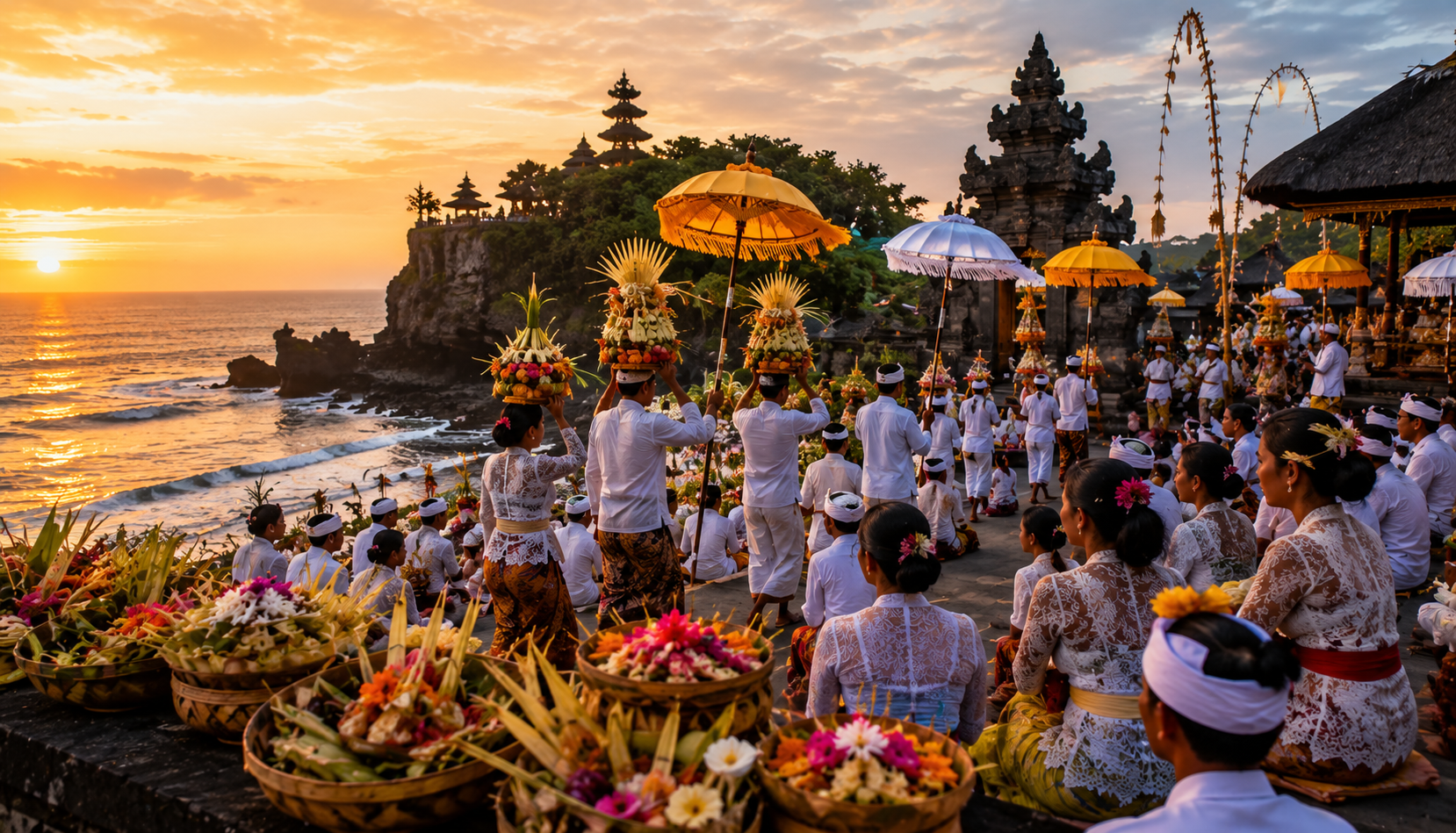
Few islands schedule their year quite like Bali. Three calendars run here at once — the familiar Gregorian one, Indonesia’s national roster of civic and religious dates drawn from four faiths, and, holding up everything beneath, the Balinese Hindu reckonings: the 210-day Pawukon and the moon-tracking Saka. Stack them and the island is rarely more than a week or two from a ceremony, be it a hushed, shuttered Nyepi or a run of lanes arched with bamboo penjor for Galungan.
What follows sets out the observances that matter most, pins their 2026 dates, and separates how each lands for a passing traveller from how it lands for someone who lives here. One thing to carry throughout: the Balinese days drift with the Pawukon and Saka cycles, and the Islamic ones turn on the moon, so nothing is locked a year ahead — treat every date as a firm guide rather than a promise, and confirm before you book.
Think of three tracks running in parallel. The national track fixes secular dates like Independence Day and lets the religious ones float — the two Eids, Christmas, Waisak. The Saka track, keyed to lunar months, governs a single but towering occasion: Nyepi, the turn of the Balinese year. And the Pawukon track, a wheel that resets every 210 days, drives Galungan, Kuningan, Saraswati and every temple’s anniversary. Because 210 days falls short of a solar year, most Pawukon festivals come round twice inside a Gregorian twelve months — though the wheel now and then lands so a year holds just one. That is precisely 2026’s situation for Galungan and Kuningan; 2027 swings back to a pair.
Nothing else on the island rivals Nyepi. It opens the Saka year and, in 2026, arrives on Thursday, 19 March. From six in the morning until six the next, Bali powers all the way down: the roads empty, lamps stay dark, businesses close, and — the unusual part — nobody, visitor or resident, is meant to set foot outside. Ngurah Rai airport even grounds its flights for the day. The logic is as poetic as it is practical: finding the island unlit and soundless, ill-meaning spirits are said to glance over it and drift past, leaving the year ahead clean.
That one still day sits within a longer arc. Days earlier, Melasti processions carry temple effigies down to the water to be cleansed. On the eve — 18 March in 2026 — neighbourhoods wheel out towering Ogoh-Ogoh, papier-mâché monsters built to embody the year’s troubles, parade them and then burn them. Silence follows. The morning after brings Ngembak Geni, a softer day of visiting relatives and mending old quarrels. For many travellers, sitting through Nyepi turns out to be the most quietly memorable part of a trip — but it rewards planning: land before the shutdown, or accept that you will spend it wherever you are staying.
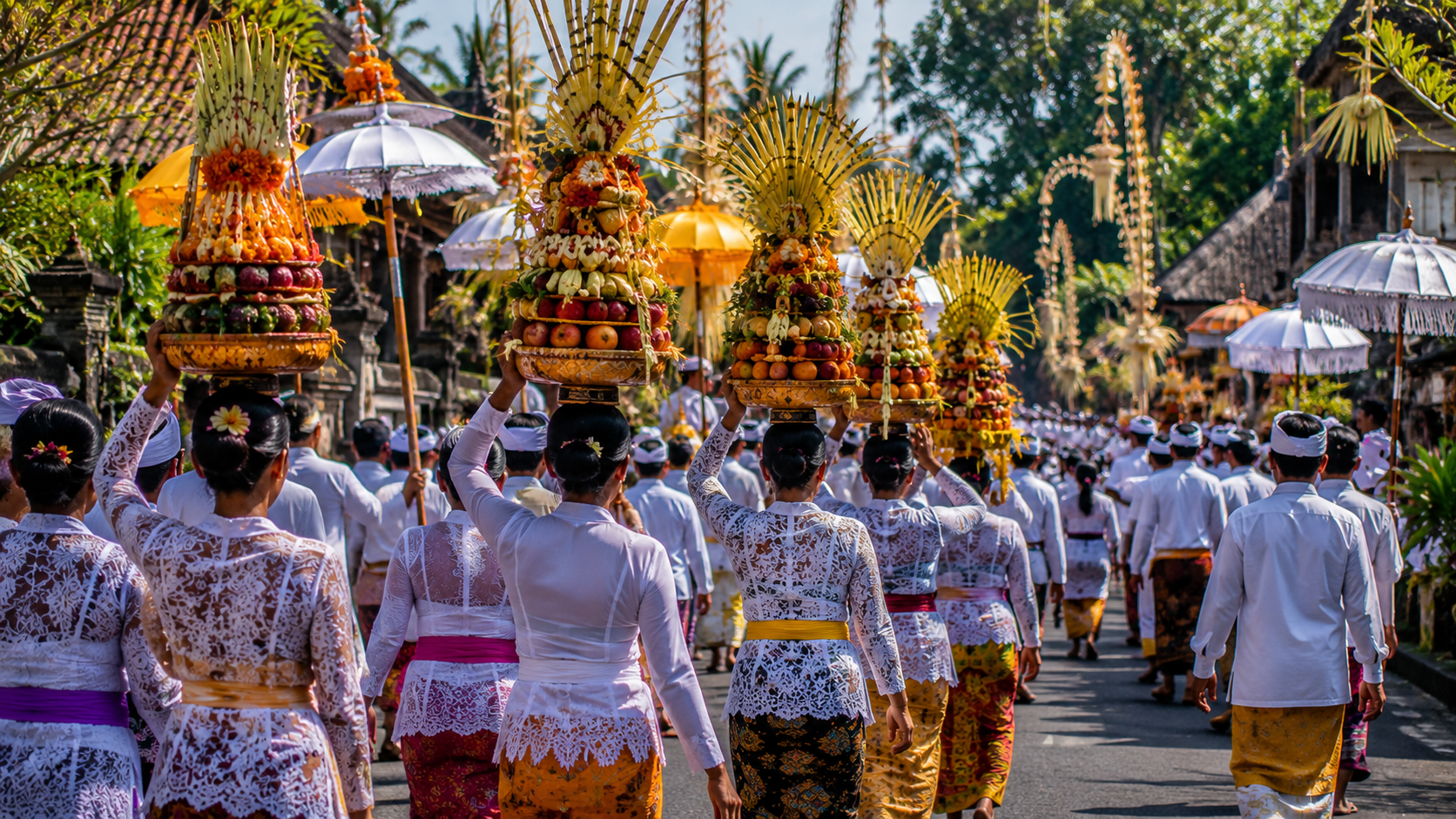
Galungan honours dharma’s triumph over disorder and the return of ancestral spirits to the homes they once knew. In the days before, tall bamboo poles — penjor, bowing under woven offerings — rise along every lane, and few sights are more photographed on the island. Its bookend, Kuningan, comes ten days later, sending those spirits back to the heavens and closing the celebration.
In 2026 the single cycle lands on Wednesday, 17 June (Galungan) and Saturday, 27 June (Kuningan). Since no days carry more weight for Balinese families, count on shutters down at many shops and sights and local staff away in their home villages — which means thinner service and slow, procession-choked roads. Onlookers are genuinely welcome, so long as they read the room: cover shoulders and knees, fall quiet during prayer, and let the ceremonies pass without stepping into them.
None of these will derail a trip, but together they account for the near-constant thread of incense, gamelan and ritual you will notice. For exact dates, consult a Balinese calendar, since they travel with the Pawukon count rather than the Gregorian one.
| Date (2026) | Holiday |
|---|---|
| 1 January | New Year’s Day |
| 17 February | Chinese New Year (Imlek) |
| 19 March | Nyepi — Balinese Hindu New Year |
| 21 March | Idul Fitri (Eid al-Fitr) |
| 3 April | Good Friday |
| 1 May | Labour Day |
| 14 May | Ascension Day of Jesus Christ |
| 27 May | Idul Adha (Eid al-Adha) |
| 31 May | Waisak (Vesak) Day |
| 1 June | Pancasila Day |
| 16 June | Islamic New Year |
| 17 June | Galungan |
| 27 June | Kuningan |
| 17 August | Indonesian Independence Day |
| 25 August | Prophet Muhammad’s Birthday |
| 25 December | Christmas Day |
Around the larger dates, the government tacks on cuti bersama — “joint-leave” bridge days that knit holidays into long weekends and send domestic travellers surging, prices trailing behind. Keep an eye on the 18–24 March window especially, when Nyepi and the Idul Fitri homecoming collide into one of the busiest runs of the year.
For a week’s holiday, only two dates truly bend a trip out of shape. Nyepi seals the island — airport included — for a full day, so you either arrive ahead of it or settle in for the duration. Idul Fitri, the year’s peak travel window, sees the Mudik homecoming jam roads, ferries and flights across the country, so book early and pad your timings. Galungan and Kuningan trim service and thicken traffic yet repay anyone who watches respectfully, and the rest of the calendar barely dents tourist life, with hotels, restaurants and beach clubs carrying on as usual. Residents and business owners read it differently: Nyepi stops operations outright, and through the Galungan–Kuningan stretch staff head home to their villages, so filings and rosters get planned around it — the point at which staying on top of your tax and accounting and company reporting earns its keep. It is also, plainly, one of the finest reasons to be here. If that draws you in, our guide to immigrating to Bali is where to begin.
When does Nyepi fall in 2026?
Nyepi — the Balinese New Year and the island’s day of silence — lands on Thursday, 19 March 2026. It holds for 24 hours from 6am, preceded the evening before (18 March) by the Ogoh-Ogoh effigy parade and followed the next day by Ngembak Geni, a round of visits and reconciliations.
What actually happens on Nyepi?
Everything pauses. No vehicles, no lights, no work, no going outdoors, with the airport closed and the rule binding on visitors as much as locals — a full day of quiet and reflection meant to make the island appear deserted so spirits pass it by. Hotels keep running for guests, who spend the day on the property.
What are the 2026 dates for Galungan and Kuningan?
There is only one cycle in 2026: Galungan on Wednesday, 17 June, then Kuningan ten days later on Saturday, 27 June. Both follow the 210-day Pawukon calendar, which usually delivers two cycles a year — 2027, for instance, carries two Galungan–Kuningan periods.
Why won’t Balinese holidays sit on the same date each year?
They answer to the 210-day Pawukon wheel and the lunar Saka calendar, not the Gregorian year, so their dates move annually. And because 210 days is shorter than a year, festivals such as Galungan tend to recur twice within a Gregorian twelve months, with 2026 an exception that holds only one.
Which are the national public holidays in Bali in 2026?
Among them: New Year’s Day, Chinese New Year (17 Feb), Nyepi (19 Mar), Idul Fitri (21 Mar), Good Friday (3 Apr), Labour Day (1 May), Ascension (14 May), Idul Adha (27 May), Waisak (31 May), Pancasila Day (1 Jun), Islamic New Year (16 Jun), Galungan and Kuningan (17 and 27 Jun), Independence Day (17 Aug), the Prophet’s Birthday (25 Aug) and Christmas.
Which holidays disrupt travel the most?
Nyepi closes the island and its airport for 24 hours, so arrive beforehand or plan to stay put through it. Idul Fitri is the country’s busiest travel stretch, with the Mudik homecoming clogging everything — book ahead. Galungan and Kuningan reduce service and add procession traffic, while the remaining holidays have little effect on visitors.
Are visitors allowed to watch Balinese ceremonies?
Yes, with courtesy. During Galungan, Kuningan and temple odalan, guests are welcome to observe — dress modestly with shoulders and knees covered, keep quiet during prayers, avoid blocking processions, and take your cues from those around you. It is one of the most rewarding sides of a Bali visit.
Is it worth visiting during a holiday period?
Frequently, yes. Living through Nyepi, or seeing lanes lined with penjor at Galungan, stays with you, and cultural events like the Bali Arts Festival make excellent trip anchors. The main task is to plan around the two disruptive dates — Nyepi and Idul Fitri — and reserve accommodation early for peak weeks.
Bali’s holidays are its culture made visible — the stillness of Nyepi, the penjor of Galungan, the endless temple odalan that lift an ordinary week into something ceremonial. Learn the 2026 dates, steer around Nyepi and the Idul Fitri crush, and, if you can, time your visit to catch a festival. And should this rhythm of ritual be part of what pulls you toward Bali, DDA Real Estate helps foreigners settle and buy property the right way, with full legal support — begin with our complete guide to buying property in Bali as a foreigner, then get in touch.