Off-plan properties
The purchase price is the figure everyone fixes on, yet a Bali villa quietly bills you for every month it stands. In a climate that is hot, humid and hard on buildings — and on a property that may be hosting guests week after week — those running costs are what decide whether you own a performing asset or a slow leak. A useful starting rule: set aside 3–5% of the property’s value each year simply to keep it in good order, and that is before rental management enters the picture at all.
This guide takes the real 2026 numbers and splits them into their parts — staff, utilities, pool and garden, taxes and community fees, repairs, and, if you let the place out, management commission. Figures are approximate, in Indonesian rupiah with rough US-dollar equivalents (around 16,000 IDR to the dollar), and shift with the villa’s size, location and how often it is occupied.
For a standalone villa with a pool and two staff, monthly operating costs — utilities, pool and garden, and wages combined — typically land between IDR 10 and 20 million ($625–1,250). Across a year, the widely used maintenance benchmark of 3–5% of value means roughly $7,500–12,500 on a $250,000 villa. Four things move that number the most:
| Role | Per month | Notes |
|---|---|---|
| Housekeeper | $120–300 | Daily or per-stay cleaning, laundry, basic guarding |
| Gardener | $50–120 | Often doubles up on pool duty |
| Pool service | $30–70 | Chemicals, skimming, equipment checks |
| Security | $120–200 | 1–2 guards for 24-hour cover in busy areas |
| Villa manager | $300–600 | Bookings, guest service, staff supervision |
A grounding figure: the 2026 minimum wage (UMK) in Badung Regency — the busiest area, covering Canggu, Seminyak and Uluwatu — is IDR 3,791,002 a month, about $230, the highest on the island. A villa running just a housekeeper and a pool-and-garden hand sits around a $5,500-a-year payroll floor, and paying fairly above the minimum is both decent and the surest way to keep reliable staff. For a standard villa, a total staff budget of roughly €250–400 a month is common.
| Utility | Per month | Notes |
|---|---|---|
| Electricity (PLN) | IDR 2–4M / $60–250 | Prepaid tokens; AC and pool pump dominate |
| Water | $5–30 | Cheap; from a well or municipal (PDAM) supply |
| Internet (fibre) | $20–65 | High-speed, essential for guests and remote work |
| Cooking gas | $2–10 | A minor line by comparison |
Taken together, an air-conditioned villa with a pool tends to run $200–300 a month in utilities, with electricity the part you can actually influence — through inverter air conditioners, a variable-speed pool pump, and a design that leans on cross-ventilation rather than constant cooling.
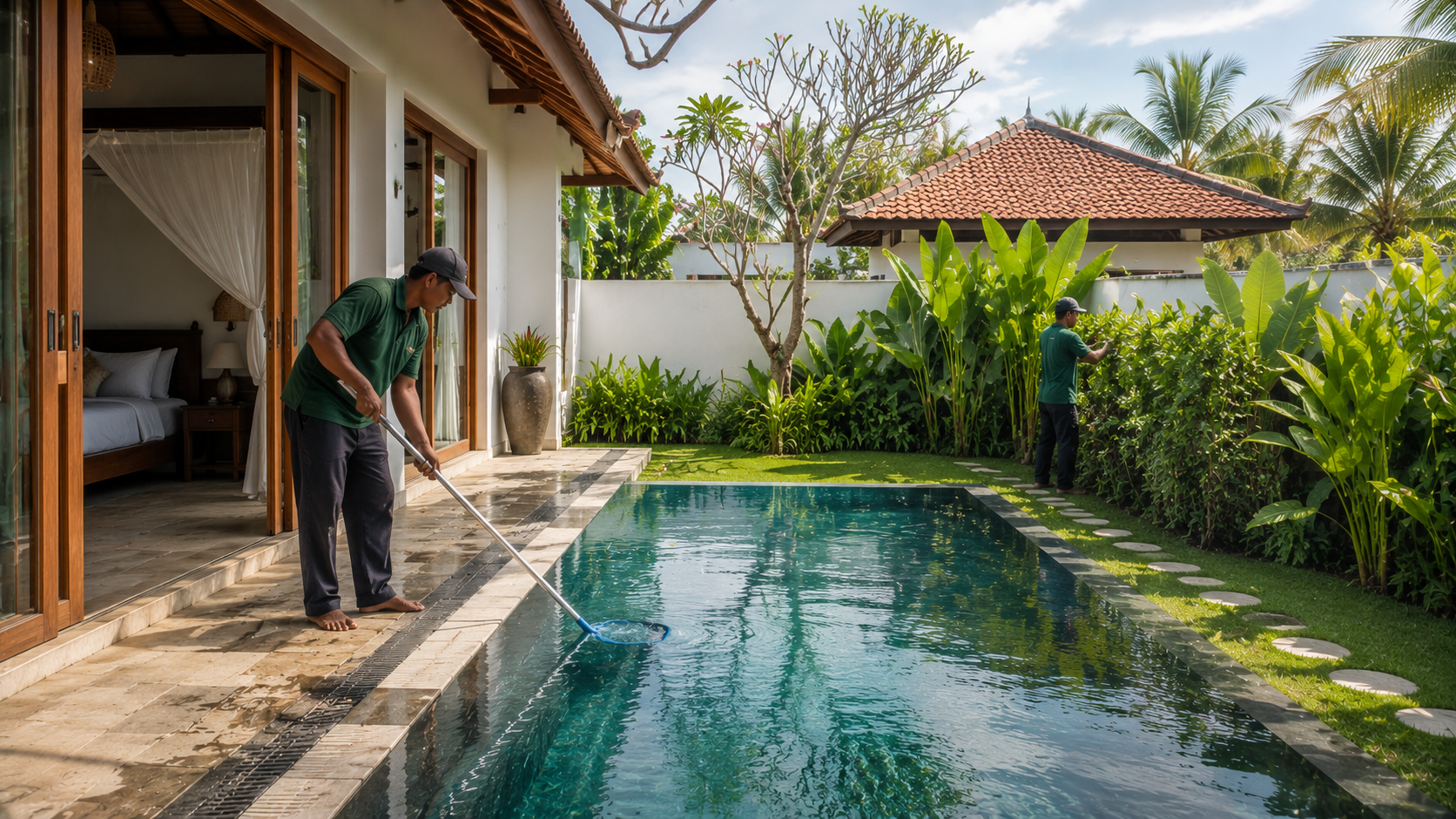
A pool and a tropical garden are what guests come for, and both need constant attention. Professional pool servicing — chemical balancing, skimming and equipment checks, usually twice weekly for rentals — runs about $30–70 a month, while garden upkeep (trimming, fertilising and pest control for plants that grow astonishingly fast) adds roughly $30–90. Bundled, budget $60–160 a month, though many owners fold both into a full-time gardener’s wage. One cost hides here: the pool pump is a steady draw on your electricity bill, so it belongs in the power budget as much as the pool one.
Ownership carries a modest set of recurring charges, which climb sharply the moment the villa becomes a rental. The predictable ones for any owner are Land and Building Tax (PBB), assessed on the government value and generally running a few hundred to a couple of thousand dollars a year by value and location; the mandatory Banjar community fee of about $10–20 a month, which supports local security and culture; and property insurance — not legally required but strongly advised — at around 0.2% of value, or $200–600 a year. Rent the villa out and more applies: rental income is taxed (a flat 10% of gross, or as business income through a company, so take proper tax and accounting advice on your specific setup), a hotel-and-restaurant levy (PHR) of up to 10% is collected from guests in Badung, and groundwater tax can apply if you run on well water.
There is also a licensing dimension that is now firmly enforced. Since a 2025 regulation, every accommodation business must be properly licensed — for a foreign owner that means an Indonesian company (PT PMA) with the correct villa classification, plus NIB, PBG and SLF — and unlicensed villas have been sealed and, in cases like Bingin Beach in 2025, demolished. Getting the right company structure in place is therefore part of the true cost of running a rental, not an optional extra.
Beyond routine upkeep, set money aside for the repairs the tropics guarantee. Owners typically spend $600–2,400 a year ($50–200 a month) on small fixes — plumbing, electrical faults, air-conditioning servicing, and the pool pumps, generators and water heaters that fail under heavy guest use. On top of that sits the slower, larger spend the climate forces: re-waterproofing, repainting, and treating rust and mould, more often on coastal and cheaply built properties. This is exactly why the 3–5%-of-value annual reserve exists — it is not padding, it is the tax the climate charges on every building.
Hand the villa to a management company and a further layer appears. Most established Bali managers charge 15–20% of gross rental revenue on commission, with budget operators at 20–25% and some using a hybrid of a lower percentage plus a fixed monthly admin fee. That sits alongside booking-channel commissions of roughly 15–17% and operating expenses passed through at cost. The figure that matters is what you keep: on a well-run villa at high occupancy, owners commonly retain around 50–60% of gross revenue as pre-tax profit. When comparing offers, three questions cut through the noise — is the commission on gross or net, are operating costs marked up, and does the company use in-house engineers (faster and cheaper) or outsourced ones (slower and marked up)?
| Cost | Indicative per year |
|---|---|
| Staff (2 part-time/full-time) | $4,000–7,000 |
| Utilities | $2,400–3,600 |
| Pool and garden (if separate) | $700–1,900 |
| Taxes, insurance, Banjar | $700–2,500 |
| Repairs and reserve | $1,500–4,000 |
| Rough total (second home) | $9,000–18,000 |
Run it as a rental and the totals rise with occupancy — more cleaning, more wear, more utilities — and management commission comes off the top, but the rental income is designed to more than cover it. The point of the exercise is to size the running cost before you buy, not after.
Every one of these lines is really a subtraction from your yield: the net return on a Bali villa is the rent it earns minus the costs above, and both sides of that equation move with location, so choosing the right spot matters twice over — our guide to the best areas to invest in Bali is a sensible first stop. A lower purchase price on an older or cheaply built villa can quietly cost more to keep, so weigh maintenance into the buying decision, not after it.
How much does it cost to maintain a villa in Bali?
As a rule of thumb, budget 3–5% of the property’s value per year — about $7,500–12,500 on a $250,000 villa. In monthly terms, a standalone villa with a pool and two staff typically runs IDR 10–20 million ($625–1,250) in combined utilities, pool and garden, and wages, before any rental management.
What are the main ongoing costs of owning a Bali villa?
Staff wages (usually the largest), utilities led by electricity, pool and garden upkeep, taxes and community fees, insurance, and a repair reserve for tropical wear. If you rent the villa out, add management commission of 15–20% of gross revenue plus booking-channel fees and rental taxes.
How much are villa staff paid in Bali?
In 2026, roughly $120–300 a month for a housekeeper, $50–120 for a gardener, $30–70 for pool service, $120–200 for security, and $300–600 for a villa manager. Badung’s 2026 minimum wage is about $230 a month; paying fairly above it is the surest way to keep reliable staff.
What is the biggest running cost?
For most villas it is electricity, because multi-room air conditioning and a pool pump draw heavily on Bali’s prepaid PLN meters — often IDR 2–4 million ($60–250) a month. Inverter air conditioners, a variable-speed pool pump and ventilation-led design are the main ways to bring it down.
What taxes apply to a Bali property?
Owners pay annual Land and Building Tax (PBB), generally a few hundred to a couple of thousand dollars by value, plus a mandatory Banjar community fee of around $10–20 a month. Renting adds income tax (a flat 10% of gross, or business income via a company) and, in Badung, a hotel-and-restaurant levy collected from guests.
Do I have to pay for property management?
Only if you rent the villa out and use a company. Managers typically take 15–20% of gross revenue (budget operators 20–25%), on top of booking-channel commissions and at-cost operating expenses. A well-run villa at high occupancy usually leaves the owner around 50–60% of gross as pre-tax profit.
Why do maintenance costs vary so much between villas?
Location (coastal salt, jungle pests), size and amenities (pool, gardens, multiple buildings), occupancy (rentals wear faster than second homes), and the age and build quality of the property all move the figure. A cheaply built or older villa in a harsh coastal spot costs far more to keep than a well-built inland one.
Is it worth budgeting a repair reserve?
Yes. The tropics guarantee wear — rising damp, rust, mould, and failing pool pumps and water heaters — so a reserve of 3–5% of value a year is standard practice. Skipping it does not remove the cost; it just delays and concentrates it into a larger, worse-timed bill later.
Maintaining a property in Bali is not expensive by international standards, but it is relentless: staff, power, a pool and garden, taxes, and a climate that never stops testing the building. Budget 3–5% of value a year for upkeep, size the running costs honestly before you buy, and remember that a well-built villa in the right area is far cheaper to keep than a bargain that fights the tropics. DDA Real Estate helps foreign owners weigh these costs, structure ownership lawfully and buy well — start with our complete guide to buying property in Bali as a foreigner, then get in touch.