Off-plan properties
Getting around Bali is simple once you understand the system — and mildly baffling, occasionally overpriced, if you don’t. There is no single “taxi” on the island but three overlapping options: ride-hailing apps like Grab and Gojek, the trusted Bluebird metered cab, and private car-and-driver hire, each suited to a different kind of trip. Layer on a few local quirks — a genuine “taxi mafia” that blocks apps in certain areas, the odd “meter broken” trick, and an airport that plays by its own rules — and five minutes of preparation saves you real money and hassle.
Here is how taxis actually work in Bali in 2026: the services on offer, what they cost, how to book each one, and the scams to sidestep. Prices are in Indonesian rupiah with rough dollar equivalents (around 16,000 to the dollar) and shift with distance, traffic and time of day.
Before the detail, the shape of it. Ride-hailing apps are almost always the cheapest and least stressful choice, with a fixed price shown before you book and no negotiation. Bluebird is the metered fallback you can trust when apps are scarce or you want a physical cab. And a private driver is the smart move for full-day trips, the airport, or anywhere outside the app-covered south. Match the tool to the job and you rarely go wrong.
For most journeys, an app is the answer. Grab and Gojek work exactly like Uber — which, for the record, left Indonesia in 2018 — showing a fixed fare upfront, tracking the car on a map, and taking cash or card, so there is nothing to haggle over. Grab tends to have the widest, most reliable coverage; Gojek is the home-grown rival, often a little cheaper on short southern hops; and budget apps like Maxim and InDrive undercut both, at the cost of fewer drivers and longer waits.
Both run smoothly across the south — Seminyak, Canggu, Kuta, Legian, Nusa Dua — and in Ubud, though coverage thins out in the north and east. Each offers a car (GoCar, GrabCar) or a cheaper, faster motorbike (GoRide, GrabBike) that weaves through traffic. The practical advice is the same for everyone: download both apps and register before you land, keep some rupiah for drivers who prefer cash, and always check that the car’s plate and the driver’s name match the app. Typical fares run about $1–5 for a short town trip, roughly $3–5 from Seminyak to Canggu, and around $25–35 out to Ubud.
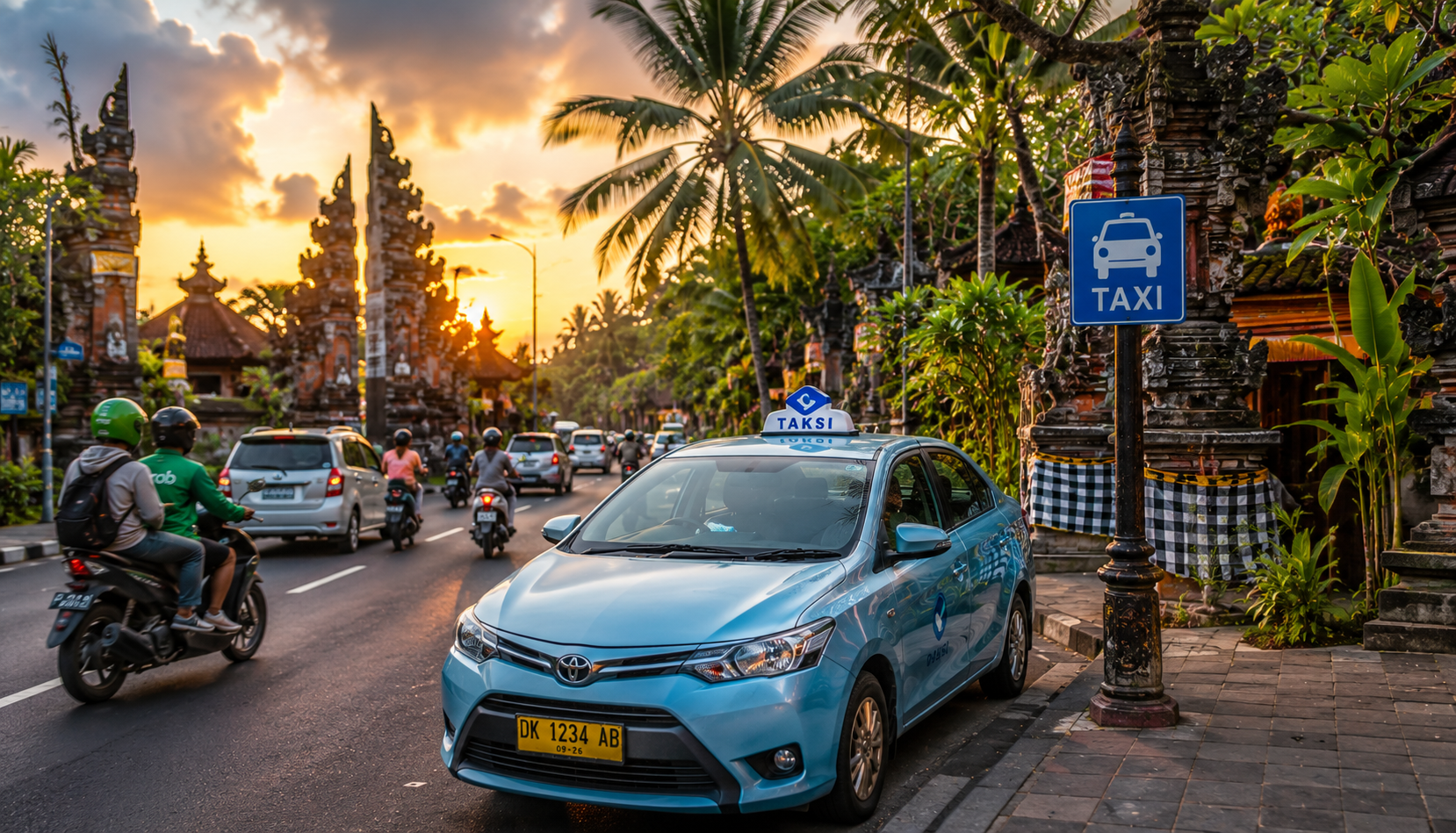
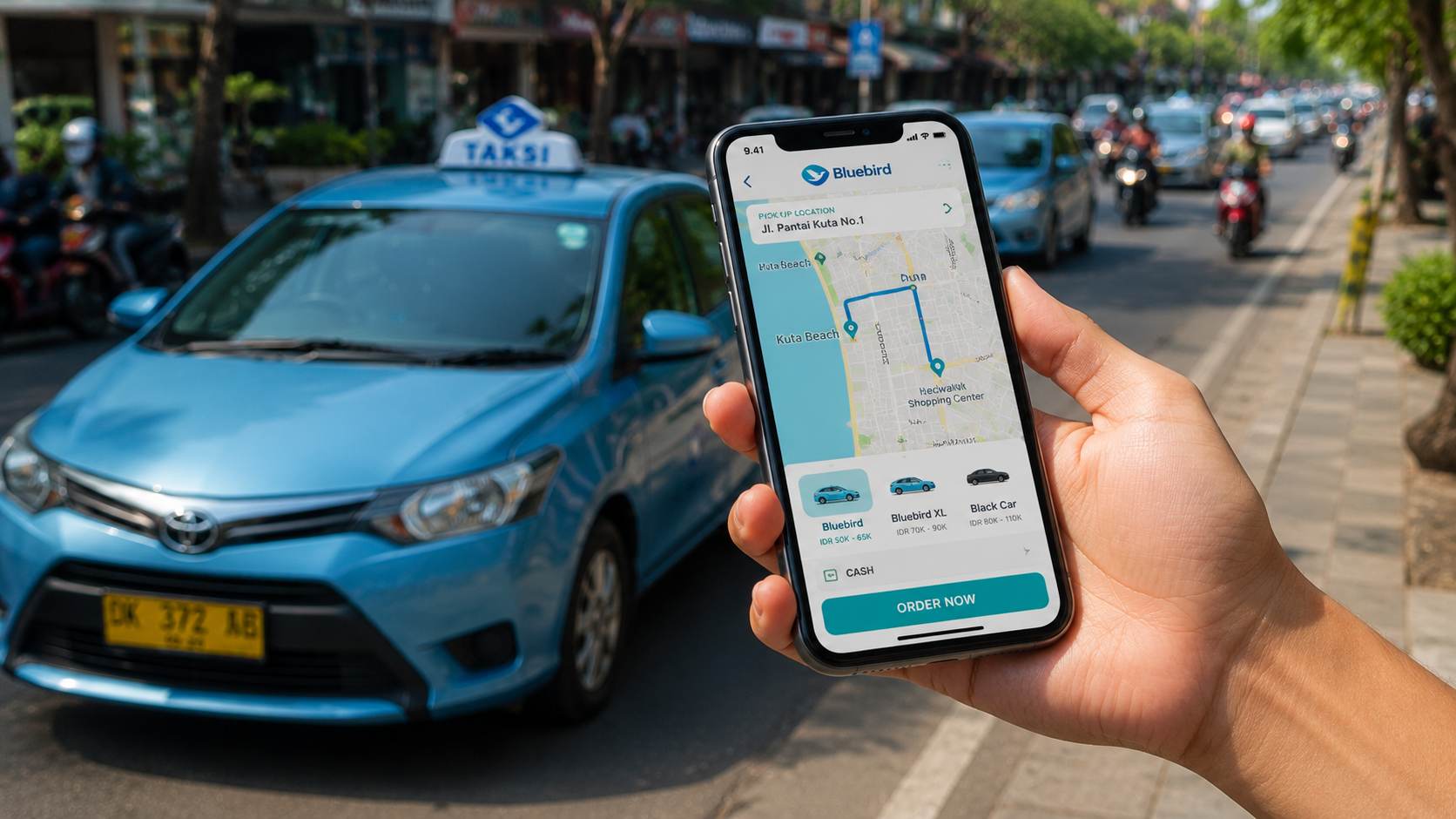
If you want an actual taxi off the street, make it a Bluebird — it is the only metered fleet on the island worth trusting. Look for the blue car and the white-bird logo, and note that word carefully: plenty of copycats paint their cars blue and slap on a lookalike badge, so check the logo rather than the colour. Genuine Bluebirds are metered, air-conditioned, and driven by professionals who will actually run the meter; you can also book through the MyBlueBird app, which shows an upfront price much like Grab.
The trade-off is cost and availability: Bluebird runs perhaps 20–30% higher than the apps, with fewer cars and occasional 15–20 minute waits. It comes into its own when you are travelling with children, elderly passengers or valuables, or simply cannot get an app car. One rule protects you from the classic scam: if a driver claims the meter is “broken” and offers a flat fee instead, decline and step out — the flat fee is always inflated.
For anything longer than a quick hop, a private car and driver is often the best value and the least stressful choice. Rates are fixed by the day at roughly $30–65 (a mid-length Ubud-area tour around IDR 700,000–900,000, longer runs to Lovina or the east more), usually including fuel and parking, with attraction entries, meals and a modest tip on top. You get a comfortable, air-conditioned vehicle that seats four to six, plus local knowledge — invaluable for multi-stop days, groups, and the north and east where apps barely reach.
Booking is easy: your hotel or villa almost always has a trusted driver on call, and platforms such as Klook, GetYourGuide and Viator list pre-vetted options, as do Grab Rent and Gojek’s GoCar Rent. For a full day of sightseeing, this beats stringing together separate app rides.
One quirk catches visitors off guard: in some areas, local transport cooperatives block app pickups to protect their patch — sometimes with prominent “no Grab/Gojek” signs and, at worst, real hostility toward app drivers. The usual hotspots are central Ubud (around the Monkey Forest and palace), pockets of Canggu near the big beach clubs, the Uluwatu temple area, and certain beaches and hotel entrances.
The workaround is easy and keeps everyone calm: you can still book the app, but pin your pickup a few hundred metres away and walk to that “buffer zone” to meet the driver, rather than at a restricted entrance. Where apps simply will not come, a motorbike taxi (ojek) or the local cooperative is your fallback — agree the price first. It is not worth arguing with a local cartel; a short walk solves it.
Ngurah Rai Airport has its own ecosystem, and knowing it spares you the arrivals-hall scrum. Your main options:
| Option | How it works | Rough cost |
|---|---|---|
| Grab / Gojek | Official lounges in the terminal; book in-app | Cheapest + ~10–12k exit fee |
| Prepaid taxi counter | Fixed zone fare in arrivals; convenient | Higher; Ubud 350–450k |
| Bluebird (workaround) | Blocked at arrivals; catch one upstairs at departures | Metered; Ubud ~250–300k |
| Private transfer | Pre-booked; driver waits with a sign | ~$10–25 fixed |
Both Grab and Gojek now run official, air-conditioned lounges inside the terminal, which is usually the cheapest route once you add the small airport exit fee. Bluebird is barred from picking up at arrivals by the airport syndicate, but the long-standing trick still works in 2026: head one floor up to departures and flag a Bluebird that has just dropped someone off. A pre-booked private transfer — driver waiting with your name on a board — is the smoothest option with luggage or a group, and its fixed price shields you when traffic is heavy. Whatever you do, walk straight past the “transport?” touts, and ignore anyone offering “Uber,” which no longer exists here.
| Trip | Typical fare |
|---|---|
| Short trip within one area | $1–5 (IDR 15–80k) |
| Seminyak to Canggu | $3–5 |
| Seminyak or Kuta to Ubud | $25–35 |
| Airport to Seminyak | ~IDR 100–150k ($6–10) |
| Airport to Ubud | ~IDR 250–450k ($16–28) |
| Private driver, full day | $30–65 |
A useful rule: a meter usually wins for trips under an hour, while a fixed rate or private driver is safer for longer runs — in Bali’s increasingly brutal traffic, a meter simply keeps ticking while you sit still.
Living in Bali, most people never buy a car. A mix of Grab and Gojek for everyday trips, an occasional private driver for longer days, and a scooter for short hops (a rental now requires an International Driving Permit and your passport) covers almost everything. What transport really shapes is where it makes sense to live: traffic between the southern hubs can be punishing at peak times, so basing yourself near your daily routes matters. If Bali is becoming more than a holiday, our guides to immigrating to Bali, the best areas to live and invest and working here legally are the natural next reads.
What is the best taxi app in Bali?
Grab and Gojek are the two leading ride-hailing apps, and both are excellent — Grab usually has wider, more reliable coverage, while Gojek is often slightly cheaper for short trips in the south. Budget apps like Maxim and InDrive are cheaper still but have fewer drivers. Download both Grab and Gojek before you arrive.
Is Uber available in Bali?
No. Uber left Indonesia in 2018 after selling its Southeast Asian business to Grab, so there is no Uber service in Bali. Anyone at the airport or on the street offering “Uber” is running an unofficial, usually overpriced arrangement — decline and use Grab or Gojek instead.
How much does a taxi cost in Bali?
Short trips within one area run about $1–5, Seminyak to Canggu around $3–5, and a longer run to Ubud roughly $25–35. From the airport, expect IDR 100–150k ($6–10) to Seminyak and IDR 250–450k ($16–28) to Ubud. A private driver for a full day costs about $30–65.
Are metered taxis reliable in Bali?
Only Bluebird. It is the one metered fleet worth trusting — blue cars with a white-bird logo, air conditioning and drivers who run the meter. Beware copycats that mimic the paint and badge, and if any driver says the meter is “broken” and quotes a flat fee, get out. You can also book through the MyBlueBird app for an upfront price.
Why are Grab and Gojek banned in some areas?
In places like central Ubud, parts of Canggu near the beach clubs, and the Uluwatu temple area, local transport cooperatives block app pickups to protect their business. You can still order a ride — just pin your pickup a few hundred metres away and walk to that buffer zone to meet the driver, rather than at the restricted entrance.
How do I get a taxi from Bali airport?
The cheapest option is usually Grab or Gojek, which now have official lounges inside the terminal (plus a small exit fee). The prepaid airport taxi counter is convenient but pricier, and a pre-booked private transfer ($10–25) is easiest with luggage. Bluebird can’t pick up at arrivals, but you can catch one upstairs at departures.
Should I hire a private driver in Bali?
For full-day sightseeing, multi-stop trips, groups, or travel into the north and east where apps are scarce, yes. A car and driver costs about $30–65 a day, usually including fuel and parking, and adds local knowledge and comfort. For short point-to-point trips in the south, an app is cheaper and quicker.
How do I avoid taxi scams in Bali?
Use apps where you can, so the price is fixed upfront. If you take a street taxi, insist on a genuine Bluebird and the meter, keep Google Maps open to check the route, and carry small notes to avoid the “no change” trick. Ignore touts offering “fixed price” rides at the airport, temples or clubs.
Taxis in Bali come down to a simple playbook: use Grab or Gojek by default, keep Bluebird as your metered backup, hire a private driver for long days and the airport, and step around the app-free zones with a short walk. Do that, and getting around is cheap, easy and stress-free. And if the island is starting to feel like home, DDA Real Estate helps foreigners settle and buy property the right way, with full legal support — start with our complete guide to buying property in Bali as a foreigner, then get in touch.