
Off-plan properties
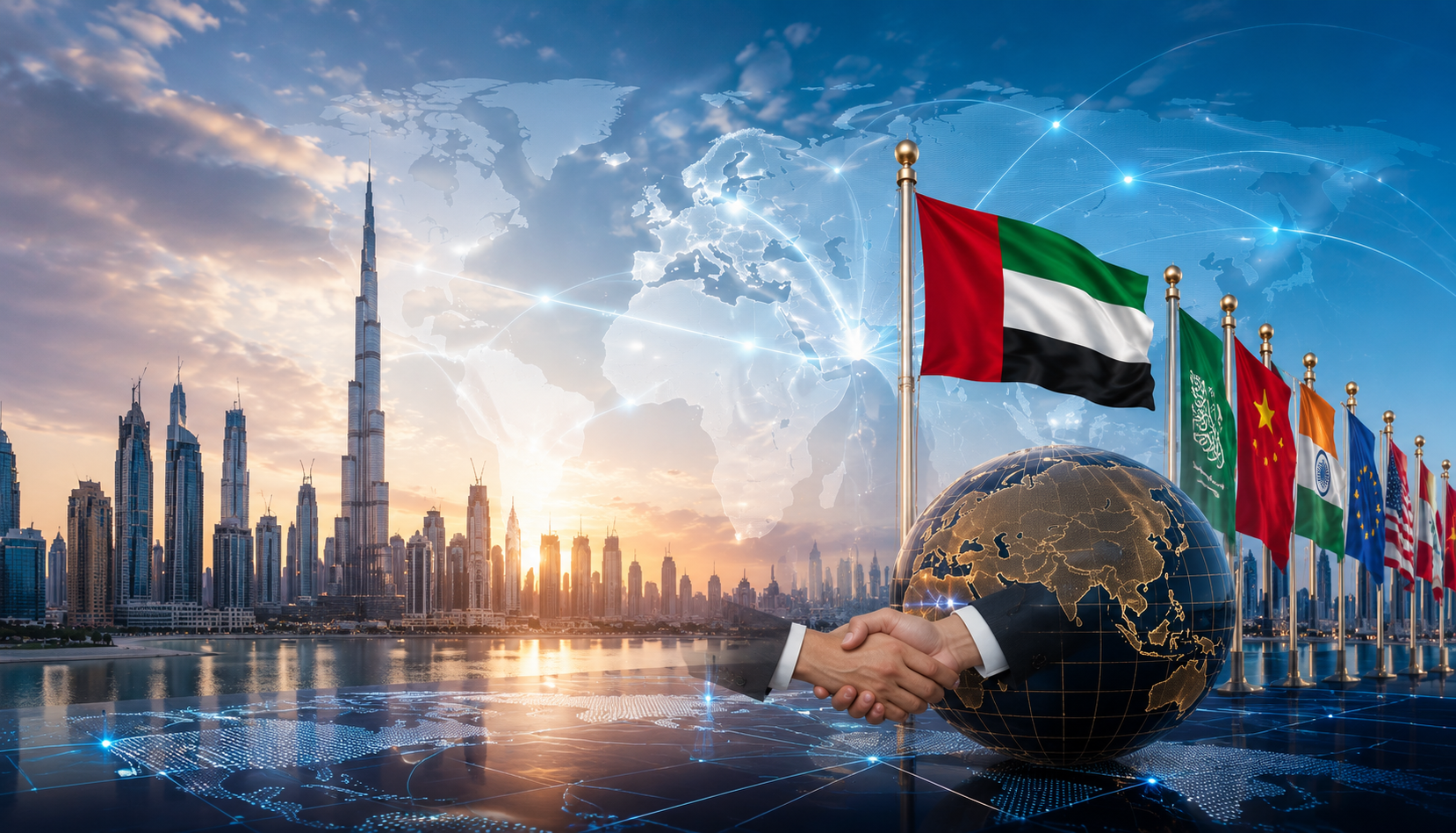
Over the past two decades, the United Arab Emirates has evolved into one of the most globally connected economies. Its strategic location between Europe, Asia, and Africa, combined with a proactive trade policy, has positioned the country as a key hub for international commerce.
In 2026, the UAE continues to expand its network of international trade agreements and global economic partnerships, strengthening its role as a bridge between major markets and emerging economies.
For investors, businesses, and international professionals, understanding these partnerships is essential to navigating opportunities in the region.
The UAE’s economic success is built on openness and global integration. Unlike resource-dependent economies, the country has focused on diversifying its income streams and strengthening non-oil sectors.
Several structural advantages support its position:
Dubai and Abu Dhabi act as central nodes in global trade flows, allowing companies to operate across multiple regions from a single base.
A cornerstone of the UAE’s trade strategy is the development of Comprehensive Economic Partnership Agreements (CEPAs).
These agreements go beyond traditional free trade deals and focus on:
Key CEPA partners:
The UAE–India CEPA, for example, significantly increased trade volumes and facilitated cooperation in sectors such as technology, logistics, and manufacturing.
CEPAs play a crucial role in accelerating non-oil economic growth.
In addition to CEPAs, the UAE maintains strong trade relations with the world’s largest economies.
The EU is one of the UAE’s primary trading partners. Cooperation focuses on industrial goods, renewable energy, and advanced technologies.
While a full trade agreement is still under discussion, economic ties remain strong and stable.
China is a key strategic partner, particularly within the Belt and Road Initiative.
The UAE serves as a regional hub for Chinese goods entering the Middle East and Africa, supported by strong logistics infrastructure and port connectivity.
The UAE and the United States maintain long-standing economic ties in sectors such as aviation, defense, energy, and technology.
The UAE is one of the largest markets for US exports in the region.
Free zones are a central component of the UAE’s economic model.
They offer:
Key free zones include:
These zones allow companies to operate internationally while benefiting from favorable regulatory conditions.
The UAE has invested heavily in infrastructure to support trade and logistics.
Key assets include:
This infrastructure enables efficient movement of goods across continents and reinforces the UAE’s role as a global logistics hub.
A distinctive feature of the UAE is its strong re-export model.
A large portion of imported goods is redistributed to other markets, including:
Dubai, in particular, has developed into a major re-export center, allowing companies to centralize distribution and reduce operational costs.
This model significantly enhances the effectiveness of trade agreements.
The UAE is actively investing in digital trade infrastructure.
Key developments include:
These advancements simplify cross-border trade and attract international entrepreneurs.
The UAE government has made small and medium-sized enterprises (SMEs) a priority within its trade strategy.
Support mechanisms include:
CEPAs are designed not only for large corporations but also to help smaller businesses expand globally.
The UAE dirham is pegged to the US dollar, which provides a high level of financial stability.
This ensures:
For investors and companies, this stability is a key factor in long-term planning.
In recent years, the UAE has increasingly focused on partnerships with emerging economies.
These include:
These regions offer high growth potential and increasing demand for trade and investment.
By strengthening early partnerships, the UAE secures long-term economic influence in these markets.
The UAE integrates trade agreements with investment strategies.
Partnerships often include:
This approach allows businesses not only to trade but also to establish long-term operations in partner countries.
Economic partnerships also influence the movement of people.
As trade expands:
This contributes to population growth in cities like Dubai and Abu Dhabi and supports demand in sectors such as housing.
As a result, real estate in the UAE benefits directly from global economic integration.
International trade agreements have a direct impact on the UAE’s real estate market.
As business activity increases:
Areas with strong business activity often show higher rental demand and long-term price growth.
Looking ahead, the UAE is expected to continue expanding its global partnerships.
Key trends include:
These developments will further strengthen the UAE’s role as a global economic hub.
What are CEPAs in the UAE?
They are advanced trade agreements that reduce tariffs, simplify trade, and increase investment between partner countries.
Which countries have trade agreements with the UAE?
Key partners include India, Turkey, Indonesia, Israel, South Korea, and others.
Why is the UAE important for global trade?
Its location, infrastructure, and business-friendly environment make it a global trade hub.
How do trade agreements affect investors?
They increase economic activity, attract businesses, and create demand in sectors such as real estate.
Are free zones important for international business?
Yes. They offer tax benefits, full ownership, and simplified operations.
Is the UAE a good place for investment?
Yes. Its global partnerships, stable economy, and investor-friendly policies make it highly attractive.
As the UAE strengthens its position in global trade, investment opportunities continue to expand — especially in the real estate sector.
DDA Real Estate helps international clients:
Contact us to explore real estate opportunities in the UAE that benefit from the country’s expanding global economic partnerships.