Bangkok Public Transport 2026: BTS, MRT, Boats & Tuk-Tuks
971 56 596-5009
day and night
Dubai
EN
$
ft²
Other articles

Public Transport in Bangkok: BTS, MRT, Boats & Tuk-Tuks Explained

Elizaveta Silakova The author of the article, the Broker
#Blog DDA
17 March 126 views

Bangkok's traffic is the stuff of legend, but the city also runs one of Southeast Asia's most useful transit networks. Between a sleek skytrain, an air-conditioned subway, century-old river boats and the unmistakable tuk-tuk, you can cross this sprawling megacity in minutes once you know which option to reach for. This guide explains each mode in turn, with fares, practical tips and the scams worth dodging, so you can move around like a local rather than sitting in a jam.

BTS Skytrain

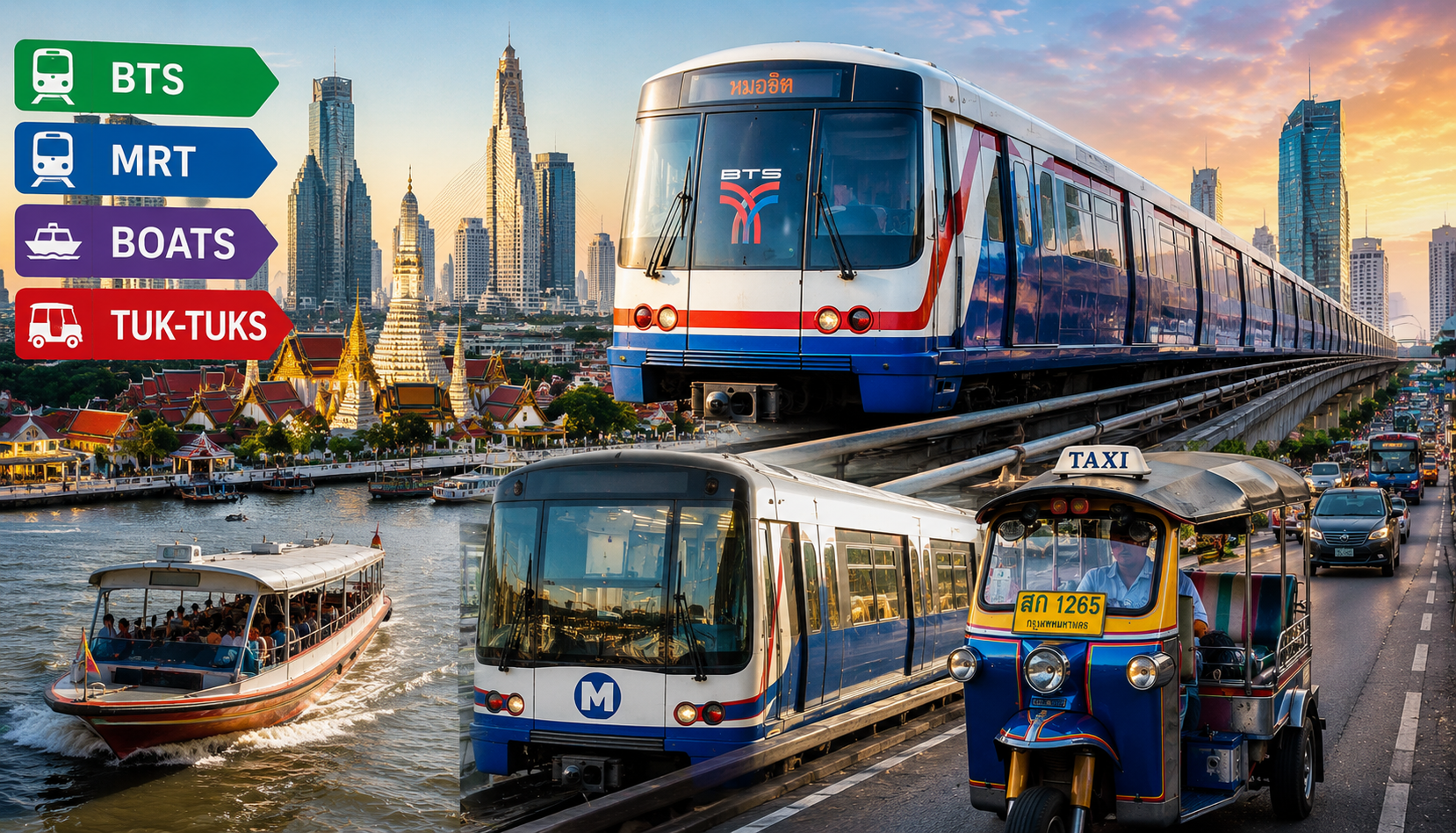
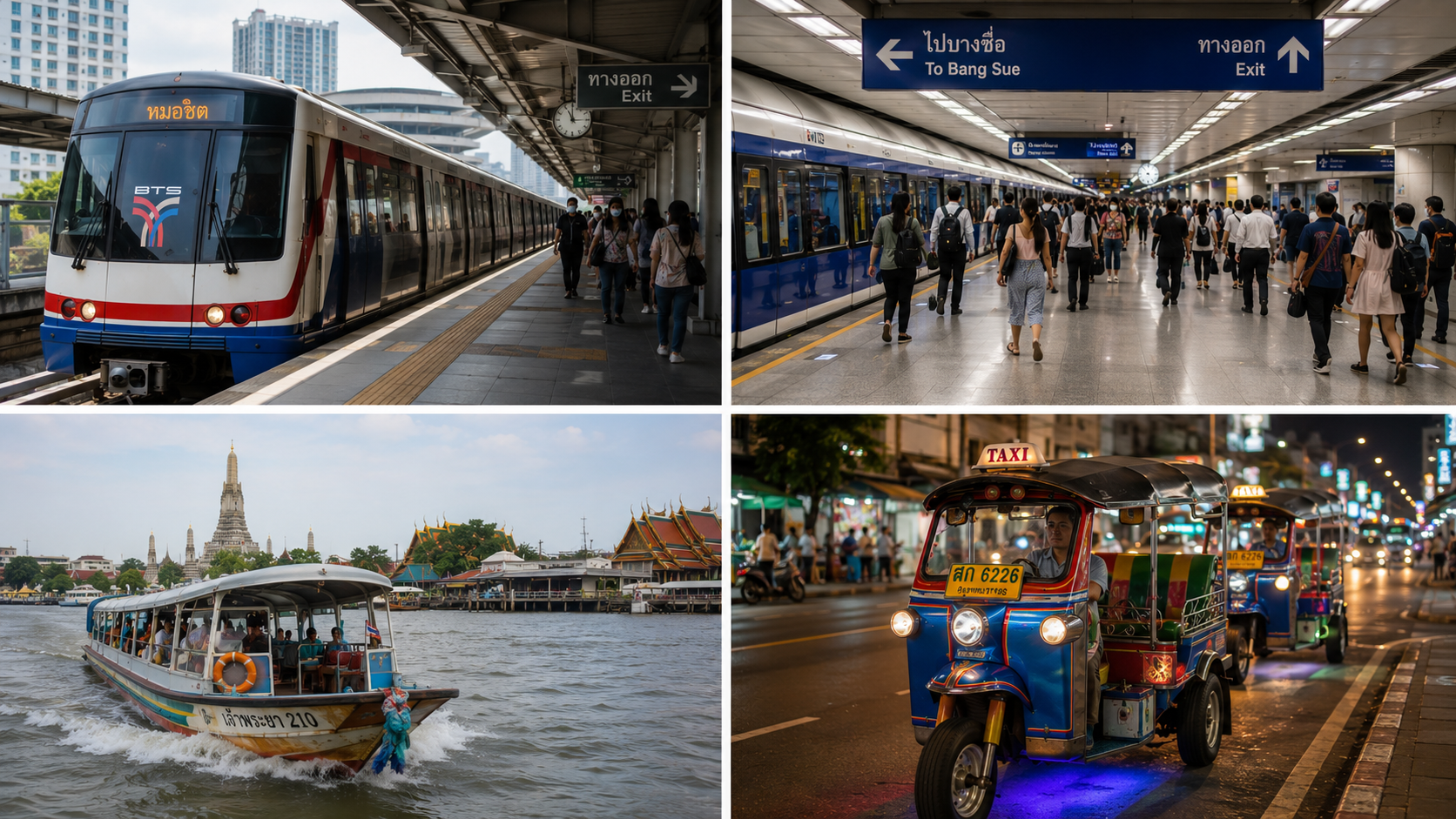
The elevated BTS Skytrain is the quickest, coolest way around central Bangkok, gliding above the gridlock from early morning until around midnight. It runs two main lines, the Sukhumvit and the Silom, which cross at Siam, plus the short Gold Line out to the ICONSIAM riverside mall. Together they string together Bangkok's main districts such as Sukhumvit, Silom and Sathorn, along with the big shopping and business hubs. Fares are distance-based, roughly 16 to 62 baht, and for more than a couple of days a rechargeable Rabbit card saves queuing. A handy detail: Saphan Taksin station drops you right at the river piers.

MRT subway

The underground MRT complements the BTS, reaching places the skytrain misses, including Chinatown and several residential and cultural districts. The Blue and Purple lines (with newer Pink and Yellow lines extending the reach) cost around 17 to 45 baht per trip. The easiest way to pay is simply to tap a contactless bank card at the gate, or buy a token. One quirk to remember: the MRT and BTS are run by different operators, so you usually exit one and walk to the other at interchanges like Asok–Sukhumvit, Sala Daeng–Si Lom and Mo Chit–Chatuchak, with separate tickets. You may also hear about the government's 20-baht flat fare on the electric trains, but as of 2026 that cap applies only to registered Thai nationals, so foreign visitors pay the standard distance-based fares.

Chao Phraya and canal boats

Getting on the water is Bangkok's secret weapon against traffic. The Chao Phraya Express Boat runs up and down the river to dozens of piers, with services marked by a coloured flag: the orange-flag boat is the most useful all-rounder at about 16 baht, while green and yellow flags are faster commuter expresses with fewer stops. The hub is Sathorn (Central) Pier, beside BTS Saphan Taksin, and boats generally run from early morning to early evening, with cash paid at the pier. For sightseeing, the blue-flag Chao Phraya Tourist Boat works like a hop-on, hop-off service with English commentary, around 60 baht for a single trip or 200 baht for a day pass. Tiny cross-river ferries shuttle you to the far bank for a few baht, and the Saen Saep canal boats offer a fast, local and slightly intimidating east-west shortcut.

Tuk-tuks

No Bangkok trip feels complete without one ride in a tuk-tuk, the noisy three-wheeler that is part taxi, part theme-park ride. They suit short, fun hops rather than long journeys, and the golden rule is to agree the price before you climb in, since a tuk-tuk is often more expensive than a metered taxi. Be aware of the classic scam: a friendly stranger offers a suspiciously cheap ride that turns into a string of stops at gem or tailor shops that pay the driver commission. Refuse any unrequested detours, and as a benchmark, check the Grab price for the same route and start negotiating from around 70 percent of it. App-based electric tuk-tuks, such as MuvMi, remove the haggling with fixed prices.

Taxis, Grab and Bolt

Metered taxis are cheap and everywhere: the meter starts at 35 baht and a typical city trip runs about 100 to 150 baht. Always insist on the meter, and if a driver refuses, which is common around the Grand Palace and Khao San Road, simply find another. Easier still are the ride-hailing apps. Uber has left Thailand, but Grab and Bolt both offer transparent, upfront pricing and let you enter your destination by map, sidestepping any language barrier. Fares can surge on rainy evenings and at rush hour, so a smart trick is to ride the BTS or MRT close to your destination and take a short taxi for the final stretch.

Motorbike taxis and buses

For the last leg into a side street, the orange-vested motorbike taxis waiting at the mouth of most sois are quick and cheap, often around 20 baht, though you should always wear the helmet and check that your travel insurance covers you on a bike. At the other end of the scale, public buses are the cheapest option of all at roughly 8 to 15 baht, with more than a hundred routes; the signage is mostly in Thai, but the ViaBus app makes routes and real-time tracking far easier to follow. Here is how the main options compare at a glance:

Mode Best for Typical fare Good to know
BTS Skytrain Downtown, shopping and business areas ~16-62 baht Air-con and traffic-free; use a Rabbit card
MRT subway Chinatown, residential and cultural spots ~17-45 baht A contactless bank card works at the gate
Chao Phraya Express boat Riverside temples and the Old Town ~16-33 baht Orange flag is the handiest; pay cash
Tourist boat (blue flag) Hop-on, hop-off sightseeing ~60 baht / 200 pass English commentary at main piers
Tuk-tuk Short, fun hops Negotiate first Often pricier than a taxi; beware shop scams
Taxi, Grab or Bolt Off-network trips and late nights From 35 baht / app price Insist on the meter or use an app
Motorbike taxi Beating traffic on short side-street trips ~20 baht and up Wear the helmet; check your insurance
Public bus Budget travel across the city ~8-15 baht Cheapest; track routes with the ViaBus app

Putting it all together

The trick is to mix and match. Use the BTS and MRT for medium distances across the centre, hop on a boat for the riverside and Old Town, call a Grab or Bolt for anything off the rail network or late at night, and save the tuk-tuk for a short, memorable spin. Try to avoid the busiest hours, roughly 07:00 to 09:00 and 17:00 to 19:30, keep some cash for tickets and boats, and pick up a Rabbit card or use a contactless card if you are staying more than a day or two. Where you base yourself relative to a station makes a real difference to how easy the whole trip feels.

Frequently asked questions

What is the cheapest way to get around Bangkok?

Public buses and the Chao Phraya Express boats are cheapest, while the BTS and MRT give the best balance of speed and price.

Do foreigners get the 20-baht flat train fare?

No, the 20-baht cap currently applies to registered Thai nationals, so tourists pay standard distance-based fares.

Is one card valid for both the BTS and MRT?

Not yet; the BTS uses the Rabbit card while the MRT accepts contactless bank cards, so you may need both or pay per ride.

Are tuk-tuks worth it?

They are fun for a short ride, but agree the price first and expect to pay more than a metered taxi.

How do I avoid taxi problems?

Insist on the meter, and if a driver refuses, use the Grab or Bolt app for fixed, upfront pricing instead.

What is the best way in from the airport?

From Suvarnabhumi, the Airport Rail Link to Phaya Thai costs around 45 baht and connects to the BTS, with taxis and Grab as alternatives.

When should I avoid the trains?

During rush hours, roughly 07:00 to 09:00 and 17:00 to 19:30, when the BTS and MRT get very crowded.

In short

Bangkok's network turns a sprawling, traffic-choked city into one you can cross in minutes, as long as you match the mode to the trip: trains for speed, boats for the river, apps for the gaps and a tuk-tuk for the fun of it. And if the city wins you over, remember that proximity to a BTS or MRT station is one of the biggest factors when choosing where to live. DDA Real Estate can help you explore buying an apartment in Thailand and understand the leasehold-versus-freehold rules every foreign buyer should know.

Popular
5 June 3912930 views
Dubai Rent Prices 2025: Average Apartment Rental Costs in Dubai Dubai's rental market continues its upward climb in 2025, driven by population growth and limited new supply, pushing average prices up by 10%
#Blog DDA
2 July 2325960 views
DLD Fees in Dubai: Everything You Need to Know Buying property in Dubai? Don't let hidden fees surprise you! Our essential guide breaks down ALL Dubai Land Department (DLD) fees
#Blog DDA
5 July 1607571 view
How Much is the Real Estate Agent Commission in Dubai? Find out how much real estate agent commission costs when buying property in Dubai.
#Blog DDA
23 November 1388457 views
How to Buy a SIM Card in Turkey in 2026: Prices, IMEI Registration, eSIM Options, and Best Mobile Operators Overview of mobile operators, available types of SIM cards, and home Internet providers
#Blog DDA
5 February 1342278 views
How Foreigners Can Own Property in Bali: Understanding PT PMA (2025) Foreigners can't own freehold land in Bali, but a PT PMA (foreign-owned company) allows secure property ownership under Hak Guna Bangunan (HGB) or Hak Pakai (HP) rights
#Blog DDA
28 August 1085616 views
Oqood vs Title Deed in Dubai: Key Differences You Must Know Buying property off-plan in Dubai? Oqood registration is mandatory to secure your ownership rights.
#Blog DDA