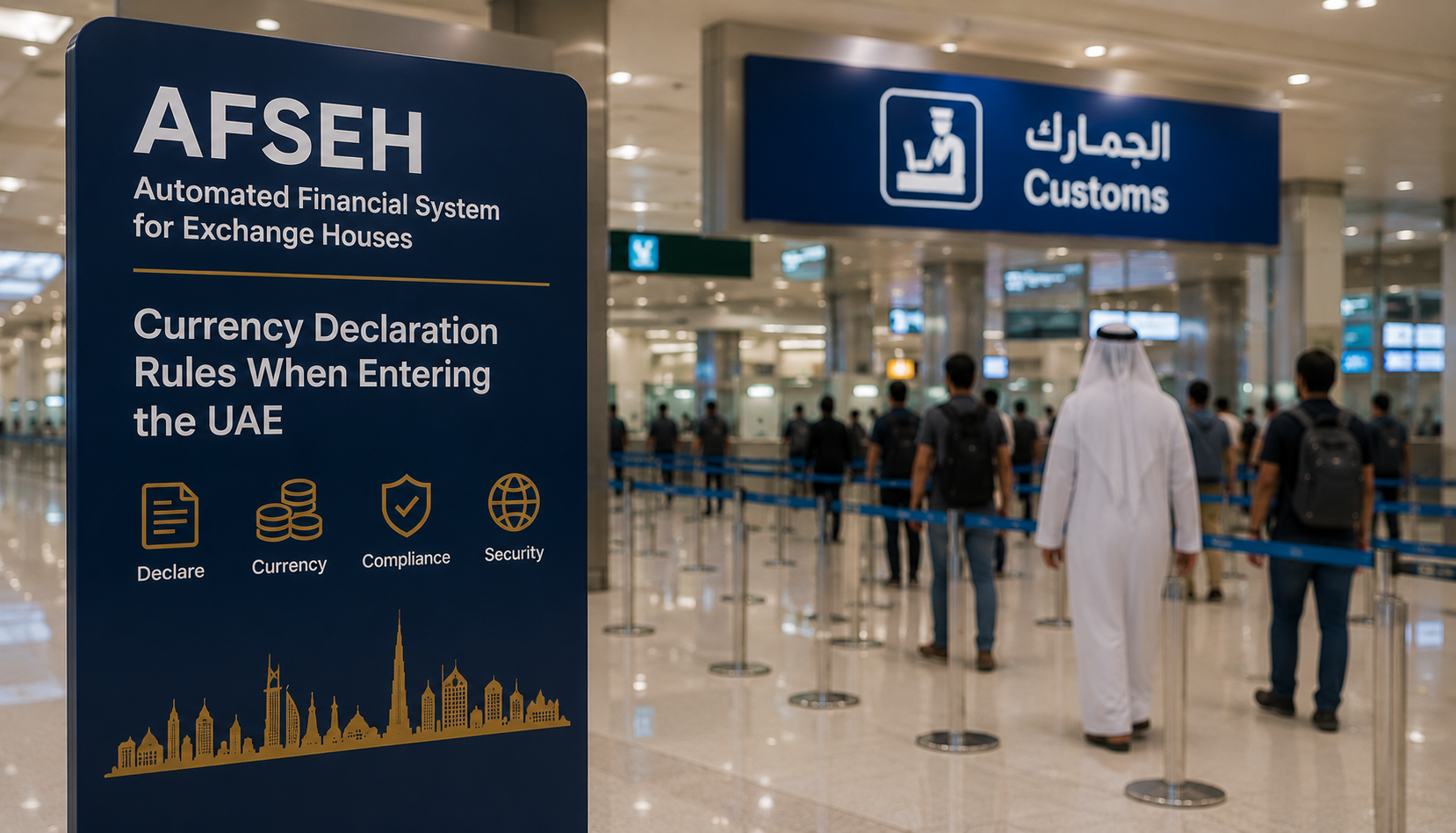
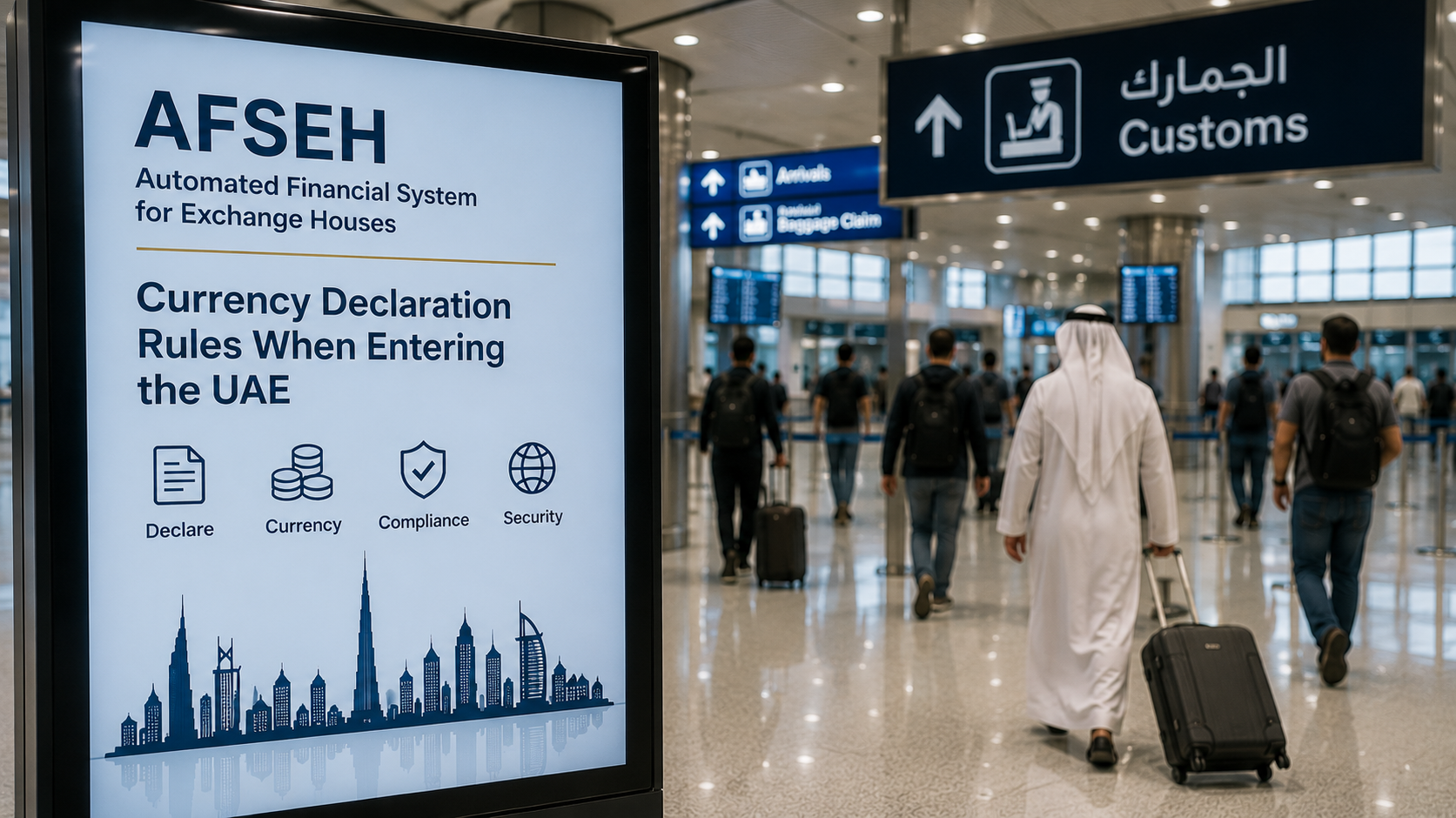

AFSEH: Currency Declaration Rules When Entering the UAE
971 56 596-5009
day and night
Dubai
EN
$
ft²
Other articles

How to Renew Your UAE Visa or Residence Permit in Dubai

Elena Polyanskaya The author of the article, the Broker
#Blog DDA
4 April 1323 view

Anyone moving to Dubai, buying property in the UAE, or arriving with a significant amount of cash or valuables needs to understand the AFSEH declaration system. It is not a new tax, not a restriction on how much you can bring — it is a mandatory reporting requirement that, if ignored, can result in confiscation, fines, and legal complications at the border. Understanding it takes about five minutes. Ignoring it can be considerably more consequential.

What Is AFSEH

AFSEH is the UAE's official digital customs declaration platform, operated by the Federal Authority for Identity, Citizenship, Customs and Ports Security (ICP). The name comes from the Arabic for "disclose" — and that is precisely what the system is designed to do: create a transparent, digital channel for travelers to declare cash and valuables above the regulatory threshold before or upon entering or leaving the UAE.

AFSEH is an Anti-Money Laundering (AML) effort — designed to combat attempts to move illicit money or assets including precious metals and stones across the border. It operates under Federal Law No. 20 of 2018 on Anti-Money Laundering and Combating the Financing of Terrorism.

The system is accessible via:

  • Web: declare.customs.ae
  • Mobile app: Afseh (available on iOS App Store and Google Play)

The Threshold: What Triggers the Requirement

Passengers travelling out of or entering the UAE with more than AED 60,000 in cash or an amount equivalent to this in other currencies, financial instruments, precious metals or valuable stones, must declare it to the Federal Authority for Identity, Citizenship, Customs and Ports Security.

AED 60,000 equals approximately $16,300 USD or €15,000 EUR at current exchange rates — though the threshold is fixed in dirhams, not in foreign currency equivalents.

What counts toward the AED 60,000 threshold:

Item Included in Calculation?
Cash in any currency Yes
Traveler's cheques Yes
Bearer negotiable instruments Yes
Gold and silver Yes
Precious stones (diamonds, etc.) Yes
Jewelry Yes
Luxury watches Yes
Bank cards and electronic transfers No
Personal clothing and electronics No
Declared bank drafts No

Cash in any currency, traveler's checks, gold, diamonds, luxury watches and other valuables — add them all together; if the total exceeds AED 60,000, you must declare.

This combined calculation catches many travelers off guard. A person arriving with $10,000 in cash, a gold watch worth $4,000, and a diamond ring worth $5,000 is over the threshold even though the cash alone would not trigger a requirement.

Who Must Declare

The declaration requirement applies to all individuals aged 18 and above.

For travelers under 18, their items can be included under a parent or guardian's declaration. Minors do not file independently — their valuables are aggregated with the accompanying adult's declaration.

The requirement applies equally to:

  • Tourists and visitors
  • UAE residents returning from abroad
  • Business travelers
  • Relocants arriving with assets
  • Investors bringing funds for property purchase

Nationality is irrelevant — the threshold applies to everyone passing through UAE customs, regardless of passport.

Which Airports Use AFSEH

The AFSEH online declaration currently applies to Abu Dhabi, Sharjah, and Ras Al Khaimah International Airports. Authorities have said that it will soon be rolled out to other airports in the UAE, so frequent travelers should familiarize themselves with the process now.

Dubai International Airport (DXB) operates under the Dubai Customs framework, which has its own declaration procedures. Travelers passing through DXB with amounts above AED 60,000 must declare to Dubai Customs officers — the AFSEH online pre-declaration system is the ICP mechanism for Abu Dhabi, Sharjah, and RAK airports, while Dubai maintains its own customs structure. The declaration obligation exists at all UAE entry points regardless of which system applies.

How to Declare: Step by Step

The process is designed to be completed before you arrive at the airport — not while standing in the customs queue.

Step Action
1 Visit declare.customs.ae or download the Afseh app
2 Log in using UAE Pass (for UAE residents) or register with passport details
3 Enter your personal, contact, and address information
4 Specify the nature, quantity, and value of cash and valuables being carried
5 Submit the declaration
6 Receive approval confirmation via SMS and in-app notification
7 Declaration is stored under "Approved Requests" — accessible at border

If approved, you will receive both an SMS and a notification on the AFSEH platform. Approved declarations are stored under Approved Requests in your dashboard for easy access.

The service is free — there are no fees for submitting a customs declaration.

For UAE residents: use your UAE Pass to log in — your personal details will be automatically pre-filled using your Emirates ID, visa details, and personal information. UAE residents must use their registered UAE address.

For non-residents and first-time visitors: registration requires passport details and a contact address. The process takes approximately 10 minutes for a first-time user.

What Happens at the Border

At the airport, customs officers can verify your declaration digitally. An approved AFSEH declaration means the process is smooth — you present confirmation, the officer verifies, and you proceed.

If you are carrying declared amounts above the threshold and have a valid AFSEH submission, there is no issue. The declaration is not a signal of suspicion — it is a compliance mechanism that actively protects the traveler.

If you have not declared and are carrying amounts above AED 60,000, the situation is different.

Consequences of Non-Compliance

Failing to declare amounts over the legal limit could result in confiscation, fines, or legal action.

Under the updated regulations effective from October 2025, failure to declare may result in confiscation, fines or other penalties. Even if you think you are within your limit, double-check — currency fluctuations and the combined value of personal belongings can quickly lead to exceeding the limit.

The severity of consequences scales with the amount undeclared and the circumstances. At the lower end — failing to declare an amount modestly over threshold — the outcome is typically a fine and a formal warning. At higher amounts or where there are signs of deliberate concealment, the consequences are more serious and can involve legal proceedings.

Undeclared amounts are treated as potential smuggling under UAE law. This is not a minor administrative infringement — it carries the legal weight of Federal Law No. 20 of 2018 on AML/CFT compliance.

What AFSEH Does NOT Restrict

This is worth stating clearly because misunderstanding of the system causes unnecessary anxiety. This rule is not intended to limit your right to carry cash or valuables — it is designed to ensure transparency in line with anti-money laundering regulations.

There is no maximum amount you are allowed to bring into the UAE. You can arrive with AED 500,000 in cash, gold bars, and diamond jewelry — provided you have declared it correctly through AFSEH. The UAE has no restriction on the amount of money entering the country; it only requires transparency about what is being brought in.

This distinction matters enormously for:

  • Investors arriving with funds intended for a property purchase
  • Relocants bringing life savings
  • Business travelers carrying significant working capital
  • Individuals transferring assets to UAE accounts

In all of these cases, the correct approach is to declare — not to split funds across multiple trips, which can itself attract scrutiny.

AFSEH for Property Buyers and Relocants

For investors arriving in the UAE with funds intended for a property purchase, the AFSEH declaration is a routine compliance step rather than an obstacle. The UAE property market is built to receive international capital — the DLD registration system, escrow requirements, and banking infrastructure all accommodate large fund flows. The AFSEH declaration is simply the customs layer in that process.

Practical guidance for property buyers arriving with cash:

Scenario Recommended Action
Arriving with cash for a down payment Declare via AFSEH before departure
Bringing jewelry and valuables when relocating Calculate combined value and declare if above AED 60,000
Wiring funds from abroad (bank transfer) No AFSEH declaration required — applies to physical cash only
Bringing a combination of cash and gold Add all values together and declare the combined amount

For most property transactions in Dubai, funds arrive via international bank transfer — which is outside the scope of AFSEH entirely. The declaration requirement applies to physical cash, instruments, and valuables crossing the border in person.

Other Customs Rules Worth Knowing

While AFSEH covers the cash and valuables declaration, a few additional customs parameters are relevant for anyone entering the UAE:

Personal gifts and goods: Personal belongings of passengers are permitted entry and shall be exempted from customs fees if the value of gifts, perfumes and personal luggage does not exceed AED 3,000.

Alcohol: Alcoholic beverages not exceeding 4 litres or 2 cartons of beer, each consisting of 24 cans not exceeding 355 ml, are permitted duty-free. Customs duty will be levied on quantities in excess of the limits provided, in addition to VAT. The rate of customs duty is 5% of the value of goods plus Cost Freight Insurance — 50% on alcohol and 100% on cigarettes.

Prohibited items: Certain items are strictly not allowed in the UAE, including narcotics, gambling devices, counterfeit currency, and materials that violate religious or public morality. Specific items such as nylon fishing nets, raw ivory, radioactive materials, and red-beam laser pens are also banned.

Frequently Asked Questions

Does the AED 60,000 threshold apply per person or per family?

Per person aged 18 and above — each adult traveling with cash or valuables above the threshold must submit their own AFSEH declaration; minors' items are included under a parent or guardian's declaration.

Do bank cards and electronic fund transfers need to be declared through AFSEH?

No — the AFSEH declaration applies to physical cash, negotiable instruments, precious metals, and valuable stones; electronic transfers and payment cards are outside the scope of the declaration requirement.

Can I submit the AFSEH declaration after arriving at the airport?

The system is designed for pre-arrival declaration, and submitting before you reach the airport is strongly advisable; declarations can technically be made at the border, but pre-submission avoids delays and demonstrates proactive compliance.

What if my jewelry is for personal use, not for sale — do I still need to declare it?

Yes — the purpose of the items does not affect the declaration requirement; if the combined value of cash, jewelry, gold, and other qualifying items exceeds AED 60,000, declaration is mandatory regardless of whether the items are for personal use.

Is there a UAE government fee to submit the AFSEH declaration?

No — the service is entirely free; there are no fees for submitting a customs declaration through the AFSEH platform.

Does declaring through AFSEH mean my assets will be taxed or questioned?

No — declaration is a transparency measure, not a tax trigger; the UAE has no income tax, no wealth tax, and no capital gains tax; a properly submitted AFSEH declaration protects the traveler and facilitates smooth customs clearance.

The AFSEH system is one of those administrative details that matters most precisely when people are least prepared for it — arriving in the UAE with funds for a property purchase, relocating with life savings, or simply bringing valuables on a visit. Understanding the threshold, the scope, and the process removes all complexity: if your cash and valuables combined exceed AED 60,000, declare via declare.customs.ae or the Afseh app before you travel.

For those arriving in the UAE with the intention of buying property, the AFSEH declaration is often the first administrative step of a much larger process. DDA Real Estate guides investors and relocants through the full journey — from first arrival and fund transfer to property selection, purchase, and residency. If you are planning to invest in UAE real estate and want to understand the practical steps involved, our advisors are available to walk you through the process.

Contact a DDA advisor to discuss your UAE property investment and get guidance on every step of the process.

Popular
5 June 3957912 views
Dubai Rent Prices 2025: Average Apartment Rental Costs in Dubai Dubai's rental market continues its upward climb in 2025, driven by population growth and limited new supply, pushing average prices up by 10%

#Blog DDA
2 July 2337993 view
DLD Fees in Dubai: Everything You Need to Know Buying property in Dubai? Don't let hidden fees surprise you! Our essential guide breaks down ALL Dubai Land Department (DLD) fees
#Blog DDA
5 July 1633023 view
How Much is the Real Estate Agent Commission in Dubai? Find out how much real estate agent commission costs when buying property in Dubai.
#Blog DDA
23 November 1465191 view
How to Buy a SIM Card in Turkey in 2026: Prices, IMEI Registration, eSIM Options, and Best Mobile Operators Overview of mobile operators, available types of SIM cards, and home Internet providers
#Blog DDA
5 February 1362375 views
How Foreigners Can Own Property in Bali: Understanding PT PMA (2025) Foreigners can't own freehold land in Bali, but a PT PMA (foreign-owned company) allows secure property ownership under Hak Guna Bangunan (HGB) or Hak Pakai (HP) rights
#Blog DDA
28 August 1107855 views
Oqood vs Title Deed in Dubai: Key Differences You Must Know Buying property off-plan in Dubai? Oqood registration is mandatory to secure your ownership rights.
#Blog DDA