Off-plan properties
Most countries give you one number to remember. Europe has 112, the Commonwealth has 999, the United States has 911. Thailand has none of these as a single front door — it runs a network of dedicated lines instead, and the first thing an emergency asks of you is which one to dial.
That would be a minor inconvenience if the lines differed only by the nature of the incident. In practice the deciding factor is usually language: the line that covers your situation and the line where somebody will understand you are frequently not the same number, and working that out at two in the morning is not the moment to start.
What follows is the list worth saving before anything happens, the logic for choosing between the lines, and the three contacts almost nobody adds until after the first incident. Response times, costs and hospital arrangements vary by province and by provider, so treat the figures as orientation and confirm the specifics that apply to your address and your policy.
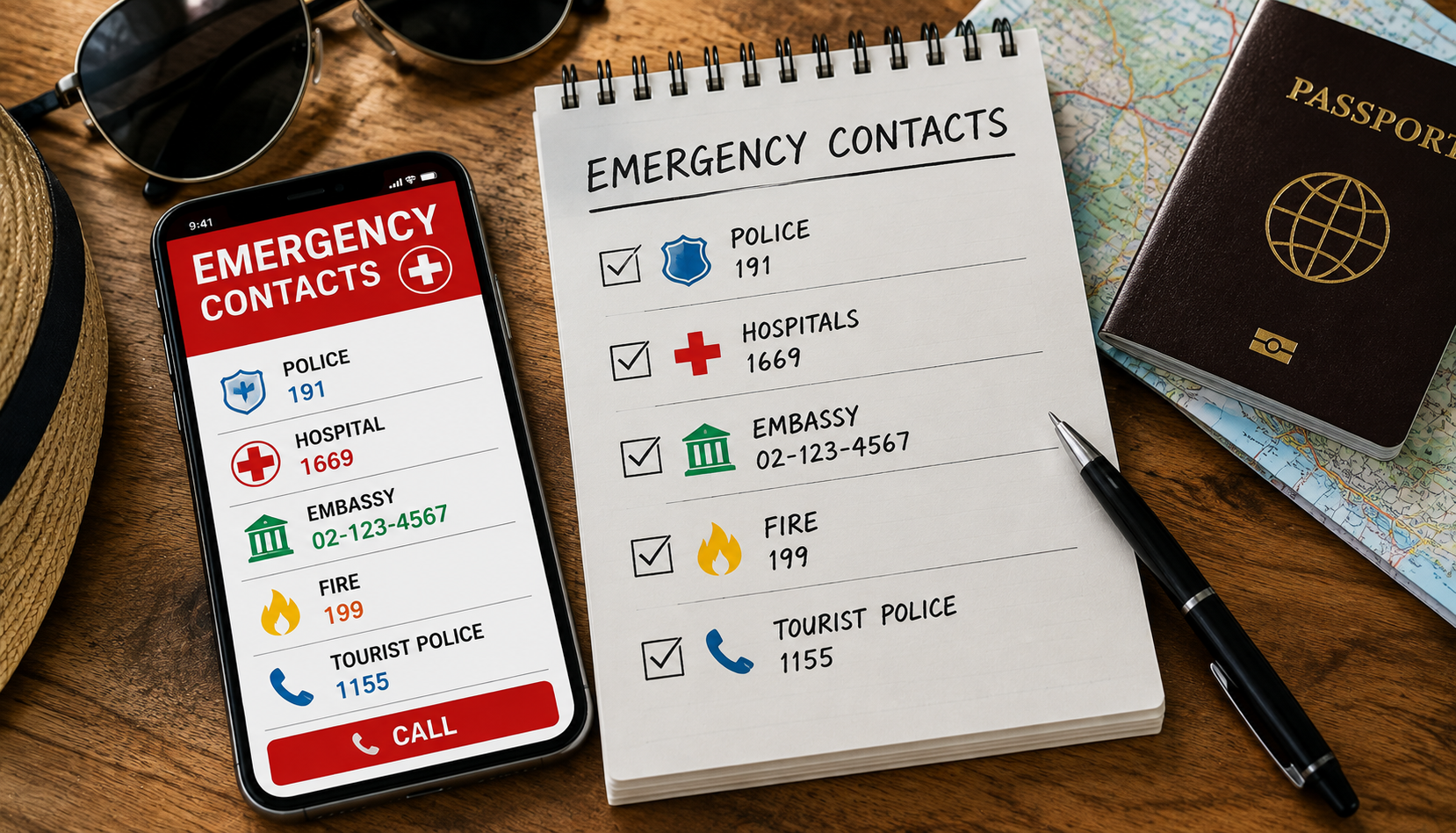
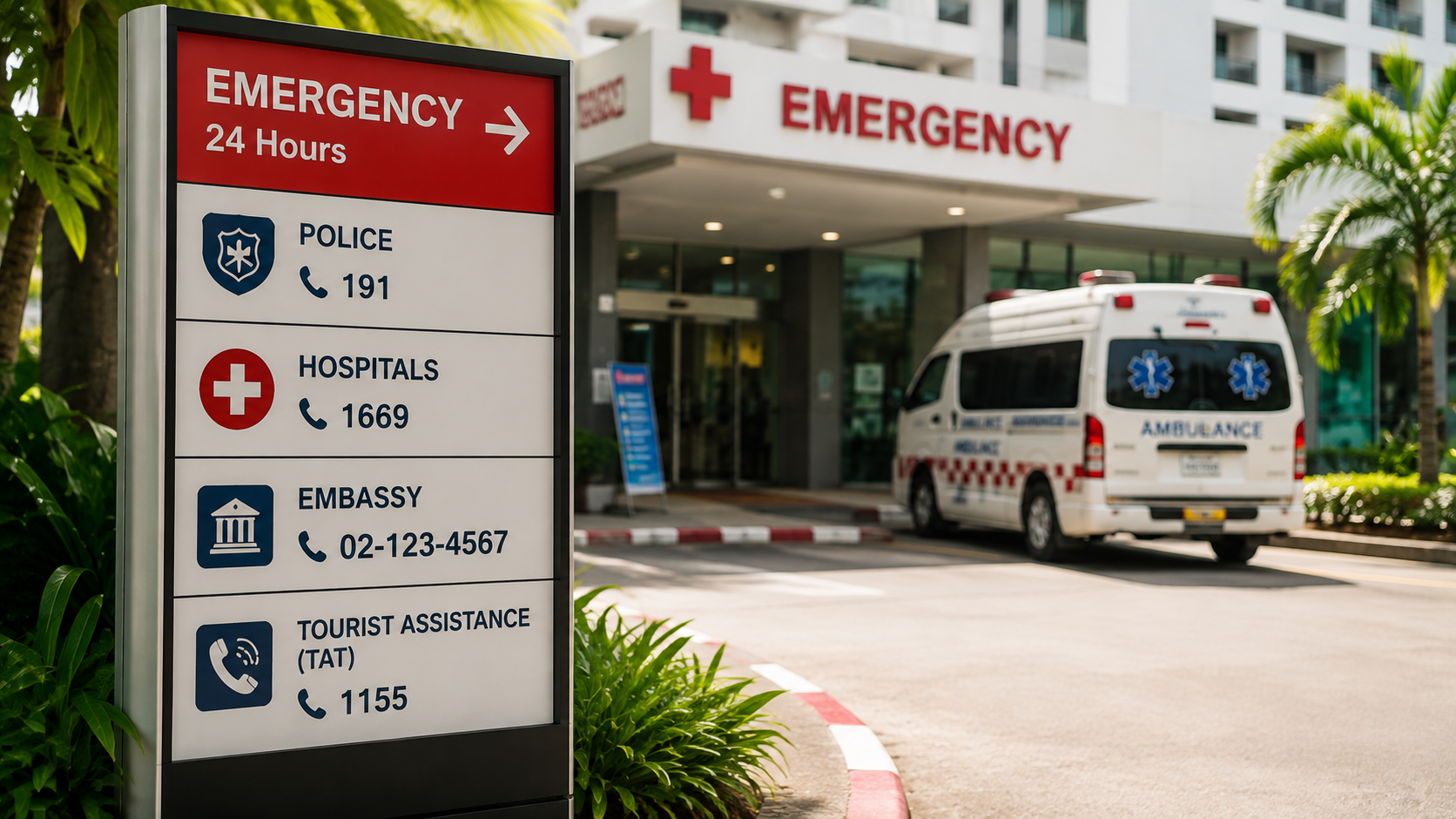
Save all of these before you need them, labelled clearly enough that somebody else holding your phone can find the right one. Emergency lines are reached without credit, and 911 was added in 2015 precisely because foreigners reach for it by reflex.
| Number | What it covers | English |
|---|---|---|
| 191 | Police and general emergencies, the closest thing to a catch-all | Not guaranteed, especially outside Bangkok |
| 1155 | Tourist police, 24 hours, also +66 2308-0333 | Yes, plus other languages |
| 1669 | National emergency medical service, free public ambulance | Limited |
| 199 | Fire and rescue | Limited |
| 1193 | Highway police, for incidents on intercity roads | Limited |
| 1784 | Disaster prevention and mitigation | Limited |
| 1554 | General ambulance and rescue services | Limited |
| 1111 | Government complaints and procedural questions | Limited |
A mental health line operates on 1323. It belongs in the same list for the same reason as the others: the moment somebody needs it is not the moment to go looking for it.
Here is the single most useful piece of local knowledge in this article. If you call 191 and cannot make yourself understood, hang up and call 1155. The tourist police will translate and dispatch on your behalf, which makes that line the English-language front door to the entire emergency system rather than a niche service for holidaymakers.
Long-term residents often skip 1155 on the assumption that it is meant for tourists and that a resident should be using the ordinary channels. That instinct costs minutes. The dispatcher on 191 may be excellent at their job and still unable to take your address; the operator on 1155 will take it and pass it on. Use whichever line gets the information across fastest, and worry about the correct channel afterwards.
In most countries this is not a decision at all. In Thailand you are choosing between a free public service, a paid private one and your own car, and the right answer depends on what is wrong and where exactly you live.
The decision is made in advance, not during the incident. Work out now whether an ambulance can physically reach your door or whether somebody has to meet it at the mouth of the lane, and whether the nearest hospital that would actually treat you is the one five minutes away or the one across town.
This is where expectations imported from home do the most damage. Foreign nationals are charged for emergency treatment in Thailand — visitors and most residents alike — which turns insurance from a sensible precaution into a structural part of living here. A serious admission at a private hospital is not a bill anyone absorbs comfortably out of savings.
The private hospitals foreign residents use are well established and run twenty-four-hour emergency departments with English-speaking staff: Bangkok Hospital, Bumrungrad, Samitivej and BNH among them. Larger facilities have helipads, and air ambulance services exist for cases that need moving between provinces or out of the country.
One question separates a manageable medical emergency from a financially brutal one, and it has nothing to do with the treatment. Find out which private hospital near you has a direct billing arrangement with your insurer. Where one exists you present a card and the hospital settles with the insurer. Where it does not, you pay up front for a serious admission and reclaim afterwards, with the same medicine and an entirely different experience. What to establish while nothing is wrong:
Everybody eventually saves the ambulance number. These three are the ones people add after the first incident rather than before it, and each of them does something no emergency line can.
For a rented house the landlord or the estate management takes the place of the juristic person office, and the practical test is the same: is there a number that answers at three in the morning, and does the person on the end of it have access to the property.
Two apartments at the same price can have completely different emergency profiles. Distance to a hospital with a proper emergency department varies enormously between provinces and even between districts of the same island, and so does how quickly a vehicle can physically reach your door.
This belongs on the checklist before signing, not after. It is one of the quieter arguments in favour of thinking carefully about which part of the country you settle in, alongside the usual questions of price and rental demand. A view is worth a great deal less than twenty minutes saved on the way to an emergency department. The questions worth asking about any address you are considering:
The failures in a Thai emergency are rarely medical. They are communication failures, and almost all of them are solved with about twenty minutes of preparation on an ordinary afternoon.
Health cover is one of the fixed lines in a monthly budget here, and it is the line people trim first because nothing has happened yet. That reasoning holds right up until the moment it does not, and the sums involved are asymmetric: a year of premiums against a single admission is rarely a close comparison.
It is worth seeing that premium beside the rest of what a month in Thailand actually costs, because in context it is a smaller share of the total than most newcomers assume. The policy features that matter in an emergency are not the ones marketing leads with — direct billing near your address, emergency evacuation, and a clear position on pre-existing conditions decide far more than the headline coverage figure.
Does 911 work in Thailand?
Yes. It was added in 2015 because foreign visitors dial it instinctively. It works, but 1155 is still the better call when language is likely to be the obstacle, because the operator there is expecting to speak English.
Is the free ambulance worse than a private one?
Not in competence. The differences are response time, which depends heavily on how accessible your address is, and destination: a private ambulance takes you to a private hospital. If you hold insurance that works with a private hospital, the private service usually gets you to the right place rather than merely to a place.
Will a hospital treat me before payment?
Emergency departments stabilise first. What follows depends on your insurer arrangement: with direct billing the hospital settles with the insurer, without it you are asked for payment or a deposit before admission. This is the single argument for sorting out the arrangement in advance.
Do I need to speak Thai to handle an emergency?
No, but you need a route to somebody who does. That route is 1155 for emergency services, an English-speaking private hospital for medical care, and a screenshot of your address in Thai script for everyone else, including taxi drivers.
What does the embassy actually do?
It issues emergency travel documents, contacts your family, provides lists of lawyers and doctors and visits nationals in detention. It does not pay medical bills, post bail or intervene in Thai legal proceedings. Knowing that boundary in advance prevents a great deal of misplaced expectation.
DDA Real Estate is a real estate agency working in Thailand, and this is one of the questions we answer for buyers and long-term tenants far more often than the brochures suggest. When we shortlist a property we look at the practical layer alongside the price: real driving time to the nearest hospital with a full emergency department, whether an ambulance or a fire vehicle can reach the entrance, whether the building keeps a manned desk overnight, and how the juristic person office actually handles incidents. We work across Phuket, Bangkok, Pattaya, Hua Hin and Samui, from condominium units to standalone villas.
Look at our offers in Thailand and leave a request: we will shortlist properties that match your budget and your requirements, tell you what the access and emergency picture looks like at each address, and be straightforward about the ones where a beautiful location sits at the end of a lane no vehicle can turn into.