

Thai Condo Bills 2026: Electricity, Water & Internet Costs
971 56 596-5009
day and night
Dubai
EN
$
ft²
Other articles

Electricity, Water & Internet Bills in Thai Condos: What to Expect Monthly

Alexandra Mitrofanova The author of the article, the Broker
#Blog DDA
19 March 48573 view

Rent or purchase price is only half the story of what a Thai condo costs each month. Electricity, water and internet add a meaningful, and sometimes surprising, amount on top, and how much you pay depends as much on the way your building bills you as on how you actually live. This guide breaks down what each utility really costs per month in 2026, explains why two near-identical condos can produce very different bills, and lists what to check before you sign anything.

Electricity: the one that matters

Electricity is almost always the largest utility bill, and air conditioning is by far the biggest factor in it. The official residential rate in 2026 sits at roughly 3.88 baht per unit for the first part of the year and about 3.95 baht for the middle months, billed on a progressive scale, plus a small fixed service charge and 7 percent VAT. Your provider depends on your address: the Metropolitan Electricity Authority (MEA) serves Bangkok, Nonthaburi and Samut Prakan, while the Provincial Electricity Authority (PEA) covers the rest of the country.

In real terms, a single 12,000 BTU bedroom air conditioner running ten to twelve hours a day can use around 1,800 baht of electricity by itself. At the government rate, a one-bedroom condo with moderate AC use typically lands between 1,200 and 2,500 baht a month, while heavy use, a work-from-home routine or a sun-facing unit with floor-to-ceiling glass can push it to 3,000 to 5,000 baht in the hot season.

The condo markup: where bills get surprising

Here is the detail that catches most newcomers out. Many condos, serviced apartments and older buildings do not bill you the government rate at all. The building buys electricity in bulk on one meter and resells it to residents at a private flat rate, commonly 6 to 9 baht per unit, sometimes more. That can easily double a heavy-AC bill. The markup is widespread and helps cover common-area power and admin, but rates above the official tariff are legally contestable for buildings managing several units, so it is worth questioning. Costs and billing practices also vary a lot by building and area, which our overview of the best areas to buy in Thailand can help you weigh up.

This cuts both ways. As a tenant or buyer, you want a unit on a direct MEA or PEA meter so you pay the government rate. As an owner letting your condo out, you will need to decide how to pass utilities on to tenants fairly, which is part of running a rental well, something we cover in our guide to maximizing income from rental property.

Water: cheap, but check the rate

Water is the easy one. On the government rate it is genuinely inexpensive, usually only about 100 to 300 baht a month for a typical household, and often less for one person. As with electricity, though, some buildings rebill it at a private rate of 18 to 25 baht per unit, which can lift the bill to 200 to 500 baht. Because water should be cheap, an unusually high water charge is a useful red flag that the building marks up its utilities.

Internet: simple and affordable

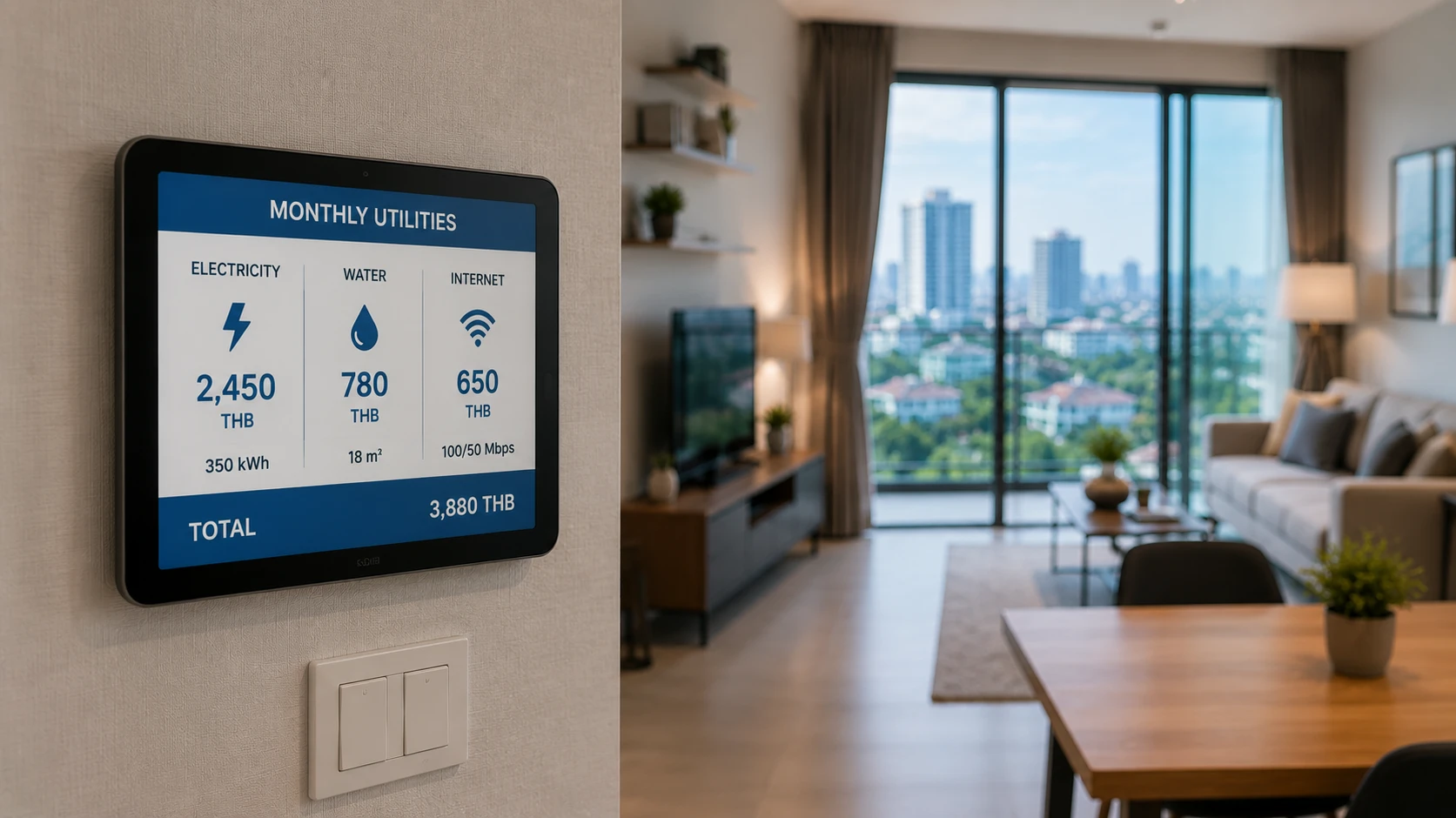
Home internet is straightforward and good value. A solid fibre plan of 300 to 500 Mbps from a provider like True, AIS, 3BB or NT costs roughly 350 to 700 baht a month, with entry plans cheaper and premium packages higher. Some condos bundle a basic connection into the rent or common fee, so it is worth asking; if not, installation is quick and a cheap mobile-data SIM makes a handy backup. Here is how the pieces fit together each month:

Utility Typical monthly cost What to watch
Electricity (your AC use) ~1,200-3,000+ baht Air conditioning is the biggest factor
Electricity at a marked-up building Often 6-9 baht/unit, much higher Ask if it is a direct MEA/PEA meter
Water ~100-300 baht Cheap; a high bill signals a markup
Internet (home fibre) ~350-700 baht 300-500 Mbps from True, AIS or 3BB
Combined, typical ~2,000-6,000 baht Mostly driven by electricity

One thing these bills do not include is the condo's common-area maintenance fee, charged separately by the juristic office at roughly 40 to 60 baht per square metre per month, along with any sinking-fund contribution. Keep that as a separate line in your budget so the utility figures above are not mistaken for your total monthly cost.

How to keep your bills down

Most of your bill is within your control, because most of it is air conditioning. A few habits make a real difference:

  • Set the AC to 25-26°C rather than chasing the coldest setting, and use the timer or sleep mode overnight.
  • Favour inverter air conditioners and an instant (on-demand) water heater over an always-on storage tank.
  • Switch off standby appliances, and choose an internet plan that matches your real usage rather than the top tier.
  • When choosing the unit itself, a direct meter and a position that avoids harsh afternoon sun both pay off month after month.

Before you sign: the checklist

Most utility surprises are avoidable with a few direct questions before you commit. Always ask the exact electricity rate per unit, the exact water rate per unit, and crucially whether you pay the government rate or a building-set rate. Ask whether you can have a direct MEA or PEA meter, and request a recent real bill rather than a vague verbal estimate. Finally, check the contract for meter minimums, water-pump or service fees, and penalties for late payment, since these small clauses can matter almost as much as the rate itself.

Frequently asked questions

How much is electricity in a Thai condo per month?

Typically 1,200 to 3,000 baht at the government rate, mostly depending on how much air conditioning you use.

Why is my condo's electricity rate higher than the government rate?

Many buildings buy power in bulk and rebill residents at a private rate of 6 to 10 baht per unit instead of around 4 baht.

Is the condo markup on electricity legal?

It is common, but rates above the official tariff are contestable for buildings managing several units, so it is worth checking your meter type.

How much is water in a Thai condo?

Usually only about 100 to 300 baht a month, so an unusually high water bill is a sign of a markup.

How much does home internet cost in Thailand?

Fibre plans of 300 to 500 Mbps from providers like True, AIS and 3BB run roughly 350 to 700 baht a month.

What should I check before signing a lease?

Ask the exact electricity and water rates, whether they are government or building rates, and ask to see a recent real bill.

What is the biggest factor in my monthly bill?

Air conditioning, by far; the rate per unit and your AC habits together decide most of the total.

In short

Once you know the rates and your own air-conditioning habits, utilities in a Thai condo are easy to budget: electricity is the big variable, water is cheap, and internet is modest and predictable. The real surprises come from building markups, not from the bills themselves, so checking the meter and the fine print before you sign is what saves money. If you are choosing a condo to rent or buy, DDA Real Estate can walk you through the essential things to check when buying a condo in Thailand and help you find a building whose running costs fit your budget.

Popular
5 June 4208274 view
Dubai Rent Prices 2025: Average Apartment Rental Costs in Dubai Dubai's rental market continues its upward climb in 2025, driven by population growth and limited new supply, pushing average prices up by 10%
#Blog DDA
2 July 2410065 views
DLD Fees in Dubai: Everything You Need to Know Buying property in Dubai? Don't let hidden fees surprise you! Our essential guide breaks down ALL Dubai Land Department (DLD) fees
#Blog DDA
23 November 1785924 view
How to Buy a SIM Card in Turkey in 2026: Prices, IMEI Registration, eSIM Options, and Best Mobile Operators Overview of mobile operators, available types of SIM cards, and home Internet providers
#Blog DDA
5 July 1733067 views
How Much is the Real Estate Agent Commission in Dubai? Find out how much real estate agent commission costs when buying property in Dubai.
#Blog DDA
5 February 1416177 views
How Foreigners Can Own Property in Bali: Understanding PT PMA (2025) Foreigners can't own freehold land in Bali, but a PT PMA (foreign-owned company) allows secure property ownership under Hak Guna Bangunan (HGB) or Hak Pakai (HP) rights
#Blog DDA
28 August 1173186 views
Oqood vs Title Deed in Dubai: Key Differences You Must Know Buying property off-plan in Dubai? Oqood registration is mandatory to secure your ownership rights.
#Blog DDA