

Off-plan properties
Whether you’re in Thailand for a two-week holiday or settling in for the long haul, getting online is one of the first things you’ll sort out — and the good news is that a local SIM costs a fraction of international roaming, with a week of data running roughly $9–20 instead of $100 or more. Thailand’s networks are fast and far-reaching, with 4G and 5G that often beat what your home carrier’s roaming would give you.
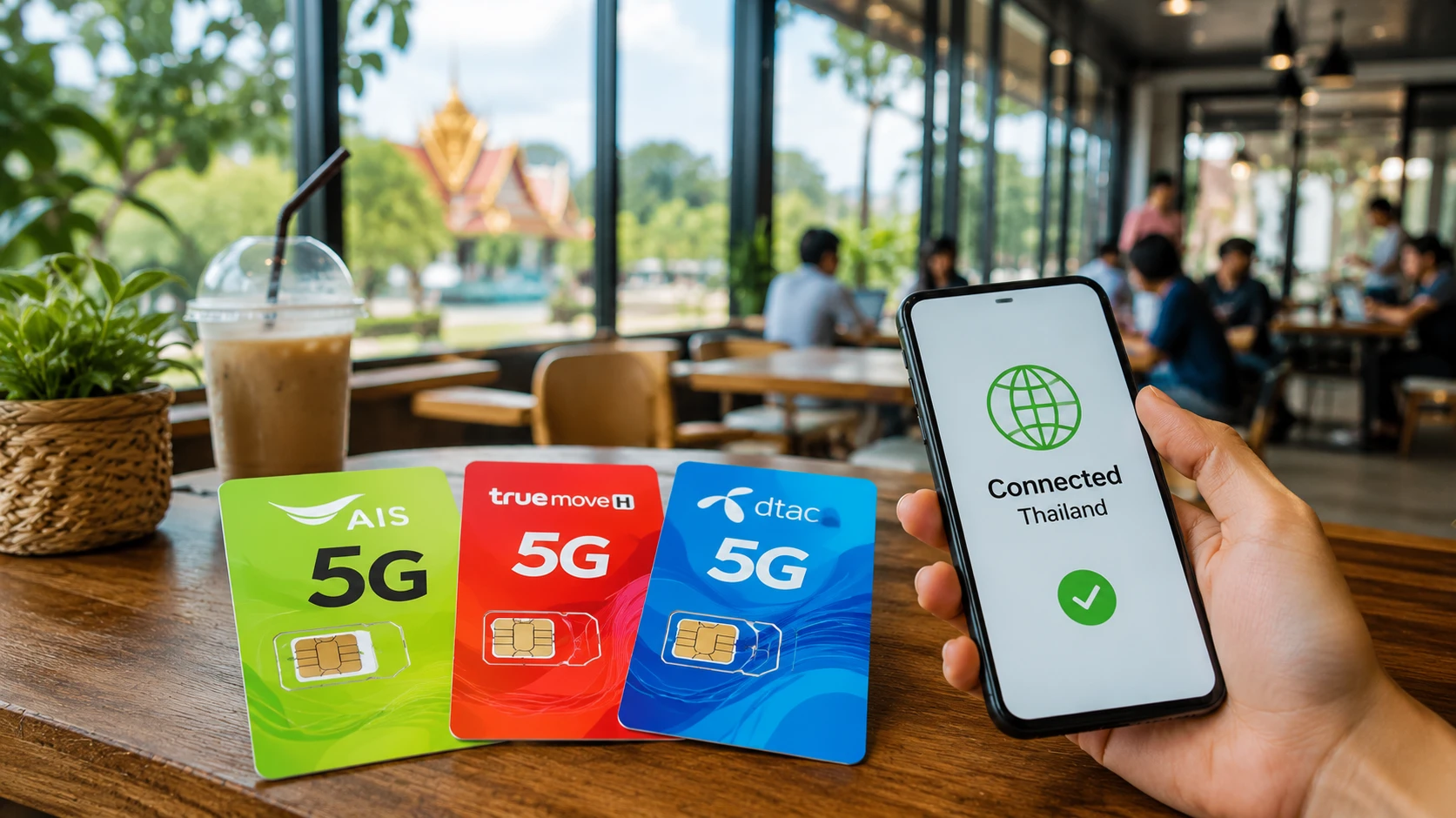
The market still runs on three familiar brands — AIS, TrueMove H and DTAC — but there’s a 2026 twist worth knowing before you choose: two of them are now the same company. This guide compares coverage, plans and prices across all three, adds a word on home internet, and helps you pick the right network for how and where you’ll actually use it. Prices are in Thai baht (around 35 to the dollar) and shift with promotions, so confirm current packages.
Here’s the key context. AIS is Thailand’s largest standalone operator. TrueMove H and DTAC, once separate rivals, merged in 2023 and now sit under a single parent, True Corporation — though both are still sold as distinct brands with their own plans. The result is effectively a duopoly: AIS and True together account for more than 98% of the country’s roughly 96 million mobile connections, with True holding around 51% of the market and AIS about 47%.
Beyond the big two, National Telecom (NT) and a handful of smaller MVNOs run on government-leased bandwidth, but for coverage and speed the choice really comes down to AIS versus True (and its DTAC brand). One rule applies to everyone: SIM registration is mandatory, so you’ll need your passport when you buy.
If you’re going anywhere beyond the big cities, AIS is usually the safe pick. It consistently leads independent testing for nationwide coverage — around 98.7% 4G availability and the fastest median speeds — and it has invested most heavily in rural areas, the northern provinces (Chiang Mai, Pai, Mae Hong Son) and, crucially, the islands. For island-hopping, national parks or any trip off the tourist spine, AIS simply reaches further.
It also tends to win on consistency, upload speed and real-time apps in independent reports, offers the most polished English-language support, and leads Thailand’s home-fibre market after absorbing 3BB. If your priorities are reliability and reach, AIS is hard to beat — you generally pay a small premium for that coverage, but it’s the network least likely to leave you with no signal.
True is the strongest challenger in the cities. In Bangkok and other major hubs it performs on par with AIS, and it has rolled out the most aggressive 5G coverage in the central districts — walk around Siam or Sukhumvit and you’ll pick up True 5G easily. It’s also well established in the big tourist areas such as Phuket, Koh Samui, Koh Phangan and Koh Lanta.
True’s other draw is its ecosystem: TrueWiFi hotspots, TrueVisions and TrueID streaming perks are often bundled into plans, which adds value if you’ll use them. Signal strength inside a specific building can vary by carrier and frequency, so True is frequently the better indoor choice in condos tuned to its network. For a Bangkok-centric stay with heavy 5G use, it’s a natural fit.
Now operating under True Corporation, DTAC (also marketed to visitors as the Happy brand) keeps a distinct, value-focused identity. It won Opensignal’s awards for video experience and reliability, making it a strong choice if you stream a lot or need a dependable connection for ride-hailing and navigation. It also tends to be the most affordable, with monthly prepaid packages starting from around 299 THB and flexible tourist options like a 10-day plan at 349 THB.
The trade-offs are a historically slower 5G rollout — improving now that it shares True’s network — and more limited English-language support than AIS. For a Bangkok-focused or budget-minded trip where streaming reliability matters more than deep rural coverage, DTAC holds up well.
Tourist SIMs are broadly similar across all three, typically valid 7–30 days with generous or unlimited data, and often calls included:
| Provider | Best for | Typical pricing |
|---|---|---|
| AIS | Islands, rural, the north; reliability | Tourist SIM ~$15–20/week; postpaid from ~599 THB/mo |
| TrueMove H | Bangkok, city 5G, ecosystem perks | Tourist SIM ~$9–20/week; competitive postpaid |
| DTAC (Happy) | Budget, streaming, Bangkok | 10-day ~349 THB; prepaid from ~299 THB/mo |
For short trips, an eSIM can be even cheaper and set up before you land — plans start from around $3 per gigabyte, and both AIS and True support eSIM activation. Postpaid contracts (typically 12 months) suit long-term residents: expect roughly 599 THB a month for 20–30 GB with unlimited calls, or around 799 THB for 50 GB.
For a longer stay, home fibre is cheap and fast. The main providers are AIS Fibre (now the market leader after merging with 3BB), True Online and NT, with plans generally spanning 100 Mbps to 1 Gbps. Monthly costs are modest by Western standards — commonly in the low hundreds to just over a thousand baht depending on speed — and mobile-plus-home bundles can trim the total. Installation is usually quick in condos and established residential areas; always confirm the exact package and speed for your specific building.
Match the network to your trip. For islands, rural travel or the north, choose AIS. For a Bangkok-centric stay with heavy 5G use, True is ideal. For budget or streaming-first use in the city, DTAC delivers. A few practical notes:
Sorting a SIM and home fibre is one of the first steps of actually living in Thailand — right alongside working out your budget and where to base yourself. If a longer stay is on the cards, our guide to the cost of living in Thailand puts connectivity in the wider monthly picture, while our tips for buying an apartment in Thailand and the guide to freehold and leasehold ownership cover what foreign residents need to know.
Which mobile network is best in Thailand?
It depends on where you’ll be. AIS has the best nationwide coverage, especially on the islands, in rural areas and the north, and consistently tops independent speed tests. True (TrueMove H) is excellent in Bangkok and major cities with strong 5G, while DTAC — now part of True Corporation — is the value option and strong for streaming. For travel beyond the cities, AIS is the safest choice.
Are DTAC and True the same company now?
Yes. TrueMove H and DTAC merged in 2023 and both now operate under the same parent, True Corporation. They are still sold as separate brands with their own plans and pricing, and DTAC keeps a distinct, value-focused identity, but they increasingly share network infrastructure — which is gradually improving DTAC’s 5G coverage.
How much does a tourist SIM card cost in Thailand?
A tourist SIM typically costs around $9–20 for a week of data — roughly 90% less than international roaming for the same usage. Packages are usually valid 7 to 30 days, often with unlimited or generous data and sometimes calls included. DTAC, for example, offers a flexible 10-day plan at around 349 THB.
Can I use an eSIM in Thailand?
Yes. Both AIS and True support eSIM activation, and eSIM coverage reaches 97–98% of the population. For short trips an eSIM can be cheaper than a physical tourist SIM and can be set up before you arrive — buy it at home, install the QR code, and you’ll have data the moment you land. Plans start from roughly $3 per gigabyte.
Do I need my passport to buy a SIM card in Thailand?
Yes. SIM registration is mandatory and strictly enforced in Thailand, so you must show your passport (or ID) at the point of purchase. You can buy a SIM at the airport, at any 7-Eleven or Family Mart, at operator shops in malls, and in most mini-markets, but registration is required everywhere.
Which network is best for the Thai islands?
AIS. It has invested the most in island and rural coverage, so it delivers the strongest, most consistent signal on destinations like Koh Samui, Koh Phangan and the smaller islands, as well as in the northern provinces. True and DTAC are fine in the main resort towns but can show their limits once you venture further out.
How much does home internet cost in Thailand?
Home fibre is inexpensive and fast, with the main providers being AIS Fibre (now the market leader after merging with 3BB), True Online and NT. Plans typically range from 100 Mbps to 1 Gbps, with monthly costs commonly running from the low hundreds to just over a thousand baht depending on speed. Bundling with a mobile plan can reduce the total.
Should I choose prepaid or postpaid in Thailand?
For short trips a prepaid tourist SIM is simplest and requires no contract. For long-term residents, a postpaid plan (usually a 12-month contract) offers better value on large data allowances — around 599 THB a month for 20–30 GB, or 799 THB for 50 GB. It’s worth testing coverage in your home and workplace on prepaid before committing to a postpaid contract.
Staying connected in Thailand is easy and cheap once you match the network to your needs: AIS for coverage and the islands, True for Bangkok and 5G, DTAC for budget and streaming — and affordable home fibre for anyone settling in. Get a prepaid SIM, test it where you’ll live, and upgrade to postpaid or fibre once you know your area. And if a connected life in Thailand is turning into a permanent one, DDA Real Estate helps foreigners buy and invest with full legal support — a good next read is our guide to property investment in Thailand. Get in touch and we’ll help you plan the move.