
Off-plan properties
On Bali the boundary between a dance and a prayer is almost impossible to draw. A tilt of the head, a spread of the fingers, a glance thrown suddenly to one side — the flick the Balinese call seledet — each is a word in a language addressed as much to the gods as to the people watching. That is why the island’s temple dances read less like shows and more like rituals that happen to have an audience, and why UNESCO placed Balinese dance on its register of Intangible Cultural Heritage back in 2015.
Below, we take the four forms every first-time visitor hears about — Kecak, Barong, Legong and Baris — and unpack what each one is actually doing: its story, its mood, and the role it plays in Balinese life. Then comes a practical section on catching them in 2026, with venues, times and ticket prices (in rupiah, at roughly 16,000 to the dollar, and liable to shift by season).
One thing makes the rest easier to follow: not every Balinese dance carries the same weight. The tradition sorts itself into three levels of holiness — wali, the innermost sacred dances reserved for temple ceremonies; bebali, a middle tier performed in the temple’s second courtyard; and balih-balihan, the pieces made to be enjoyed, which is the category almost every visitor sees. Underpinning nearly all of them is the gamelan, a tuned bronze orchestra whose rippling, metallic waves of sound set the pace for every movement.
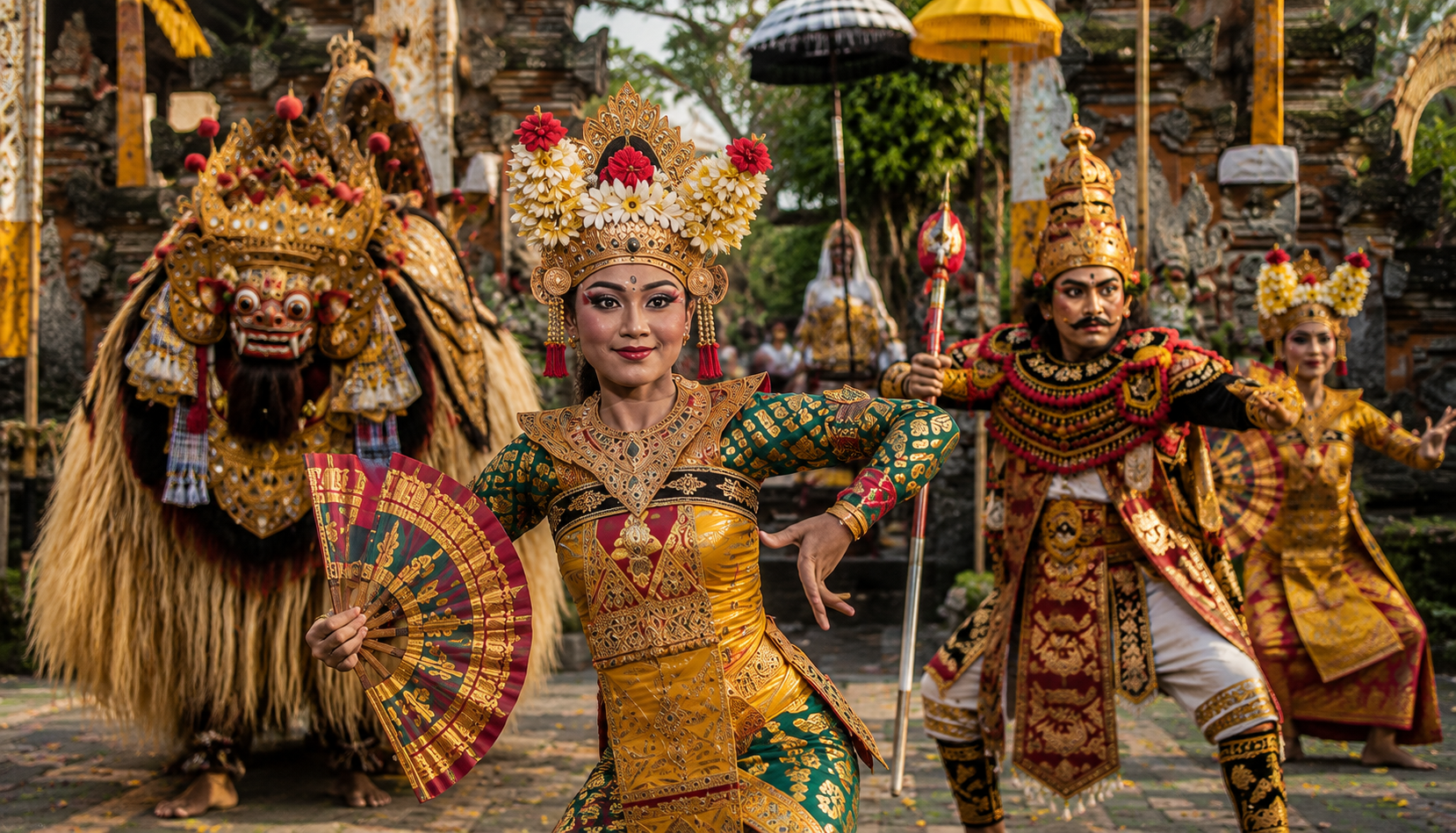
The vocabulary of the body is just as codified. Expect sharp, geometric postures, fingers bent back and fanned wide, hands trembling into symbolic shapes, and eyes that do half the storytelling. Costumes are heavy with gold leaf, silk and frangipani, and the dancers behind them usually started training as small children — the sheer control on display is the product of years. Watch closely and you are seeing devotion rehearsed to perfection, not simply choreography.
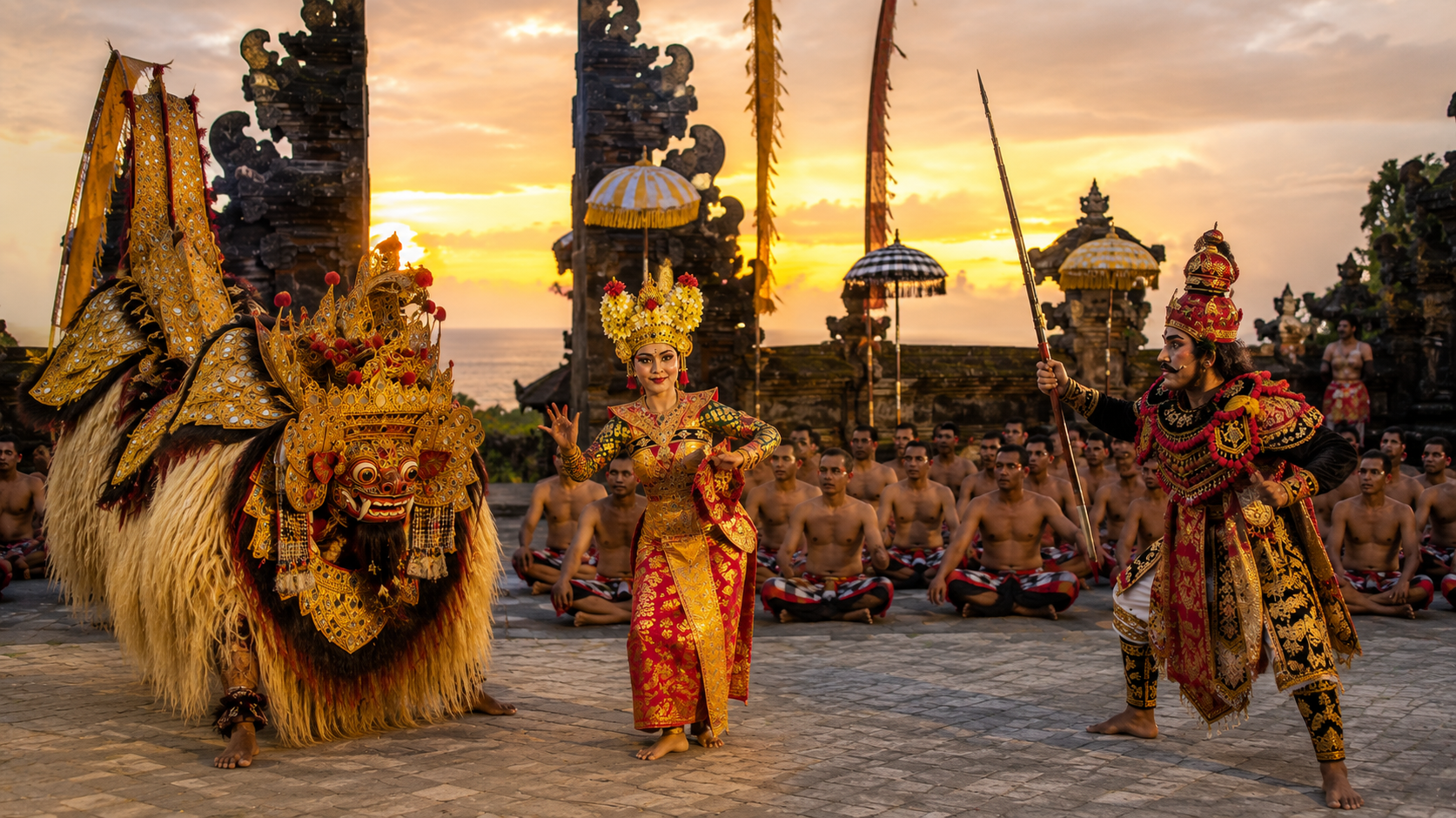
The Kecak dispenses with the gamelan altogether, and that is precisely what makes it unforgettable. Its score is entirely human: rings of bare-chested men, often a hundred strong, packed in circles around a single flame, tossing a clipped “chak” back and forth until the overlapping voices lock into one throbbing, trance-like engine of sound. Inside that circle, performers play out a slice of the Ramayana — Princess Sita seized by the demon king Ravana, and the rescue mounted by Hanuman and his monkey army, whose ranks are the chanting men themselves.
For all its timeless feel, the Kecak is surprisingly modern. It was assembled in the 1930s, when the local dancer Wayan Limbak, working with the German painter Walter Spies, reworked the far older Sanghyang trance ceremony into something built for spectators. A good number of stagings finish with a fire sequence, an entranced dancer treading barefoot across a bed of burning coconut husks. Catch it on a clifftop as the sun drops, and it earns every bit of its reputation.
Where the Kecak overwhelms, the Barong dramatises an idea — that order and chaos are permanent partners rather than enemies with a winner. At its centre is the Barong himself, a shaggy, lion-like guardian of the village brought to life by two dancers working in tandem, in a manner not unlike a Chinese lion dance. His opposite is Rangda, a terrifying widow-witch who channels the darker powers, and their confrontation, frequently pulled from the tale of Calon Arang, resolves into a stalemate rather than a triumph.
The scene everyone remembers arrives when men bearing the kris, the wavy Balinese dagger, are swept into a trance and press the blades to their own chests — kept from harm, believers say, by the Barong’s protective power, so the metal never breaks the skin. It is this genuine trance element that keeps the Barong on the sacred side of the ledger; it is treated as a rite of protection first and a performance second.
If the Kecak is force, the Legong is finesse — routinely called the most exquisite dance the island produces. Convention hands it to very young girls, dressed head to toe in gold leaf, vivid silk and frangipani, who turn control itself into the spectacle: eyes flicking on the beat, fingers unfurling like petals, feet placing each step with a precision in which no gesture is accidental. The name it goes by, Legong Keraton, betrays where it came from — the royal courts of the 1800s.
Its best-loved narrative follows Lasem, a king who carries off a woman against her will and rides toward a war he is doomed to lose, the whole tale conveyed through stylised motion with never a spoken line. Quiet, mesmeric and technically merciless, the Legong is the dance that gives back the most when you can watch it up close and without hurry.
The Baris answers the Legong’s delicacy with something altogether tougher: a male solo that maps the inner weather of a young warrior about to march into combat. There is no plot to speak of — only a body cycling through pride, courage, hesitation and rage, expressed in quivering muscles, planted stances, quick swivels of the gaze and abrupt explosions of movement. Its purpose is partly to celebrate valour and partly to drill discipline into the men who learn it.
It comes in two shapes. Baris Tunggal is the exposed solo, a single dancer with nowhere to hide, judged on control alone; Baris Gede is its ceremonial, collective form, ranks of spear-carrying warriors moving together. Punchy and combative, it is often slotted into a programme beside softer pieces so that an evening travels the full span of the tradition’s moods.
| Performance | Where | When | Ticket |
|---|---|---|---|
| Kecak & Fire Dance | Uluwatu Temple | Daily at sunset | ~Rp 150,000 |
| Legong, Barong, Kecak | Ubud Palace | Nightly, 7:30pm | ~Rp 100,000 |
| Barong & Kris Dance | Batubulan village | Daily, 9:30am | ~Rp 100,000 |
| Legong (lotus setting) | Saraswati Temple, Ubud | Select evenings | ~Rp 80–100,000 |
| Arts-focused programme | ARMA Museum, Ubud | Select evenings | ~Rp 150,000 |
A little planning pays off. Turn up 30 to 60 minutes ahead, because the good seats vanish quickly and the Uluwatu Kecak in particular sells out in peak months — reserve a day or two in advance. Temple venues expect a sarong and sash, borrowed or bought at the gate for about Rp 20,000–30,000. Snapping photos is generally welcome; using a flash is not. And should your trip fall in June or July, the month-long Bali Arts Festival in Denpasar pulls the island’s strongest companies together under one roof.
What is a highlight for a traveller is, for a resident, simply the background hum of ordinary life. Temple anniversaries (odalan) crowd the year, gamelan carries over the paddies after dark, and in village halls children drill the Legong and the Baris. That current runs strongest around Ubud, the island’s creative core. For plenty of people, being surrounded by it day in, day out becomes the very reason to stay — and our guides to immigrating to Bali, the best areas to live and invest and working here legally map out the practical route.
What are the most famous traditional dances of Bali?
Four stand out: the Kecak, driven by a chanting male chorus rather than instruments; the Barong, a sacred dance of cosmic balance built around a lion-like guardian; the Legong, a refined court dance given to young women; and the Baris, an energetic warrior solo. Beyond them sit the Pendet, Topeng, Sanghyang and others.
What is the Kecak dance?
It is a Balinese dance-drama with no gamelan — dozens of men supply the sound by chanting an interlocking “chak” while performers stage a scene from the Ramayana. Adapted in the 1930s from the older Sanghyang trance ritual, it frequently ends in a fire dance and is most famously staged at sunset on the cliff at Uluwatu Temple.
What does the Barong dance represent?
It portrays the ceaseless balance between good and evil. The Barong, a protective lion-like spirit, faces Rangda, a demon-widow of dark power, and neither truly wins. It is regarded as sacred and protective, and its signature moment is the trance in which kris-wielding dancers press blades to themselves yet stay unharmed, said to be shielded by the Barong.
Who performs the Legong dance?
Tradition assigns it to very young girls, picked for their grace and trained from childhood. In gold, silk and frangipani, they execute minutely detailed movements of eyes, hands and feet. Rooted in the royal courts of the 19th century, the Legong is widely held to be the most refined of all the island’s dances.
What is the Baris dance about?
The Baris follows the emotions of a young warrior bracing for battle — pride, courage, unease and fury — through trembling, forceful, martial movement rather than a storyline. It both honours valour and trains dancers, and appears either as an exposed solo (Baris Tunggal) or as a spear-carrying group (Baris Gede).
Where can I watch Balinese dance?
The most celebrated setting is the sunset Kecak and Fire Dance at Uluwatu Temple. Ubud Palace runs nightly shows at 7:30pm, Batubulan village performs a daily Barong at 9:30am, and Ubud temples such as Saraswati host evening Legong. Tickets usually fall between Rp 100,000 and Rp 150,000.
Is there a dress code for a dance performance?
At temple venues, yes — a sarong and sash are expected as a sign of respect, and both can be borrowed or bought at the entrance for roughly Rp 20,000–30,000. Non-temple stages are more relaxed, though modest clothing is always appreciated. Photography is normally allowed, but flash is considered rude.
Is Balinese dance religious?
Very much so. Many forms are sacred offerings tied to temple ritual, and even the visitor-facing versions descend from religious practice. In Bali, dancing is an act of devotion and a means of keeping cultural identity alive, which is why its gestures, costumes and stories are handled with such reverence.
The dances of Bali are its inner life turned outward — the hypnotic drone of the Kecak, the uneasy truce of the Barong, the jewelled precision of the Legong, the fighting spirit of the Baris. Make room for at least one on any visit; the sunset Kecak at Uluwatu is the natural place to start. And if this ever-present culture is part of what pulls you toward staying, DDA Real Estate helps foreigners settle and buy property the right way, with full legal support — start with our complete guide to buying property in Bali as a foreigner, then get in touch.