


Off-plan properties
An overseas business wins its first Dubai client. Another opens a UAE subsidiary. A third buys an apartment and receives rent. All three may describe themselves as foreign companies, but they need different tax assessments. The first useful question is which legal entity earns the income and what connects it to the UAE.
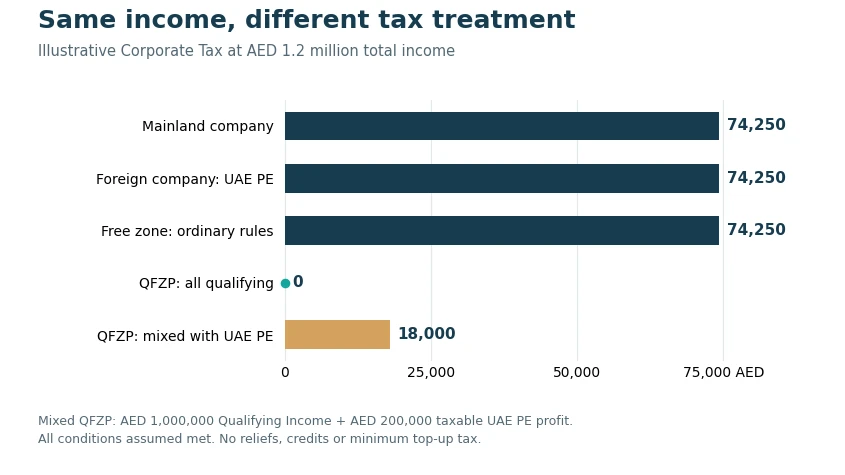
The difference shows up in the bill. In the ordinary Corporate Tax regime, AED 1.2 million of taxable income gives a basic liability of AED 74,250. A qualifying free zone company can owe zero on the same amount if all of it is Qualifying Income. An overseas corporate landlord can enter the tax system through rental income even without a local office.
This guide follows those situations through to the calculation, VAT and filing calendar. Official sources were checked in October 2026. All worked amounts are hypothetical and stated in AED. They exclude foreign taxes, credits and special-sector treatment; the separate minimum-tax rules for large groups are noted below.
Look at the name on the contract and the entity that owns the asset. A UAE company owned by foreign shareholders is generally a UAE resident juridical person for Corporate Tax. Calling it “foreign-owned” does not turn it into a non-resident company.
| Business arrangement | Corporate Tax starting point | What needs examining |
|---|---|---|
| UAE-incorporated operating company | Generally a UAE Resident Person | Worldwide income, then applicable exemptions and reliefs |
| UAE free zone entity | Resident company with a possible special regime | Whether the company and its income meet the qualifying conditions |
| Overseas company with UAE operations | A permanent establishment may arise | Actual activities and profit attributable to that establishment |
| Overseas company receiving UAE property income | An immovable-property nexus can arise | Income attributable to the property nexus |
| Overseas supplier selling remotely to UAE customers | Customer location alone does not settle the position | Residence, permanent establishment, nexus and the VAT supply rules |
Incorporation is only part of the residence test. The FTA’s guidance on resident companies also covers foreign-incorporated entities effectively managed and controlled in the UAE. Where strategic and commercial decisions are regularly made matters. An overseas registration certificate therefore needs to be considered alongside the way the business is run.
For a business that remains non-resident, a fixed place of business or certain agent arrangements can create a permanent establishment. The FTA permanent establishment guidance sets out the tests and exceptions. Review the people, premises and functions involved, together with any relevant treaty, before deciding which profits belong in the UAE calculation.
A non-resident company with only State Sourced Income and no UAE permanent establishment or nexus generally does not have to register for Corporate Tax solely for that income. The non-resident guide explains the distinction. The current withholding framework applies a 0% rate to the relevant income outside a permanent establishment or nexus. VAT still requires its own review.
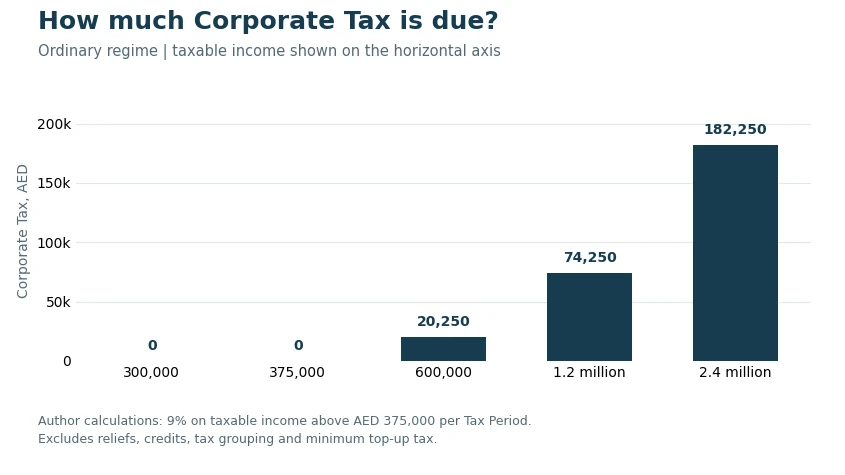
For an ordinary taxpayer, the first AED 375,000 of taxable income falls in the zero-rate band. The basic calculation above it is 9% × (taxable income - AED 375,000). This band belongs to the taxpayer for the Tax Period; it does not restart for every customer, property or invoice.
| Taxable income, AED | Basic Corporate Tax, AED | Tax as a share of taxable income |
|---|---|---|
| 300,000 | 0 | 0.00% |
| 375,000 | 0 | 0.00% |
| 600,000 | 20,250 | 3.38% |
| 1,200,000 | 74,250 | 6.19% |
| 2,400,000 | 182,250 | 7.59% |
The rate structure comes from the FTA General Corporate Tax Guide. The figures above assume no relief election, credits, tax grouping or minimum top-up tax. At AED 1.2 million, multiplying all income by 9% would give AED 108,000. Applying the zero-rate band reduces that basic figure by AED 33,750, to AED 74,250.
The income figure also needs work. Start with the accounts, then reconcile them to taxable income using the FTA guidance on determining taxable income. Revenue, accounting profit and taxable income should remain separate lines in the spreadsheet. A loan repayment or an asset purchase cannot simply be treated as an ordinary operating deduction.
For example, take revenue of AED 3.6 million and accounting expenses of AED 2.4 million. Accounting profit is AED 1.2 million. If the reconciliation requires AED 60,000 of add-backs and there are no other adjustments, taxable income becomes AED 1.26 million. Basic Corporate Tax is then AED 79,650. The assumed adjustment adds AED 5,400 to the bill; it is not a statement that a particular expense is disallowed.
A free zone licence is not enough to budget for zero tax. The company must meet the requirements for a Qualifying Free Zone Person, usually shortened to QFZP, and identify which income qualifies. Income can receive different treatment within the same company.
| Assumed structure | Income for comparison | Corporate Tax, AED |
|---|---|---|
| Mainland taxpayer under ordinary rules | 1,200,000 taxable income | 74,250 |
| Non-resident with an ordinary UAE permanent establishment | 1,200,000 attributable taxable income | 74,250 |
| Free zone company under ordinary rules | 1,200,000 taxable income | 74,250 |
| QFZP with all income qualifying | 1,200,000 Qualifying Income | 0 |
| QFZP with a separately taxable mainland establishment | 1,000,000 Qualifying Income + 200,000 Domestic PE taxable income | 18,000 |
In the last row, AED 200,000 is taxable income attributable to a Domestic Permanent Establishment. It is not an arbitrary share of non-qualifying sales. The QFZP’s separately taxable amount does not benefit from the ordinary AED 375,000 band: AED 200,000 × 9% gives AED 18,000. The FTA Free Zone Persons Guide explains this treatment.
Before using the zero result, review the actual contracts. Cabinet Decision No. 100 of 2023 distinguishes transactions with Free Zone Persons from those with other counterparties. The current qualifying and excluded activity rules are in Ministerial Decision No. 229 of 2025. A customer being overseas does not, on its own, establish Qualifying Income.
The company also needs adequate substance, transfer-pricing compliance, audited financial statements and compliance with the other QFZP conditions, including not electing into ordinary treatment. These requirements are summarised in the FTA free zone bulletin. Put the relevant staffing, premises, accounting and audit costs beside the tax comparison.
Then monitor the de minimis test. After the required statutory exclusions, permitted non-qualifying Revenue is the lower of 5% of relevant total Revenue or AED 5 million. The denominator is not automatically the turnover shown on the first page of the accounts.
| Relevant total Revenue, AED | Five percent, AED | De minimis ceiling, AED |
|---|---|---|
| 4,000,000 | 200,000 | 200,000 |
| 12,000,000 | 600,000 | 600,000 |
| 120,000,000 | 6,000,000 | 5,000,000 |
With relevant Revenue of AED 12 million, AED 540,000 of non-qualifying Revenue represents 4.5%; AED 660,000 represents 5.5%. The first meets this test and the second exceeds it. All other conditions still apply. Failure generally removes QFZP status from the start of that Tax Period and for four subsequent Tax Periods. Certain separately taxed property and permanent-establishment streams are excluded from this revenue calculation, so the mixed case above is not a 16.7% de minimis breach.
A small UAE-resident company should assess Small Business Relief before assuming it will pay the ordinary bill. It is available to eligible Resident Persons whose Revenue has not exceeded AED 3 million in the relevant or previous Tax Periods. It is a revenue test, not a ceiling on profit.
The Ministry of Finance has announced an extension to eligible Tax Periods ending on or before 31 December 2029. The published amendment extends the window previously ending in 2026. Use the updated endpoint when planning; the other eligibility requirements remain important.
| Example: Revenue 2,800,000; accounting profit 600,000 | Assumed treatment | Corporate Tax, AED |
|---|---|---|
| Eligible resident company making a valid election | Treated as having no taxable income for the period | 0 |
| Same resident company without the election | Ordinary rules; no tax adjustments assumed | 20,250 |
| Non-resident company’s ordinary UAE permanent establishment | Not eligible for this resident-person relief; no tax adjustments assumed | 20,250 |
The FTA Small Business Relief Guide explains the resident-person requirement and exclusions for QFZPs and specified multinational group members. Read its eligibility guidance with the later extension announcement. Registration and a return remain necessary; the election does not happen simply because turnover is low. Prior revenue breaches must also be checked.
Corporate Tax and VAT both use an AED 375,000 figure, but they measure different things. For ordinary Corporate Tax it is a taxable-income band. For mandatory VAT registration of a UAE-resident business it is a threshold for taxable supplies and imports, tested over the previous 12 months or expected next 30 days.
| Question | Corporate Tax | VAT |
|---|---|---|
| What is assessed? | Taxable income for the Tax Period | Supplies, imports and applicable VAT rules |
| Main figure in this comparison | 0% up to AED 375,000 taxable income; 9% above | Mandatory resident-business threshold: AED 375,000 |
| What if the company pays no Corporate Tax? | Registration and filing may still be required | VAT obligations must still be assessed |
| Does a free zone licence settle the issue? | QFZP eligibility and income need checking | No blanket exemption from VAT |
The FTA VAT registration page also gives a voluntary threshold of AED 187,500, which can include eligible taxable expenses. Zero-rated supplies count as taxable supplies. Exempt supplies have different consequences, including for input-tax recovery.
For a non-resident supplier, the usual resident threshold is not the starting protection. The FTA registration service explains that UAE taxable supplies can require registration regardless of their value unless another party in the UAE is responsible for settling the VAT. Establish the place of supply and any reverse-charge treatment for the particular transaction.
Consider a VAT-registered company invoicing AED 240,000 for standard-rated services, excluding VAT. Output VAT is AED 12,000. If AED 80,000 of purchases carry 5% VAT and all AED 4,000 is recoverable in the same return, the net VAT payable is AED 8,000. This example assumes the recovery conditions and timing are satisfied.
That AED 8,000 is not calculated on company profit. Nor would adding the 5% VAT rate to the 9% Corporate Tax rate give a meaningful combined rate. For pricing, record whether the customer’s agreed amount includes VAT. For cash planning, record when output VAT is due and when input VAT can be recovered.
A corporate property purchase deserves a tax review before the ownership structure is fixed. An overseas company can create a UAE nexus by earning income from immovable property. Cabinet Decision No. 35 of 2025 covers income including letting and disposal, and requires registration where that nexus exists. It applies to Tax Periods starting on or after 1 January 2025.
The natural-person real estate investment exclusion should not be copied into a corporate model. The FTA guide for individuals deals with qualifying personal investment activity outside a required business licence. A separate company holding the same apartment needs its own assessment.
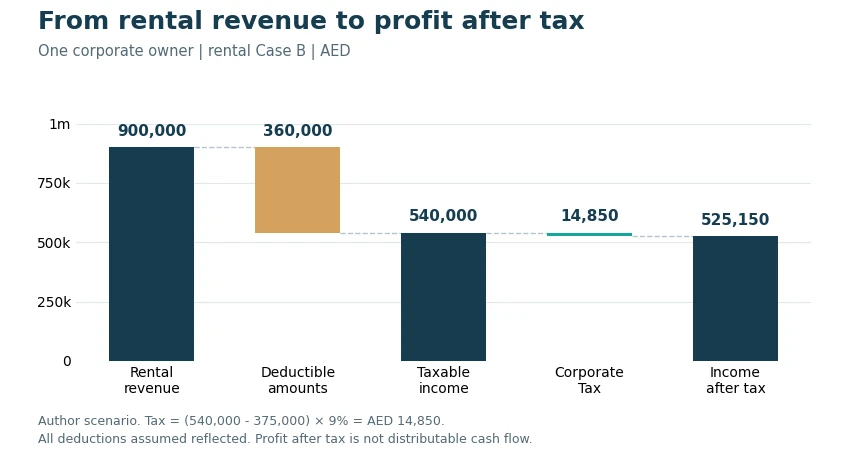
Here is a worked rental comparison for one non-resident corporate owner under ordinary rules. There is no other taxable income, relief or credit. Each deduction figure includes all assumed allowable costs and relevant depreciation, with no further adjustment needed. The figures are examples, not quoted rental returns.
| Annual amount, AED | Case A | Case B | Case C |
|---|---|---|---|
| Rental revenue | 700,000 | 900,000 | 1,100,000 |
| Assumed deductible amounts | 280,000 | 360,000 | 440,000 |
| Taxable income | 420,000 | 540,000 | 660,000 |
| Corporate Tax | 4,050 | 14,850 | 25,650 |
| Taxable income after Corporate Tax | 415,950 | 525,150 | 634,350 |
In Case B, 9% of the AED 900,000 rent would be AED 81,000. The illustrated tax is AED 14,850 because the calculation uses taxable income after assumed deductions and applies the ordinary zero-rate band. Keep the tax calculation separate from cash flow: depreciation, capital spending and loan principal can make the two differ.
VAT depends on what is supplied. The Ministry of Finance VAT overview distinguishes standard-rated commercial sales and leases from residential supplies. The first qualifying supply of a new residential building within three years of completion is zero-rated; later qualifying residential supplies are generally exempt. Residential VAT exemption does not exempt a company’s rental profit from Corporate Tax.
Free zone property has its own distinctions. Commercial Property in a free zone transacted with a Free Zone Person can qualify, subject to the rules; certain other property income is separately taxable. Accommodation is not automatically Commercial Property for this purpose. Read the property provisions in Cabinet Decision No. 100 against the proposed use and tenant.
Accounting choices can matter over the holding period too. Ministerial Decision No. 173 of 2025 provides a conditional depreciation-adjustment election for qualifying investment property held at fair value, including limits and realisation rules. It does not give every company an automatic 4% deduction. Have the adviser model the eventual sale along with the annual accounts.
DDA Real Estate can compare properties and gather the purchase, lease and operating information needed for the tax review. Our guide to commercial property rules in Dubai covers related legal questions. Keep acquisition charges, Corporate Tax and VAT as separate lines when comparing ownership options.
A company can owe no tax and still need to register, keep accounts and file. Record the date it enters the relevant category; the registration deadline can arrive well before the first tax return.
| Category or obligation | General timing |
|---|---|
| UAE company formed on or after 1 March 2024 | Corporate Tax registration within 3 months of incorporation, establishment or recognition |
| Non-resident UAE permanent establishment arising on or after 1 March 2024 | Corporate Tax registration within 6 months of the establishment existing |
| Non-resident property nexus arising on or after 1 March 2024 | Corporate Tax registration within 3 months of the nexus arising |
| Foreign-incorporated company effectively managed and controlled in the UAE from the stated March 2024 category | Corporate Tax registration within 3 months of financial year-end |
| Corporate Tax return and payment | Generally 9 months after the Tax Period ends |
| VAT return and payment | Generally 28 days after the assigned VAT Tax Period ends |
| Corporate Tax records | At least 7 years after the relevant Tax Period ends |
Sources: FTA registration timelines, the Corporate Tax Law as amended and VAT return guidance. The registration examples cover the stated categories from March 2024 onward; earlier cases, special regimes and extensions require their own check.
For a normal 12-month Tax Period ending on 31 December 2026, the general Corporate Tax filing and payment deadline is 30 September 2027. That date does not postpone registration. Use the VAT period assigned to the company rather than assuming VAT follows the annual accounts.
Keep support for related-party fees, interest and rent as the transactions occur. The FTA Transfer Pricing Guide describes the arm’s length framework. A parent-company invoice needs evidence of what was supplied and how the price was set.
Check reporting requirements for the chosen category as well. Ministerial Decision No. 84 of 2025 requires audited financial statements for QFZPs and, among other cases, a non-tax-group taxpayer whose Revenue exceeds AED 50 million. Specified non-resident revenue is assessed through UAE permanent establishments and nexuses. Certain Designated Zone distribution activities also have additional reporting procedures.
Large multinational groups need a separate Domestic Minimum Top-up Tax assessment. The regime targets in-scope groups meeting the EUR 750 million consolidated-revenue test in at least two of the four preceding financial years and seeks a 15% effective minimum under its own calculation. None of the ordinary worked examples above calculates that liability.
Before choosing a structure, ask the adviser for a short written comparison using your actual contracts, expected revenue, costs and proposed property use. Include the tax result, required elections and annual compliance costs. The structure that looks cheaper on its headline rate may require a different operating setup to qualify.
Does foreign ownership change the UAE Corporate Tax rate?
Shareholder nationality does not set the rate. A UAE-incorporated company is generally a resident juridical person. Its income, applicable regime and relief eligibility determine the calculation.
Can an overseas company have obligations without a UAE office?
Yes. Income from UAE immovable property can create a Corporate Tax nexus. A non-resident supplier may also need VAT registration for a UAE taxable supply unless another UAE party is responsible for settling the tax.
Is the first AED 375,000 of sales tax-free?
For ordinary Corporate Tax, AED 375,000 refers to taxable income, not sales. VAT uses the same number for a separate resident-business registration threshold based on taxable supplies and imports.
Does a free zone company automatically qualify for zero tax?
No. Review the QFZP conditions and the classification of its income. In our example, AED 1.2 million of fully Qualifying Income produces zero Corporate Tax; an ordinary free zone taxpayer with AED 1.2 million of taxable income owes AED 74,250 before credits or reliefs.
Is Small Business Relief still limited to 2026?
The Ministry of Finance has announced an extension to eligible Tax Periods ending on or before 31 December 2029. Eligibility, the Revenue test and a valid election still need to be established.
Does exempt residential rent mean the company pays no Corporate Tax?
No. Residential VAT exemption concerns the supply. The corporate owner must separately calculate any attributable taxable income. The personal real estate investment exclusion does not automatically apply to a company.
Buying UAE property through a company? Contact DDA Real Estate with your budget and intended use. We can prepare a property shortlist and help assemble the commercial details for your independent legal and tax advisers before the purchase.