Off-plan properties
Academic reputation usually takes generations. A university publishes, hires, graduates people who do notable things, and forty years later the name means something.
The UAE took a different route. Rather than waiting to build reputations, it imported them. Established universities were invited to open campuses that award the home institution’s degree from the first graduating class.
This guide explains how that model works and what a branch campus degree actually is. It also covers where home-grown institutions now stand on their own, and what all of it means for a student choosing between countries. Programmes and regulations change, so verify current details with the institution.
The UAE hosts one of the largest concentrations of international branch campuses anywhere, and the concentration is deliberate.
Dedicated education free zones were created to host them. A foreign university sets up inside one, operates under its own academic standards, and teaches a curriculum aligned with the home campus.
The free zone structure is what made this possible. It gave foreign institutions a regulatory home they understood and enough independence to protect their own academic governance. The same mechanism that attracted international companies attracted universities — the model is explained in our guide to UAE free zones.
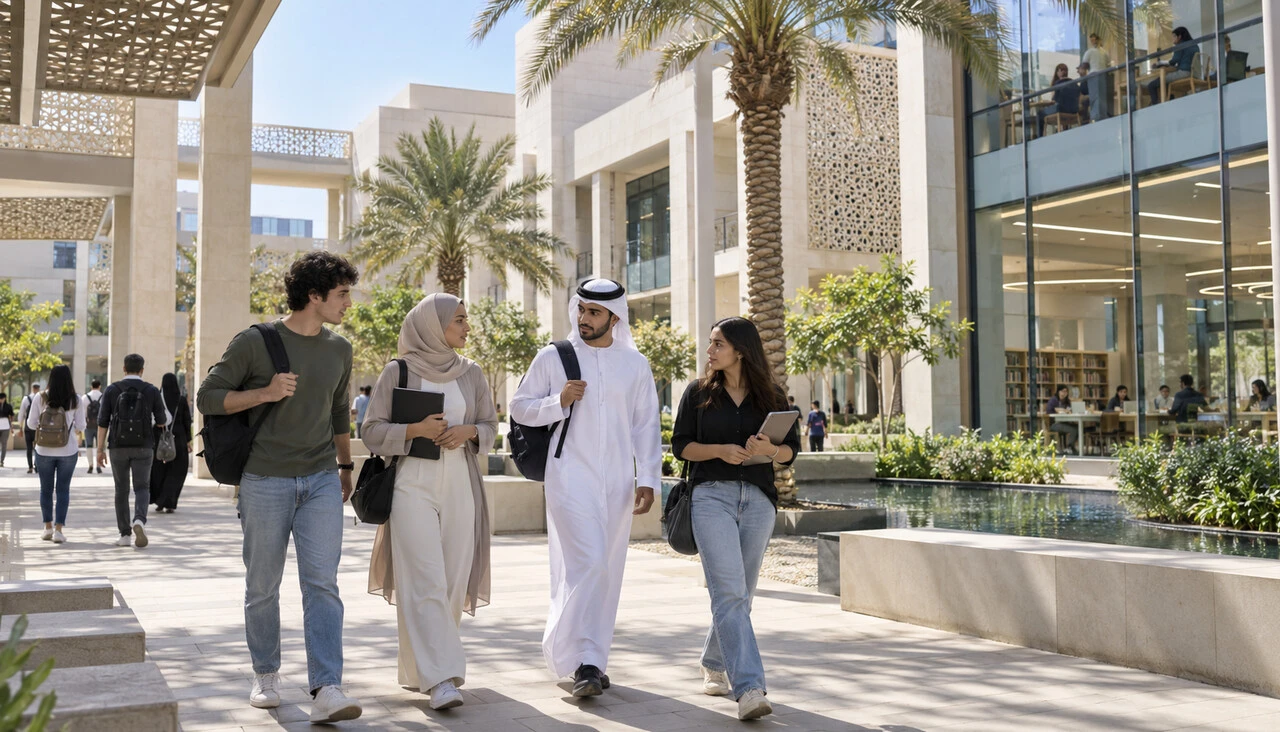
Universities from the United Kingdom, Australia, the United States, France and India all operate campuses here. For students the practical effect is that several national education systems are available in one city.
The question every prospective student asks, and the answer is more straightforward than expected.
The degree is awarded by the home university. A graduate of a British university’s Dubai campus receives that British university’s degree, not a local equivalent.
That is the whole basis of the recognition. The qualification travels because it is the same qualification, issued by an institution whose name was already established long before it arrived here.
Two things still deserve checking. They apply anywhere rather than specifically here:
The more interesting development, and the one that changes the picture over time.
Alongside the imported campuses, domestic universities have been building genuine research capacity. Several now appear in international rankings on their own merits rather than by association.
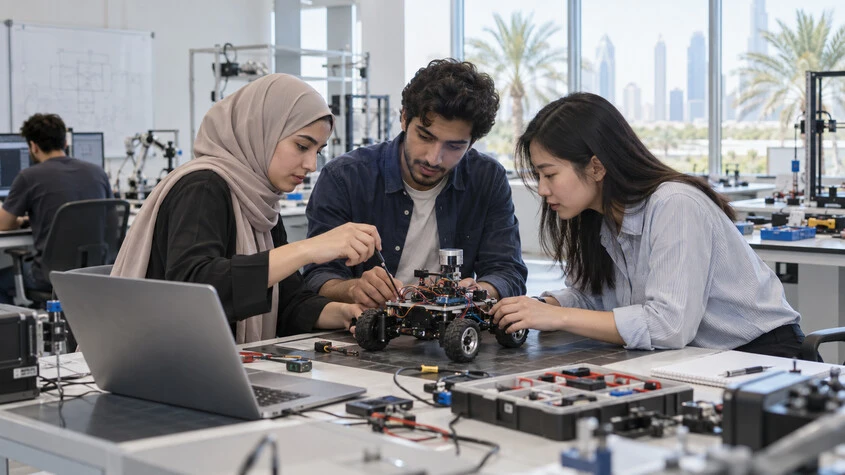
The pattern is specialisation rather than breadth. Rather than trying to be comprehensive, these institutions concentrated on a few fields of strategic interest. Energy, engineering, artificial intelligence, space science and applied technology.
That focus is why recognition is uneven and why an honest answer to «is a UAE degree respected» depends entirely on the subject. In some fields the reputation is now substantial. In others it is still being built.
Worth knowing before choosing, because the answer varies more by field than by institution.
| Field | Position |
|---|---|
| Engineering and energy | Strong, backed by decades of industry and research investment |
| Artificial intelligence and data | Rising fast, with dedicated institutions and funding |
| Business and management | Well served by branch campuses of established schools |
| Space and applied sciences | Growing, supported by national programmes |
| Medicine and health sciences | Developing, with licensing requirements to check separately |
| Humanities and social sciences | Present, with reputation concentrated in a few institutions |
The first two rows reflect national strategy rather than accident. Where the country has invested in an industry, the academic capacity followed, and employers know it. How that investment shows up in everyday life is set out in our overview of innovation in Dubai.
The distinction runs through everything above, and it is worth setting out side by side.
| Branch campus | Domestic institution | |
|---|---|---|
| Who awards the degree | The home university abroad | The institution itself |
| Basis of recognition | Inherited from the home name | Earned through research and outcomes |
| Breadth | Follows the home curriculum | Concentrated in chosen fields |
| Faculty | Mixed, with home-campus oversight | Recruited internationally |
| Best for | A qualification that travels immediately | Specialist fields with strong local investment |
Neither route is superior. They answer different questions, and the right one depends on where you intend to use the degree and in what subject.
Five forces, and they reinforce each other.
The fifth is the one that compounds. A graduate who stays becomes an employer, a researcher or a founder here. That is how an education system stops being an import and starts being an ecosystem.
The professional environment those graduates enter is part of the attraction. The specialist centres are a large component of it, and the financial one is covered in our overview of DIFC.
Four practical advantages, and they are specific rather than general.
You can study for a British, Australian or American degree without living in Britain, Australia or America. For students from the region that means less distance from family, and for everyone it usually means a lower total cost than the home campus.
Teaching is in English across almost all international programmes. That removes the language year that many European destinations require and shortens the whole timeline.
The student body is unusually international, which matters more than it sounds. Graduates leave with a network spread across dozens of countries rather than concentrated in one.
And the city itself is part of the education. Internships in finance, logistics, technology and hospitality are available at a scale that smaller university towns cannot match.
Two practical matters that shape the decision.
Tuition at a branch campus is typically lower than at the home institution, though it varies widely by university and programme. Living costs depend heavily on the emirate and on housing choices, and that is the line students control most.
Students need a residence visa, usually sponsored by the university. It runs for the duration of the programme and is renewed alongside it. The mechanics work like any other residence application here — they are set out in our guide to renewing a UAE visa or residence permit.
Health insurance is mandatory and is generally arranged through the institution. Budget for it as a fixed annual cost rather than an optional extra.
On housing, options run from university accommodation through shared apartments to family housing where a parent relocates. The rental market and what a lease commits you to are covered in our guide to renting in Dubai as an expat.
A route that has widened considerably and is now part of why students choose the country.
Outstanding students and researchers can qualify for long-term residence independent of an employer. Graduates entering the workforce follow the standard employment route, and the local job market actively recruits from the universities here.
The combination is what distinguishes the proposition. In many study destinations a degree is followed by a visa problem. Here the pathways are designed to retain graduates, because retaining them is the point of the investment.
For families thinking several years ahead, that changes the arithmetic. A student who is likely to stay makes a property purchase a more reasonable proposition than a three-year rental commitment — the long view is set out in our guide to buying a home in the UAE.
Eight checks. All are answerable by email and all are worth doing.
The last one is the most informative and the least often requested. Universities track it, and a programme confident in its outcomes will share the data.
Recognition here is real, and it is uneven. Both things are true.
A degree from a branch campus of an established university carries that university’s name and travels accordingly. That is not a claim about the UAE; it is a fact about who issues the parchment.
For home-grown institutions the position is field-specific. In engineering, energy and artificial intelligence the reputation is substantial and improving quickly. In fields where the country has not concentrated investment, it is earlier in the process.
The direction of travel is not in question. Research output, faculty quality and international standing have all risen, and the funding behind them is sustained rather than episodic. The sensible approach for a student is to check the specific programme rather than the country.
Are UAE degrees recognised internationally?
Branch campus degrees are awarded by the home university and carry its recognition. For domestic institutions it depends on the field, with engineering, energy and artificial intelligence the strongest.
Is a branch campus degree the same as the home one?
The award comes from the home institution. Confirm at programme level that the accreditation and the wording of the qualification match what you expect.
Is teaching in English?
At almost all international programmes, yes. That removes the preparatory language year that several European destinations require.
Is it cheaper than studying at the home campus?
Tuition is typically lower, though it varies by institution and programme. Living costs depend on the emirate and on housing, which is where students have the most control.
Do I need a visa?
Yes, a student residence visa, usually sponsored by the university and renewed alongside the programme. Health insurance is mandatory and normally arranged through the institution.
Can I stay after graduating?
Yes. Outstanding students and researchers can qualify for long-term residence, and graduates entering employment follow the standard route. Retention is a deliberate part of the policy.
Will my degree let me practise medicine or law back home?
Recognition of a degree and a professional licence are different things everywhere. Establish the licensing route in your intended country before enrolling, not after graduating.
Families usually arrive with a rental plan and a three-year horizon. Then the student finds an internship, the internship becomes a job, and a sibling applies to the same university. At that point the question is no longer where to rent for the course but whether the family should have a base here at all. DDA Real Estate is a real estate agency in the UAE. We work across Dubai, Abu Dhabi, Sharjah and the northern emirates, including the districts around the university campuses.
Explore our listings in the UAE and get in touch: tell us which campus and how long you expect to be here. We will show what works for the first year and what makes sense if the stay turns into something longer.