Emergency Contacts in Thailand 2026
66 2 026-1660
day and night
Thailand
EN
$
ft²
Other articles

Emergency Contacts Every Expat Should Save: Police, Hospitals, Embassy & More

Timur Ikhsanov The author of the article, the Broker
#Blog DDA
16 July 1071 view

Most countries give you one number to remember. Europe has 112, the Commonwealth has 999, the United States has 911. Thailand has none of these as a single front door — it runs a network of dedicated lines instead, and the first thing an emergency asks of you is which one to dial.

That would be a minor inconvenience if the lines differed only by the nature of the incident. In practice the deciding factor is usually language: the line that covers your situation and the line where somebody will understand you are frequently not the same number, and working that out at two in the morning is not the moment to start.

What follows is the list worth saving before anything happens, the logic for choosing between the lines, and the three contacts almost nobody adds until after the first incident. Response times, costs and hospital arrangements vary by province and by provider, so treat the figures as orientation and confirm the specifics that apply to your address and your policy.

The numbers, and what each one is actually for

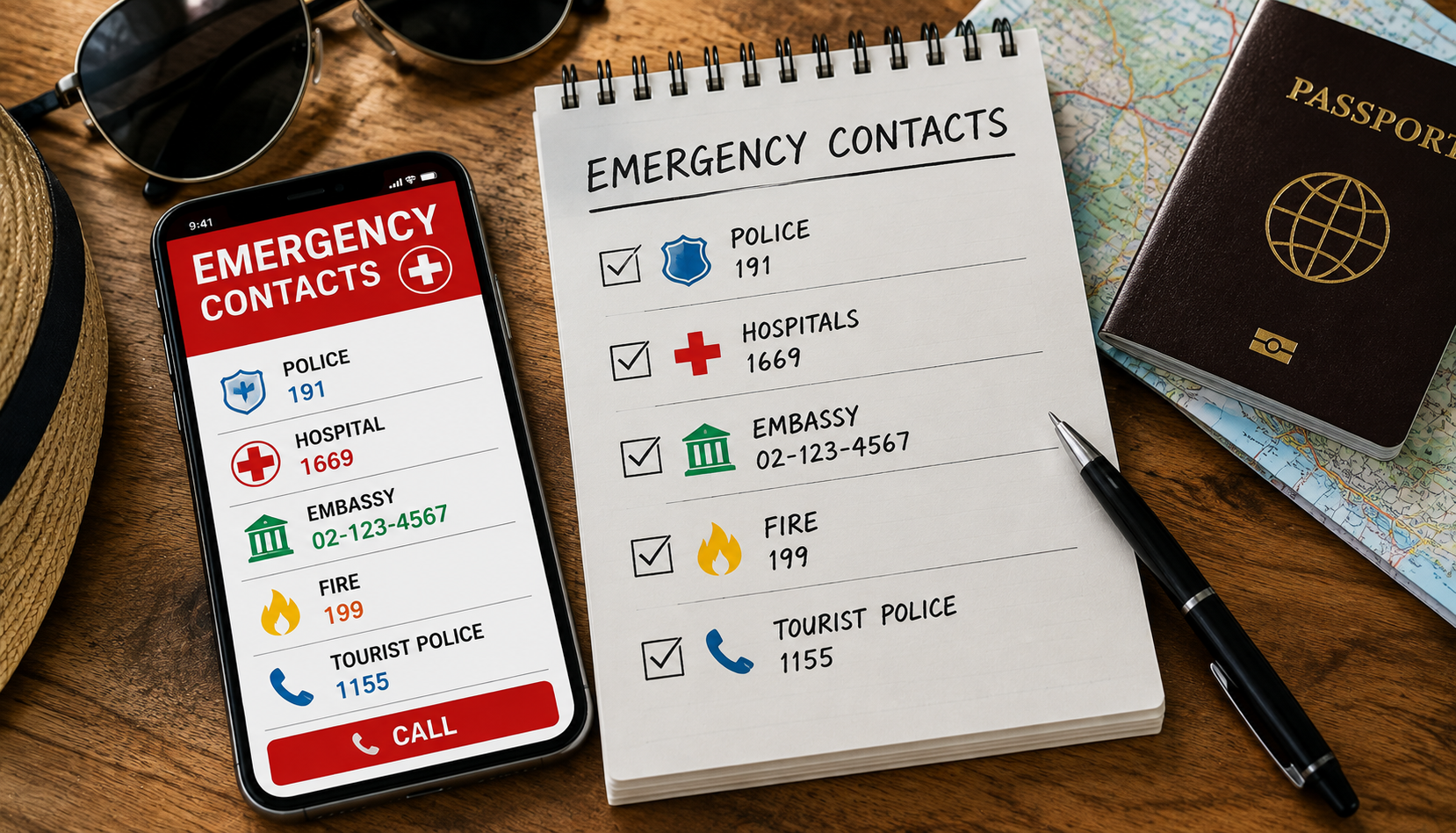
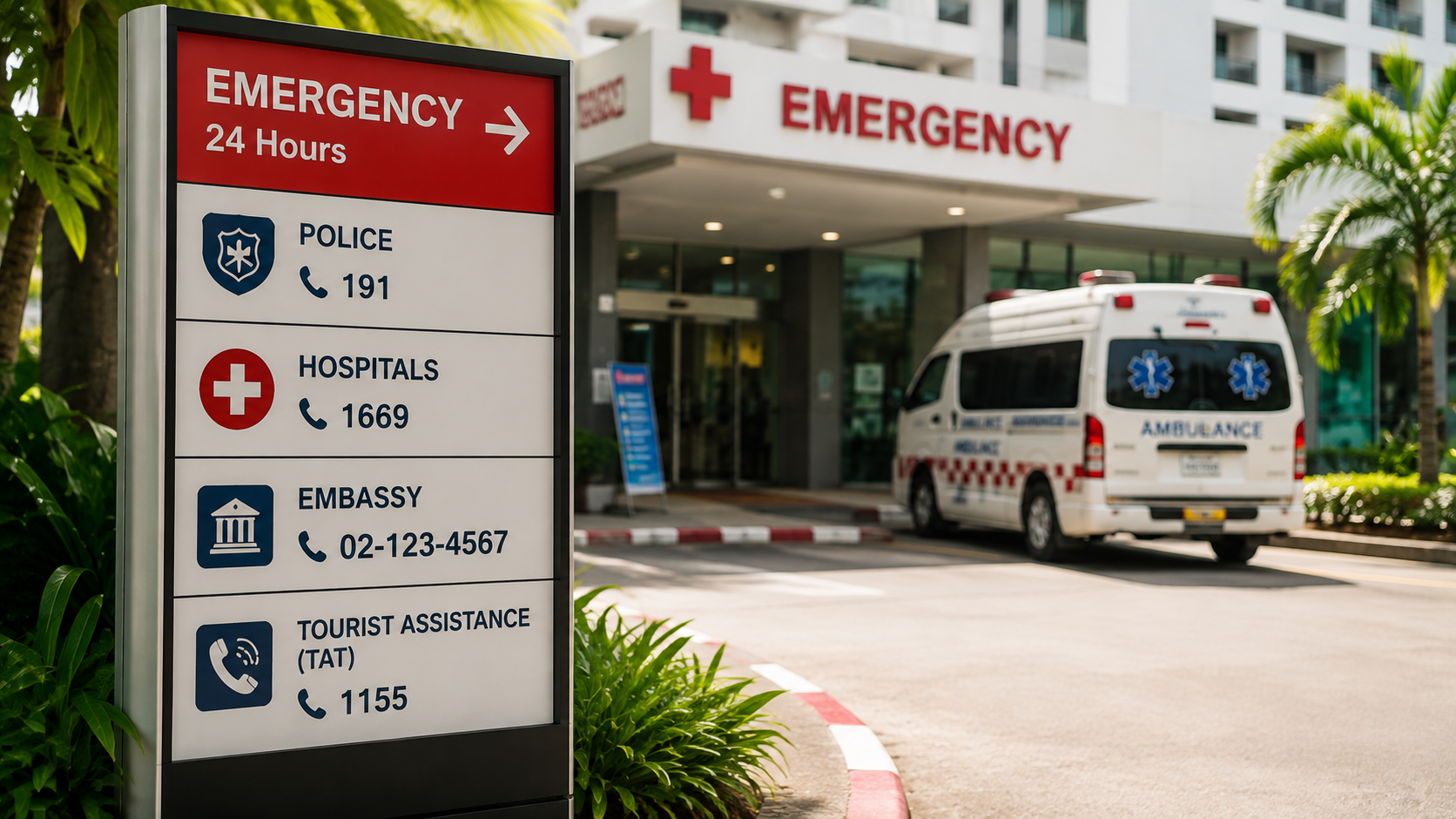
Save all of these before you need them, labelled clearly enough that somebody else holding your phone can find the right one. Emergency lines are reached without credit, and 911 was added in 2015 precisely because foreigners reach for it by reflex.

NumberWhat it coversEnglish
191Police and general emergencies, the closest thing to a catch-allNot guaranteed, especially outside Bangkok
1155Tourist police, 24 hours, also +66 2308-0333Yes, plus other languages
1669National emergency medical service, free public ambulanceLimited
199Fire and rescueLimited
1193Highway police, for incidents on intercity roadsLimited
1784Disaster prevention and mitigationLimited
1554General ambulance and rescue servicesLimited
1111Government complaints and procedural questionsLimited

A mental health line operates on 1323. It belongs in the same list for the same reason as the others: the moment somebody needs it is not the moment to go looking for it.

The language rule that changes everything

Here is the single most useful piece of local knowledge in this article. If you call 191 and cannot make yourself understood, hang up and call 1155. The tourist police will translate and dispatch on your behalf, which makes that line the English-language front door to the entire emergency system rather than a niche service for holidaymakers.

Long-term residents often skip 1155 on the assumption that it is meant for tourists and that a resident should be using the ordinary channels. That instinct costs minutes. The dispatcher on 191 may be excellent at their job and still unable to take your address; the operator on 1155 will take it and pass it on. Use whichever line gets the information across fastest, and worry about the correct channel afterwards.

The ambulance decision is genuinely three-way

In most countries this is not a decision at all. In Thailand you are choosing between a free public service, a paid private one and your own car, and the right answer depends on what is wrong and where exactly you live.

  • Public ambulance on 1669 — free and competent, with roughly ten to fifteen minutes typical in cities and half an hour or more in rural areas; the variable that matters is micro-location, since an address off a main road is reached far faster than one deep down a narrow soi
  • Private ambulance on 1724 or 1719 in Bangkok — more expensive, generally faster, and they take you directly to a private hospital; local guidance is blunt that if you carry insurance these are the numbers to use
  • Your own vehicle — often the fastest option for serious but movable cases, because an ambulance sits in the same traffic you would; the exceptions are suspected spinal injury, chest pain and loss of consciousness, where moving the patient yourself is the wrong call

The decision is made in advance, not during the incident. Work out now whether an ambulance can physically reach your door or whether somebody has to meet it at the mouth of the lane, and whether the nearest hospital that would actually treat you is the one five minutes away or the one across town.

Emergency treatment is not free

This is where expectations imported from home do the most damage. Foreign nationals are charged for emergency treatment in Thailand — visitors and most residents alike — which turns insurance from a sensible precaution into a structural part of living here. A serious admission at a private hospital is not a bill anyone absorbs comfortably out of savings.

The private hospitals foreign residents use are well established and run twenty-four-hour emergency departments with English-speaking staff: Bangkok Hospital, Bumrungrad, Samitivej and BNH among them. Larger facilities have helipads, and air ambulance services exist for cases that need moving between provinces or out of the country.

The direct billing question

One question separates a manageable medical emergency from a financially brutal one, and it has nothing to do with the treatment. Find out which private hospital near you has a direct billing arrangement with your insurer. Where one exists you present a card and the hospital settles with the insurer. Where it does not, you pay up front for a serious admission and reclaim afterwards, with the same medicine and an entirely different experience. What to establish while nothing is wrong:

  • Ask your insurer for the list of direct billing hospitals within reach of your address, not the national list
  • Confirm whether the arrangement covers emergency admission or only planned treatment, since the two are sometimes handled separately
  • Check whether the policy covers emergency evacuation, which is a different clause from ordinary treatment cover
  • Save the policy number beside the insurer's emergency line rather than in a folder at home
  • Re-check after any renewal, because hospital networks change between policy years

The three contacts nobody saves

Everybody eventually saves the ambulance number. These three are the ones people add after the first incident rather than before it, and each of them does something no emergency line can.

  • Your insurer's assistance line — the line that authorises treatment and evacuation, useless if the policy number sits in an email you cannot open from a hospital corridor
  • Your embassy's out-of-hours number — a different line from the switchboard, and the only one that answers on a Sunday night for a lost passport, a death in the family or an arrest
  • The building's juristic person office — the genuine first responder for fire, flooding, power failure and security, holding keys and access no external service has, which is one of the reasons how a condominium is actually run matters as much as the unit itself

For a rented house the landlord or the estate management takes the place of the juristic person office, and the practical test is the same: is there a number that answers at three in the morning, and does the person on the end of it have access to the property.

Your address is part of your emergency plan

Two apartments at the same price can have completely different emergency profiles. Distance to a hospital with a proper emergency department varies enormously between provinces and even between districts of the same island, and so does how quickly a vehicle can physically reach your door.

This belongs on the checklist before signing, not after. It is one of the quieter arguments in favour of thinking carefully about which part of the country you settle in, alongside the usual questions of price and rental demand. A view is worth a great deal less than twenty minutes saved on the way to an emergency department. The questions worth asking about any address you are considering:

  • How far is the nearest hospital with a twenty-four-hour emergency department, measured in traffic rather than kilometres
  • Is it a facility your insurer works with, or would you be paying up front
  • Can an ambulance enter your soi, your estate or your building's parking level
  • Does the building have a manned desk overnight, or does the entrance lock at midnight
  • Where is the nearest police station and the nearest pharmacy open late

Preparation that actually helps

The failures in a Thai emergency are rarely medical. They are communication failures, and almost all of them are solved with about twenty minutes of preparation on an ordinary afternoon.

  • A screenshot of your address in Thai script — thirty seconds of showing a screen beats two minutes of spelling a transliteration to a dispatcher
  • A landmark, not just a soi number — soi numbering confuses local drivers too, and a temple, a school or a well-known shopfront is understood immediately
  • Your passport within reach — hospitals register patients against it, and an admission without it starts with an argument
  • Clearly labelled contacts — a stranger holding your unlocked phone should be able to find the right person without knowing your naming habits
  • One person who knows where you are — a neighbour, a colleague or the building desk; this matters far more in a house than in a serviced building with a reception

What insurance costs against what it prevents

Health cover is one of the fixed lines in a monthly budget here, and it is the line people trim first because nothing has happened yet. That reasoning holds right up until the moment it does not, and the sums involved are asymmetric: a year of premiums against a single admission is rarely a close comparison.

It is worth seeing that premium beside the rest of what a month in Thailand actually costs, because in context it is a smaller share of the total than most newcomers assume. The policy features that matter in an emergency are not the ones marketing leads with — direct billing near your address, emergency evacuation, and a clear position on pre-existing conditions decide far more than the headline coverage figure.

Questions we hear most

Does 911 work in Thailand?

Yes. It was added in 2015 because foreign visitors dial it instinctively. It works, but 1155 is still the better call when language is likely to be the obstacle, because the operator there is expecting to speak English.

Is the free ambulance worse than a private one?

Not in competence. The differences are response time, which depends heavily on how accessible your address is, and destination: a private ambulance takes you to a private hospital. If you hold insurance that works with a private hospital, the private service usually gets you to the right place rather than merely to a place.

Will a hospital treat me before payment?

Emergency departments stabilise first. What follows depends on your insurer arrangement: with direct billing the hospital settles with the insurer, without it you are asked for payment or a deposit before admission. This is the single argument for sorting out the arrangement in advance.

Do I need to speak Thai to handle an emergency?

No, but you need a route to somebody who does. That route is 1155 for emergency services, an English-speaking private hospital for medical care, and a screenshot of your address in Thai script for everyone else, including taxi drivers.

What does the embassy actually do?

It issues emergency travel documents, contacts your family, provides lists of lawyers and doctors and visits nationals in detention. It does not pay medical bills, post bail or intervene in Thai legal proceedings. Knowing that boundary in advance prevents a great deal of misplaced expectation.

Key takeaways

  • There is no single number — 191 is the closest to a catch-all, but the line you need depends on the incident and on who can understand you
  • 1155 is the English front door — if 191 stalls on language, hang up and call it; the tourist police translate and dispatch
  • The ambulance is a choice, not a default — public, private or your own car, decided by the condition and by how reachable your address is
  • Treatment is charged — insurance is structural here, and direct billing near your address is the clause that matters most
  • Your address is part of the plan — hospital distance in traffic and vehicle access to your door belong on the checklist before you sign

How far is your address from a hospital?

DDA Real Estate is a real estate agency working in Thailand, and this is one of the questions we answer for buyers and long-term tenants far more often than the brochures suggest. When we shortlist a property we look at the practical layer alongside the price: real driving time to the nearest hospital with a full emergency department, whether an ambulance or a fire vehicle can reach the entrance, whether the building keeps a manned desk overnight, and how the juristic person office actually handles incidents. We work across Phuket, Bangkok, Pattaya, Hua Hin and Samui, from condominium units to standalone villas.

Look at our offers in Thailand and leave a request: we will shortlist properties that match your budget and your requirements, tell you what the access and emergency picture looks like at each address, and be straightforward about the ones where a beautiful location sits at the end of a lane no vehicle can turn into.

Popular
5 June 4152141 view
Dubai Rent Prices 2025: Average Apartment Rental Costs in Dubai Dubai's rental market continues its upward climb in 2025, driven by population growth and limited new supply, pushing average prices up by 10%
#Blog DDA
2 July 2382282 view
DLD Fees in Dubai: Everything You Need to Know Buying property in Dubai? Don't let hidden fees surprise you! Our essential guide breaks down ALL Dubai Land Department (DLD) fees
#Blog DDA
23 November 1710198 views
How to Buy a SIM Card in Turkey in 2026: Prices, IMEI Registration, eSIM Options, and Best Mobile Operators Overview of mobile operators, available types of SIM cards, and home Internet providers
#Blog DDA
5 July 1702512 views
How Much is the Real Estate Agent Commission in Dubai? Find out how much real estate agent commission costs when buying property in Dubai.
#Blog DDA
5 February 1394568 views
How Foreigners Can Own Property in Bali: Understanding PT PMA (2025) Foreigners can't own freehold land in Bali, but a PT PMA (foreign-owned company) allows secure property ownership under Hak Guna Bangunan (HGB) or Hak Pakai (HP) rights
#Blog DDA
28 August 1145844 view
Oqood vs Title Deed in Dubai: Key Differences You Must Know Buying property off-plan in Dubai? Oqood registration is mandatory to secure your ownership rights.
#Blog DDA