

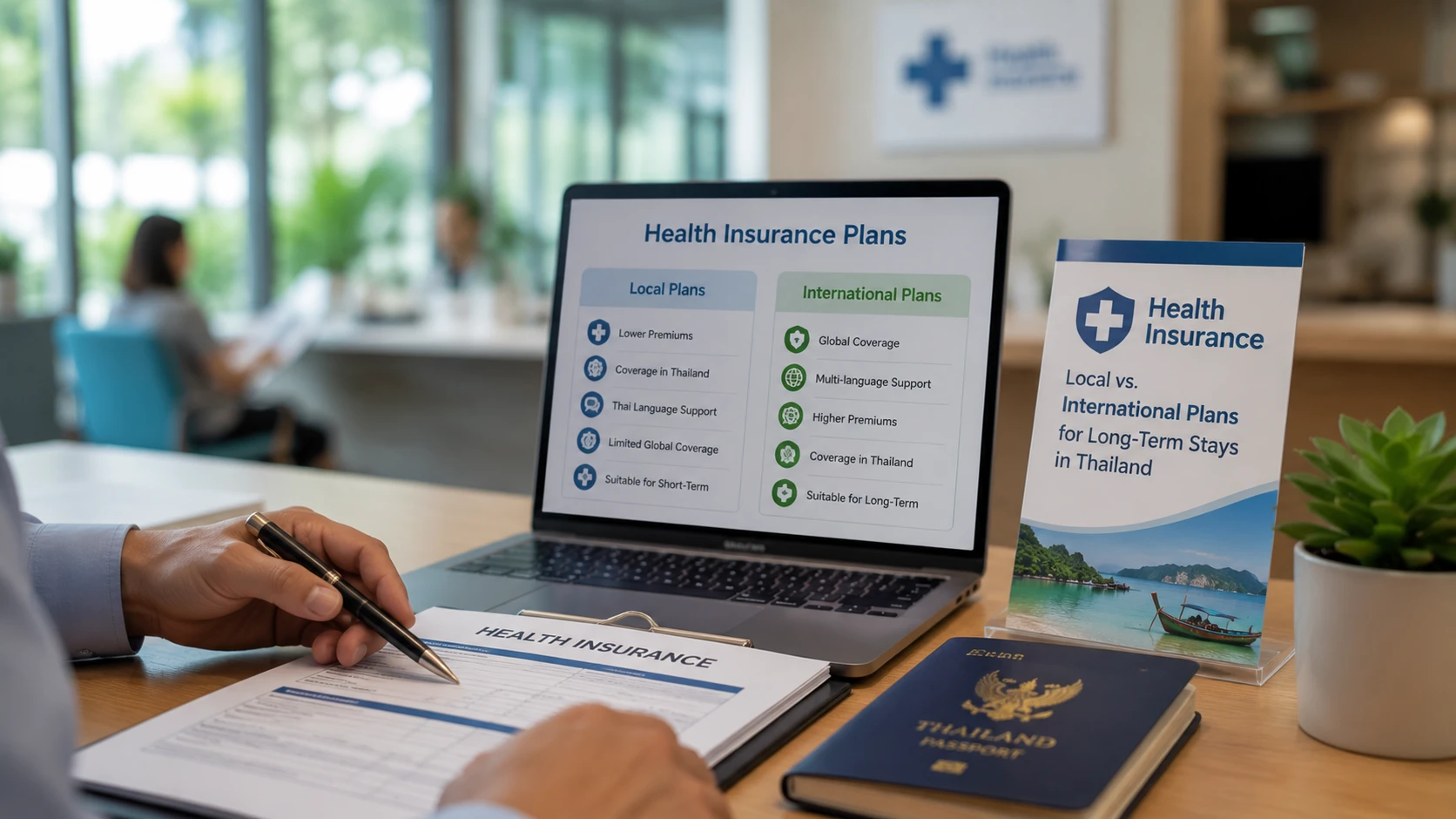

Health Insurance in Thailand: Local vs International for Expats
66 2 026-1660
day and night
Thailand
EN
$
ft²
Other articles

Health Insurance in Thailand: Local vs. International Plans for Long-Term Stays

#Blog DDA
7 May 6615 views

For a long-term stay in Thailand, health insurance does two jobs at once. It is a legal requirement for several visas, and it is the only thing standing between you and the full cost of private care in a country where foreigners have no access to public healthcare. Thai private hospitals are genuinely world-class, but they price like it: a serious admission can run from a few thousand dollars to well past fifty thousand, and bills are usually settled before you are discharged. On top of that, medical costs are climbing fast — WTW's 2026 Global Medical Trends report puts Asia-Pacific medical inflation near 14% for the year, which compounds hard over a multi-year stay. The central decision is local Thai plan versus international plan, and the right answer depends on your visa, your age, your budget and where you expect to be treated. This guide goes through what care actually costs, the visa rules, both kinds of plan, the claims mechanics that catch people out, and how to match a policy to your situation.

Why Insurance Matters: No Free Ride in Thai Healthcare

Thailand's Universal Coverage Scheme pays for healthcare for Thai citizens and eligible residents, but foreigners do not automatically qualify. The one real exception is being employed on a work permit: through the Social Security system (Section 33), you and your employer each contribute 5% of salary, capped at a 15,000 THB salary ceiling, so the maximum is 750 THB a month from each side. That buys access to one designated hospital — useful and cheap, but basic, tied to a single facility, and mostly relevant if you are working in Thailand on a Non-B visa. Everyone else pays out of pocket.

Public hospitals will treat foreigners at "foreigner rates" that are still far below private prices, but the trade-offs are real: waits of four to eight hours are common, English can be limited, and facilities are basic. That is why an estimated 95% of foreign patients use private hospitals — and why the price gap matters so much. A basic blood test that costs around 300 THB in a public hospital can be 2,000 to 8,000 THB at a flagship like Bumrungrad. The comfort, the English-speaking staff and the fifteen-minute wait are part of what you pay for, and it adds up quickly.

What Treatment Actually Costs

The case for insurance is easiest to see in real numbers. The figures below are indicative private-hospital costs; government hospitals are far cheaper, and premium Bangkok hospitals sit at the top of each range.

Service or procedureIndicative private-hospital cost
Emergency-room visit (consultation)2,000–5,000 THB ($55–140); $200–500+ with tests and X-rays
Specialist consultation2,000–6,000 THB
Standard private room, per night3,000–12,000 THB (mid-tier to premium)
Intensive care, per nightFrom ~25,000 THB, up to ~100,000 THB
Appendectomy120,000–350,000 THB ($3,400–9,800); double with complications
Cardiac event (surgery, ICU, rehab)$15,000–56,000+
Hip replacementImplant $3,000–8,000 plus fees and 5–10 days
Normal birth / C-section~63,000 THB / ~94,000 THB
Medical evacuation~350,000 THB within Thailand; $50,000–150,000 international

Then factor in inflation. If Asia-Pacific medical costs keep rising at around 14% a year, a 300,000 THB procedure today would cost roughly 575,000 THB in five years. For a long stay, that means two things: the limit that looks generous when you sign up will buy less every year, and premiums on every plan tend to rise at renewal — which is exactly why locking in coverage early, while you are younger and healthier, matters so much.

Thailand's Private Hospitals: The Landscape

Thai private care is concentrated in a few large networks. Bangkok Dusit Medical Services (BDMS) runs around 60 hospitals and over 9,000 beds nationwide, with JCI-accredited flagships in Bangkok, Phuket, Chiang Mai, Pattaya, Hua Hin and Koh Samui. Bumrungrad International is the most recognised name globally — it treated more than 600,000 patients from over 180 countries in 2025 and was the only Thai hospital in Newsweek's World's Best Hospitals 2026 top 100. Samitivej, MedPark and BNH compete at the same tertiary level. At equivalent quality, Thai private care runs roughly 30 to 50% below Singapore and around 70% below comparable Western hospitals, and the genuine capability gap is now limited to a few ultra-specialised procedures such as proton therapy and certain transplants.

The practical point for insurance is that hospital access tracks location. The big expat hubs — Bangkok, plus Phuket and its BDMS flagship, Pattaya, Hua Hin and Chiang Mai — put international-standard care within easy reach, while quieter towns and islands can mean a long transfer for anything serious. That should shape both your plan (does it cover evacuation?) and where you choose to live.

When Insurance Is Mandatory: The Visa Rules

For several long-stay visas, insurance is not optional, and a policy that is "approved" for your visa is not the same as one that is genuinely good — it simply clears the immigration minimum.

VisaInsurance requirement
Retirement O-A / O-XRequired, from an OIC-approved Thai insurer for extensions; minimum 400,000 THB inpatient + 40,000 THB outpatient (O-A often raised to ~3,000,000 THB / USD 100,000 incl. COVID — verify by embassy)
LTR (10-year)Required: at least USD 50,000 cover, or Thai social security, or a USD 100,000 deposit; international plans accepted
Non-O (retirement/marriage)Not legally required, but some officers ask for it at extension
Elite / PrivilegeNot required, but strongly recommended
Work (Non-B)Not mandated by immigration; Social Security or employer cover applies

Two rules cut through the detail. First, if insurance was required to obtain your visa, you must keep it to extend the visa inside Thailand — and for O-A and O-X extensions, only a Thai OIC-approved insurer counts, so an international policy, however generous, will not satisfy the counter. (Applicants also submit a signed, stamped Foreign Insurance Certificate; approved Thai plans appear on the TGIA long-stay list.) Second, requirements vary by embassy and change over time, so confirm the current figures with the consulate handling your application. A common trap deserves its own mention: if you move from a work permit to a retirement visa, your Section 33 cover ends the day your employment does, and you need a private policy in place before your O-A or O-X extension falls due — many people are caught uninsured in that gap.

Local Thai Plans

Local insurers are built for this market and dominate visa-compliance cover. They are cheaper, quick to issue, OIC-approved (so they satisfy O-A and O-X extensions), and several offer products designed specifically for retirement visas. Luma's Long Stay Care, for instance, targets O-A holders, accepts applicants up to 80 with no health check above 70, and can come in under 20,000 THB a year. AXA's EasyCare Visa is TGIA-listed for long-stay and LTR visas, takes new applicants up to 80 and renews to 99 with no medical check, pays up to 4,000,000 THB per disability with cashless service at 400-plus hospitals. Pacific Cross, a Thailand-based insurer of 50-plus years, is known for value and accepts applicants up to 75, renewing well beyond.

The trade-offs are equally real. Deductibles can be high — sometimes 200,000 THB or more — overall limits are lower (often around 3,000,000 THB), cover is usually valid only inside Thailand, pre-existing conditions are typically excluded, and many local insurers stop accepting new applicants at 60. For someone whose life is firmly in Thailand and who mainly needs to meet a visa rule affordably, a local plan is often the sensible choice; for a major event, those lower limits can fall short.

International Plans

International insurers sit at the other end of the spectrum. Limits are far higher — commonly up to 35,000,000 THB or more — cover is typically worldwide (often excluding the USA), so you can be treated at home as well as in Bangkok, and the plans are more stable and tightly regulated. Cigna Global, as one example, covers the full top-tier Thai network, offers add-on modules for outpatient, dental and vision, wellness and international evacuation, allows deductibles up to USD 10,000 and a cost-share option to trim premiums, applies no financial limit to cancer treatment, uses full medical underwriting (so pre-existing conditions are assessed upfront rather than quietly excluded later), and sets no upper age limit for new enrolment. Allianz Care, AXA Global, Bupa, IMG and William Russell occupy similar ground with different structures.

These plans also satisfy LTR and SMART visa requirements. The catches are cost — noticeably higher, especially past 60 — and one structural limit: an international policy does not meet O-A or O-X extension requirements inside Thailand, where an approved Thai insurer is mandatory. International cover suits those who want high limits, treatment flexibility across borders, robust pre-existing handling, or who split their year between countries.

Direct Billing and Claims: The Detail That Bites

How a plan pays is almost as important as how much it covers. Thai private hospitals usually require full payment before discharge, so the question is whether your insurer settles the bill directly. The major networks — Bumrungrad, BDMS, MedPark, BNH and Samitivej — hold direct-billing arrangements with international insurers, which means no deposit, no upfront cash and no waiting to be repaid. Public hospitals almost never do. Where there is no direct billing, you pay first and claim back: reimbursement typically takes two to four weeks digitally and up to 45 days on paper, with a denial rate around 15 to 20%, driven by Thai-language invoices, coding mismatches and pre-existing disputes. The lesson is simple — before buying any plan, confirm that the hospital you would actually use is in its direct-billing network, and favour a policy with a guarantee of payment over one that only reimburses.

Local vs. International, Side by Side

FactorLocal Thai planInternational plan
CostLower (from under 20,000 THB/yr)Higher (about USD 80 to 500+/month)
Coverage limitsLower (often around 3M THB)High (up to 35M THB or more)
Geographic coverThailand onlyWorldwide (often excluding USA)
Visa complianceOIC-approved; valid for O-A/O-XAccepted for LTR/SMART, not O-A/O-X extensions
Pre-existing conditionsUsually excludedOften covered after underwriting
DeductiblesOften high (up to 200,000 THB)Flexible, frequently lower
Age limitsMany stop at 60; some to 75–80Generally higher or no cap
Best forVisa compliance, Thailand-based lifeComprehensive cover, treatment abroad

What It Costs: Premiums by Age

Premiums move with age, health history and how much cover you buy above the visa minimum. The ranges below are indicative; remember that renewals tend to rise each year as medical inflation feeds through.

ProfileLocal visa-compliantInternational plan
Under 50, healthyFrom under 20,000 THB/yrFrom about USD 80/month
Around 60, healthy~20,000–60,000 THB/yrOften USD 200–400+/month
70+ or medical history100,000 THB+, if availableUSD 500+/month, full underwriting

Two cost levers matter beyond the headline number: the deductible (a cheap local premium often hides a large excess) and a cost-share or higher deductible on international plans, which can bring the price down without cutting the core ceiling. Health cover is a real line in any long-stay budget — our guide to the cost of living in Pattaya sets it alongside rent, utilities and everyday spending.

Matching the Plan to the Person

The same rules point to very different answers depending on who is asking.

The 35-year-old remote worker (DTV or LTR)

Young and healthy, not tied to an O-A insurer, and possibly travelling: an international mid-tier plan with worldwide-excluding-USA cover and a moderate deductible usually wins, and it satisfies the LTR's USD 50,000 threshold. Check the Bangkok direct-billing network before buying.

The 52-year-old couple splitting time between countries

With time spent both in Thailand and at home, an international plan that covers treatment in both places is the natural fit, and full medical underwriting now means any minor condition is assessed openly rather than disputed at claim time.

The 65-year-old retiree on an O-A visa

Compliance comes first: the extension requires an OIC-approved Thai insurer, so a Luma, AXA or Pacific Cross long-stay plan is the baseline. Enrol before the age caps bite, and consider topping up limits or adding an international layer, because the base policy's ceiling can look thin against a serious cardiac or cancer bill.

The family on a work permit

Section 33 covers the basics at one designated hospital, but most working families add private cover for choice of hospital and shorter waits; an employer group plan, where offered, can be the most cost-effective top-up.

How to Choose

Work through it in order. First, visa compliance: if your visa mandates cover, that decides the shortlist before preference does. Second, age — the unforgiving factor, because most insurers close new enrolment at 70 to 80 while letting earlier members renew for life, so applying before the cutoff protects your options for decades. Third, pre-existing conditions, which local visa plans usually exclude and international plans may cover after underwriting. Fourth, where you expect to be treated — Thailand only, or also at home. And fifth, where you will actually live, because the area you settle in shapes your access to top hospitals: Bangkok, Hua Hin, Phuket and Pattaya have international-standard care close by, whereas quieter spots and islands such as Koh Phangan can mean a longer trip to serious treatment — a reason to value evacuation cover and to weigh plan and place together.

Common Mistakes to Avoid

A handful of errors come up again and again. Buying a policy that is approved but not actually adequate — meeting the visa minimum while leaving you exposed in a real emergency. Leaving enrolment too late and finding that, past 70 or 75, no approved insurer will take a new applicant. Relying on travel insurance for what is really a long-term stay. Chasing a low premium without reading the deductible behind it. Ignoring whether your hospital is in the plan's direct-billing network, then having to pay tens of thousands of baht up front. Falling into the work-permit-to-retirement gap when Section 33 ends. And under-insuring against inflation, so a limit that looked comfortable at signup quietly erodes year after year.

Frequently Asked Questions

Is health insurance mandatory in Thailand?

Only for certain visas (O-A, O-X and LTR). For others it is optional but strongly advised, since foreigners have no access to public healthcare.

Does an international plan satisfy a retirement visa?

For LTR and SMART visas, yes; but O-A and O-X extensions inside Thailand require a policy from an OIC-approved Thai insurer.

Local or international — which is cheaper?

Local plans are cheaper and meet visa minimums; international plans cost more but offer far higher limits and worldwide cover.

What cover do O-A and O-X visas require?

Commonly 400,000 THB inpatient plus 40,000 THB outpatient; the O-A is often raised to around 3,000,000 THB (USD 100,000) including COVID, so verify with your embassy.

Is there an age limit?

Many local insurers stop new enrolment at 60 to 80, and renewals usually continue if you joined earlier, so it pays to apply before the cutoff; some international plans have no upper limit.

Are pre-existing conditions covered?

They are usually excluded on local visa plans; international plans often cover them after medical underwriting.

What does treatment cost without insurance?

An ER visit is $55–140 before tests, an appendectomy $3,400–9,800 at a private hospital, and a cardiac event with ICU can exceed $50,000.

Will my plan pay the hospital directly?

Only if the hospital is in your insurer's direct-billing network; otherwise you pay first and claim back, so confirm the network before buying.

Planning the Whole Move, Not Just the Policy

Health insurance rarely stands alone. For most people it is one piece of a larger relocation that also involves the right visa, where to live and, often, buying or leasing a home. The pieces interact: the visa drives the insurance, the location drives healthcare access, and the property anchors the whole plan. DDA Real Estate helps clients put that picture together — matching a property and area to your long-stay goals and aligning the purchase with the right visa, then connecting you with trusted insurance and legal partners for the rest. Talk to us to plan a move to Thailand where the lifestyle and the paperwork both work.

Popular
5 June 4152141 view
Dubai Rent Prices 2025: Average Apartment Rental Costs in Dubai Dubai's rental market continues its upward climb in 2025, driven by population growth and limited new supply, pushing average prices up by 10%

#Blog DDA
2 July 2382282 view
DLD Fees in Dubai: Everything You Need to Know Buying property in Dubai? Don't let hidden fees surprise you! Our essential guide breaks down ALL Dubai Land Department (DLD) fees
#Blog DDA
23 November 1710198 views
How to Buy a SIM Card in Turkey in 2026: Prices, IMEI Registration, eSIM Options, and Best Mobile Operators Overview of mobile operators, available types of SIM cards, and home Internet providers
#Blog DDA
5 July 1702512 views
How Much is the Real Estate Agent Commission in Dubai? Find out how much real estate agent commission costs when buying property in Dubai.
#Blog DDA
5 February 1394568 views
How Foreigners Can Own Property in Bali: Understanding PT PMA (2025) Foreigners can't own freehold land in Bali, but a PT PMA (foreign-owned company) allows secure property ownership under Hak Guna Bangunan (HGB) or Hak Pakai (HP) rights
#Blog DDA
28 August 1145844 view
Oqood vs Title Deed in Dubai: Key Differences You Must Know Buying property off-plan in Dubai? Oqood registration is mandatory to secure your ownership rights.
#Blog DDA