
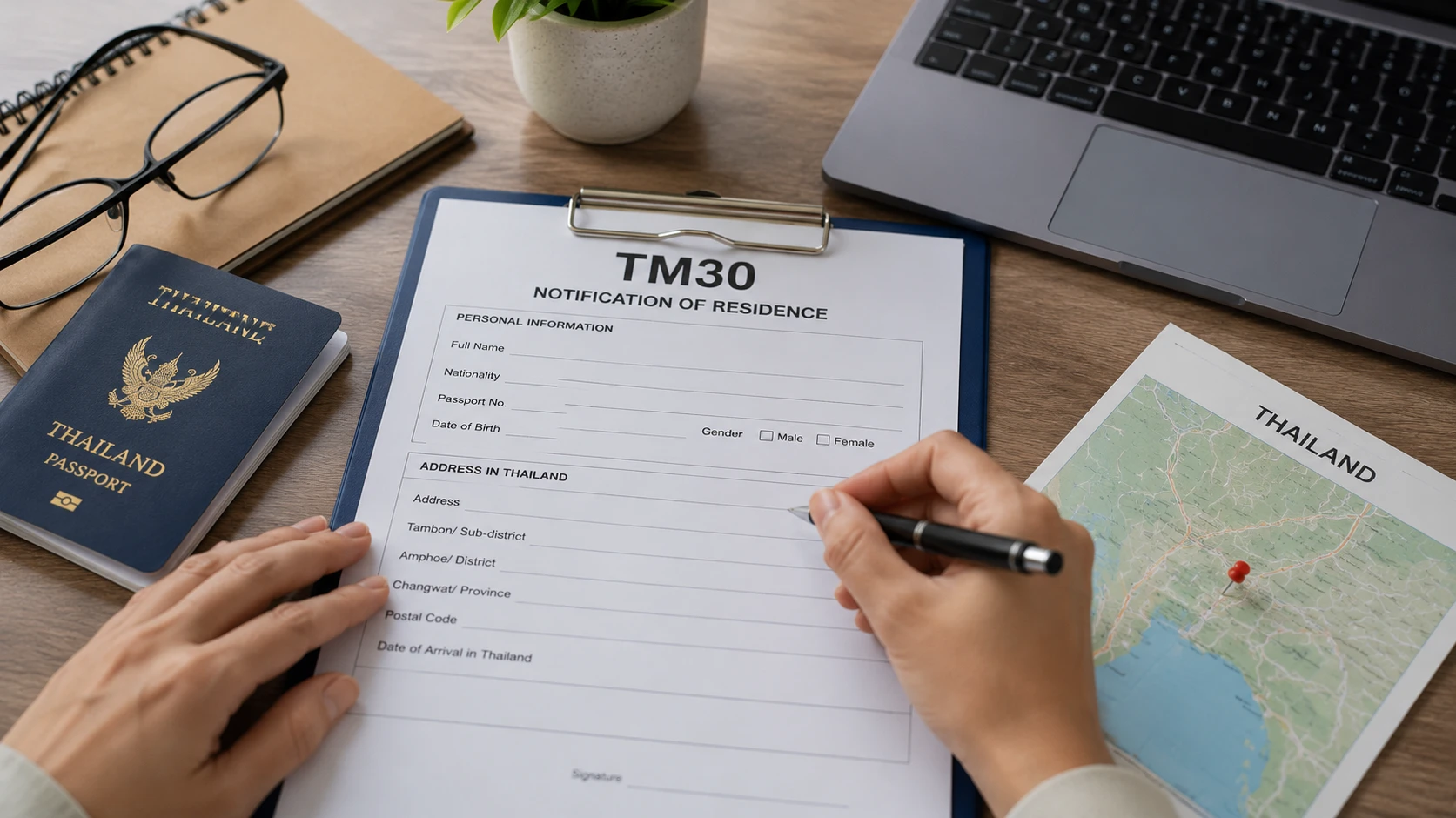

How to Register Your Residence in Thailand: TM30 Form Explained
66 2 026-1660
day and night
Thailand
EN
$
ft²
Other articles

How to Register Your Residence in Thailand: TM30 Form Explained

#Blog DDA
14 May 2709 views

Stay in Thailand for more than a hotel break and you will soon meet the TM30 — the address registration that quietly underpins almost every other immigration task. It is one of the country's most misunderstood requirements: by law it is the landlord's or owner's job, yet it is the foreigner who gets turned away at the counter when it is missing. A valid TM30 is the difference between sailing through your 90-day report or visa extension and being sent home to sort out paperwork first. This guide explains what the TM30 is, who must file it and when, how to do it (including online), the penalties, the genuinely confusing re-filing rules after travel, and why one small slip of paper matters so much.

What the TM30 Actually Is

The TM30 is the Notification of Residence for Foreigners. Under Section 38 of the Immigration Act B.E. 2522 (1979), the owner, occupier or possessor of any residence — or a hotel manager — must notify Thai Immigration within 24 hours whenever a foreigner takes up residence there. In plain terms, it is a residency-tracking system that tells the authorities where every non-Thai is staying. It is entirely separate from your visa, from the Thailand Digital Arrival Card (TDAC) you complete before flying in, and from the 90-day report — but, awkwardly, those other processes depend on it. No current TM30 on file, and the rest can grind to a halt.

Who Has to File It

Section 38 names the householder, owner, possessor or hotel manager — in practice, whoever provides the roof. How that plays out depends on your situation.

Your situationWho filesWhat you should do
Hotel or serviced apartmentThe hotel, automatically at check-inAsk reception for the TM30 receipt
Renting a condo or houseYour landlord, within 24 hoursInsist on the PDF receipt; file yourself if they won't
You own your homeYou, the "house master"Register on the TM30 portal and file it
Staying with friends or familyYour hostEven unpaid hosts must file for an overnight foreign guest

The recurring problem is that many landlords — especially those who usually rent to Thais — are unaware of the rule or unwilling to bother. Because the practical consequences land on you, not them, foreigners very often end up filing the TM30 themselves. The good news is that you are allowed to: a tenant can file online or at the immigration office on the property's behalf, and once you settle into a rented condo and daily life, it is worth sorting out from day one.

When a TM30 Is Required

A TM30 is tied to an address and a moment of arrival, so it is needed more often than people expect. You need one when you first move into any new address — a rental, a hotel, even a friend's spare room — and again whenever you change address. Re-entering Thailand from abroad also creates a fresh entry record, which generally means a new TM30 within 24 hours of getting back, even to the very same apartment. Domestic travel is greyer: if you stay overnight in another province, a new notification is technically expected on your return, though many offices no longer insist on it. Whatever the trigger, the legal deadline is the same — within 24 hours of arrival at the residence.

The Re-Filing Confusion After Travel

This is where almost everyone gets tangled, so it is worth being precise. Since a Royal Thai Police notification of 30 June 2020, a landlord no longer has to resubmit a TM30 every single time you leave and return to the same address within the stay window declared on the last filing. If you stay put at one address all year without leaving Thailand, a single TM30 covers you, and short domestic trips no longer require the separate TM28 if your main address is unchanged. The catch is international travel: re-entry still commonly triggers a fresh filing, enforcement varies sharply by office, and the requirement remains on the books in 2026.

One specific trap causes most of the grief: an address mismatch. If a hotel in another province files a TM30 for you during a trip, that becomes your latest registered address — and it will not match your home address when you try to file your 90-day report, which then bounces. The fix is simple once you know it: have a new TM30 filed for your home address on return, so the records line up. The safe habit is to refile (or at least check that the record still covers you) after any international trip or any night spent elsewhere, before you attempt any immigration errand.

How to File the TM30

There are three routes, and you can choose whichever suits you. Online is the modern default: the official TM30 portal was overhauled in September 2023 and is far more reliable than before, and both owners and tenants can file there — you will need the property's house-registration book (Tabien Baan) details alongside the foreigner's documents. In person, you visit your local immigration office, where an officer enters the data and staples a white notification slip into the passport. By post, you can send the form with a self-addressed envelope for the return slip. Whatever the method, the documents are much the same: the passport photo page, the entry stamp, the visa or exemption stamp, the rental contract or house-registration book, and the owner's Thai ID or passport.

Whichever way you file, keep the receipt — the Return Slip. Save the PDF in a dedicated folder on your phone and, if you will use it for a visa task, print it too, since some offices still want to see the stamped paper. Lose it, and you may need a police report to get a replacement.

Penalties, and Why the Receipt Matters More

The formal fine for late or missing filing is modest — commonly 800 to 2,000 THB for the property owner, and in some cases higher — with the foreigner liable up to 2,000 THB for failing to ensure it was done. But the fine is rarely the real cost. Without a current TM30, immigration officers will often refuse to process your 90-day report or your visa extension until the filing is on record, and you cannot obtain a Certificate of Residence — the document you need for a driver's licence, a bank account or a vehicle purchase. In practice, most owners who never file simply get told to do it retroactively, while the foreigner is the one stuck unable to complete an urgent errand. That asymmetry is the whole reason to stay on top of it.

TM30 vs. the Other Immigration Forms

The acronyms blur together, but each form does a distinct job, and one never replaces another.

FormWhat it's forWho files it
TM30Registers the address where you stayThe owner, landlord or hotel
TDACLogs your arrival into ThailandYou, online before you travel
TM47 (90-day report)Confirms you're still in the countryYou, every 90 days of stay
TM28Notifies a change of address or provinceYou, when you relocate

If You Own Your Home — or Your Landlord Won't File

Ownership changes your role here. When you own the condo, villa or house you live in, you are the "house master," so the duty to file falls on you — a small but real administrative responsibility that comes with owning rather than renting, and one more reason to understand the freehold and leasehold structures before you buy. If you rent and your landlord refuses, you have clean options: file online yourself, go to the immigration office in person, or — best of all — choose accommodation that handles it. Professionally managed condominiums with a juristic office almost always file the TM30 as a standard service, so it pays to ask before you sign and, ideally, to put the obligation in the lease.

Common Mistakes to Avoid

The usual slip-ups are easy to sidestep once you know them. Assuming the hotel or landlord always files, and never checking. Throwing away or losing the receipt you will be asked for again and again. Forgetting to refile after an international trip, then failing your 90-day report on an address mismatch. Letting a hotel stay in another province quietly become your registered address. Leaving the whole thing until the morning you urgently need a service. And confusing the TM30 with the 90-day report — they are separate obligations, filed by different people at different counters, and doing one does not cover the other.

Frequently Asked Questions

What is the TM30?

It is the Notification of Residence for Foreigners — a filing that tells Thai Immigration where a foreigner is staying, required within 24 hours of arrival at an address.

Who is responsible for filing it?

Legally the property owner, landlord or hotel; but if you own your home you file it yourself, and tenants often file when a landlord won't.

Do I need a new TM30 after travelling abroad?

Returning from abroad usually triggers a re-filing within 24 hours, and enforcement varies, so refile or at least check the record after international trips.

Can I file the TM30 online?

Yes — both owners and tenants can file through the official TM30 portal; you'll need the property's house-registration details.

What is the penalty for not filing?

A fine of 800 to 2,000 THB (sometimes more) for the owner; the bigger cost is being blocked from 90-day reports, extensions and a residence certificate.

Is the TM30 the same as the 90-day report?

No — the TM30 registers your address and is filed by the host, while the 90-day report (TM47) confirms you're still in the country and is filed by you.

What if my landlord refuses to file?

File it yourself online or at immigration, choose TM30-friendly or professionally managed accommodation, and always keep the receipt.

Make the Admin Part of Choosing the Right Home

The TM30 is a small task, but it is a useful lesson in how much smoother life in Thailand becomes when the property side is handled properly — a managed building files it for you, a cooperative landlord keeps you compliant, and owning your own home simply makes you responsible for a quick online form. DDA Real Estate helps international clients choose where and what to buy or rent, with a bias toward professionally run developments that take the paperwork off your plate, and guidance on the immigration and ownership details newcomers find most confusing. Get the home right, and the formalities follow.

Popular
5 June 4152141 view
Dubai Rent Prices 2025: Average Apartment Rental Costs in Dubai Dubai's rental market continues its upward climb in 2025, driven by population growth and limited new supply, pushing average prices up by 10%

#Blog DDA
2 July 2382282 view
DLD Fees in Dubai: Everything You Need to Know Buying property in Dubai? Don't let hidden fees surprise you! Our essential guide breaks down ALL Dubai Land Department (DLD) fees
#Blog DDA
23 November 1710198 views
How to Buy a SIM Card in Turkey in 2026: Prices, IMEI Registration, eSIM Options, and Best Mobile Operators Overview of mobile operators, available types of SIM cards, and home Internet providers
#Blog DDA
5 July 1702512 views
How Much is the Real Estate Agent Commission in Dubai? Find out how much real estate agent commission costs when buying property in Dubai.
#Blog DDA
5 February 1394568 views
How Foreigners Can Own Property in Bali: Understanding PT PMA (2025) Foreigners can't own freehold land in Bali, but a PT PMA (foreign-owned company) allows secure property ownership under Hak Guna Bangunan (HGB) or Hak Pakai (HP) rights
#Blog DDA
28 August 1145844 view
Oqood vs Title Deed in Dubai: Key Differences You Must Know Buying property off-plan in Dubai? Oqood registration is mandatory to secure your ownership rights.
#Blog DDA