Thai Culture Do's and Don'ts 2026: A Guide
66 2 026-1660
day and night
Thailand
EN
$
ft²
Other articles

Thai Culture Do’s and Don’ts: Avoiding Cultural Faux Pas as a Foreigner

#Blog DDA
25 June 1008 views

The standard etiquette listicle has a structural flaw: it puts a criminal offence carrying years of imprisonment and a minor table-manners slip in the same bulleted list, formatted identically. A visitor reads twenty rules, remembers four at random, and has no idea which four mattered. For someone living in Thailand rather than passing through, that is the wrong way to hold the information.

The distinction matters more in 2026 than it did a few years ago, because two things moved. Enforcement around temple dress, public behaviour and the lèse-majesté law has tightened, with fines, deportation orders and prosecutions affecting foreign nationals; ignorance is not accepted as a defence. And two substances that many arrivals still believe they understand have changed status: recreational cannabis was recriminalised on 25 June 2025 and is now medical-only, while e-cigarettes have been illegal since 2014 and were the subject of an intensified crackdown that saw over 120,000 devices seized and, in one reported week, 690 arrests.

This article sorts Thai etiquette by consequence rather than by theme: what can cost you your liberty, what has changed recently and catches out people relying on old information, and what merely costs goodwill. It also sets out the two underlying ideas from which most of the social rules can be derived, so you are not memorising a list. Figures and legal positions are current as of July 2026, several widely repeated claims turn out to be wrong and are corrected below, and anything with legal consequences should be confirmed against official sources rather than travel guides.

Two Ideas That Generate Most of the Rules

Almost all Thai social etiquette follows from two organising principles. Learn these and you can work out the correct behaviour in situations no list covers.

The first is a vertical hierarchy of the body. The head is the highest and most sacred part, believed to house the spirit, which is why touching anyone's head — including a child's, affectionately — reads as spiritually intrusive rather than merely familiar. Hairdressers sometimes ask permission before touching a client's head. The feet are the lowest, physically and spiritually, so pointing them at a person, a Buddha image or a monk places that person or object beneath you. Everything about seating, the mermaid pose in temples, and stepping over rather than on thresholds derives from this single axis.

The second is face, supported by the related ideas of a cool heart and considerate restraint. Public anger does not signal that you are serious; it signals that you have lost control, and it costs face on both sides, which usually makes the underlying problem harder to solve. A complaint delivered calmly and with a smile gets further in Thailand than the same complaint delivered forcefully — not because Thais are conflict-averse in a soft sense, but because the loud version has just made the other party's cooperation costly to them.

The Tier That Carries Prison Time

This is not etiquette. Section 112 of the Criminal Code makes it an offence to defame, insult or threaten the King, Queen, Heir Apparent or Regent, with penalties of three to fifteen years of imprisonment per count. It applies to everyone on Thai soil, including foreign nationals, and it has been applied to social media activity.

What this means in practice

  • Online counts. Posts, comments, shares and likes are all within scope, and material published before arrival has featured in cases.
  • Currency carries the King's image. Stepping on a rolling banknote or coin to stop it is the textbook example of an act that looks trivial and is not.
  • Third parties can report. Complaints are frequently brought by bystanders rather than by the state noticing directly.
  • The royal anthem is played daily. At 08:00 and 18:00 in many public spaces, and before films in cinemas. Stand still and stay quiet.
  • There is no safe amount of commentary. The workable rule for a foreign resident is to hold no public position at all on the subject.

Adjacent to this sits domestic politics. Thailand's recent history includes coups and deep divisions that remain raw, and taking sides in a conversation is a poor trade for a foreigner: nothing is gained and a great deal can be lost. Listening respectfully is a complete response.

The Tier That Changed While You Were Not Looking

Two areas catch out people working from information that was accurate two or three years ago, and both now carry real penalties.

Cannabis is medical-only

Thailand reversed its 2022 liberalisation on 25 June 2025. Cannabis flower is now regulated as a controlled herb requiring a prescription from a Thai-licensed doctor for a defined set of conditions, with prescriptions valid up to thirty days. Foreign medical cannabis cards have no legal effect. Purchase without a prescription, public consumption and buying from unlicensed vendors carry fines cited at up to 25,000 baht and imprisonment up to three months, and further ministerial regulations tightened licensing and export rules in April 2026. Shops remaining visible on the street is not evidence that the rules did not change.

Vapes are not a grey area

Electronic cigarettes, vaporisers, e-liquids and heated tobacco devices have been illegal since 2014 — import, sale, possession and use. A crackdown ordered in 2025 raised enforcement to its highest level, and reported outcomes include confiscation at airports with fines in the thousands of baht, and on-the-spot fines cited in the range of 20,000 to 30,000 baht for street use during enforcement periods. An airline permitting a device in your baggage is a carriage rule, not permission from the Thai state.

One correction worth making, because published guidance has been inconsistent: nicotine pouches were classified as tobacco products in early 2026 and a crackdown followed in March, which several guides read as a consumer ban. The health authorities have since been explicit that the restrictions apply to sellers rather than to consumers. Where guidance has been revised like this, prefer the most recent official statement over the summary that repeated the earlier reading.

The Tier That Costs Goodwill

Nothing here will get you arrested. All of it affects how you are treated by neighbours, staff and the people you deal with repeatedly — which for a resident compounds in a way it never does for a tourist.

SituationWhat to doWhy
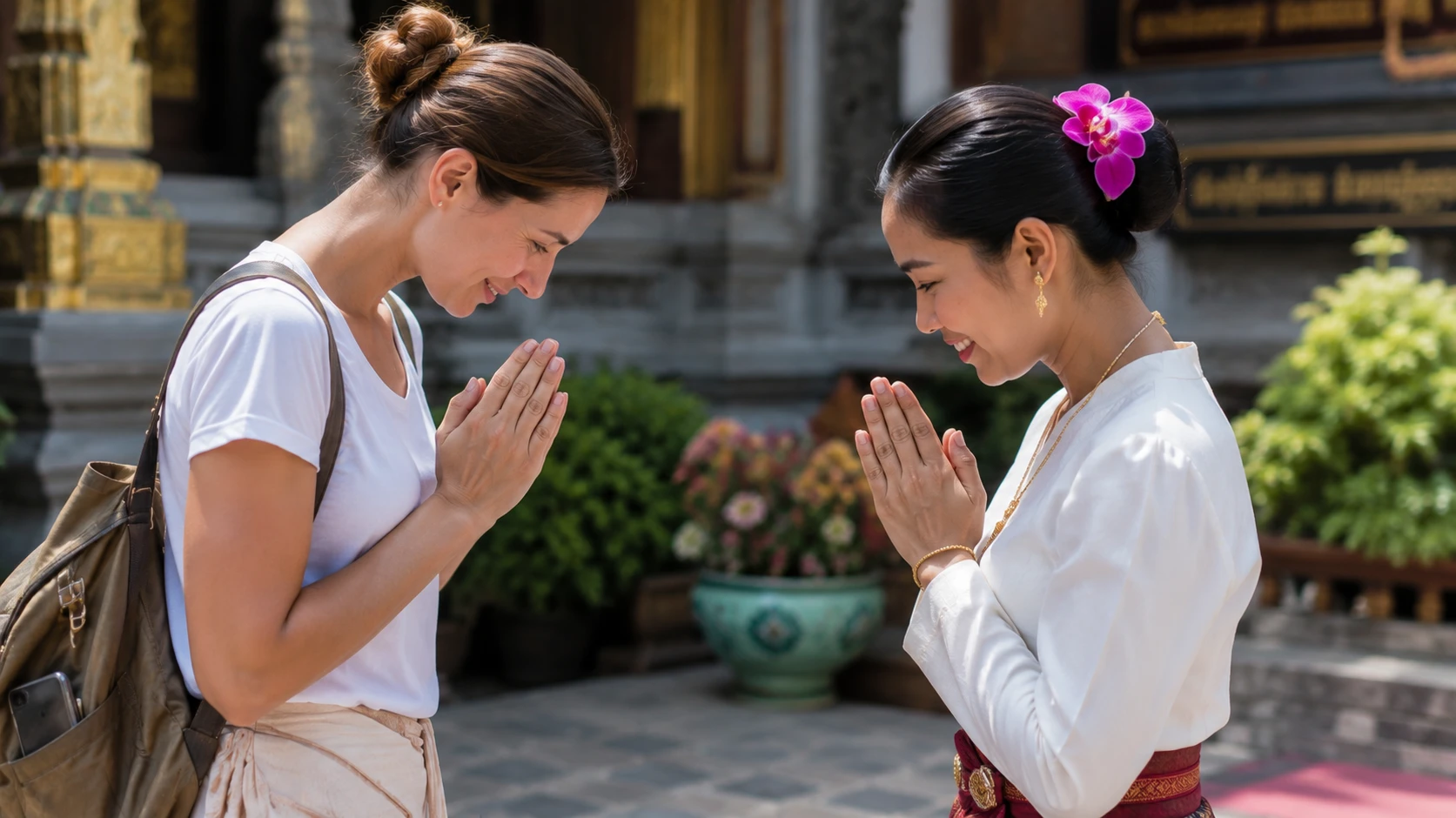
Being greeted with a waiReturn it at chest level with a slight nodYou are not expected to initiate, and returning it is the courteous default
Service staff or children wai youA smile and a nod is sufficientReturning a wai downward is not expected and reads as awkward rather than polite
Entering a templeCover shoulders and knees; step over the thresholdDress codes are enforced, and thresholds are traditionally significant
Sitting near a Buddha imageTuck legs to one side, feet pointing awayFeet directed at the image invert the hierarchy
Encountering a monkGive way; women should avoid contact and pass items via a cloth or surfaceMonastic rules restrict physical contact with women
Something goes wrong in a shop or officeStay calm, keep smiling, lower your voiceVisible anger costs face on both sides and reduces cooperation

Buddha images deserve a separate note because the mistake is usually made with good intentions. They are sacred objects rather than decorative ones: climbing on a statue for a photograph has led to legal consequences, and taking images out of the country is restricted, with larger souvenirs often requiring paperwork. Photographing monks at close range without asking is increasingly discouraged, particularly at quieter temples.

Claims That Do Not Hold Up

  • «Wai everyone.» You are not expected to wai service staff, children or vendors. Over-application looks less respectful, not more.
  • «Cannabis is legal, so the rules must be relaxed generally.» The two areas moved in opposite directions. Cannabis was restricted while vaping enforcement intensified; there is no shared logic to extrapolate from.
  • «Foreigners get a pass on the serious laws.» Section 112 applies to everyone on Thai soil, and public-decency incidents have produced deportations and entry bans.
  • «A drone is fine if nobody objects.» Use around temples is frequently restricted or requires permits, and the registration process runs through more than one authority with timelines measured in months. Assume it is not permitted until confirmed.
  • «Etiquette is uniform across the country.» Expectations around dress and public affection are noticeably firmer in rural provinces and at religious sites than in resort districts.

Living Here Versus Visiting

The practical difference is repetition. A tourist who gets something wrong leaves; a resident meets the same building manager, the same neighbours and the same shopkeepers every week, and small impressions accumulate into how easily things get done.

Three habits do most of the work. Learn a handful of phrases, because effort is registered even when pronunciation is poor. Observe before acting in any unfamiliar setting — following what people around you are doing resolves most uncertainty faster than any rule. And treat the building you live in as a community rather than a service: in condominiums much of daily life is governed by internal rules and by relationships with management, which is worth understanding before you sign anything, as our guide to buying an apartment in Thailand sets out.

Location also shapes how much adjustment is asked of you. Resort districts with large international populations are more forgiving of unfamiliarity than provincial towns, where you are more visible and expectations are firmer. That trade-off is worth weighing alongside the usual criteria; our overview of where it is better to buy real estate in Thailand compares the main destinations.

Further Reading

Cultural fluency is one part of settling in; the other is the practical arithmetic of daily life, from housing and transport to healthcare and utilities. Typical costs across those categories are set out in our guide to the cost of living in Pattaya.

Frequently Asked Questions

What is the single most serious mistake a foreigner can make?

Anything touching the monarchy. Section 112 carries three to fifteen years of imprisonment per count, applies to foreign nationals, and extends to online activity. Unlike social missteps, it cannot be repaired with an apology.

Do I need to wai everyone?

No. You are not expected to initiate a wai, and returning one to service staff, children or vendors is unnecessary — a smile and a nod is the appropriate response. Thais generally do not expect precise wai etiquette from foreigners and appreciate the attempt.

Is cannabis legal in Thailand in 2026?

Only medically. Recreational use was recriminalised on 25 June 2025, and cannabis flower now requires a prescription from a Thai-licensed doctor, valid up to thirty days. Foreign medical cards have no effect, and purchase without a prescription or public consumption carries fines cited at up to 25,000 baht and up to three months' imprisonment.

Can I bring my vape?

No. E-cigarettes, e-liquids and heated tobacco devices have been illegal since 2014, covering import, possession and use, and enforcement intensified sharply after a crackdown ordered in 2025. An airline allowing the device in your baggage does not make it lawful to bring into the country.

What should I wear to a temple?

Shoulders and knees covered, for both men and women — no vests, short shorts or see-through fabric. Stricter sites turn people away, and while sarongs are often available to rent at entrances, bringing your own is more reliable.

How do I complain about something without giving offence?

Calmly, quietly and with a smile. Raising your voice causes both parties to lose face and typically makes the problem harder to resolve. Persistence delivered politely is far more effective than force.

Conclusion

Thai etiquette is easier than the lists make it look, provided you sort it correctly. Two ideas — the body's vertical hierarchy and the preservation of face — generate most of the social rules, so you can reason your way through situations no guide anticipated. Above those sits a thin layer that is not etiquette at all but criminal law, where the monarchy and the two substances discussed above belong, and where the correct approach is caution rather than judgement. Below them sits a broad layer of small courtesies that Thais do not expect foreigners to perform perfectly and appreciate whenever attempted. Get the top layer right without exception, derive the middle, and relax about the rest.

DDA Real Estate helps you find property in Thailand — from Bangkok condominiums to villas in Phuket and Koh Samui, including building rules, lease terms and what daily life in each area actually looks like. Check out our offers in Thailand and leave a request: we'll find options for your budget and goal.

Popular
5 June 4152141 view
Dubai Rent Prices 2025: Average Apartment Rental Costs in Dubai Dubai's rental market continues its upward climb in 2025, driven by population growth and limited new supply, pushing average prices up by 10%
#Blog DDA
2 July 2382282 view
DLD Fees in Dubai: Everything You Need to Know Buying property in Dubai? Don't let hidden fees surprise you! Our essential guide breaks down ALL Dubai Land Department (DLD) fees
#Blog DDA
23 November 1710198 views
How to Buy a SIM Card in Turkey in 2026: Prices, IMEI Registration, eSIM Options, and Best Mobile Operators Overview of mobile operators, available types of SIM cards, and home Internet providers
#Blog DDA
5 July 1702512 views
How Much is the Real Estate Agent Commission in Dubai? Find out how much real estate agent commission costs when buying property in Dubai.
#Blog DDA
5 February 1394568 views
How Foreigners Can Own Property in Bali: Understanding PT PMA (2025) Foreigners can't own freehold land in Bali, but a PT PMA (foreign-owned company) allows secure property ownership under Hak Guna Bangunan (HGB) or Hak Pakai (HP) rights
#Blog DDA
28 August 1145844 view
Oqood vs Title Deed in Dubai: Key Differences You Must Know Buying property off-plan in Dubai? Oqood registration is mandatory to secure your ownership rights.
#Blog DDA