

Off-plan properties
You can live in Thailand with almost no Thai — plenty of people do — but a hundred words changes everything. They bring warmer service, fairer prices, smoother days and far less friction when you rent a home or deal with an office. Thai looks intimidating, with its unfamiliar script and five tones, yet the grammar is genuinely simple and you do not need to read a word to be useful from day one. This guide covers the survival phrases that actually matter, the politeness rules that shape every first impression, just enough about tones to keep you out of trouble, the apps worth using in 2026 (and the famous ones that do not even offer Thai), and the phrases that help most when you are settling into a home.
Thailand runs on two tracks. In tourist zones and international offices, English will get you through; step into a local market, a government counter, a neighbourhood clinic or a landlord's kitchen, and it fades fast. A few words flip the dynamic instantly — vendors soften, prices drop, and the famous Thai warmth opens up because you bothered to try. It also keeps you safer and more independent: reading a menu, telling a taxi where to stop, asking for the toilet or a pharmacy without a screen between you. And once daily life moves from hotels to a rented condo and the everyday cost of living, the small phrases — bills, deposits, repairs — quietly save you money and stress.
Here is the encouraging part: Thai grammar is far simpler than European languages. There is no verb conjugation, no tenses to memorise, no gendered nouns, no plurals and no articles — you bolt words together and context does the rest. The difficulty lives elsewhere, in two places. First, tone: Thai has five (mid, low, falling, high, rising), and the same syllable means different things depending on the pitch. Say "suay" with a rising tone and it means beautiful; flatten it and it means unlucky. The words for near (glai, falling) and far (glai, mid) differ only in tone. Second, the script — 44 consonants, 32 vowels, written with no spaces between words. The practical shortcut for beginners is to skip the script entirely at first, learn phrases in romanised form, and lean on listening so your ear picks up the tones before your eyes tackle the alphabet.
If you learn only one thing, learn the politeness particles. Men end sentences with "khrap" and women with "ka" — added to greetings, thanks, questions and almost anything else. They carry no meaning of their own, but leaving them out sounds blunt, while using them makes you instantly more likeable. Pair them with the "wai" (a slight bow with palms together) for greetings and thanks, address people as "khun" plus their first name, and keep the spirit of "mai pen rai" — the all-purpose "no worries, it's fine" that sums up a lot of Thai social life. None of this requires fluency; it is the highest-return effort you can make.
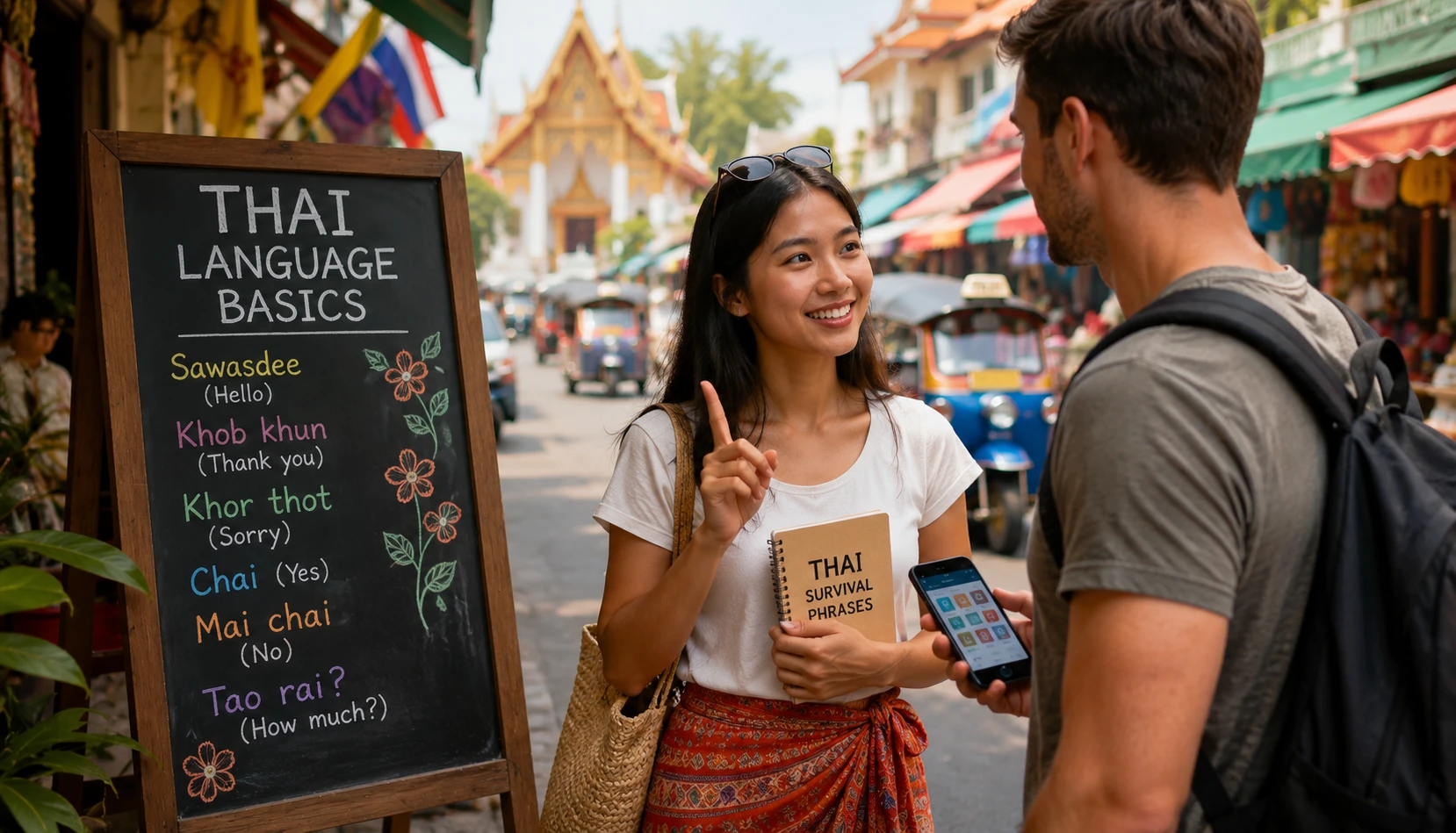
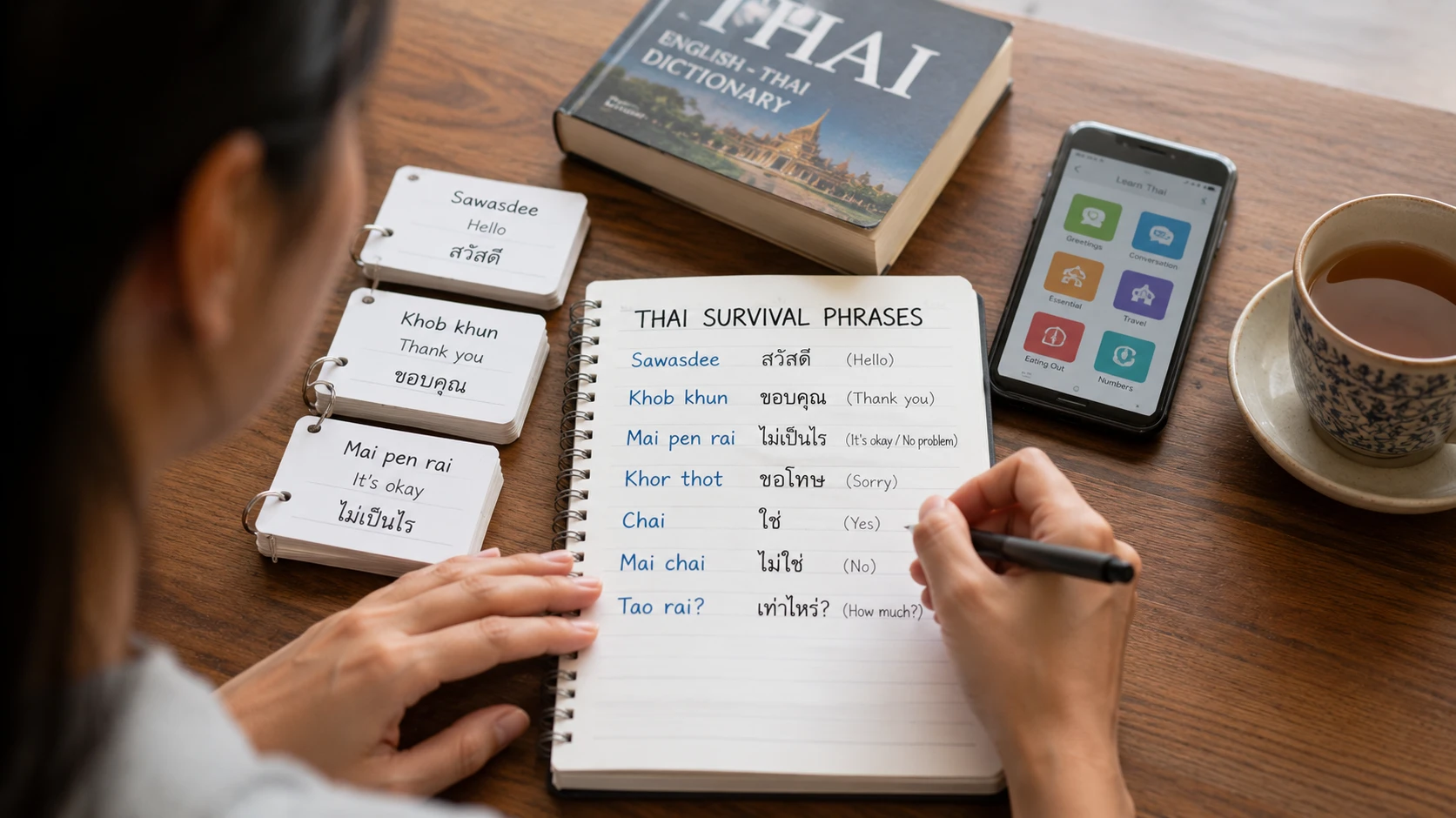
Start here. Add "khrap" or "ka" to each line, and you will sound polite even with a tiny vocabulary.
| English | Thai (romanised) | Notes |
|---|---|---|
| Hello / goodbye | sawatdee (+ khrap/ka) | Works at any time of day |
| Thank you | khop khun (+ khrap/ka) | Always add the particle |
| No worries / it's fine | mai pen rai | The all-purpose reassurance |
| Excuse me / sorry | khor thot | Also to get attention |
| Yes / no | chai / mai chai | "mai" negates most things |
| I don't understand | mai khao jai | Add "phut cha-cha" = speak slowly |
| Do you speak English? | phut phasa angkrit dai mai? | A useful opener |
These cover markets, food and getting around — the situations you meet every single day. Numbers help too: one to ten are neung, song, sam, si, ha, hok, jet, paet, kao, sip; then sip-et (11), yi-sip (20), roi (100) and phan (1,000).
| English | Thai (romanised) | Notes |
|---|---|---|
| How much? | tao rai? | The phrase you'll use most |
| Too expensive | phaeng | "lot dai mai?" = can you lower it? |
| Delicious | aroi | A guaranteed smile |
| Not spicy / no chili | mai phet | Say it — "Thai spicy" is real |
| Water | nam (nam plao = plain) | Bottled water is everywhere |
| The bill, please | check bin / kep ngern | Either is fine |
| Where is the toilet? | hong nam yu thi nai? | Essential everywhere |
| Stop here | jot thi ni | For taxis and motorbikes |
| Straight / left / right | trong pai / liao sai / liao khwaa | Directions for drivers |
Rare, but the moments when language matters most. Keep these where you can find them fast, and remember the national emergency number is 191 (1669 for an ambulance).
| English | Thai (romanised) | Notes |
|---|---|---|
| Help! | chuai duai! | Say it loudly |
| Hospital | rong phayabaan | Private hospitals have English staff |
| I'm not well / sick | mai sabai | Common and understood |
| Pharmacy | raan khai ya | Pharmacists often speak some English |
| Call the police | riak tamruat | Tourist police: 1155 |
This is where a little Thai turns into real money saved. Leases, deposits and utility bills are often discussed in Thai, especially with private landlords, and knowing the vocabulary stops misunderstandings before they start.
| English | Thai (romanised) | Notes |
|---|---|---|
| For rent / for sale | hai chao / khai | Signs use these words |
| How much per month? | duean la tao rai? | For monthly rent |
| Deposit | ngern mat jam | Usually 1–2 months |
| Contract | sanya | Always get it in writing |
| Water & electricity bill | kha nam kha fai | Ask if it's included |
| Is it included? | ruam mai? | For bills, internet, fees |
Even with these phrases, the legal side of a Thai lease or purchase should never rest on your own translation. Foreigners can own a condominium freehold but not land, so most houses and villas are taken on a 30-year lease — the structures are explained in our guide to freehold and leasehold ownership, and the realities are separated from the rumours in our review of foreign-ownership truths and myths. Use your Thai to build rapport; use a lawyer for the contract.
One surprise for newcomers: the big names many people expect — Duolingo, Rosetta Stone and Babbel — do not offer Thai at all. The tools that do are often better suited to a tonal language anyway, because they put audio and pronunciation first. The table below maps the best of them to what each is actually good for.
| App | Best for | Note |
|---|---|---|
| Ling | An all-round beginner course | Gamified; alphabet to speaking, with an AI chat |
| Pimsleur | Speaking from day one | Audio-only 30-minute lessons, great on commutes |
| ThaiPod101 | Structured lessons and culture | Huge audio/video library across four levels |
| Drops | Vocabulary in 5-minute bursts | Visual and fun, but a supplement, not a course |
| Mango Languages | Practical phrases, often free | Free through many public libraries |
| Write It! Thai | Learning the Thai script | Focused only on reading and writing |
| italki / Preply | Live one-on-one tutors | Real tone feedback; lessons from about $7 |
| Google Translate | On-the-spot help | Camera mode reads menus and signs |
The system that works is not one app but a small stack: one main course (say Ling or Pimsleur), one review habit (Drops or flashcards), and one channel for real speaking (a tutor on italki or Preply). Apps build vocabulary and listening; only a real person can correct your tones in the moment.
Progress comes from a few habits, not from collecting apps. Speak from day one rather than waiting until you feel "ready" — that day rarely arrives on its own. Learn with audio so tones go in through your ears, and get a tutor early for honest feedback. Front-load numbers and the politeness particles, since you use them constantly. Practise on willing locals — market vendors and taxi drivers are patient and encouraging. And lean on Google Translate's camera for menus, contracts and signage while your reading catches up. Twenty focused minutes a day beats an hour once a week.
A few errors trip up nearly everyone. Ignoring tones and assuming context will save you — sometimes it will not, and "beautiful" becomes "unlucky." Dropping the politeness particles and sounding curt without realising it. Downloading a course that does not exist, then wondering why Duolingo has no Thai. Memorising single words instead of whole phrases you can actually deploy. Being too shy to speak, which is the single biggest brake on progress. And assuming everyone speaks English — true in a Bangkok mall, much less so in a rural clinic or a landlord's living room.
Do I need to learn Thai to live in Thailand?
No, but basics dramatically improve daily life, prices and the respect you're shown, since English fades quickly outside tourist areas.
Is Thai hard to learn?
The grammar is simple — no conjugation or tenses — but the five tones and the script are the real challenge, so beginners usually start with romanised phrases.
What are the most important words?
The politeness particles khrap (men) and ka (women), plus hello (sawatdee), thank you (khop khun) and mai pen rai.
Does Duolingo have Thai?
No — Duolingo, Rosetta Stone and Babbel don't offer Thai; use Ling, Pimsleur or ThaiPod101 instead.
Which app is best to start with?
Ling for an all-round beginner course, or Pimsleur if speaking quickly is your main priority.
Do I need to read the Thai script?
Not to get by — spoken phrases and Google Translate's camera cover most situations, though reading pays off for a long stay.
A handful of Thai phrases and the right place to live are two halves of the same thing: feeling at home. The language smooths the daily details; the property decision sets the foundation. DDA Real Estate helps international clients find the right area and property across Thailand — from choosing where to buy to handling the contract, the ownership structure and the Thai-language paperwork that newcomers find hardest. Learn the phrases for the market and the taxi, and let us take care of the part where the words really have to be right.