Iskan in Turkey: A Buyer Guide to the Occupancy Permit
Turkey
EN
$
ft²
Other articles

Iskan in Turkey: Everything You Need to Know About the Occupancy Permit

Alexandr Khromchenko The author of the article, the Broker
#Blog DDA
8 June 13923 view

When buying property in Turkey, most buyers focus on the TAPU — the title deed. That makes sense: the TAPU is proof of ownership, and getting it right is the foundation of any transaction. But there is a second document that matters just as much for anyone buying a new-build or recently completed property, and it receives far less attention: the Iskan.

Missing or ignoring the Iskan is one of the most common and most consequential mistakes foreign buyers make in the Turkish property market. This guide explains what it is, why it matters, how to check for it, and what to do if it is absent.

What Is the Iskan?

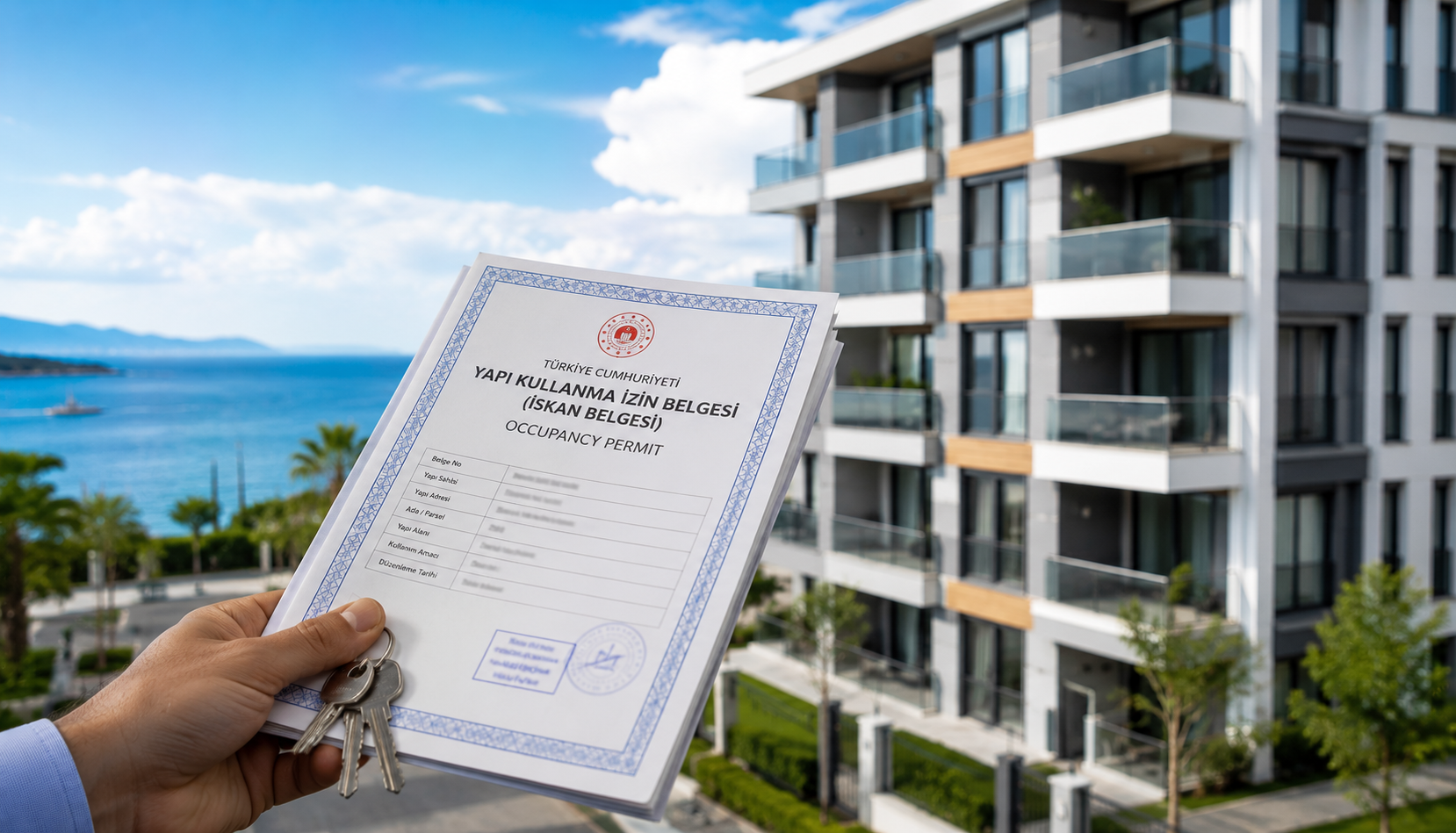
Iskan (İskan Belgesi) is the Turkish occupancy permit — an official document issued by the local municipality confirming that a building has been constructed in accordance with its approved architectural project and complies with all applicable building regulations, fire safety standards, and infrastructure requirements.

In plain terms: the Iskan is the municipality's formal sign-off that the building is legal, safe, and fit for human habitation.

Without an Iskan, a building technically does not have legal permission to be occupied — regardless of whether people are already living in it.

What Iskan confirms Details
Construction compliance Building matches the approved architectural project
Safety standards Fire safety, structural integrity, emergency access
Infrastructure connections Water, electricity, gas, sewage legally connected
Zoning compliance Building used for its designated purpose (residential, commercial)
Municipal approval Local authority has inspected and signed off

Why the Iskan Matters for Buyers

The Iskan is not a bureaucratic formality. Its presence or absence has direct, practical consequences for the owner.

Utility connections. In Turkey, utility providers — electricity (TEDAŞ), water (municipality), and gas (BOTAŞ/distributors) — require a valid Iskan before establishing a legal subscriber connection to a property. Without it, utilities may be connected informally through the developer or a neighboring unit, which means you do not have a contract in your own name, cannot control your billing, and can be disconnected at any point.

Residence registration. Registering your address with the local population directorate (Nüfus Müdürlüğü) — required for residency permit applications and various administrative procedures — typically requires a property with a valid Iskan.

Resale and financing. Turkish banks will not issue a mortgage against a property without a valid Iskan. When you come to sell, any buyer using financing will be blocked — which effectively limits your buyer pool to cash purchasers and reduces liquidity significantly.

Legal exposure. A building without Iskan is technically in violation of municipal regulations. In theory, authorities can issue fines, restrict use, or — in extreme cases — order demolition of non-compliant structures. In practice, enforcement varies, but the risk is real and should not be dismissed.

Insurance. Home insurance policies in Turkey are more difficult to obtain and less comprehensive for properties without a valid Iskan. DASK (compulsory earthquake insurance) can technically be issued without it, but comprehensive coverage is often restricted.

Iskan for the Whole Building vs. Individual Units

This distinction catches many buyers off guard. There are two levels at which Iskan can apply:

Building-level Iskan (Bina İskanı): Issued for the entire structure once the building as a whole meets all requirements. This is the standard and most straightforward situation.

Individual unit Iskan (Bağımsız Bölüm İskanı): In some cases — particularly in large developments — individual units can receive occupancy permits separately, even if other units or common areas of the same building do not yet have full clearance.

What this means for buyers: Always confirm that the Iskan covers your specific unit, not just another part of the building. A developer may truthfully say "the building has Iskan" while your particular apartment does not yet have its individual clearance.

The Difference Between Iskan and TAPU

Buyers often confuse these two documents — or assume that having a TAPU means everything is in order.

Document What It Confirms Issued By
TAPU (Title Deed) Legal ownership of the property Land Registry (Tapu ve Kadastro)
Iskan (Occupancy Permit) Building is legally fit for occupation Local Municipality (Belediye)

You can have a TAPU for a property that has no Iskan — and this is not uncommon in Turkey, particularly in older developments and in areas where construction outpaced regulatory compliance. The TAPU proves you own the property. The Iskan proves the property is legally habitable. Both matter, and neither substitutes for the other.

Types of Iskan: What You May Encounter

Not all occupancy documentation is identical. Buyers should understand the distinctions.

Type Description What It Means in Practice
Full Iskan (Tam İskan) Complete occupancy permit for the building Ideal — full legal compliance confirmed
Partial Iskan (Kısmi İskan) Certain floors or units approved, others pending Verify your specific unit is covered
Temporary Iskan (Geçici İskan) Short-term permit while final compliance is resolved A flag — find out what is pending and when it will be resolved
No Iskan Building has no occupancy permit High risk — proceed only with full legal due diligence

Temporary Iskan is worth particular attention. Developers sometimes obtain a temporary permit to allow residents to move in while outstanding issues — typically related to landscaping, communal facilities, or minor infrastructure — are resolved. If a developer is offering a property with a temporary Iskan, request a written timeline for full Iskan and have a lawyer review what specifically remains outstanding.

How to Check Whether a Property Has Iskan

For buyers purchasing a new-build in Turkey, verifying the Iskan status is a non-negotiable step — and it should happen before signing a sales agreement, not after.

Ask the developer directly. Request a copy of the Iskan certificate. A reputable developer will provide it without hesitation. Reluctance or vague answers about "Iskan being in process" warrant significant caution.

Verify independently through the municipality. The Iskan can be confirmed at the local Belediye (municipality) office where the property is located. Your lawyer or a trusted local agent can do this on your behalf — it is a routine inquiry.

Check the TAPU record. In some cases, the Iskan status is reflected in the land registry records. A Turkish lawyer can review the TAPU extract (tapu kaydı) and identify any flags related to construction compliance.

Instruct a lawyer before signing. Legal due diligence in Turkey — including Iskan verification, encumbrance checks, zoning confirmation, and TAPU review — costs $300–600 and covers the most material risks in a property transaction. It is the single most cost-effective protection a foreign buyer can buy.

New Developments: What to Check Before Signing

For buyers purchasing off-plan or recently completed new-build property in Turkey, Iskan requires specific attention at each stage of the process.

Before signing the sales agreement:

  • If the building is under construction, Iskan will not yet exist — this is normal. What matters is that the project has a valid construction permit (Yapı Ruhsatı) and that the developer has a track record of obtaining Iskan on completed projects.
  • Ask the developer for evidence of Iskan on their previous completed developments. Established developers in Alanya, Antalya, and Istanbul will have this on file.
  • Ensure the sales agreement (satış sözleşmesi) includes a clause committing the developer to obtain full Iskan within a specified timeframe after construction completion.

At handover:

  • Do not accept the keys and do not sign any handover documentation until you have confirmed Iskan status. Once you sign the handover acceptance, your legal leverage to push for Iskan resolution diminishes significantly.
  • If Iskan is pending at the time of handover, negotiate a retention — a portion of the purchase price held back until Iskan is obtained — or obtain a written commitment with a specific deadline and financial penalty for non-compliance.

After handover:

  • Once Iskan is confirmed, establish all utility subscriptions in your name immediately. This is the point at which informal connections should be formalized.
  • If you discover post-handover that Iskan is absent and the developer is unresponsive, consult a Turkish lawyer immediately. There are legal remedies available, including claims for damages and contract rescission in serious cases.

The Iskan Amnesty: A Note on Older Properties

Turkey has periodically issued "zoning amnesty" legislation (İmar Barışı) that allowed owners of buildings constructed without proper permits to regularize their status by paying a fee. The most recent significant amnesty was in 2018. These amnesties do not create full Iskan — they create a limited regularization certificate (yapı kayıt belgesi) that confirms the building's existence is acknowledged, but does not confirm construction quality or safety compliance.

For buyers of secondary market properties — particularly older apartments in established resort towns — the distinction between a proper Iskan and an amnesty certificate matters. A yapı kayıt belgesi is better than nothing, but it is not equivalent to a full Iskan and should be treated accordingly in due diligence.

Iskan and the Investment Case

For investors purchasing Turkish property for rental income, the Iskan question intersects directly with yield and liquidity.

A property without Iskan cannot be legally listed on platforms like Airbnb or Booking.com under a formal short-term rental license in Turkey — the licensing process requires confirmed legal status of the property. Properties without Iskan are also harder to insure comprehensively, harder to finance for future buyers, and carry an unquantified regulatory risk that needs to be reflected in any return calculation.

The practical implication: when evaluating investment property in Turkey, Iskan status should be treated as a binary — either it exists or it does not. A higher yield on a property without Iskan does not compensate for the structural risk. Filter first, then evaluate returns.

Frequently Asked Questions

Can I legally live in a property in Turkey that has no Iskan?

Technically no — without an Iskan the building has no legal occupancy permission; in practice many people do, but the owner carries legal, financial, and insurance risk that should not be underestimated.

Does every property in Turkey have an Iskan?

No — a significant portion of Turkey's existing housing stock, particularly older buildings and developments in rapidly growing resort towns, was built before or without full regulatory compliance; always verify before purchasing.

If the developer says Iskan is "in process," should I be concerned?

It depends on the stage — for a building under construction, this is normal; for a completed building where residents are already living, "in process" is a yellow flag that requires a written timeline and legal advice before proceeding.

Can I get a mortgage in Turkey without Iskan?

No — Turkish banks require a valid Iskan as a condition for mortgage financing; a property without Iskan is effectively limited to cash buyers, which significantly reduces its resale liquidity.

How long does it take to obtain Iskan after construction is complete?

For compliant projects with an experienced developer, typically 3–6 months after construction completion; delays occur when outstanding issues — infrastructure connections, final inspections, communal area completion — remain unresolved.

What is the difference between Iskan and the construction permit (Yapı Ruhsatı)?

The construction permit (Yapı Ruhsatı) authorizes the building to be constructed; the Iskan certifies that construction has been completed in compliance with that permit and the building is fit for occupation — they are issued at different stages of the same process.

The Iskan is one of those details that experienced buyers check automatically and first-time buyers discover the hard way. It is not complicated — but it requires asking the right questions before money changes hands rather than after.

DDA Real Estate works with buyers across Turkey's key markets — Alanya, Antalya, Istanbul, and Bodrum — with full legal due diligence support at every stage of the transaction. Our team verifies Iskan status, construction permits, encumbrances, and TAPU compliance as standard practice on every deal we handle. If you are considering a property purchase in Turkey and want to be certain you are buying something legally sound, our advisors are available to guide you through the process.

Contact a DDA advisor to discuss your Turkey property search and ensure your purchase is legally protected from the start.

Popular
5 June 4152078 views
Dubai Rent Prices 2025: Average Apartment Rental Costs in Dubai Dubai's rental market continues its upward climb in 2025, driven by population growth and limited new supply, pushing average prices up by 10%
#Blog DDA
2 July 2382282 view
DLD Fees in Dubai: Everything You Need to Know Buying property in Dubai? Don't let hidden fees surprise you! Our essential guide breaks down ALL Dubai Land Department (DLD) fees
#Blog DDA
23 November 1710135 views
How to Buy a SIM Card in Turkey in 2026: Prices, IMEI Registration, eSIM Options, and Best Mobile Operators Overview of mobile operators, available types of SIM cards, and home Internet providers
#Blog DDA
5 July 1702512 views
How Much is the Real Estate Agent Commission in Dubai? Find out how much real estate agent commission costs when buying property in Dubai.
#Blog DDA
5 February 1394505 views
How Foreigners Can Own Property in Bali: Understanding PT PMA (2025) Foreigners can't own freehold land in Bali, but a PT PMA (foreign-owned company) allows secure property ownership under Hak Guna Bangunan (HGB) or Hak Pakai (HP) rights
#Blog DDA
28 August 1145844 view
Oqood vs Title Deed in Dubai: Key Differences You Must Know Buying property off-plan in Dubai? Oqood registration is mandatory to secure your ownership rights.
#Blog DDA