Off-plan properties
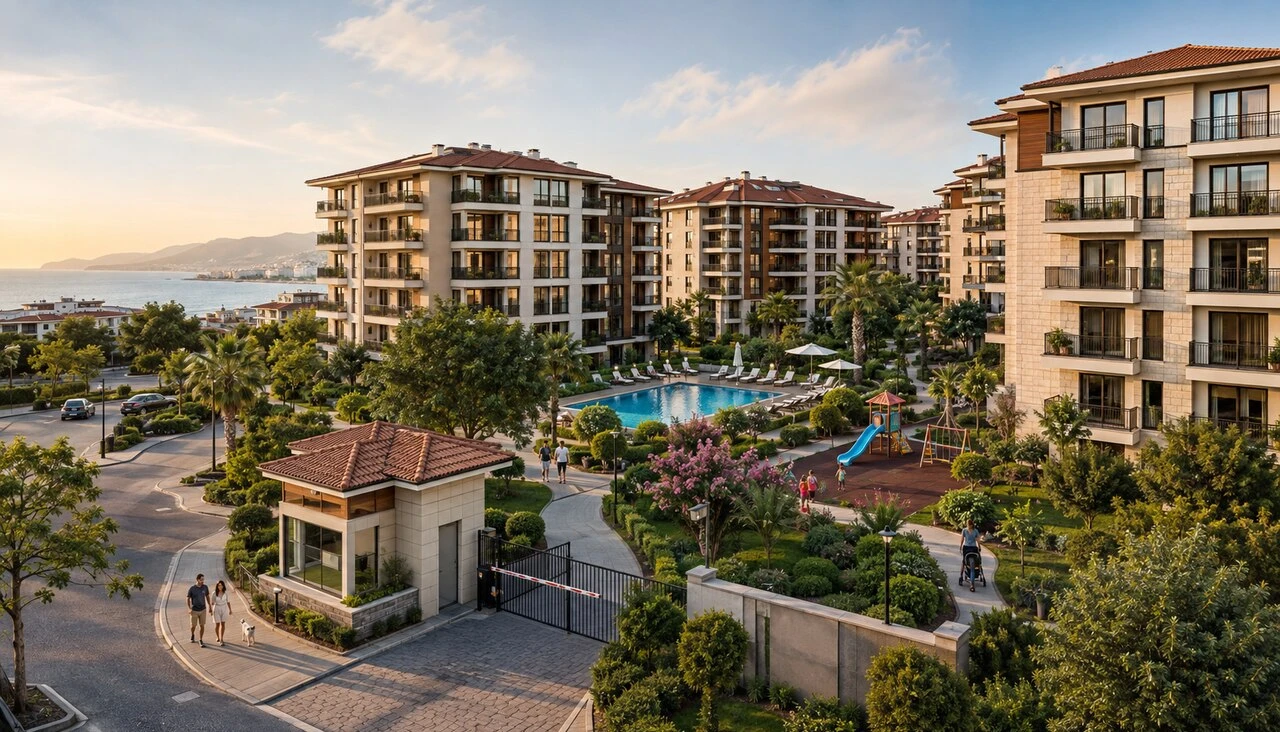
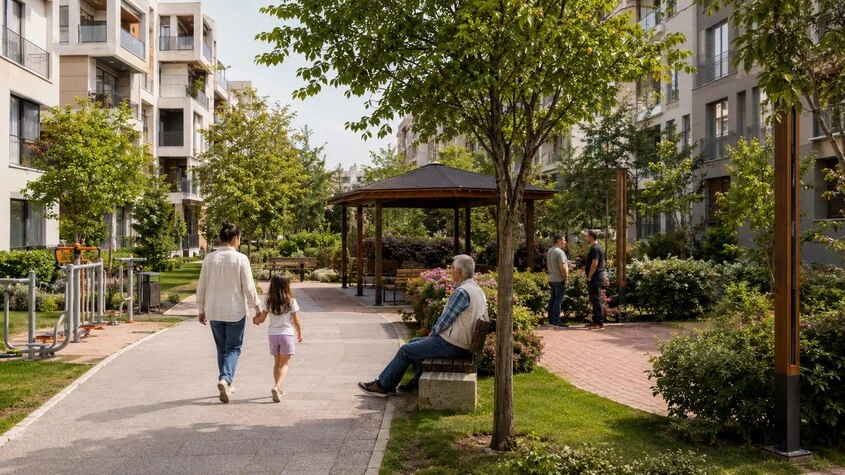
English-speaking buyers read «site» and think of a building plot. In Turkish it means something else entirely. A site is a gated residential development with shared facilities and its own management.
The word appears in almost every listing. The difference between a site and an ordinary building decides your monthly costs, your rules and often your resale. It is worth understanding before you view anything.
This guide covers what a site is, who runs it, what the monthly charge pays for, what the rules can forbid and what to check before buying into one. Conditions reflect August 2026 and vary by development.
Turkish listings use three terms for residential buildings. They describe different products at different prices.
| Apartman | Site | Rezidans | |
|---|---|---|---|
| What it is | A single standalone building | A gated development of several blocks or villas | A serviced building, hotel-like |
| Facilities | Usually none | Pool, gym, gardens, playgrounds | Full service plus concierge |
| Security | A door lock | Gate, cameras, often guards | Staffed reception |
| Monthly charge | Low | Moderate to high | Highest |
| Management | Informal or minimal | Formal, with a plan and a board | Professional operator |
| Rules | Few | Written and enforced | Extensive |
The gap between the first two columns is where most surprises live. Two flats of the same size in the same district can differ several times over in monthly charge, purely because one sits in an apartman and the other in a site.
There is no legal ranking here. A site is not automatically better. It is a different set of trade-offs.
Every site has a management structure, and it is not the developer. Once the development is handed over, the owners run it.
Owners form a general assembly. It meets at least once a year, approves the budget and elects a managing board. The board either runs the site directly or hires a management company.
Decisions are made by majority, and they bind everyone. That includes owners who did not attend, did not vote and disagree. A budget approved without you still produces a bill for you.
This is the practical reason to care about a site’s governance before buying. You are joining an organisation, not just acquiring an apartment.
Every site has a management plan. It is registered with the title and it binds every owner, present and future.
The plan sets out how the site is run, how the charge is calculated, what owners may and may not do, and how decisions are taken. It is the constitution of the development.
Buyers ask about the amount of the charge and skip the plan. The amount changes every year. The plan does not, and it governs everything else.
The monthly charge is called aidat. It covers running the shared parts of the site.
| What it typically covers | What it does not |
|---|---|
| Staff: security, cleaning, gardening | Anything inside your own walls |
| Electricity for common areas and lifts | Your own utilities |
| Pool and gym operation | Your own repairs |
| Landscaping and grounds | Your property tax |
| Lift maintenance | Your insurance |
| Building insurance for common parts | Contents insurance |
The amount varies enormously. A plain site with a small pool and a caretaker sits at one end. A large development with several pools, a gym, a sauna and round-the-clock security sits at the other, and the difference is not marginal.
Two costs drive the charge more than anything else: staff and electricity for common areas. Both rise with inflation, which is why a charge quoted today tells you little about what it will be in three years. Ask for the figures from the last three years instead.
How these payments fit into the wider cost of owning is set out in our guide to registration and annual expenses in Turkey.
This is the single most useful question to ask about a site, and almost nobody asks it.
Buildings need major work periodically. Facade renewal, lift replacement, roof, plumbing. These are large one-off costs.
A site with a reserve fund saves for them month by month. A site without one issues a special assessment when the work falls due, and every owner receives a large bill at once.
The difference between the two is not visible in the monthly charge. In fact the site without a fund often looks cheaper, right up until the year the lift needs replacing.
Ask three things: whether a reserve fund exists, how much is in it, and what major work is planned in the next five years. Then read the minutes of the last few general assemblies, where these decisions are recorded.
A site is a private community with written rules. They are enforceable, and they can affect why you bought.
Check the letting rules before you build any income projection. This is the mismatch that most often ruins an investment plan in Turkey. The apartment permits it, the site does not, and the site’s rule is the one that applies.
The pool, the gym and the gardens are the reason people choose a site. They are also the reason the charge is what it is.
You pay for them every month, including the months you are not there and the years you never use the gym. For a family living there full time that is fine. For an owner who visits twice a year it is worth calculating.
Ask whether the facilities operate all year. In coastal sites the pool is often drained in winter and the poolside staff are seasonal. You may be paying an annual charge for something that runs five months.
Ask also about occupancy out of season. A site that is lively in August and ten per cent occupied in January is a different place to live, and it affects security, services and atmosphere.
The general assembly is where the budget, the charge and the special assessments are decided. It is conducted in Turkish.
Foreign owners often skip it for that reason. The result is that decisions affecting their costs are taken without them, year after year.
You can vote by proxy. A written authorisation lets someone attend and vote on your behalf, and that is the practical answer for owners who live elsewhere.
It is worth using. The assembly decides whether to build a reserve fund, whether to tender for cheaper contractors and whether to approve a large project. Those votes are where the money is.
The word also covers gated villa developments, and the mechanics are the same with a different balance.
Owners share roads, gates, security, landscaping and often a communal pool. Each house is separate, so the charge covers less and tends to be lower per unit than in a tower site.
Individual maintenance shifts to you. The roof, the facade, the garden and any private pool are yours to maintain. In a tower site more of that sits inside the shared budget.
For anyone considering a newly built villa, the construction side has its own questions — these are set out in our guide to villa construction in Turkey.
Nine points, in the order they matter:
The last point is the one that costs money quietly. Unpaid charges attach to the unit, so an unresolved debt becomes yours at handover. The broader checking process for resale property is set out in our due diligence guide for resale property in Turkey.
One more document belongs alongside these. A site without an occupancy permit is not a completed development, whatever it looks like — what that permit establishes is covered in our guide to the occupancy permit.
Neither is better. They suit different situations.
| If you | Choose | Why |
|---|---|---|
| Live there full time with a family | Site | Security, facilities, community, maintained grounds |
| Want the lowest monthly cost | Apartman | No facilities means no facility charge |
| Visit a few times a year | Site | Someone is present and the place is maintained |
| Plan short-term letting | Check first | Many sites prohibit it outright |
| Want to renovate freely | Apartman | Fewer restrictions on changes |
| Are buying to resell in a strong market | Site | Facilities widen the buyer pool in most segments |
The fourth row is a check, not a choice. Decide the letting question by reading the management plan, not by asking the agent.
Does «site» mean a plot of land?
No. In Turkish property language a site is a gated residential development with shared facilities and its own management. It has nothing to do with a building plot.
Is a site always more expensive?
The monthly charge is higher because it pays for facilities and staff. The purchase price is not automatically higher, and in some districts a site apartment costs the same as one in an ordinary building.
Can the site forbid short-term rentals?
Yes, and many do. The restriction sits in the management plan and it binds all owners. Check it before making any income projection.
Who decides the monthly charge?
The general assembly of owners, by majority vote, on a budget prepared by the managing board. Decisions bind owners who did not attend.
What is a special assessment?
A one-off charge for major work such as a facade or a lift. Sites with a reserve fund spread these costs over years. Sites without one issue a single large bill.
Do I inherit the previous owner’s arrears?
Unpaid charges attach to the unit rather than the person, so an outstanding debt can become your problem. Ask the management for a clearance before completion.
Can I vote if I do not speak Turkish?
Yes, by written proxy. Someone can attend and vote on your behalf. This is the usual arrangement for owners who live abroad.
Are commercial units inside a site a good idea?
They serve a narrow catchment, which is the residents of the site itself. The economics differ from street retail, and they are covered in our guide to buying a shop in Turkey.
An apartment in a site comes with neighbours who vote on your costs, a plan that limits what you may do, and a budget you did not write. None of that is a problem when the site is well run. All of it is a problem when it is not, and the difference is visible in documents you can read before you commit. DDA Real Estate is a real estate agency in Turkey. We work across Antalya, Alanya, Istanbul, Izmir, Bodrum and Mersin. We pull the management plan, the charge history and the assembly minutes before a viewing rather than after an offer.
Explore our listings in Turkey and get in touch: tell us how you intend to use the property. We will check whether the site allows it, what its charge has done over three years and whether it saves for major work. The wider picture of ownership costs is set out in our guide to costs and property management in Turkey.