Off-plan properties
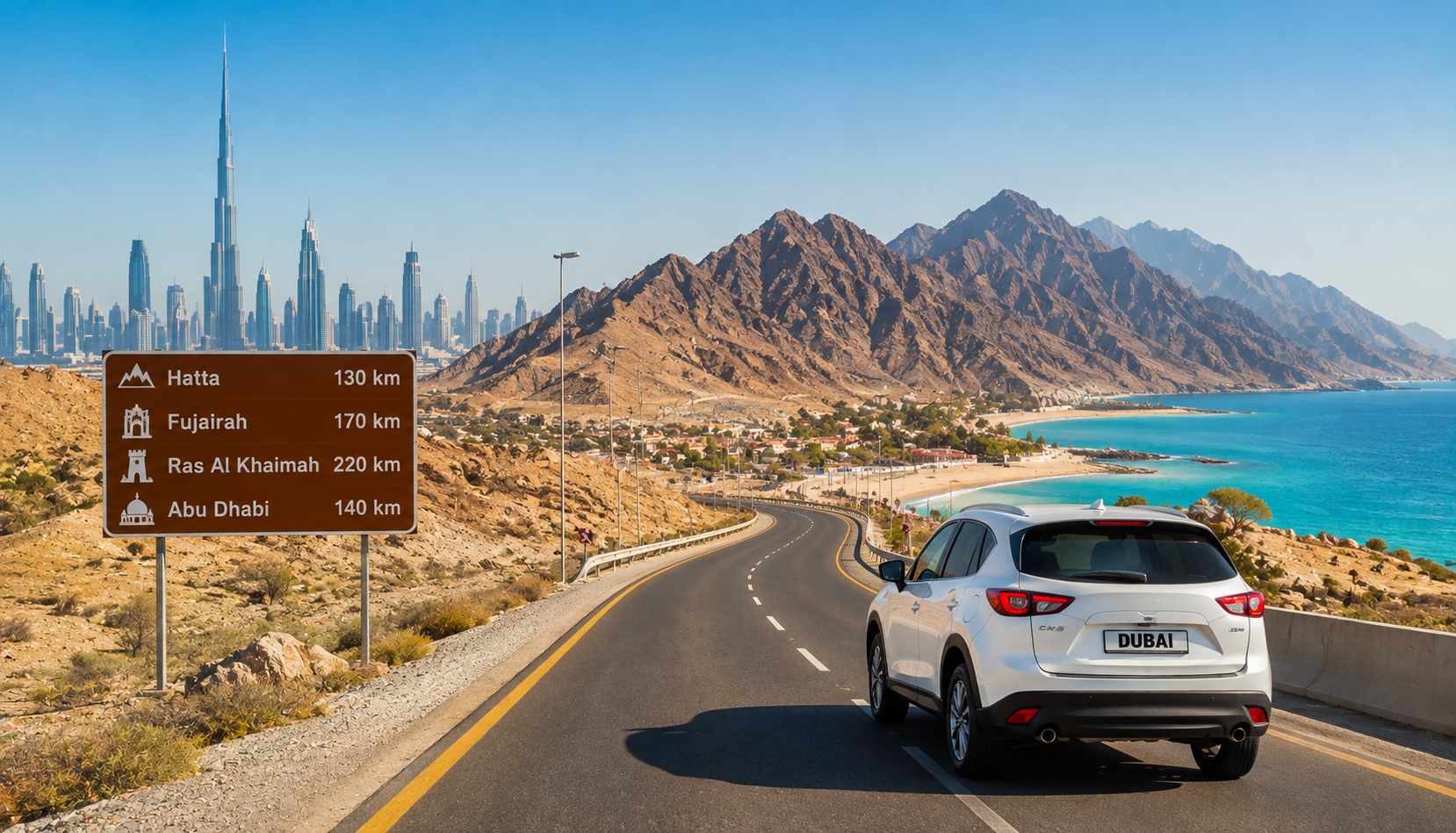
Within three hours of driving from Dubai you can reach a 1,934-metre mountain summit, the edge of the world’s largest sand desert, and a coastline on a different sea. Few countries compress that much variety into a single afternoon’s range.
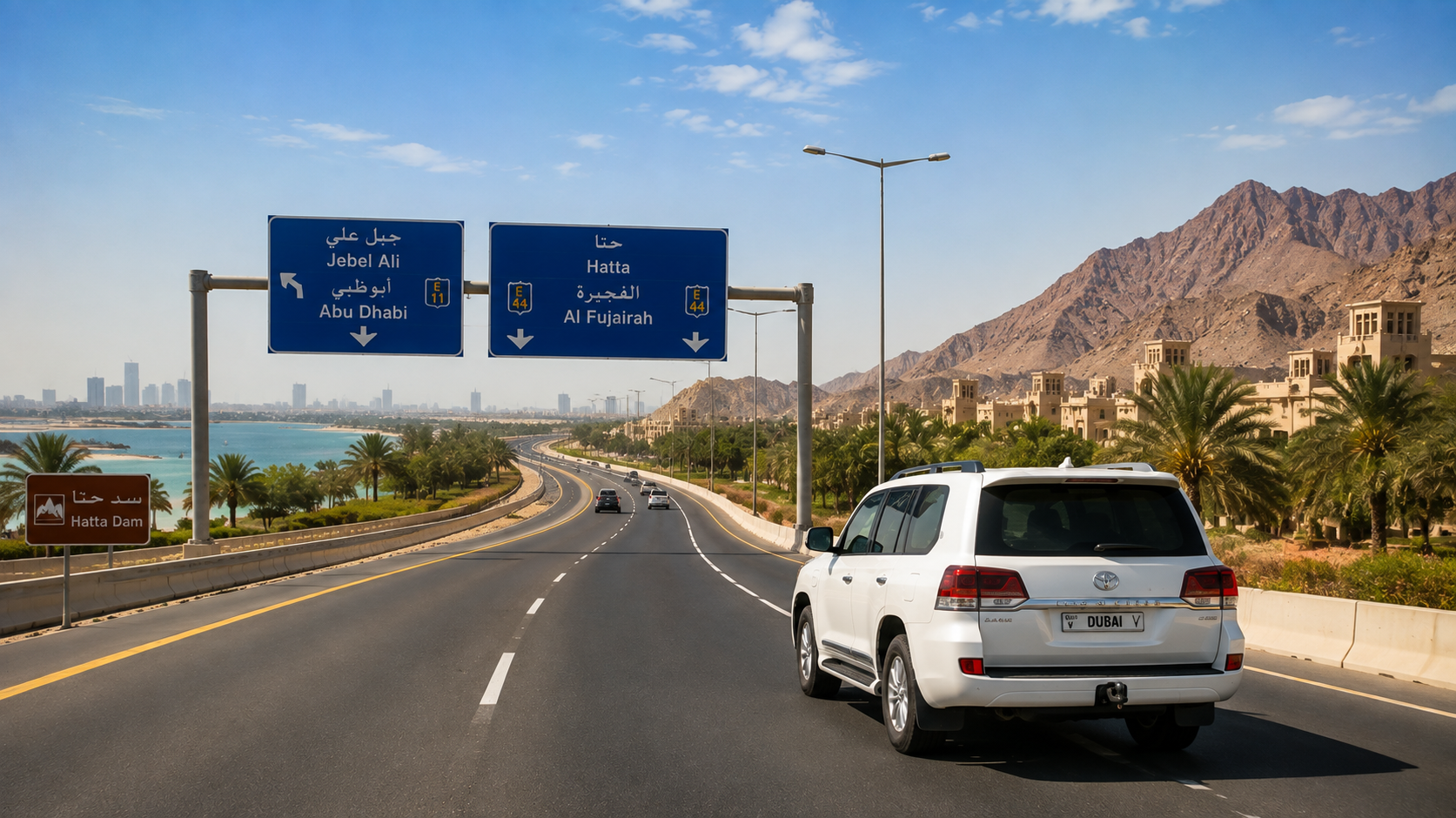
The infrastructure makes it easy in a way that is genuinely unusual: multi-lane highways in excellent condition, English signage everywhere, automated tolls that never require stopping, and fuel among the cheapest in the developed world. A weekend away needs almost no logistics beyond deciding which direction to point the car.
This guide covers eight destinations grouped by character — mountains, desert, coast, heritage cities and quick escapes — with the drive itself, what waits at the end, which vehicle you actually need, and when to go. Prices and conditions reflect August 2026 and shift; fuel in particular is repriced monthly, so check before budgeting a long route.
Distance from Dubai sorts the options more usefully than anything else, because it determines whether something is an afternoon, a day or a weekend.
| Destination | Drive from Dubai | Character | Vehicle |
|---|---|---|---|
| Sharjah | 30 minutes | Museums, heritage, souks | Any |
| Ajman | 45 minutes | Mangroves, quiet beaches | Any |
| Umm Al Quwain | 1 hour | Wildlife, water park, low-key | Any |
| Al Ain | 1.5 hours | Oases, UNESCO heritage, mountain road | Any |
| Abu Dhabi | 1.5 hours | Capital culture, museums, islands | Any |
| Hatta | 2 hours | Mountains, dam, kayaking | Any, SUV for trails |
| Jebel Jais, RAK | 2 – 2.5 hours | Summit road, zipline, cool air | Any |
| Fujairah East Coast | 2 hours | Gulf of Oman beaches, diving | Any |
| Liwa | 2.5 – 3.5 hours | Empty Quarter dunes, desert resort | 4x4 beyond paved roads |
One point worth absorbing before planning anything: only Liwa genuinely requires a specialised vehicle, and only for the dunes themselves. Everything else on that list is reachable in an ordinary car on well-maintained tarmac. The instinct to rent a large four-wheel drive for a UAE road trip is usually the rental company’s idea rather than a requirement.
Requirements differ sharply between residents and visitors, and the difference catches people out at the rental desk.
On rentals, expect economy cars from around AED 100 to 150 a day, mid-size crossovers at AED 200 to 300, and premium vehicles from AED 500 upwards, with weekly and monthly rates cutting 20 to 40 per cent. Take the collision damage waiver seriously: standard packages include third-party liability but leave an excess of AED 1,500 to 3,000 on any damage claim.
If Oman is anywhere in your plan, raise it at booking. Most UAE rental cars are not insured across the border, cross-border cover adds AED 100 to 200, some companies levy a daily surcharge, and a few prohibit it outright. Discovering this at the frontier ends the trip.
Two running costs shape a road trip budget, and both work differently from what most visitors expect.
Tolls are a Dubai phenomenon only. The Salik system reads a windscreen tag and debits automatically at AED 4 to 6 per gate — no stopping, no cash. Rental cars come with active tags and the charges appear on the final bill with a small administrative fee. Crucially, no other emirate operates an equivalent system: driving through Sharjah, Ajman, Ras Al Khaimah, Fujairah or Al Ain costs nothing in tolls. Only entering and leaving Dubai does. A round trip to Abu Dhabi adds roughly AED 20 to 30; a day of active Dubai driving before departure can add AED 30 to 60.
Fuel is repriced monthly by the government, and 2026 has been an unusually volatile year — the figure has moved across a range of roughly AED 2.65 to 3.30 per litre for the standard grade depending on the month. Even at the upper end that is a third to a half of typical Western European pricing, and a full weekend of driving rarely exceeds AED 200 to 400. Check the current month’s rate rather than assuming, particularly for the longer southern routes.
Two mountain destinations sit within a comfortable two hours, and they offer quite different experiences.
Hatta
A Dubai exclave 130 kilometres east, surrounded on three sides by Omani territory — which produces the trip’s one administrative quirk: the road passes through Oman near the Madam junction, so carry a passport even for a UAE-only day out. Occasional checkpoint verification does happen.
The draw is Hatta Dam, turquoise water held between Hajar Mountain walls, with kayak rental at AED 60 to 100 an hour. Beyond it sit the restored Heritage Village, a hill park with barbecue areas and viewpoints, and an adventure hub offering mountain biking and similar. Winter mornings drop to 5 to 10 degrees at elevation, which makes hiking genuinely pleasant rather than an endurance exercise.
Jebel Jais, Ras Al Khaimah
The destination here is partly the road. Thirty-six kilometres of engineered switchbacks climb to 1,934 metres with proper barriers, laybys and viewpoints throughout — it stands comparison with any celebrated mountain drive anywhere, and would be worth doing with nothing at the top.
There is something at the top regardless: the world’s longest zipline at 2.83 kilometres, which needs booking two or three days ahead at around AED 650; a mountain sledge track; a free viewing deck; and the country’s highest restaurant at 1,484 metres. The summit runs 8 to 10 degrees cooler than sea level, which turns a 45-degree August afternoon into something tolerable and can produce actual frost in January.
Liwa is the only destination on this list that requires real preparation, and the only one that rewards it with genuine remoteness.
The drive runs 250 to 280 kilometres south through Abu Dhabi, taking two and a half to three and a half hours depending on capital traffic. It ends at the northern edge of the Rub’ al Khali — the Empty Quarter, the largest continuous sand desert on earth, spanning into Saudi Arabia and Oman. Moreeb Dune rises around 300 metres and hosts dune-racing events each January; Qasr Al Sarab, the luxury desert resort at AED 2,500 to 5,000 a night, provides the comfortable version of the experience; the oasis itself holds traditional palm groves and Bedouin heritage sites.
Two constraints are non-negotiable. A four-wheel drive is essential for anything beyond the paved roads, and dune driving specifically requires a trained driver — book through a qualified operator in Liwa town rather than improvising. And the season is genuinely narrow: November to March only. Summer temperatures exceed 55 degrees in the deep desert, which is not an inconvenience but a hazard. Winter mornings, conversely, can drop to 5 degrees, which surprises almost everyone.
The east coast offers something the Dubai shoreline cannot: a different sea. Fujairah and the Sharjah exclaves face the Gulf of Oman rather than the Arabian Gulf, and the water is measurably clearer and cooler year-round, with better snorkelling and diving and far less industrial development.
The route matters as much as the beach. The road from Sharjah cuts through the Hajar Mountains via wadis and traditional villages, and it is the scenic portion of the journey — 150 kilometres and around two hours in total, on well-paved road with proper barriers.
Two destinations at ninety minutes each, both on fast straight highways, both offering something Dubai does not.
Al Ain
The country’s greenest city, a UNESCO World Heritage Site at the foot of Jebel Hafeet, and the birthplace of the nation’s founder. The oasis holds 147,000 date palms fed by traditional falaj irrigation channels, with walking trails through the shade — a genuinely different register from anything on the coast.
The Jebel Hafeet road is the other reason to come: 11.7 kilometres of switchbacks to 1,240 metres, regularly listed among the world’s best driving roads, and best taken at sunset for the views back across the city. Hot springs sit in the park at the base, and accommodation — including a hotel at the summit — runs AED 400 to 800 a night, notably cheaper than the Dubai equivalent.
Abu Dhabi
The capital moves at a different pace: wealthier per head than Dubai, more traditional in atmosphere, and stronger on institutional culture. Sheikh Zayed Grand Mosque is free to enter with respectful dress and is among the largest in the world; the Louvre charges AED 63 and is worth a half-day on its own. Yas Island holds the major theme parks, and the Saadiyat beaches are among the cleanest in the country.
This is the one route with meaningful toll costs, since Sheikh Zayed Road carries multiple gates on the Dubai section. Budget AED 20 to 30 for the round trip.
Three emirates sit close enough for an afternoon, and each has a distinct character rather than being a smaller version of Dubai.
Season is the single largest variable in whether a UAE road trip is a pleasure or an ordeal.
| Month | Temperature | Suitability |
|---|---|---|
| October | 30 – 38°C | Season opens, beaches viable again |
| November | 24 – 32°C | Excellent across all destinations |
| December | 18 – 26°C | The best month overall — warm days, cool nights |
| January | 16 – 24°C | Peak winter, frost possible on Jebel Jais |
| February | 17 – 26°C | Ideal for the desert |
| March | 20 – 30°C | Still good for mountains, season winding down |
| April | 24 – 35°C | Last comfortable month, mornings only for beaches |
| May – September | 30 – 45°C and above | Indoor attractions only; outdoor exposure is dangerous |
If you must drive in summer, go at sunrise or after six in the evening, carry more water than seems necessary, check the air conditioning before departure, and never leave anyone in a parked car. During Ramadan, driving itself is unaffected but many restaurants close until sunset, and traffic becomes noticeably faster and less patient in the fifteen minutes before iftar — a good stretch to be off the road. Spring brings occasional sandstorms that cut visibility sharply; weather apps give around a day’s warning, and pulling over safely is the correct response.
A few conventions are worth knowing before the first long drive.
Oman opens up two further options, both requiring a visa, additional insurance at AED 100 to 200, and full documentation. Musandam is around three hours via Ras Al Khaimah and delivers fjord landscapes and dhow cruises with dolphins; Muscat is five to six hours via Al Ain and Nizwa. Border crossings take 30 to 90 minutes, and fuel stations thin out considerably outside the Omani capital, so fill up before crossing.
For residents rather than visitors, road-trip access is a genuine input into where to live — and one that rarely appears on a property brochure.
Highway proximity works quietly in your favour every weekend. Neighbourhoods with fast access to the main northern artery reach Ras Al Khaimah, Fujairah and Hatta without first crossing the city; those positioned for the coastal road reach Abu Dhabi and the south more easily. Over a few years of weekends, that difference in access is worth more than most of the amenities that get marketed, and it belongs in the same conversation as the other factors covered in our note on why location matters in real estate.
A second pattern is common among longer-term residents: a primary Dubai home plus a weekend property in Ras Al Khaimah or on the Fujairah coast. If that is the direction of travel, two things need checking early. The ownership form available in the specific location determines what you actually acquire, and the distinction is set out in our comparison of freehold and leasehold property in Dubai. And the transaction costs on a second property are the same percentages as on the first, which on a modest weekend home is a larger proportional bite — the fee structure is broken down in our guide to Dubai Land Department fees.
After a weekend in the mountains or the desert, the return to the city tends to end the same way — with dinner somewhere that justifies the drive back. Our guide to the best areas in Dubai for nightlife, dining and entertainment covers where to point the car once you are home.
Can tourists rent a car without an international driving permit?
It depends on nationality. Citizens of the US, UK, Canada, Australia, most EU states, Japan and South Korea can rent on a home licence. Others need an international permit, obtained before travelling, since it cannot be issued in the UAE.
How does fuel compare with European prices?
Substantially cheaper — roughly a third to a half of typical Western European pricing. Rates are reset monthly by the government and have moved noticeably through 2026, so check the current month before budgeting a long route.
What is the best single-day trip from Dubai?
It depends on what you want. Hatta at two hours for mountains and kayaking, Sharjah at thirty minutes for museums, Ajman at forty-five for mangroves, Abu Dhabi at ninety minutes for the Grand Mosque, Al Ain at ninety for the Jebel Hafeet drive.
Do I need a four-wheel drive?
Not for most destinations. An ordinary car handles Abu Dhabi, Al Ain, Sharjah, Ajman and the main routes to Hatta, Jebel Jais and Fujairah. A four-wheel drive is essential only for deep desert driving around Liwa.
What do tolls cost for a weekend in Abu Dhabi?
Around AED 20 to 30 for the round trip on the coastal highway, plus any Dubai gates crossed before departure. Budget AED 30 to 50 in total. No other emirate charges tolls.
Is driving here safe for visitors?
The infrastructure is excellent and signage is in English throughout, so the practical difficulty is low. The main risks are heat exposure on summer drives and automated speed enforcement, both of which are entirely manageable with planning.
Can I drive to Muscat?
Yes, in five to six hours via Al Ain and Nizwa, with a visa, cross-border insurance and full documentation. A rental car needs the company’s advance approval, and some prohibit it entirely.
When is the best time of year?
November to March, with December the strongest single month. October and April work for morning activities. Peak-season weekends need accommodation booked two to three weeks ahead.
Two apartments at the same price can sit forty minutes apart in practical terms once the weekend starts, depending on which highway they feed onto and whether reaching it means crossing the city first. That difference compounds across every trip you take. DDA Real Estate is a real estate agency in the UAE. We work across Dubai, Abu Dhabi and the northern emirates, and we factor access into the shortlist — how a neighbourhood connects to the main arteries, and what a weekend property on the coast or in the mountains would actually cost to own.
Explore our UAE listings and get in touch: we will match properties to your budget and the way you actually use the country, compare locations on real journey times rather than map distance, and set out the full cost of a second home if that is the direction you are heading.