

Online Banking UAE 2026: Digital Banks Guide
971 56 596-5009
day and night
United Arab Emirates
EN
$
ft²
Other articles

Online Banking in the UAE: How Digital Banking Works for Residents and Expats

Liliya Vardanyan The author of the article, the Broker
#Blog DDA
8 June 3969 views

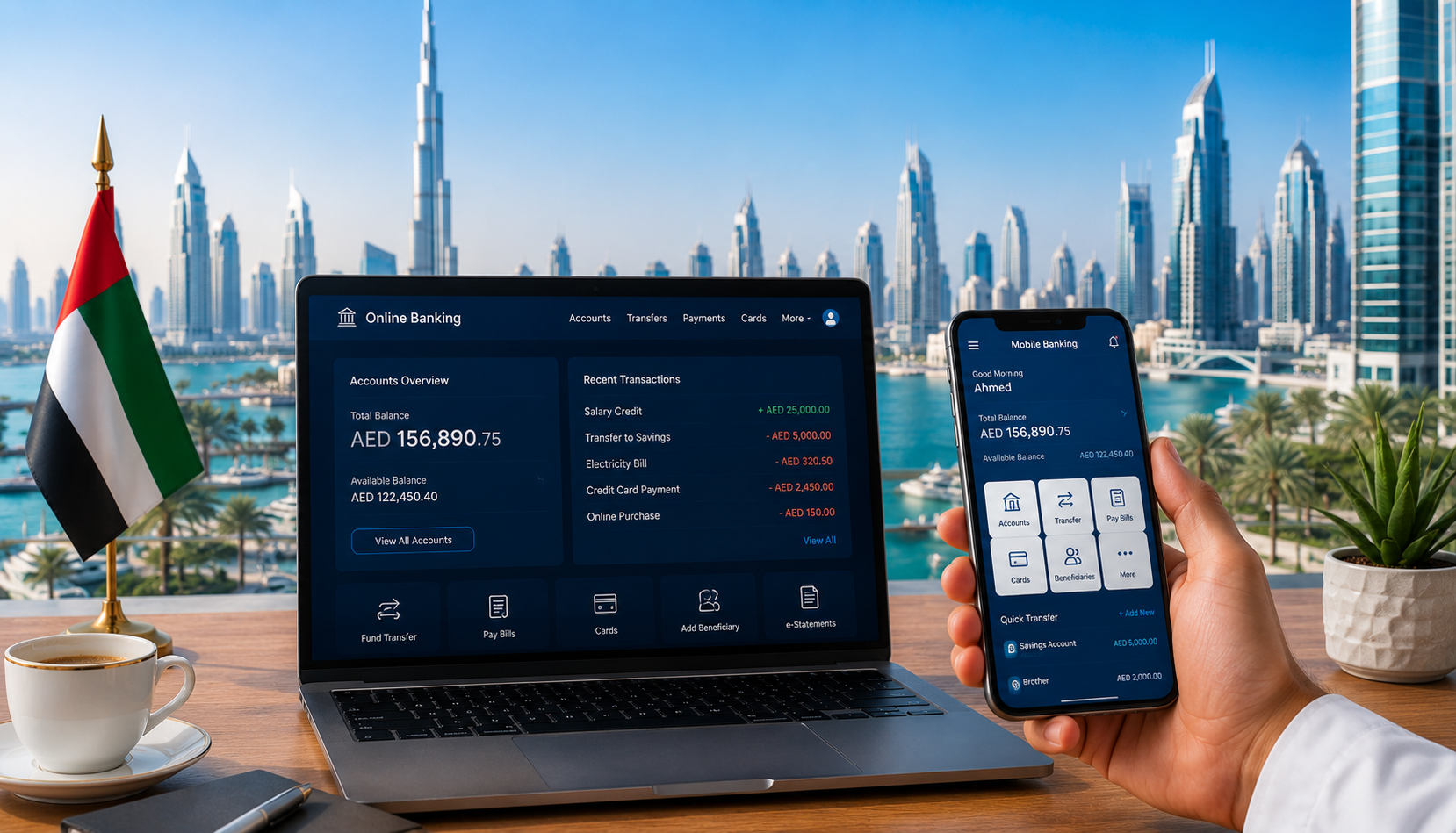
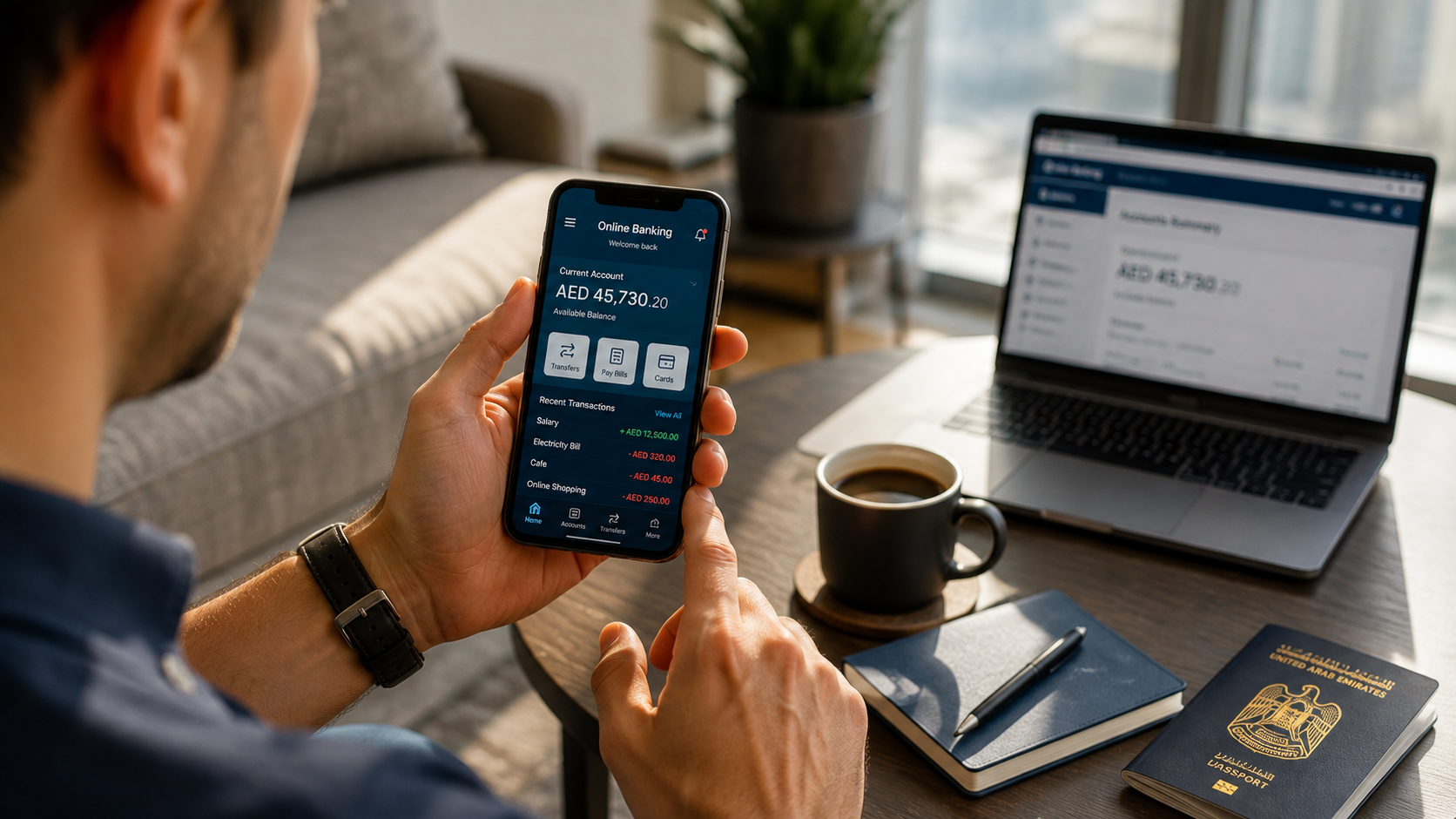
A new UAE resident with a valid Emirates ID can have a working bank account fifteen minutes after downloading an app. At a traditional bank the same person waits three to seven days and visits a branch in person. That gap is the single most useful thing to understand about banking here.

Three fully digital banks lead the retail market — Wio, Liv X and Mashreq Neo — alongside established names that still hold the ground that matters for property: mortgages, cheque books and non-resident accounts. Underpinning all of them is Aani, the national instant payment network, which moves money between any two UAE accounts in seconds using a mobile number.

This guide sets out what each tier is good for, what documents you need as a resident or a non-resident, how the systems behind salary and instant payments work, and which combination suits which situation. Details reflect August 2026 and change frequently — confirm current terms with the bank before committing.

How the Market Splits

Every bank in the country, digital or otherwise, is licensed and supervised by the central bank, and all of them apply the same identity and anti-money-laundering requirements. What differs is speed, cost of entry and the range of products behind the app.

  • Fully digital banks. Branchless and app-based: Wio, Liv X, Mashreq Neo, YAP, Zand, Mbank. Account opening takes minutes, minimum balances are usually zero, and the interface is built rather than retrofitted.
  • Traditional banks with digital services. Emirates NBD, ADCB, FAB, Mashreq, RAKBANK, ADIB. Slower to open, higher minimums, but they hold the products digital banks mostly do not: mortgages, cheque books, branch support and non-resident accounts.
  • International banks. HSBC, Standard Chartered and Citibank, positioned around clients who need accounts linked across countries and who can meet substantial balance requirements.

The practical implication is that this is rarely an either-or decision. Most residents end up better served by one digital account for daily life and one traditional relationship kept ready for the moment a mortgage or a property transaction appears.

What You Need to Open an Account

The document list diverges sharply depending on whether you hold residency, and the gap explains most of the frustration non-residents encounter.

ResidentsNon-residents
Core identity documentEmirates ID, originalPassport with six months validity
VisaValid residence visa matching the IDNot applicable
Proof of addressRegistered tenancy contract, utility bill or title deedHome country equivalent, sometimes notarised
Financial backgroundSalary certificate or employment letterThree to six months of home bank statements
ReferencesNot usually requiredLetter from your home bank
Minimum balanceOften zero at digital banksAED 25,000 – 100,000, and far higher at premium tiers
Account types availableCurrent and savingsSavings only

That last row is the one that surprises people. Without a residence visa you cannot hold a current account with a cheque book — only savings. Since cheques remain embedded in UAE rental and property practice, this is a genuine functional limitation rather than an inconvenience.

Two smaller points ease the process for new arrivals. Many banks now accept an employment offer letter in place of a salary certificate, which removes a chicken-and-egg problem in the first weeks. And digital banks will often take a tenancy contract straight from the official property app rather than requiring a printed copy, where traditional banks usually will not.

The Digital Banks

The three leading digital banks are not interchangeable — each has built around a different type of customer, and choosing on interface alone tends to produce a mismatch.

Wio

The first fully digital bank licensed directly by the central bank, backed by an Abu Dhabi sovereign investor, which gives it institutional weight that newer entrants lack. Its personal account carries no minimum balance and folds in stock, gold and fund investing directly in the app.

Its real differentiator is business banking. Onboarding for free zone companies is materially simpler than at traditional banks, with invoicing, expense categorisation and analytics built in — and it is the one route by which a non-resident can realistically obtain UAE banking, by registering a free zone entity first and opening a business account against it. A creator account launched in January 2026 extends this to people earning across multiple platforms, with revenue tracking and tax preparation tools.

Liv X

Emirates NBD’s digital arm, rebranded and expanded through 2025 and 2026 with investing and multi-currency cards. It runs on the parent bank’s identity infrastructure, so opening takes about fifteen minutes, and it inherits access to the largest ATM network in the country plus the option of branch support when something genuinely needs a human.

Positioning is deliberately lifestyle-led — cashback up to 4 per cent with a monthly cap, automated expense categorisation, savings goals, travel rewards — and aimed at younger salaried professionals. The quiet advantage is the parent relationship: mortgage products remain reachable through Emirates NBD rather than requiring a separate banking relationship later.

Mashreq Neo

The oldest of the three, launched in 2017, and the most conservative in character. It offers among the strongest savings rates in the digital tier, multi-currency savings in four currencies, and a broader investment range than either Wio or Liv X, including funds and structured products.

The trade-off is onboarding: expect to supply an employment letter or a source-of-funds declaration where competitors ask for less. In return, large transactions clear more readily, which matters if the account will handle property-scale sums rather than everyday spending.

The rest

  • YAP. Built around multi-currency handling and competitive exchange rates, run in partnership with RAKBANK. The strongest choice for anyone sending money home regularly.
  • ADCB Hayyak. ADCB’s digital arm, useful mainly for the parent bank’s branch and ATM coverage. International features are thin.
  • Zand. A hybrid retail and corporate model aimed at higher-net-worth individuals and businesses rather than everyday users.
  • Mbank. Free current and savings accounts with no minimum. A sound budget option where premium features are not the point.

When a Traditional Bank Still Wins

Digital banks handle daily life better on almost every measure. The exceptions are narrow but consequential, and nearly all of them involve property.

Mortgages are the clearest case. No fully digital bank currently originates them; Liv X reaches them only through its parent. Traditional lenders offer up to 80 per cent loan-to-value for residents and hold the relationships with developers that matter on off-plan purchases — the mechanics of which are set out in our guide to mortgages for off-plan property in Dubai.

Non-residents are the second case. Where a digital bank simply declines, the international tiers at HSBC and Emirates NBD will open accounts against balances of roughly AED 350,000 to 500,000, and support property transactions without local residency. The lending side of that picture — narrower and pricier than for residents — is covered in our guide to Dubai mortgage options for non-residents.

  • Emirates NBD. The largest bank by assets, with the widest branch and ATM network and the deepest mortgage range. Its priority tier at AED 500,000 and above adds relationship management and preferential exchange rates.
  • ADCB. Notably strong on English-language service and documentation, with competitive remittance corridors to India, the Philippines and the UK.
  • FAB. Oriented toward corporate banking, wealth management and substantial balances rather than everyday retail.
  • HSBC and Standard Chartered. For clients who need accounts linked across countries, at high balance thresholds.
  • RAKBANK. Lower fees than the major banks and a natural fit for residents of the northern emirates.

Comparing the Options

Set side by side, the trade-off between speed of entry and depth of product becomes obvious.

BankMinimum balanceOpening timeStrongest for
WioAED 015 minutesFreelancers, creators, small businesses
Liv XAED 0 with conditions15 minutesYoung salaried professionals
Mashreq NeoAED 0, higher tier from AED 3,00015 – 20 minutesSavings rates and investments
YAPAED 010 – 15 minutesMulti-currency and remittances
MbankAED 010 minutesBasic banking on a budget
Emirates NBDAED 3,000 – 5,0003 – 7 daysMortgages and long relationships
ADCBAED 3,000 – 5,0003 – 5 daysService quality and transfers
FABFrom AED 5,0005 – 7 daysLarge balances and business
HSBC PremierFrom AED 350,0005 – 10 daysInternational and non-residents
RAKBANKAED 3,0003 – 5 daysNorthern emirates, lower fees

Salary Payments and Instant Transfers

Two national systems shape how money actually moves, and neither restricts which bank you choose.

The wage protection system

Employers on the mainland and in most free zones are required to pay salaries through a central electronic system, which means your account must sit with a registered bank. In practice every UAE bank is registered, so this constrains nothing — but it does mean telling your employer promptly when you switch, since a mismatch between HR records and your account interrupts payment.

Salary transfer is also where the benefits concentrate. Banks routinely waive monthly fees, raise card limits, unlock personal lending and pre-approve mortgages for accounts receiving a salary. Those concessions are frequently worth more than the headline features of a premium account, which is an argument for choosing your salary bank deliberately rather than accepting whatever HR suggests.

Aani

Launched by the central bank in late 2023 and fully deployed across the market during 2024 and 2025, Aani moves money between any two UAE accounts in seconds, at any hour, using a mobile number instead of account details. It replaced interbank transfers that previously took one to two working days.

The effect on daily life has been larger than the description suggests. Rent to a landlord, splitting a restaurant bill, paying a contractor or a domestic worker, sending money to family — all of it now settles instantly and, for personal use within monthly limits, without fees. Registration is a one-time step with your bank.

Moving Money Across Currencies

For most expatriates this is the second most important banking question after salary, and the right tool depends heavily on amount.

  • Multi-currency accounts. Mashreq Neo holds four currencies in separate sub-accounts; YAP is built around currency handling with tight margins; Liv X added multi-currency cards through 2025 and 2026; HSBC’s premier tier links accounts across its global network, which can make transfers between your own accounts cheap or free.
  • Traditional wire transfers. Available from any major bank at AED 30 to 100 plus intermediary charges, arriving in one to five business days. The sensible choice above roughly AED 50,000, where fixed fees stop mattering and reliability does.
  • Direct remittance corridors. Several digital banks operate dedicated routes to India, Pakistan, the Philippines and the UK at rates competitive with specialist services.
  • Specialist transfer services. Generally the best rates for smaller sums between roughly AED 1,000 and 50,000, though they function alongside a bank account rather than replacing one.
  • Exchange houses. Still widely used for cash transfers, particularly where the recipient has no bank account.

One rule cuts through the comparison: for anything at property scale, judge the total that lands rather than the advertised fee. The exchange margin on a large transfer routinely exceeds every explicit charge combined, and it is the number least prominently displayed.

Security and What Is Now Standard

Feature parity across digital banks is high, so these rarely differentiate — but knowing what to expect helps identify a weak offering.

  • Biometric login. Face or fingerprint authentication as the default access method.
  • Instant card freeze. Lock and unlock a card from the app the moment it goes missing, without calling anyone.
  • Virtual cards. Disposable or dedicated card numbers for online purchases and subscriptions, isolating your main card from exposure.
  • Real-time notifications. Every transaction pushes instantly, which is what makes unauthorised activity detectable within seconds rather than at month end.
  • Spending analysis. Automated categorisation, subscription tracking and budget forecasting are now standard across the digital tier.
  • National digital identity integration. Single sign-on linking banking with government services, property registration and utilities.

Which Setup Suits Which Situation

Rather than a single best bank, the useful question is which combination fits the way you will actually use it.

SituationPrimaryAlongside it
Salaried employee, straightforward needsLiv X or Wio personalA traditional account opened before a mortgage application
Freelancer or creatorWio, creator or personal accountYAP if clients pay in several currencies
Small business ownerWio business accountA traditional bank once volumes or trade finance grow
Property buyer seeking a mortgageEmirates NBD or ADCBA digital account for daily spending and instant transfers
Retiree on long-term residencyA premium tier with advisory serviceMashreq Neo if wealth management is not needed
Non-residentWio business via a free zone entityHSBC or Emirates NBD premier tier at high balance

The property buyer row deserves emphasis, because the sequencing catches people out. Mortgage pre-approval draws on banking history, so opening a traditional account only when you find a property costs weeks at exactly the point where speed matters most. Opening it early and letting it accumulate a record is close to free.

Banking also intersects with property in two places most buyers meet unprepared. Payments on projects under construction are held in supervised accounts rather than paid to the developer directly, a mechanism explained in our piece on escrow accounts in Dubai real estate. And at completion, settlement and the associated fees follow a defined sequence, which we set out in our walkthrough of the property transfer process in Dubai.

Frequently Asked Questions

How long does opening an account take?

About fifteen minutes at a digital bank if you hold a valid Emirates ID, or three to seven working days at a traditional bank, including a branch visit for signatures and document verification.

Can non-residents open an account online?

Generally no. Digital banks require residency for personal accounts, with one route around it: registering a free zone entity and opening a business account against it. Traditional banks accept non-residents but require an in-person visit and substantial minimum balances.

What minimum balance should I expect?

Zero at most digital banks. AED 3,000 to 5,000 for a traditional current account, AED 25,000 to 100,000 for non-resident accounts, and AED 350,000 or more for premier and priority tiers.

Does instant transfer work between different banks?

Yes. The national instant payment network is deployed across all major banks, digital and traditional alike, and transfers settle in seconds using a registered mobile number.

Can I get a mortgage from a digital bank?

Not directly. Liv X reaches Emirates NBD mortgage products through its parent, but the mainstream route remains a traditional lender, with up to 80 per cent loan-to-value for residents.

What do digital accounts cost to run?

Basic tiers usually carry no monthly maintenance fee. Higher tiers charge roughly AED 10 to 25 monthly if spending or salary conditions are not met. Traditional banks typically charge around AED 25 monthly if the minimum balance lapses.

Which option is best for sending money home?

For regular transfers, a multi-currency account or a dedicated remittance corridor usually wins on rate. For large one-off sums, a traditional wire is more reliable. Compare the amount that arrives rather than the fee quoted.

Can I switch banks without disrupting my salary?

Yes, provided you update your employer’s records promptly. Allow one payroll cycle for the transition; some banks bridge the gap with temporary credit.

Key Points to Remember

  • Speed is the defining difference. Fifteen minutes against several days, with a branch visit at one end and none at the other.
  • Residency draws the hard line. Without it, current accounts and cheque books are unavailable, which limits participation in normal rental and property practice.
  • Mortgages still live at traditional banks. No fully digital bank originates them, so a property plan means opening a conventional relationship at some point.
  • Open the traditional account early. Pre-approval draws on banking history; starting the relationship when you find a property costs weeks you will not have.
  • Two accounts beat one. A digital bank for daily life and a traditional one held ready covers nearly every situation without compromise.

The Banking Setup Comes Before the Property Search

Buyers regularly discover in the same week that they want a specific property, need a mortgage, and have no banking history with a lender who offers one. The sequence works far better in the other order: establish the relationship, let a few months of record accumulate, and arrive at the negotiation already financeable. DDA Real Estate is a real estate agency in the UAE. We work with buyers across Dubai, Abu Dhabi and the northern emirates, and we raise the financing question at the start of a search rather than at the offer stage.

Explore our UAE listings and get in touch: we will match properties to your budget and financing position, set out what a mortgage application will need from you and when, and coordinate the payment and transfer steps so the transaction side does not become the bottleneck.

Popular
5 June 4151133 view
Dubai Rent Prices 2025: Average Apartment Rental Costs in Dubai Dubai's rental market continues its upward climb in 2025, driven by population growth and limited new supply, pushing average prices up by 10%

#Blog DDA
2 July 2381904 view
DLD Fees in Dubai: Everything You Need to Know Buying property in Dubai? Don't let hidden fees surprise you! Our essential guide breaks down ALL Dubai Land Department (DLD) fees
#Blog DDA
23 November 1709127 views
How to Buy a SIM Card in Turkey in 2026: Prices, IMEI Registration, eSIM Options, and Best Mobile Operators Overview of mobile operators, available types of SIM cards, and home Internet providers
#Blog DDA
5 July 1702008 views
How Much is the Real Estate Agent Commission in Dubai? Find out how much real estate agent commission costs when buying property in Dubai.
#Blog DDA
5 February 1394505 views
How Foreigners Can Own Property in Bali: Understanding PT PMA (2025) Foreigners can't own freehold land in Bali, but a PT PMA (foreign-owned company) allows secure property ownership under Hak Guna Bangunan (HGB) or Hak Pakai (HP) rights
#Blog DDA
28 August 1145655 views
Oqood vs Title Deed in Dubai: Key Differences You Must Know Buying property off-plan in Dubai? Oqood registration is mandatory to secure your ownership rights.
#Blog DDA