Off-plan properties
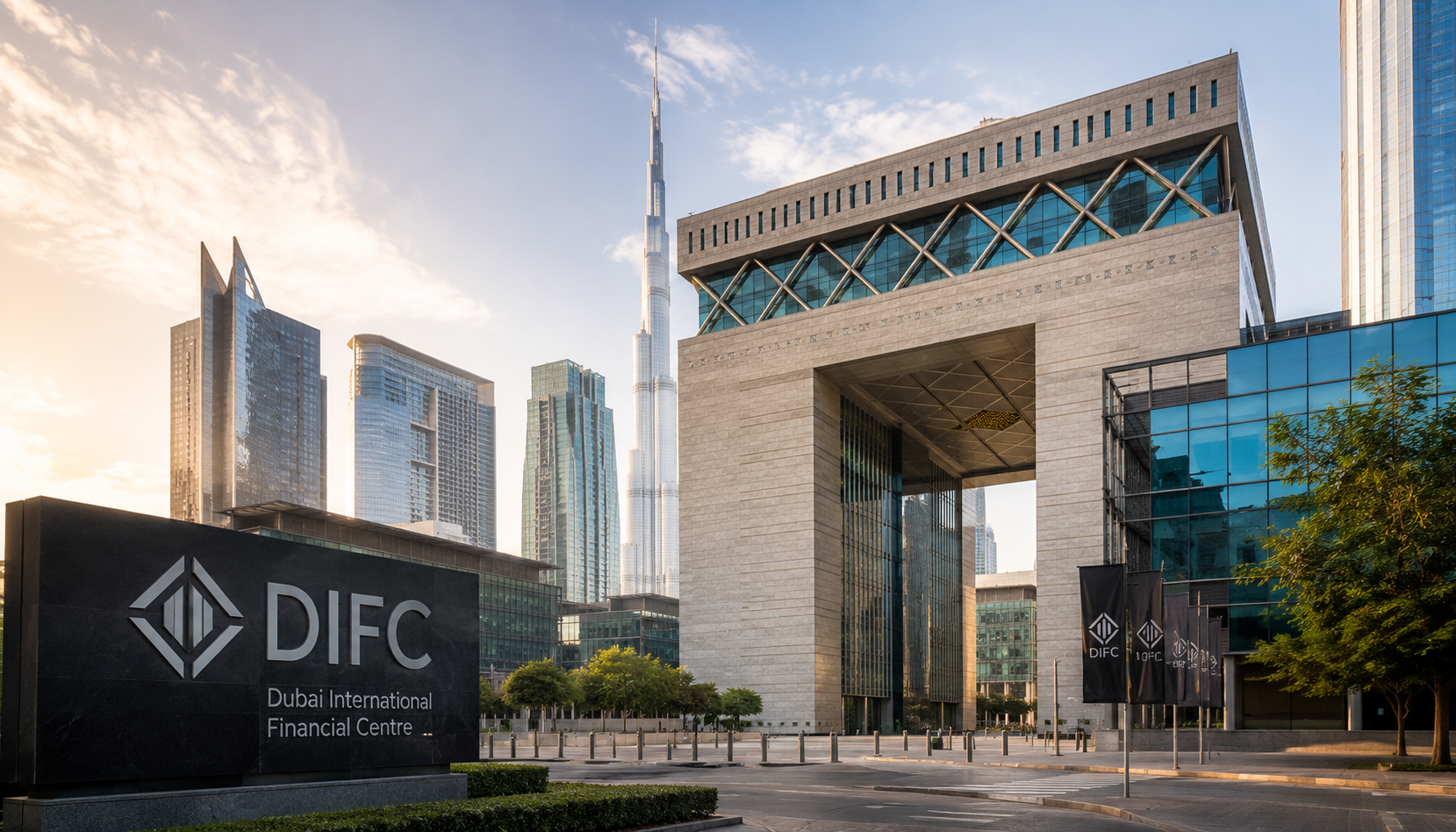
Most Dubai free zones offer cheaper company setup than DIFC. None of them offer what DIFC actually sells: an independent legal system built on English Common Law, with its own courts and its own financial regulator. That is the entire proposition, and it explains both the premium and the queue.
The numbers behind the queue are striking. In the first quarter of 2026 alone, 775 new companies registered — 62 per cent up year on year — taking the total past 5,523 active entities and the working population beyond 25,000 professionals. New family office foundations more than doubled over the same period.
This guide sets out what makes DIFC structurally different, how the 2026 tax framework really works, which five types of business it suits and which it does not, what setup costs and requires, and the commercial and residential property market inside it. Figures reflect August 2026 and are indicative; confirm current requirements with the authority or a licensed adviser before acting.
The distinction that matters is legal, not fiscal. Every UAE free zone offers ownership and tax advantages; DIFC is one of only two jurisdictions in the country that operates outside UAE civil law entirely.
For a firm doing complex cross-border transactions, this is not an abstraction. The ability to write a contract that will be interpreted by a court applying familiar principles, with an outcome enforceable across most of the world, is the specific thing multinationals are paying the premium for. Everything else DIFC offers is available more cheaply elsewhere.
DIFC is regularly described as tax-free. That is not accurate, and the imprecision costs companies money when they structure badly.
| Element | Treatment | Condition |
|---|---|---|
| Qualifying income | 0 per cent corporate tax | Qualifying Free Zone Person status, for 50 years from incorporation |
| Non-qualifying income | 9 per cent above AED 375,000 | Applies to mainland activity and other non-qualifying sources |
| Personal income | 0 per cent | Unconditional, for employees and shareholders alike |
| Foreign ownership | 100 per cent permitted | No local partner requirement |
| Capital repatriation | Unrestricted | No withholding on profits or capital moved out |
Qualifying status is conditional and revocable, which is the part most often glossed over. Maintaining it requires audited financial statements, demonstrable substance in the centre — real employees, real premises, real management presence — and satisfaction of economic activity tests. Losing it costs the zero rate not only for that year but for the four years following, which turns a compliance lapse into a five-year tax event.
The practical consequence is that structuring is not optional housekeeping here. A company earning meaningfully from mainland activity while assuming blanket zero treatment will find the assumption expensive, and the time to model it is before incorporation rather than at the first audit.
Five categories account for most of the centre’s registrations, and the fit in each case is specific rather than general.
Financial services
Banks, asset managers and insurers form the core, with more than 350 financial firms now operating inside. Regulation by the centre’s own authority carries international credibility that a generic free zone licence does not, and for wealth managers the positioning is sharper still: the surrounding region holds an estimated USD 3.5 trillion in private wealth, and a neutral jurisdiction under English Law is precisely what those clients want as a booking centre.
Family offices
The fastest-growing category, with foundations more than doubling in the first quarter of 2026. The structure suits multi-generational wealth preservation, succession planning and philanthropy, and it combines privacy protections stronger than most jurisdictions with international recognition — a combination that is rarer than it sounds and particularly well matched to Middle Eastern and South Asian family structures.
Holding companies and regional headquarters
More than 200 of the Fortune Global 500 maintain a presence, most using the centre as a regional base rather than an operating company. The attraction is the combination of a neutral legal framework for governing subsidiaries across several jurisdictions and zero treatment on qualifying holding income.
Fintech and innovation
A dedicated innovation hub and accelerator provide subsidised workspace for early-stage firms, and an innovation licence covers non-regulated activity without the full regulatory burden. One notable 2026 change: from January the regulator stopped maintaining a list of recognised crypto tokens, shifting the assessment onto firms themselves against published criteria. That is more flexibility and correspondingly more responsibility.
Professional services
Over 100 international law firms and the major accounting networks operate from the centre, serving the financial ecosystem around them. The clustering is self-reinforcing: firms locate there because their clients are there.
This is the more useful section for most readers, because the wrong choice here is expensive in both fees and lost time.
Entry costs reflect the positioning. Setup starts from around AED 44,100, against AED 15,000 to 25,000 at standard Dubai free zones, though multi-year licences paid upfront typically attract a 15 to 20 per cent discount.
| Licence type | Suits | Typical timeline |
|---|---|---|
| Standard commercial | Professional services firms | 5 – 14 business days |
| Regulated | Financial services requiring authorisation | 30 – 90 days |
| Innovation | Non-regulated fintech and Web3 activity | 5 – 14 business days |
| Foundation | Family wealth and succession structuring | Varies with complexity |
The gap between five days and ninety is entirely about regulatory authorisation, and it is the single biggest planning variable. A professional services firm can be operating inside a fortnight; a regulated financial firm should budget a quarter and staff the application accordingly.
Physical premises are required for every licence type without exception. Innovation hub members access shared workstations at subsidised rates, while regulated firms generally take dedicated space in the main towers. That requirement is not merely administrative — it feeds directly into the substance test that qualifying tax status depends on.
Two comparisons come up constantly, and they have different answers.
| DIFC | Standard Dubai free zones | ADGM, Abu Dhabi | |
|---|---|---|---|
| Legal system | English Common Law | UAE civil law | English Common Law |
| Courts | Own independent courts | UAE courts | Own independent courts |
| Registered entities | Over 5,523 | Varies by zone | Over 2,000 |
| Setup from | AED 44,100 | AED 15,000 – 25,000 | Comparable to DIFC |
| Physical office | Mandatory, all licences | Often optional | Mandatory |
| Best for | Financial services and holding structures | Trading, consulting, SMEs | Financial services, crypto-forward |
Against other Dubai free zones the answer is usually clear-cut: unless you need the legal system or the financial ecosystem, you are paying a substantial premium for neither. Against Abu Dhabi’s equivalent the comparison is genuinely close — DIFC is larger, more established and better connected internationally, while its counterpart is growing faster proportionally, has built a stronger crypto framework and competes on cost. The deciding factor is usually where a firm’s clients and counterparties already sit.
The centre is a property market in its own right, and 2026 produced one of the largest office transactions in Dubai’s history.
Commercial
An Abu Dhabi developer acquired an under-construction 40-floor commercial tower for AED 2.3 billion in 2026, with completion due in 2028 — a transaction that says more about institutional confidence in the centre than any registration statistic. Prime space in the established buildings runs from roughly AED 200 to over AED 400 per square foot annually, and constrained supply of top-grade stock continues to push rents upward.
Residential
Several residential towers sit within the boundary itself, with more in walking distance across Downtown Dubai and Business Bay. Studios start around AED 800,000 to 1.2 million, one-bedroom units at AED 1.2 to 1.8 million, and two-bedroom at AED 1.8 to 2.8 million. Rental yields of 5 to 7 per cent are typical, supported by a tenant base of professionals working a few hundred metres away.
Two points matter for buyers. Ownership structures differ between developments, and the distinction between full ownership and long-term rights determines what you can do with the asset later — we set the difference out in our comparison of freehold and leasehold property in Dubai. And the transaction costs are the standard Dubai schedule rather than anything special to the centre, broken down in our guide to Dubai Land Department fees.
At these price points, property investment also clears the AED 2 million threshold for long-term residency in the upper part of the range, which for relocating professionals turns a housing decision and a visa decision into one transaction.
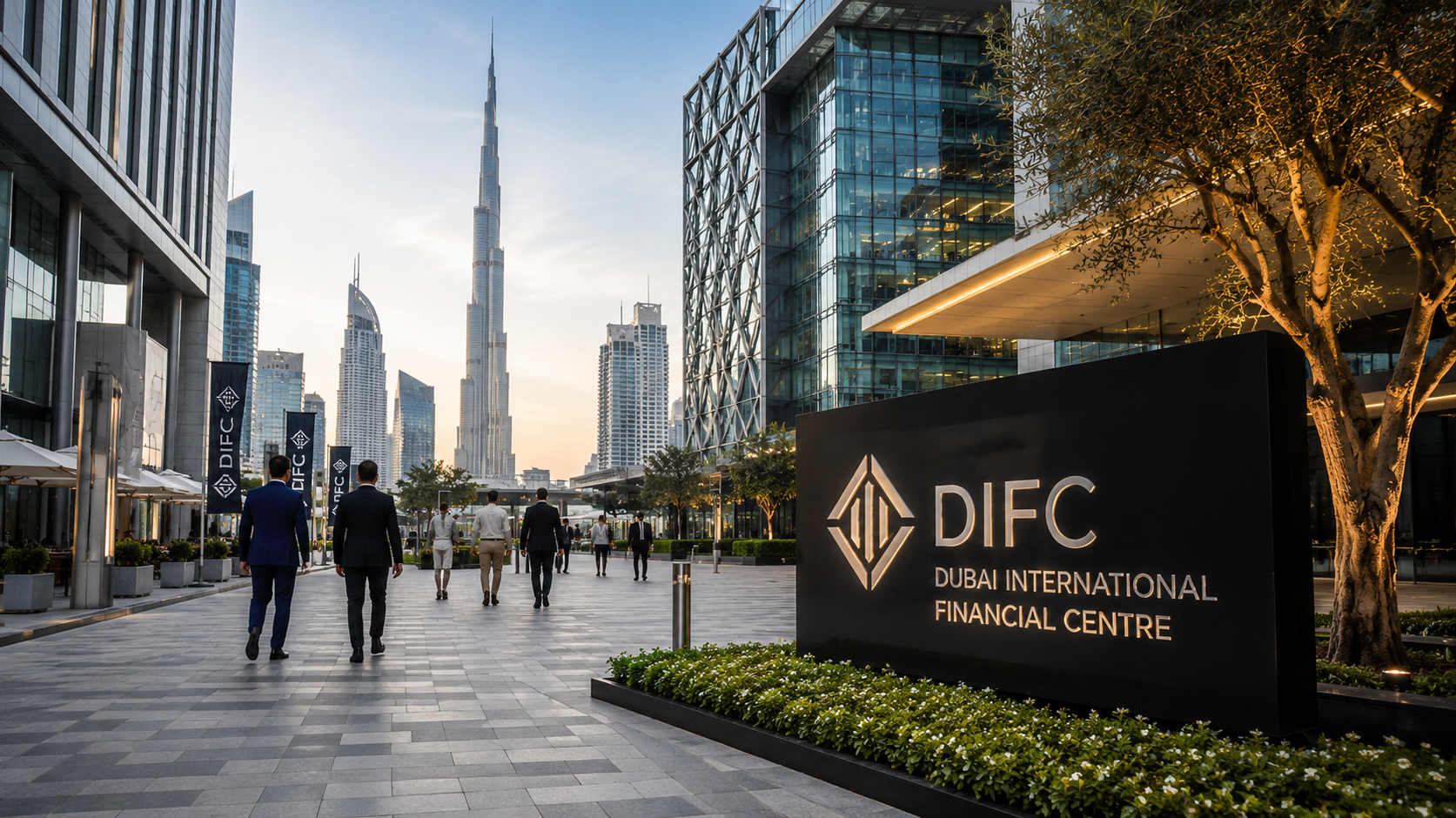
The practical appeal for professionals is unglamorous and considerable: you can walk to work. In a city where commuting defines the shape of a day, living within the centre or immediately adjacent to it removes an hour or more from most weekdays.
For anyone buying rather than renting in or around the centre, the transaction runs on a standard set of forms and documents that govern each stage of the process, and knowing what each one does before signing avoids the most common delays — we cover them in our guide to property transaction documents in Dubai.
Is DIFC actually tax-free?
Not automatically. Qualifying income attracts zero corporate tax for entities holding qualifying status, but non-qualifying income — including mainland activity — is taxed at 9 per cent above AED 375,000. Personal income tax is zero unconditionally.
Can a DIFC company trade with the UAE mainland?
Not directly. It requires a mainland branch or an authorised distributor. The centre is designed for financial services, holding structures and regional operations rather than local trade.
How does it differ from other Dubai free zones?
It operates under an independent English Common Law system with its own courts and financial regulator, where other zones fall under UAE civil law. That legal certainty is what the higher cost buys.
Does it suit startups and small businesses?
It depends entirely on the activity. Fintech ventures benefit from the innovation licence and accelerator; regulated financial startups need the framework. A small non-financial business is usually better served by a standard free zone at far lower cost.
How does it compare with Abu Dhabi’s financial centre?
Both use English Common Law and offer comparable frameworks. DIFC is larger and more established internationally; its Abu Dhabi counterpart is growing faster proportionally, has a stronger crypto framework and competes on cost. The choice usually follows where your counterparties are.
Is a physical office really required?
Yes, for every licence type — virtual offices are not permitted. Innovation hub members can use subsidised shared workstations, but some real presence is mandatory and it underpins the substance test behind qualifying tax status.
What yields do residential properties there produce?
Typically 5 to 7 per cent, supported by steady demand from professionals working within walking distance. Studios start around AED 800,000 and two-bedroom units reach AED 2.8 million.
A company setting up here needs premises to hold its licence, and its people need somewhere to live that justifies the commute they were trying to avoid. Handled separately, those two searches compete for the same budget and the same weeks. DDA Real Estate is a real estate agency in the UAE. We work across Dubai and the wider Emirates, sourcing office space inside the financial district and residential property within it and in the surrounding districts, with the ownership and residency implications set out before an offer rather than after.
Explore our UAE listings and get in touch: we will shortlist properties around your working location, compare the cost of living inside the district against the alternatives with the commute priced in, and set out how a purchase interacts with long-term residency if that is part of the plan.