
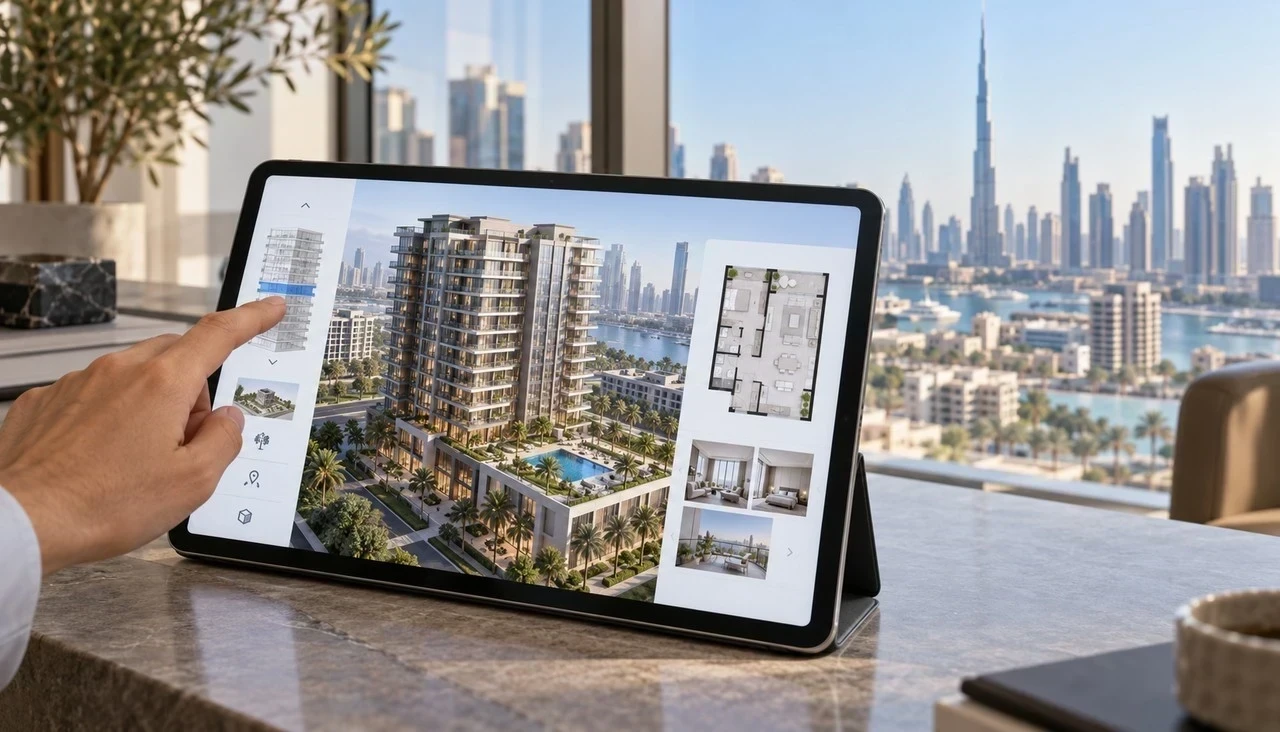


Off-plan properties
The most important part of digital transformation in UAE real estate is not simply that transactions are becoming faster. It is that buyers, owners and tenants can now independently verify information that previously depended heavily on an agent, developer or property manager.
In Dubai in particular, Dubai Land Department (DLD) has built a digital ecosystem covering transactions, rental data, projects, developers, brokers, service charges, advertising permits and property records. The tools described below are primarily Dubai-specific; systems in Abu Dhabi and other emirates are administered by their respective authorities.
This guide explains what property buyers can verify themselves in 2026, which official DLD services provide the information and where technology still cannot replace physical due diligence.
Many basic property checks can now be carried out through official Dubai Land Department services.
| Question | Official source |
|---|---|
| Is the project registered and what is its completion status? | DLD Project Status / Mashrooi |
| Is the developer registered with DLD? | DLD Licensed Developers / Real Estate Data |
| Is the broker or permit valid? | DLD Verify License and Permits |
| Is the advertisement authorised? | Trakheesi / Madmoun QR code |
| What did comparable properties actually sell for? | DLD Real Estate Data |
| What rents were registered in the area? | DLD Real Estate Data |
| What rent increase does the official index indicate? | DLD Smart Rental Index |
| What are the approved service charges? | DLD Service Charge Index |
| Is a Title Deed valid? | DLD Title Deed Verification |
The important change is access to primary data.
Buyers no longer have to rely entirely on asking prices, brochures or verbal statements when checking a project, developer or comparable transaction.
Dubai Land Department launched the Smart Rental Index in January 2025, replacing a simpler area-based approach with a more detailed system incorporating artificial intelligence and building classification.
Dubai Land Department — Smart Rental Index announcement
According to DLD, the system evaluates buildings using factors including:
The purpose is to make the rental benchmark more reflective of the characteristics and quality of an individual building rather than relying only on a broad geographic average.
The index is also connected to Dubai’s official framework for determining permitted rental increases.
For a specific tenancy, landlords and tenants can use the current DLD Rental Index service by entering information such as the contract expiry date, property type, location or Ejari details and current annual rent.
This distinction matters: the Smart Rental Index is not an asking-rent portal. It is an official DLD tool used within Dubai’s rental regulatory framework.
DLD reported that more than 900,000 rental contracts were registered in 2024, an 8% increase from the previous year, when it announced the Smart Rental Index.
One of the central tools in Dubai’s property digitalisation is Dubai REST, the official smart real estate platform of Dubai Land Department.
DLD describes Dubai REST as a platform serving property owners, tenants, brokers, developers, valuers, investors and other participants in the real estate market.
Dubai Land Department — Dubai REST
The application provides access to a wide range of information and services, including:
For off-plan developments, DLD states that Dubai REST can provide information such as project completion percentage, actual project photographs, escrow-account information and payments due from owners.
This makes the app particularly useful for buyers who want to verify a project before relying on a sales presentation.
Digitalisation is no longer limited to checking data.
Dubai has also begun moving property transactions themselves into fully digital channels.
DLD’s Digital Sale service through Dubai Now allows eligible users to complete the sale and registration process digitally, including creating the sale request, signing the Sale and Purchase Agreement, transferring the purchase amount and fees and receiving the Title Deed. UAE PASS is used for electronic signing.
DLD — Buy or Sell Property via Dubai Now
The service currently has specific eligibility conditions, so it should not be assumed that every international buyer and every property can use the same fully digital process.
For example, DLD currently specifies that this particular Dubai Now service is for individuals with a UAE ID and qualifying properties meeting its service conditions.
This is why UAE PASS should not be described as mandatory for every property-related check. Some services are publicly accessible, while other transactions require identity authentication.
Property advertisements in Dubai are regulated through DLD and RERA systems.
RERA introduced the Madmoun service through the Trakheesi system, which generates a QR code for real estate advertising permits.
DLD states that real estate companies are required to display the QR code on real estate advertisements, allowing potential customers to verify the authenticity and authorised information associated with the advertisement.
DLD — Madmoun real estate advertisement verification
Scanning the code can provide access to authorised property and advertisement details.
DLD also offers a separate Verify License and Permits service for checking licences and permits issued through the Trakheesi system.
DLD — Verify License and Permits
For a buyer searching online, this should be one of the first checks performed before relying on the advertisement.
One of the most useful elements of Dubai’s digital real estate infrastructure is the official DLD Real Estate Data portal.
Dubai Land Department — Real Estate Data
DLD publishes separate datasets covering:
For registered property transactions, available fields include transaction date, transaction type, registration type, freehold status, area, usage, property type, property subtype, transaction amount, size, room count and project information.
For rental transactions, the dataset includes information such as:
This is why registered transactions are more useful than listing prices when trying to understand what buyers have actually paid.
An asking price shows what a seller hopes to receive. A registered transaction records a completed deal.
Transaction data is powerful, but poor comparisons can still lead to poor conclusions.
When analysing a property, compare it with transactions that are as similar as possible:
Do not base a valuation on one unusually high or low transaction.
It is usually more useful to examine several comparable transactions and the direction of prices over a defined period.
For previous-year datasets, DLD also directs users to data.dubai, an initiative of Digital Dubai.
Developer verification should not start with social media, reviews or the developer’s own website.
Dubai Land Department provides an official Licensed Developers directory.
The registry contains details such as:
DLD’s Real Estate Data portal also contains a dedicated Developer dataset with developer registration and licence information.
This answers one basic question:
Is the developer present in the official DLD system?
But registration alone does not answer whether a specific project is progressing as planned.
That requires a second check.
Dubai Land Department provides a Project Status Enquiry, also available through Mashrooi in Dubai REST.
DLD — Project Status Enquiry / Mashrooi
The service allows users to search by project name or project number.
Depending on the available project record, it can show:
For a buyer considering an off-plan property, checking both the licensed developer and the individual project is more useful than checking only the company name.
The DLD open-data portal also includes project records with fields for developer name, project value, escrow-account number, project status, completion percentage and inspection or completion information.
DLD also publishes the official process through which developers register real estate projects.
Its Register Project service enables real estate development companies to register a project and open an escrow account for off-plan sales.
The process includes submission through the Oqood system, technical requirements, opening the escrow account and DLD review of the project-registration request.
For investors, this helps explain why the DLD project register and escrow information are important parts of off-plan due diligence.
Service charges can materially change the real cost of owning an apartment.
Two properties with similar purchase prices and rents may produce very different net returns if their annual building costs are substantially different.
Dubai Land Department provides an official Service Charge Index where users can search charges by project, property information and budget year.
For an investment property, this figure should be checked alongside the purchase price and expected rent.
A headline rental yield that ignores service charges is not the same as the owner’s net yield.
DLD provides a Verify Title Deed service allowing users to check the validity of a Certificate of Title / Title Deed issued by Dubai Land Department. The service is available through the DLD website and Dubai REST.
This is another example of the larger change in Dubai property transactions: documentary verification is increasingly available directly through the regulator’s digital infrastructure.
For a buyer, the practical benefit is the ability to complete much of the documentary due diligence before arranging a viewing.
Before visiting an off-plan project, for example, a buyer can check:
For ready property, registered sale prices, rental data, service charges and Title Deed verification can all contribute to the analysis.
Technology does not tell the buyer which property to choose, but it reduces the amount of information that has to be accepted on trust.
Greater visibility of registered transactions also affects sellers.
When buyers can access comparable sale information, it becomes harder to justify an asking price simply by referring to other listings.
A useful pricing comparison should therefore examine completed transactions, not only properties currently advertised for sale.
At the same time, digital data cannot explain every difference.
A renovated unit, exceptional view, rare layout, high floor or unusually strong tenant contract may justify a difference from the area average.
The data establishes the comparison range. Property-level characteristics explain where within that range an individual unit may sit.
The Smart Rental Index gives both landlords and tenants access to an official reference point for rent reviews.
The current DLD Rental Index covers multiple property categories, including residential, commercial and industrial property, and allows calculations using property and tenancy information.
Combined with digital Ejari services through Dubai REST, this gives both sides a more structured record of the tenancy relationship.
The important distinction is that asking rents on property portals and the official rental index serve different purposes.
Portal listings show current advertised supply.
The DLD index is part of the official rental framework.
Digital transformation is also changing the developer side of the market.
In September 2026, DLD launched its Initial Registration platform, integrating project registration, real estate transaction registration and escrow-account management into a connected digital process.
DLD states that the platform uses AI and automation to support document reading, data extraction and transaction processing.
DLD — Initial Registration platform announcement
This is important because digital transformation in Dubai real estate is moving beyond consumer-facing apps into the regulatory and project-registration infrastructure itself.
Tokenisation is another area where Dubai’s property market changed substantially between 2025 and 2026.
DLD launched the pilot phase of its Real Estate Tokenisation Project in 2025, creating a regulated framework for fractional ownership through blockchain-based property tokens.
In February 2026, DLD announced Phase II, enabling resale activity in the secondary market within the controlled project framework.
DLD — Real Estate Tokenisation Project
DLD — Phase II and secondary-market resale
This means tokenisation should no longer be described simply as something Dubai is planning.
However, buyers still need to understand exactly what type of interest they are acquiring and whether a particular offering forms part of the regulated DLD framework.
Tokenised property investment is also not the same as paying for a conventional property purchase with cryptocurrency.
Official data can answer many documentary questions, but it cannot inspect an apartment for you.
Digital services do not reliably show:
This is why physical inspection remains important even in a highly digitised property market.
Digital due diligence and physical due diligence solve different problems.
A buyer can use the available systems in the following order:
1. Verify the advertisement.
Check the Madmoun QR code or permit.
2. Verify the broker or permit.
Use the DLD licence and permit verification service.
3. Check the developer.
Search the DLD developer records.
4. Check the project.
For off-plan property, use Project Status / Mashrooi and review the available completion and escrow information.
5. Check registered transaction prices.
Use DLD Real Estate Data rather than relying only on asking prices.
6. Check registered rental evidence.
For investment property, compare realistic rental data for comparable units.
7. Check service charges.
Use the DLD Service Charge Index for the relevant project and year.
8. Check the official rental index where relevant.
For an existing tenancy or rent review, use the DLD Rental Index.
9. Verify the Title Deed where applicable.
10. Inspect the property physically.
The sequence helps separate documentary problems from property-level problems before money is committed.
The Smart Rental Index is Dubai Land Department’s official rental-index system. DLD launched it in 2025 using artificial intelligence and a building-classification methodology designed to take property quality and building characteristics into account.
Dubai Land Department publishes registered transaction data through its Real Estate Data portal. Users can search by dates, area, property type and other parameters and access transaction amounts and property characteristics.
Yes. DLD provides an official Licensed Developers directory as well as developer data through its open Real Estate Data portal.
Use the DLD Project Status Enquiry / Mashrooi service. It can provide project status, developer details, completion information and available escrow-account information.
Yes. Dubai’s Madmoun system uses a QR code linked to a real estate advertising permit. DLD recommends checking authorised advertisements through the system.
Yes. DLD provides a Verify License and Permits service covering licences and permits issued through Trakheesi.
Yes. Dubai Land Department provides a Service Charge Index that can be searched by project and relevant property information.
Yes. DLD’s Title Deed Verification service allows users to check the validity of a Title Deed through the website or Dubai REST.
No. DLD describes Dubai REST as a platform for owners, tenants, brokers, developers, valuers, investors and other real estate-market participants.
No. Official systems are valuable for checking documentary, regulatory and market information, but they cannot fully show physical condition, noise, maintenance quality or how the property feels in everyday use.
Dubai’s digital transformation has made property information substantially easier to verify directly through official sources.
The Smart Rental Index provides an official rental benchmark. Dubai REST brings together property information and multiple real estate services. DLD Real Estate Data provides registered transaction and rental records. Developer and project registers allow buyers to check who is building a project and its reported status.
But digital verification should be used as the first layer of due diligence, not the last.
A property can pass every documentary check and still be a poor purchase because of its condition, view, building management, layout or price relative to the best comparable units.
Considering buying property in Dubai? DDA Real Estate can help you combine official DLD data with property-level analysis. We can check comparable transactions, project and developer information, service charges and rental scenarios, then help you assess what the official databases cannot show before you make a purchase decision.