Remote Property Purchase in Turkey in 2026
Alanya
EN
$
ft²
Other articles

Buying Property in Turkey Without Being There

Sergey Dubinets The author of the article, the Broker
#Blog DDA
6 September 7182 view

Buying remotely is not a shortened version of buying in person. It is the same transaction with one part removed and paid for separately.

The part removed is your own eyes. What replaces them is independent representation, and that costs money. Buyers who treat a remote purchase as a way to save on a trip usually end up spending the saving twice over.

This guide sets out the document chain, what the power of attorney must say, what a video viewing has to show and how to stage the payments. Procedures change, so confirm the current requirements with a Turkish lawyer before starting.

What Stays the Same and What Changes

The legal steps are identical. Remote buyers complete the same registration, pay the same taxes and receive the same title.

In personRemotely
Legal procedureStandardIdentical
Who signs at the registryYouYour representative under a power of attorney
Who inspects the propertyYouSomeone you pay to do it
Verification of documentsLawyer, optional in practiceLawyer, not optional
Cost of the transactionStandardStandard plus representation
Main riskMissing something on a viewingRelying on the wrong person

The last row is the whole subject. Everything else is procedure. The outcome of a remote purchase depends almost entirely on who acts for you, and that is the one decision you cannot delegate.

The full sequence of a Turkish purchase is the same whether you attend or not, and the purchase procedure from start to finish is worth reading before anything else.

The Document Chain

Six steps, and each produces something the next one needs. Starting them in the wrong order wastes weeks.

  • Tax number. The first document, needed for everything after it. It is free and quick, and obtaining a Turkish tax number can be done before you have chosen a property.
  • Bank account. Payments route through Turkish banking, so the account is a precondition. Opening a Turkish bank account as a foreigner is the slowest step in the chain and should start early.
  • Power of attorney. Prepared abroad, legalised and translated. Also slow, and also worth starting before you have a specific property.
  • Sale agreement. The terms, the deposit, the refund triggers and the completion date. What belongs in a sale and purchase agreement matters more when you are not present to renegotiate.
  • Valuation report. Required in transactions involving foreign buyers, arranged locally.
  • Currency certificate. Foreign buyers convert funds through the banking system and receive a certificate confirming it. The foreign currency purchase certificate is checked at the registry, so the conversion has to happen after the price is final.

Start the first three before you find a property. The tax number takes an hour. The bank account and the power of attorney take weeks. Doing them in parallel with the search removes the usual bottleneck.

The Power of Attorney

The document that makes the whole thing possible, and the one where mistakes are expensive.

It can be executed at a Turkish consulate in your country, which is the simpler route. The alternative is a local notary, followed by legalisation and sworn translation into Turkish.

Make it specific. It should name the property, name the representative and list the exact powers granted. A general document handing over broad authority is convenient for everyone except you. The rules for registering a power of attorney set out what the form requires.

What to include, and what to leave out:

IncludeExclude
Signing the transfer at the land registryPower to sell the property afterwards
Paying transfer tax and feesPower to mortgage or encumber
Obtaining the valuation reportPower to delegate to a third party
Applying for utility connectionsOpen-ended authority over your assets
Collecting documents on your behalfAnything not needed for this purchase

Give it a term. A power of attorney with an expiry date is safer than an open-ended one, and it can be renewed if the transaction takes longer than expected.

Who Holds It

The single most consequential choice in a remote purchase.

Grant it to your own lawyer. Not to the seller’s agent or the developer’s representative. And not to a helpful contact who speaks your language and works in the same office as the seller.

This is not about anyone’s honesty. It is about whose interests the relationship is built around, which becomes visible precisely when something is disputed.

How to choose the lawyer:

  • Found by you, not introduced by the seller or the agency.
  • Licensed and verifiable through the local bar.
  • Experienced with foreign buyers and able to correspond in your language.
  • Paid by you directly, with a written scope of work.
  • Willing to say no to a property, which a party earning commission on the sale is not.

Budget for this properly. Independent representation is the cost that replaces your presence, and trying to avoid it removes the only protection a remote purchase has.

What a Video Viewing Must Show

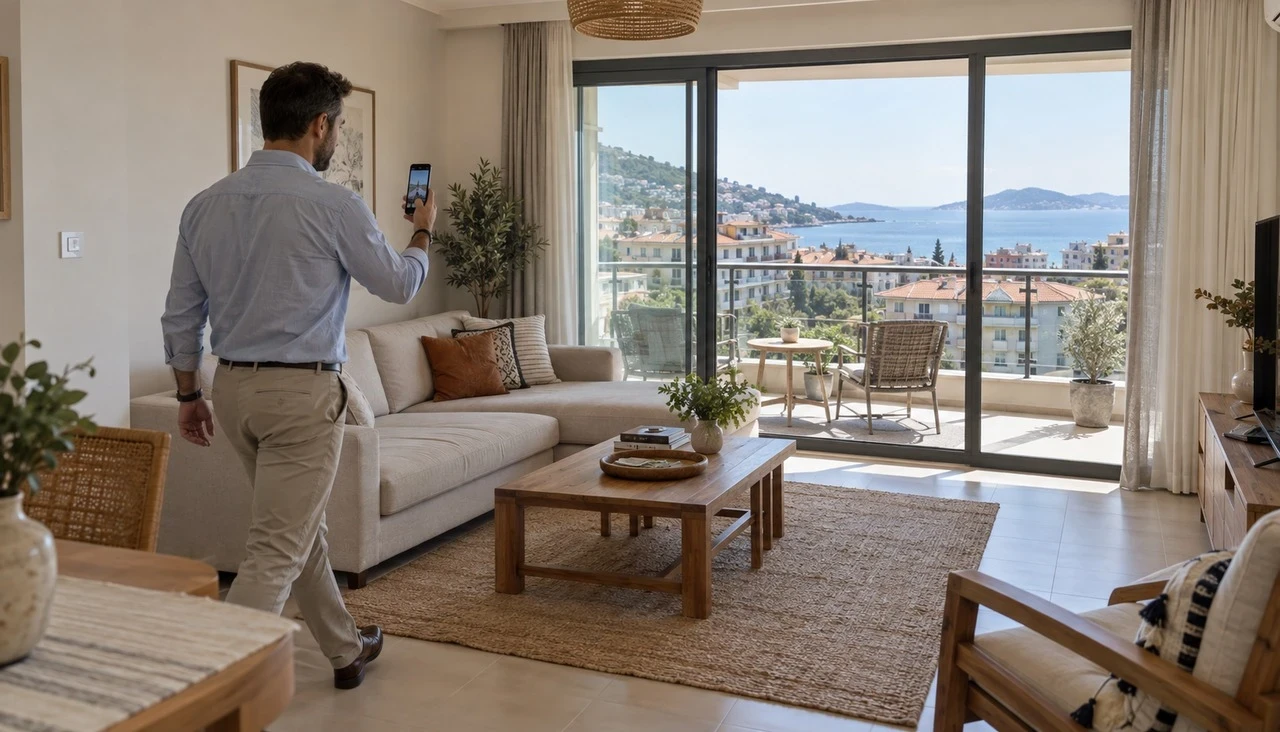
Photographs are selected. A live video call is not, and it is the closest substitute for standing in the room.

Insist on live rather than recorded, and direct it yourself. Ask for the camera to be pointed where you want it rather than accepting a prepared tour.

  • The full walk, unbroken. From the building entrance to the front door to every room, without cuts.
  • Ceiling corners and window reveals. Where damp shows first. Ask for a slow pan.
  • Under the sinks and around the bathroom. Leaks and previous repairs are visible there.
  • Windows opened. So you hear the street rather than seeing it.
  • A slow pan from the balcony. Not a framed shot of the view, which hides what is beside it.
  • The common areas. Lift, stairwell, entrance, bins, parking. These tell you how the building is run.
  • The street outside. Walked, not filmed from the window.

Ask for a second call at a different time of day. Evening shows the lighting, the parking and whether the building is occupied. A single midday call shows the quietest hour of the week.

Verification You Pay Someone to Do

Four checks that cannot be done from another country, and all four are worth their cost.

A lawyer confirms the title, the ownership, any charges or debts registered against the property and the status of the occupancy permit. A surveyor or technical inspector assesses the physical condition. A valuation establishes an independent figure for the price. And someone visits the district, ideally in the evening.

The district visit is the one buyers skip and later regret. Title problems are recoverable. A noisy road, a bar below the window or a complex that empties in winter are not, and none of them appear in a listing.

Listing language is its own obstacle when you cannot see the property, and knowing what agent terminology actually means saves a lot of wasted viewing time.

Money

The area where remote buyers are most exposed and where the rules are clearest.

Funds move through the Turkish banking system into an account in your name. From there the payment goes to the seller. The conversion produces the certificate the registry requires.

  • Never pay a person. Payments go to the seller or the developer through banking channels, not to an agent, an intermediary or a private account.
  • Stage the payments. A small reservation, then the balance after verification is complete. Never the full amount before the checks.
  • Specify who bears transfer charges. International transfers lose money to intermediary banks, and arriving short at conversion delays everything.
  • Keep every confirmation. The bank will ask for evidence of source later, and so will anyone you eventually sell to.
  • Convert after the price is final. The certificate has to match the declared figure.

A request to pay outside the banking system is where a remote purchase should stop. There is no legitimate reason for it, and no recovery afterwards.

Handover

The moment of maximum leverage, and it happens without you.

Before the final payment, defects are the seller’s problem. Afterwards they are yours. A remote buyer who accepts handover unseen gives up that position entirely.

Send someone independent to inspect. Not the agent who sold it. A surveyor or your lawyer, with a written snagging list and photographs, before the balance is released.

Have meter readings recorded on the same day and keys handed to a named person. Both are small, both cause disproportionate trouble when skipped.

Staging the Whole Thing

A sequence that keeps your exposure small until the checks are done.

StageWhat you commitWhat you get
ShortlistNothingDocuments and video calls
ReservationA small deposit with written refund triggersThe property off the market
VerificationLegal and technical feesTitle, condition and valuation confirmed
AgreementContractual commitmentTerms, price and date fixed
CompletionThe balanceRegistration and title
HandoverFinal release if stagedKeys, meters, snagging resolved

The second row does the protective work. A reservation deposit is small, and the written refund triggers are what turn it from a gamble into a hold. Negotiate those triggers before paying anything.

What Not to Do

Five decisions that account for most of the bad outcomes.

  • A general power of attorney. Broad authority over your assets granted for a single purchase.
  • Representation from the selling side. Convenient, free, and aligned with someone else.
  • Full payment before verification. The checks lose their purpose once the money has gone.
  • Accepting a recorded video tour. Edited, framed and taken at the best hour.
  • Skipping the district visit. The one category of problem that cannot be fixed later.

Four of these are avoided by spending money. That is the honest summary of remote buying: the trip you did not take is replaced by professionals, and the arithmetic still works.

Frequently Asked Questions

Is it legal to buy without visiting Turkey?

Yes, and it is routine. A representative completes the registration under a power of attorney, and the title you receive is the same as if you had attended.

Where do I sign the power of attorney?

At a Turkish consulate in your country, which is simpler, or before a local notary followed by legalisation and sworn translation into Turkish.

Who should hold the power of attorney?

Your own lawyer, found by you and paid by you. Not the seller’s agent or the developer’s representative, however helpful they are.

What should the power of attorney allow?

Signing the transfer, paying fees and taxes, obtaining the valuation and connecting utilities. It should exclude selling, mortgaging and delegating to anyone else, and it should carry an expiry date.

How do I inspect a property from abroad?

A live video call you direct yourself, plus an independent technical inspection and a visit to the district by someone who is not selling to you. Recorded tours are not a substitute.

How should payments be made?

Through the Turkish banking system into an account in your name, then to the seller. Stage them so the bulk is paid after verification, and never pay a private individual.

Does buying remotely cost more?

Slightly, because you pay for the representation and inspections that your presence would have covered. It is the correct trade rather than an overhead to minimise.

Key Points to Remember

  • You are buying independent eyes. That is the cost that replaces the trip, and cutting it removes the protection.
  • Start the slow documents early. The bank account and the power of attorney take weeks; the tax number takes an hour.
  • Keep the power of attorney narrow. Named property, listed powers, expiry date, no right to sell or delegate.
  • Direct the video call yourself. Live, unbroken, windows open, and a second call in the evening.
  • Stage the money. Small reservation, verification, then the balance.

If You Are Starting From Another Country

Begin with the paperwork that does not depend on a property. A tax number takes an hour, a bank account and a power of attorney take weeks, and all three can run while you are still choosing. Buyers who do this find themselves able to move when the right unit appears, rather than watching it go while their documents catch up. DDA Real Estate is a real estate agency in Turkey. We work across Antalya, Alanya, Istanbul, Izmir, Bodrum and Mersin, and a good share of our clients complete without setting foot in the country.

Explore our listings in Turkey and get in touch: tell us where you are and what you are looking for. We will arrange live viewings you direct and put you in front of independent legal representation rather than our own. The payment stages are set so the checks come before the money.

Popular
5 June 4322178 views
Dubai Rent Prices 2025: Average Apartment Rental Costs in Dubai Dubai's rental market continues its upward climb in 2025, driven by population growth and limited new supply, pushing average prices up by 10%
#Blog DDA
2 July 2484972 view
DLD Fees in Dubai: Everything You Need to Know Buying property in Dubai? Don't let hidden fees surprise you! Our essential guide breaks down ALL Dubai Land Department (DLD) fees
#Blog DDA
23 November 1947078 views
How to Buy a SIM Card in Turkey in 2026: Prices, IMEI Registration, eSIM Options, and Best Mobile Operators Overview of mobile operators, available types of SIM cards, and home Internet providers
#Blog DDA
5 July 1816605 views
How Much is the Real Estate Agent Commission in Dubai? Find out how much real estate agent commission costs when buying property in Dubai.
#Blog DDA
5 February 1473822 view
How Foreigners Can Own Property in Bali: Understanding PT PMA (2025) Foreigners can't own freehold land in Bali, but a PT PMA (foreign-owned company) allows secure property ownership under Hak Guna Bangunan (HGB) or Hak Pakai (HP) rights
#Blog DDA
28 August 1239084 view
Oqood vs Title Deed in Dubai: Key Differences You Must Know Buying property off-plan in Dubai? Oqood registration is mandatory to secure your ownership rights.
#Blog DDA