

Retirement Residency: Indonesia, Thailand, Emirates
Bali
EN
$
ft²
Other articles

Retiring Abroad: Three Countries, Three Different Bargains

Anna Sarapkina The author of the article, the Broker
#Blog DDA
26 September 1764 view

Comparisons of retirement visas usually line up the requirements side by side, as if the three countries offered versions of the same thing. They do not. Each asks you to lock up something different — money, a sponsor, or your own time.

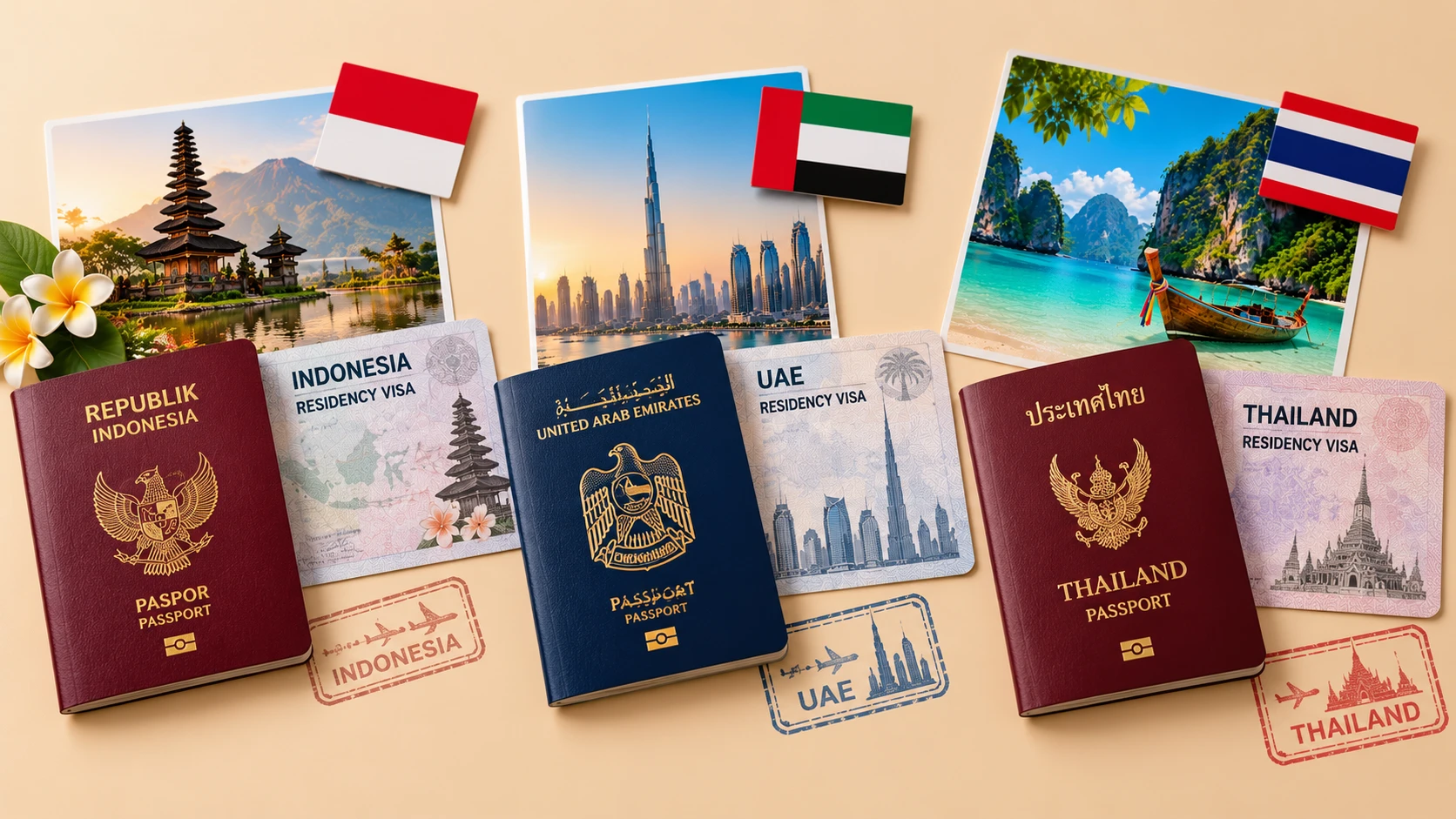
Indonesia wants a local sponsor and ties your status to a structure someone else controls. Thailand wants funds parked or income proven, and a renewal every year for as long as you stay. The Emirates want capital, usually in property, and give a longer document in return.

So the question is not which requirements are easiest to meet this year, but which bargain suits the next twenty. Below is what each one actually costs you, what none of them gives, and the question retirees ask last and should ask first. Rules change frequently, so confirm current conditions before acting.

What each country asks you to lock up

The requirements differ in kind rather than in degree, and that changes who each option suits:

IndonesiaThailandEmirates
What is lockedA relationship with a sponsorFunds or proven incomeCapital, usually in property
Renewal rhythmPeriodic, sponsor-dependentAnnual, indefinitelyMulti-year
Who controls itYour sponsor and the agentYou, if the money staysYou, while you hold the asset
Property roleGrants no statusGrants no statusCan qualify you
Ends whenThe sponsor stopsThe funds moveThe asset is sold

The row that decides most cases is the third. Two of these options leave your status in someone else's hands, and one does not.

None of them is permanent

This is the part that gets lost in comparisons. All three are renewable permissions to stay, not permanent residence in the European or North American sense.

You can live in any of them for twenty years and still hold a document that expires. Citizenship is realistically out of reach in all three for someone arriving at retirement age. Plan as a long-term guest, not as a future national, because that assumption shapes what you should own and where.

Ask what happens at seventy-five

Retirees compare visas at the age they are now and rarely at the age they will be. The second number is the one that matters.

Can you renew comfortably at an advanced age? Will insurance still cover you, and at what price? Can you reach a hospital that handles serious cases? A visa that is easy at sixty and impossible to service at eighty is not a retirement plan, it is a decade-long holiday.

Health insurance is the real constraint

Most international policies raise premiums steeply with age and some stop issuing new cover past a certain point. Pre-existing conditions narrow the field further.

This limits the choice more than any visa requirement does, and it should be checked before the country is chosen. Get an insurance quote for the age you will be in fifteen years, not for today. If nobody will quote, that answers the question about the country.

Where serious medicine actually is

Routine care is good and affordable in all three. Complex cases are where they diverge sharply.

Thailand and the Emirates have large hospitals that handle major procedures. On Bali the picture is narrower and serious cases often mean a flight, which is set out in the guide to healthcare on the island. Measure the distance to a hospital that could handle a cardiac event, not to the nearest clinic.

Property does not equal status, except in one place

This trips up buyers constantly. In Indonesia and Thailand, buying property grants no right to live in the country. The two are entirely separate questions.

Only in the Emirates does property routinely support residence, which makes the purchase and the visa one decision rather than two. What a foreigner can actually hold in Indonesia is set out in the guide to apartments and condominiums there. Everywhere else, buy for the home and arrange the status separately.

The sponsor question

Indonesia's route runs through a sponsor, which in practice usually means an agency. That is normal and workable, and it has a consequence worth naming.

Your right to stay depends on a company continuing to exist and continuing to act for you. Change of agent, change of rules or a lapse on their side becomes your problem. Choose the sponsor as carefully as the property, and keep copies of everything they file on your behalf.

Cost of living against cost of status

These pull in opposite directions and are usually discussed separately, which produces bad decisions.

Indonesia and Thailand are cheaper to live in and cheaper to enter. The Emirates cost more on both counts but ask less of you afterwards. Add the annual cost of maintaining the status to the monthly budget — agents, renewals, insurance and the money you cannot move because it secures the visa.

Money that cannot be touched

Where a status depends on funds held in country, that capital stops being available. It is not spent, but it is not yours to use either.

Treat locked funds as a cost, not as savings. At retirement, liquidity matters more than it did at forty, and money that secures a visa cannot also pay for a medical emergency.

Climate over twenty years

Heat and humidity are pleasant on a two-week visit and demanding as a permanent condition, more so with age and with most chronic conditions.

The Emirates are extreme in summer and comfortable in winter; the tropics are steady and humid year-round. Spend a full wet season and a full hot season somewhere before committing, because both are avoidable on a holiday and unavoidable in a life.

Distance from family

The practical measure is not kilometres but how easily someone can reach you in an emergency, and how easily you can go home.

Direct flights, visa requirements for visiting family, and the cost of a last-minute ticket all matter more than they seem at the planning stage. Count the connections, not the hours: a single-stop route ages far better than a two-stop one.

Language and daily independence

Independence in later years depends on being able to handle a pharmacy, a bank and a doctor without an intermediary.

English carries further in the Emirates than in most of Thailand or Indonesia, where it thins out quickly outside expatriate areas. Choose a location where you can manage a bad day alone, not one where every errand needs a translator.

What to arrange before you move

These belong in place before the first application, and all of them are harder to sort out afterwards:

  • Health insurance quoted for your age and conditions
  • A will in the country where you will hold assets
  • A power of attorney for someone who can act if you cannot
  • Pension arrangements checked against living abroad
  • A plan for where medical treatment happens in a serious case
  • An exit plan, if health or circumstances change

The last one is the one nobody writes down, and it is the difference between a decision and a trap. Knowing in advance what would take you home, and what it would cost to unwind, makes staying a choice rather than an accident.

Rent before you buy, everywhere

At retirement the cost of a wrong move is higher, because the energy for a second one is not there.

A year of renting settles the questions no comparison can: whether the climate suits you, whether the neighbourhood works, whether you feel at home. Buy in the second year, not the first. The rent is cheaper than the mistake.

Which suits whom

Since the bargains differ, so do the people they fit:

  • Indonesia — lowest cost, strongest lifestyle draw, needs comfort with a sponsor
  • Thailand — good hospitals and a large retired community, annual renewals forever
  • Emirates — highest cost, most self-contained status, property and visa in one decision
  • Undecided — rent in two of them for a season each before choosing

Questions we hear most

Which country is easiest for retirees?

They are not easier or harder so much as different. Indonesia asks for a sponsor, Thailand for funds or income with annual renewal, and the Emirates for capital. The right question is which of those three you are comfortable depending on for twenty years.

Does buying property get me residence?

In the Emirates it often supports it. In Indonesia and Thailand it does not — ownership and the right to stay are entirely separate questions there, so the purchase and the status have to be arranged independently.

Can any of these lead to permanent residence?

Realistically no, not for someone arriving at retirement age. All three are renewable permissions rather than permanent status, so it is wiser to plan as a long-term guest than as a future citizen.

What is the biggest thing people overlook?

Health insurance at an older age. Premiums climb steeply and some insurers stop issuing new cover past a certain point, which constrains the choice more than any visa rule. Get a quote for the age you will be in fifteen years.

Should I buy straight away?

Rent for a year first, wherever you choose. At this stage a wrong move is expensive and tiring to undo, and a year on the ground answers what no comparison can about climate, neighbourhood and whether the place feels like home.

Key takeaways

  • Three different bargains — a sponsor, locked funds, or capital
  • None of them is permanent — plan as a long-term guest
  • Ask what happens at seventy-five — not what works at sixty
  • Insurance constrains more than visas — quote it before choosing
  • Property equals status in one place only — elsewhere they are separate

Decide the bargain first, then the address

The country decides what you depend on for the next twenty years, and the property decides how those years feel day to day. DDA Real Estate is a real estate agency working in Indonesia and Thailand, and for retiring buyers we set the two questions out separately: what a property gives you and what it does not, since here ownership brings no status with it. The routes to living here are covered in the guide to moving to Bali for permanent residence, and the Thai side in the account of retiring in Thailand.

Look at our offers in Bali and leave a request: tell us how many months a year you plan to be here and what matters as you get older, and we will shortlist accordingly — single-level homes, short distances to a hospital, places that work in every season.

Popular
5 June 4329171 view
Dubai Rent Prices 2025: Average Apartment Rental Costs in Dubai Dubai's rental market continues its upward climb in 2025, driven by population growth and limited new supply, pushing average prices up by 10%
#Blog DDA
2 July 2491650 views
DLD Fees in Dubai: Everything You Need to Know Buying property in Dubai? Don't let hidden fees surprise you! Our essential guide breaks down ALL Dubai Land Department (DLD) fees
#Blog DDA
23 November 1956087 views
How to Buy a SIM Card in Turkey in 2026: Prices, IMEI Registration, eSIM Options, and Best Mobile Operators Overview of mobile operators, available types of SIM cards, and home Internet providers
#Blog DDA
5 July 1823913 views
How Much is the Real Estate Agent Commission in Dubai? Find out how much real estate agent commission costs when buying property in Dubai.
#Blog DDA
5 February 1478925 views
How Foreigners Can Own Property in Bali: Understanding PT PMA (2025) Foreigners can't own freehold land in Bali, but a PT PMA (foreign-owned company) allows secure property ownership under Hak Guna Bangunan (HGB) or Hak Pakai (HP) rights
#Blog DDA
28 August 1245321 view
Oqood vs Title Deed in Dubai: Key Differences You Must Know Buying property off-plan in Dubai? Oqood registration is mandatory to secure your ownership rights.
#Blog DDA