
Thailand rental seasonality: occupancy, rates, net yields
66 2 026-1660
day and night
Bangkok
EN
$
ft²
Other articles

How Seasonality Affects Rental Occupancy in Thailand

Maxim Shramko The author of the article, the Broker
#Blog DDA
8 September 11088 views

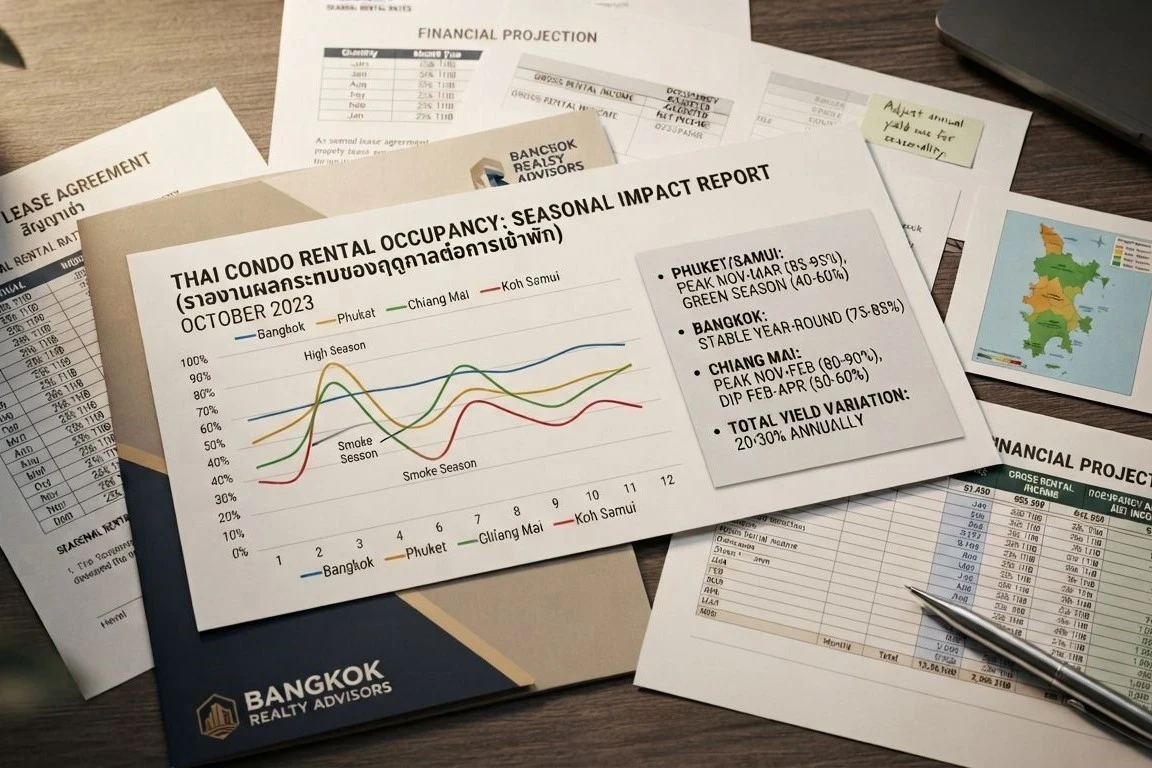
Thailand's rental market follows clear seasonal patterns that differ by region and property type. Tourist arrivals drive short-term demand, while long-term rentals respond to school calendars, corporate relocations and expat hiring cycles. For an investor this matters directly: occupancy and nightly rates can differ by 30–50% between peak and low season.

Peak and Low Seasons Across Thailand

Peak demand arrives at different times depending on the destination. Beach resorts follow their own calendar, while Bangkok benefits from steadier year-round demand from business travellers and expats. The main patterns are:

  • Phuket, Pattaya and Hua Hin. Peak season runs from November to March, driven by European winter travel and the dry season. In Phuket, high-season bookings are largely settled by October.
  • Koh Samui. The island's rains fall mainly in October to December, so its peak runs from late December to April, with an extra boost in July and August.
  • Bangkok. Tenant demand peaks from January to March and from July to September, driven by relocations, university terms and a steady flow of business and medical visitors.
  • Chiang Mai. Short-term demand is strongest in tourist and lifestyle areas but drops sharply during the smoke season, roughly from February to April.

Occupancy Rates

The gap between peak and low-season occupancy is large in every resort destination, while Bangkok stays relatively stable. Typical levels look like this:

  • Phuket. Around 80% in peak season and 35–45% in the rainy months, which averages out to roughly 60–65% over the year in good locations.
  • Pattaya. 75–90% from November to March, falling to 35–55% from May to October, for an annual average of about 55–65%.
  • Bangkok. Fairly stable at 82–88% year-round, with little seasonal risk.
  • Koh Samui. Around 55–65% over the year, reflecting the pronounced seasonality of the island market.

Nightly Rates and Revenue

Occupancy swings come with large differences in nightly rates, which shape rental income directly. In peak season, short-term rentals can earn two to four times the equivalent long-term rent. Typical rates by market:

  • Phuket. Studios average around 2,500–3,200 THB a night in high season and one-bedroom condos 3,200–5,500 THB. Green-season rates usually sit 20–30% lower.
  • Bangkok. One-bedroom condos near BTS stations achieve 1,800–2,800 THB a night with consistent occupancy.
  • Pattaya. Lower purchase prices are offset by stronger seasonality, which keeps annual occupancy around 55–65%.
  • Koh Samui. Pool villas in the premium segment rent at 8,000–20,000 THB a night in peak months.

Bangkok as the Exception

Bangkok works differently from the resorts. Business travellers, remote workers and medical visitors create demand every month of the year, which gives a steadier income. Prime short-term rental zones include Sukhumvit – Nana, Asok, Phrom Phong and Thong Lo – as well as Silom and Ratchathewi.

Management is also cheaper than on the islands: typically 15–20% of gross revenue in Bangkok against 25–30% in Phuket.

Managing the Low Season

The green season from May to October is the hardest period for owners in resort areas. Booking windows have shortened sharply: in Phuket, green-season reservations now often arrive five days to a week before check-in, compared with one to two months ahead in high season. That means prices have to move with demand, and owners should plan for lower occupancy and rates.

A few strategies help:

  • Dynamic pricing. Green-season rates typically sit 20–30% below high season and should follow demand.
  • Different tenant segments. Long-term and mid-term stays of one to three months become more attractive in the low season – and they also avoid the licensing question entirely, since stays under 30 days require a hotel licence and are banned by many condominium buildings.
  • A vacancy budget. Build lower occupancy and revenue into the annual net-yield calculation from the start.

What It Means for Investors

For an investor, seasonality shapes the whole financial model. Net yield has to allow for weaker green-season months, and the gap between gross and net widens further because management fees, utilities and maintenance continue whether the unit is booked or not.

After those costs, realistic net yields tend to look like this:

  • Phuket. Roughly 4–6% from short-term letting, depending on location and management.
  • Bangkok. Around 3.5–5%, with little seasonal risk.
  • Pattaya. Around 4–5.5%, with higher vacancy risk in the low season.

Seasonality defines Thailand's rental market. Phuket, Pattaya and Koh Samui earn strongly in peak months but lose a large share of occupancy in the rainy season, while Bangkok offers steadier, more predictable returns. The headline yield in a resort area only becomes meaningful once it is adjusted for the green-season months.

If you are choosing between a resort unit and a Bangkok condo, DDA Real Estate can model both on a full-year basis – peak, green season and vacancy included – so you compare them on what they would actually earn.

Popular
5 June 4322682 view
Dubai Rent Prices 2025: Average Apartment Rental Costs in Dubai Dubai's rental market continues its upward climb in 2025, driven by population growth and limited new supply, pushing average prices up by 10%
#Blog DDA
2 July 2485476 views
DLD Fees in Dubai: Everything You Need to Know Buying property in Dubai? Don't let hidden fees surprise you! Our essential guide breaks down ALL Dubai Land Department (DLD) fees
#Blog DDA
23 November 1947645 views
How to Buy a SIM Card in Turkey in 2026: Prices, IMEI Registration, eSIM Options, and Best Mobile Operators Overview of mobile operators, available types of SIM cards, and home Internet providers
#Blog DDA
5 July 1817235 views
How Much is the Real Estate Agent Commission in Dubai? Find out how much real estate agent commission costs when buying property in Dubai.
#Blog DDA
5 February 1474452 view
How Foreigners Can Own Property in Bali: Understanding PT PMA (2025) Foreigners can't own freehold land in Bali, but a PT PMA (foreign-owned company) allows secure property ownership under Hak Guna Bangunan (HGB) or Hak Pakai (HP) rights
#Blog DDA
28 August 1239525 views
Oqood vs Title Deed in Dubai: Key Differences You Must Know Buying property off-plan in Dubai? Oqood registration is mandatory to secure your ownership rights.
#Blog DDA