

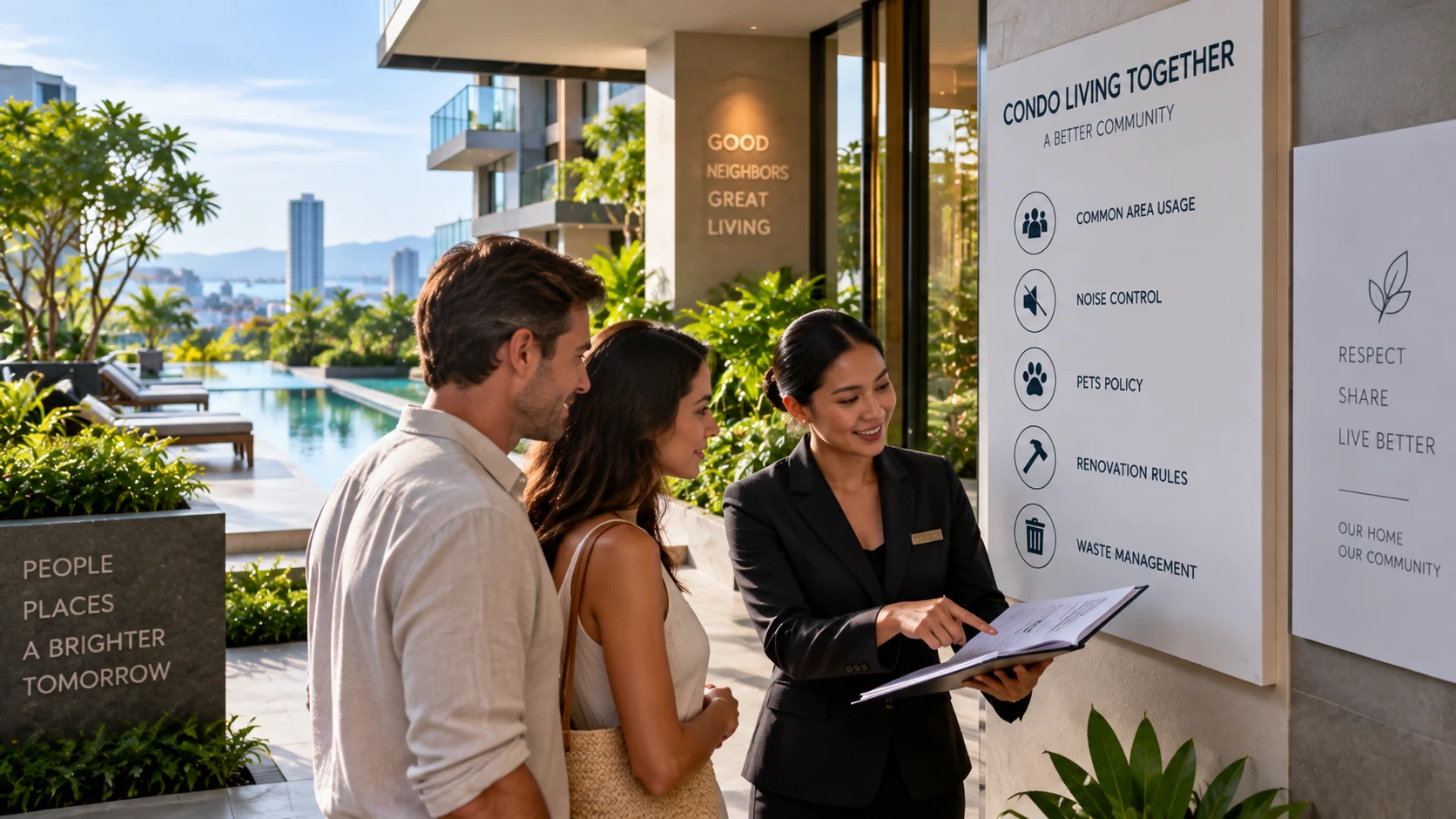

Condo Rules in Thailand: Who Makes Them
66 2 026-1660
day and night
Hua Hin
EN
$
ft²
Other articles

Condo Rules in Thailand: Who Actually Makes Them

Nikita Sokolov The author of the article, the Broker
#Blog DDA
14 September 8757 views

Buyers arriving from North America look for the homeowners' association and cannot find one. Thailand does not have HOAs — a condominium here is run by a registered legal entity of its own, with a manager who holds statutory powers and a committee elected by the owners.

The difference is not terminology. Voting weight follows the share of floor area you own rather than the number of units, and unpaid fees are enforced by blocking your sale rather than by a lawsuit.

Below is how the structure works, where the real power sits, what the rules can and cannot restrict, and the two documents that decide whether a building is well run. Regulations differ between buildings and the law is amended periodically, so confirm specifics for your own building.

The entity, the manager and the committee

Three things get confused with each other, and knowing which is which tells you who to talk to about what:

BodyWhat it isWhat it does
The juristic personA registered legal entity owning nothing but acting for all ownersHolds the accounts, contracts and obligations
The managerAn appointed officer, often a management companyDay-to-day running, signs on the entity's behalf
The committeeOwners elected at a general meetingOversees the manager, approves within limits
The general meetingAll co-owners, weighted by area ownedBudget, regulations, appointments

The manager is not your landlord and not a service provider you hired. They are an officer of a legal entity you part-own, which is why complaints work differently here than in a rented building.

Votes follow floor area

This is the single most consequential difference from the associations foreign buyers know. Your voting weight is your share of the building's total floor area, not one vote per unit.

A large penthouse outvotes several studios. More importantly, a developer still holding unsold units controls the meeting, and in a newly completed building that is usually the case. Decisions taken in the first years often reflect the developer's preferences rather than the residents'.

Two payments, not one

Buyers routinely merge these and then find the second one unexpected. They are separate, calculated differently and paid at different times.

The common area fee is recurring, charged per square metre of your unit, and covers cleaning, security, gardens, pool and shared utilities. The sinking fund is a one-off contribution collected at purchase and held for major works. The sinking fund is the one to ask about, because most buyers never do: what it holds, what has been drawn from it and for what.

How unpaid fees are enforced

Here the Thai system is more effective than most, and it catches sellers by surprise rather than debtors.

A unit cannot be transferred at the Land Department without a certificate from the juristic person confirming that nothing is outstanding. No certificate, no transfer. Arrears do not produce a lawsuit, they produce an unsellable unit, and they accrue interest while they sit. Anyone buying should see that certificate, and anyone selling should request it early rather than in the final week.

The debt follows the unit

This is why the certificate matters to a buyer as much as to a seller. Outstanding common fees attach to the unit rather than to the person who ran them up.

Buy without checking, and you inherit the arrears along with the keys. It is one of the recurring patterns described in the guide to avoiding scams when buying property in Thailand. The certificate is not paperwork, it is the check.

What the regulations can restrict

Each building writes its own regulations within the framework of the law, and they bind owners and tenants alike. The common ones:

  • Pets, which are prohibited outright in a large share of buildings
  • Short-term letting, often banned regardless of what the law says
  • Renovation hours, noise and which works need approval
  • Use of common areas, including who may bring guests to the pool
  • Parking allocation and how many spaces a unit carries
  • Alterations visible from outside, including air conditioning units and glazing

Read the regulations before the contract, not after. They are a condition of ownership, they change by vote, and nobody hands them to you unprompted.

Short letting is two separate prohibitions

This trips up investors constantly. Letting a unit for under thirty days generally requires a hotel licence, which almost no condominium holds. That is the law.

Separately, the building's own regulations may ban it even where a licence exists. Both have to permit it, and a unit sold on its short-let income may satisfy neither. Ask the juristic office directly rather than the seller, and ask before price is discussed.

The 49% quota and who votes

Foreigners may collectively hold up to 49% of a building's total floor area in freehold. The remainder is held by Thai owners or Thai companies.

Since votes follow area, that ceiling caps foreign influence at the meeting by design. A building with a full foreign quota still has a Thai majority in any contested decision. This matters when owners split along lines that correlate with nationality, which happens most often over short letting.

Meetings and how decisions actually pass

An annual general meeting approves the accounts and the budget. Extraordinary meetings handle anything urgent. Both require a quorum measured in floor area, and both are frequently inquorate at the first attempt.

Different decisions need different majorities, and the heavier ones — amending regulations, major expenditure — need more than a simple majority. Proxies decide most Thai condominium meetings, because absent owners are the norm. Whoever collects proxies shapes the outcome.

Voting from abroad

Most foreign owners are not in the country on meeting day, and a unit that never votes has no influence at all.

A written proxy solves it, and the building will have a prescribed form. Send it to someone who will actually attend rather than to the manager by default. Giving your proxy to the management is giving it to the person the meeting is supposed to oversee.

Signs a building is run well

These are visible at a viewing if you know to look, and they predict the next ten years better than the lobby finish:

  • Accounts produced annually and available to owners on request
  • A sinking fund with a balance and a record of what it funded
  • Lifts, pumps and pool plant serviced on a schedule rather than on failure
  • A committee that meets and includes owners who live there
  • Low arrears across the building, which the office can quantify
  • Regulations that are enforced consistently rather than selectively

Security arrangements are part of the same picture, and what to ask about them is set out in the guide to security in Thai condominiums.

Signs of trouble

The warning signs are equally visible and rather more important:

An office that will not show the accounts, a manager appointed by the developer years after handover, visible deferred maintenance, a sinking fund nobody can describe, and high arrears. A building with large arrears has a funding problem that becomes yours the day you buy, because the shortfall is eventually met by a levy on everyone paying.

What to ask the juristic office

Ten minutes in that office tells you more than an hour with an agent. Six questions cover it:

  • What is the monthly fee per square metre and when was it last raised?
  • What does the sinking fund hold and what has it paid for?
  • What proportion of units are in arrears?
  • May I see the current regulations in full?
  • Is short letting permitted, and does the building hold a hotel licence?
  • Who appoints the manager, and when does the contract end?

An office that answers all six readily is itself the answer. Reluctance on the arrears question is the one to take seriously.

Tenants are bound too

Renting does not put you outside the regulations. Pets, noise, guests, parking and pool rules apply to occupants regardless of who owns the unit.

What differs is that you have no vote and no standing at meetings, so a rule you dislike is simply a condition of living there. That asymmetry belongs in the comparison of renting versus buying in Thailand. Ask for the regulations before signing a lease, particularly about pets and guests.

Changing something you dislike

It is possible and it is slow. Regulations are amended at a general meeting by the majority the law requires for that type of change, which is higher than a simple majority.

Realistically that means building support among owners with significant floor area, gathering proxies and putting the item on the agenda properly. One owner writing letters to the manager changes nothing, because the manager has no power to amend what the meeting adopted. The wider habits of dealing with Thai administrative bodies are covered in the survival guide to Thai bureaucracy.

When the developer hands over

The transition from developer control to owner control is the moment a building's future is decided, and most buyers miss it entirely.

Until enough units are sold, the developer holds the votes and usually appoints a management company from its own group. As units sell, that grip loosens. Ask how many units remain unsold and who currently appoints the manager — in an older building still managed by the developer's company, ask why.

Questions we hear most

Is there an HOA in Thailand?

No. A condominium is run by a registered legal entity with an appointed manager and a committee elected by owners. The powers and the enforcement mechanisms differ from an American association, so the analogy misleads more than it helps.

Can they stop me selling?

Effectively yes, if you owe money. A transfer at the Land Department requires a certificate from the juristic person confirming no outstanding fees. That is how arrears are enforced, and it is why they should be settled long before a sale.

Do I inherit the previous owner's debts?

Outstanding common fees attach to the unit, so in practice yes unless they are cleared at transfer. This is exactly what the debt certificate exists to prevent, which is why a buyer should insist on seeing it.

Can the building ban short letting?

Yes, through its own regulations, and separately the law requires a hotel licence for stays under thirty days. Both have to permit it. A unit marketed on short-let income may satisfy neither, so ask the juristic office before discussing price.

How do I vote if I live abroad?

By written proxy on the building's prescribed form. Send it to an owner who will attend rather than to the management, since the meeting exists partly to oversee the manager. A unit that never votes has no influence.

Key takeaways

  • There is no HOA — a registered entity, a manager and an elected committee
  • Votes follow floor area — so an unsold developer stock controls the meeting
  • Arrears block the sale — no debt certificate, no transfer
  • Short letting needs two permissions — the law and the building's own rules
  • Ask the juristic office, not the agent — ten minutes there is the real due diligence

Ten minutes in the juristic office

Nobody does it, and it tells you more about the next decade in a building than any viewing. DDA Real Estate is a real estate agency working in Thailand, and this is part of what we check before a client sees a unit: the fee per square metre and when it last moved, what the sinking fund holds, what proportion of owners are in arrears, and whether the regulations allow what the buyer intends to do.

Look at our offers in Thailand and leave a request: we will shortlist buildings whose rules match your plans, set out the running costs before you view rather than after an offer, and say plainly when a building's management is the reason to walk away.

Popular
5 June 4322178 views
Dubai Rent Prices 2025: Average Apartment Rental Costs in Dubai Dubai's rental market continues its upward climb in 2025, driven by population growth and limited new supply, pushing average prices up by 10%
#Blog DDA
2 July 2484972 view
DLD Fees in Dubai: Everything You Need to Know Buying property in Dubai? Don't let hidden fees surprise you! Our essential guide breaks down ALL Dubai Land Department (DLD) fees
#Blog DDA
23 November 1947078 views
How to Buy a SIM Card in Turkey in 2026: Prices, IMEI Registration, eSIM Options, and Best Mobile Operators Overview of mobile operators, available types of SIM cards, and home Internet providers
#Blog DDA
5 July 1816605 views
How Much is the Real Estate Agent Commission in Dubai? Find out how much real estate agent commission costs when buying property in Dubai.
#Blog DDA
5 February 1473822 view
How Foreigners Can Own Property in Bali: Understanding PT PMA (2025) Foreigners can't own freehold land in Bali, but a PT PMA (foreign-owned company) allows secure property ownership under Hak Guna Bangunan (HGB) or Hak Pakai (HP) rights
#Blog DDA
28 August 1239084 view
Oqood vs Title Deed in Dubai: Key Differences You Must Know Buying property off-plan in Dubai? Oqood registration is mandatory to secure your ownership rights.
#Blog DDA