

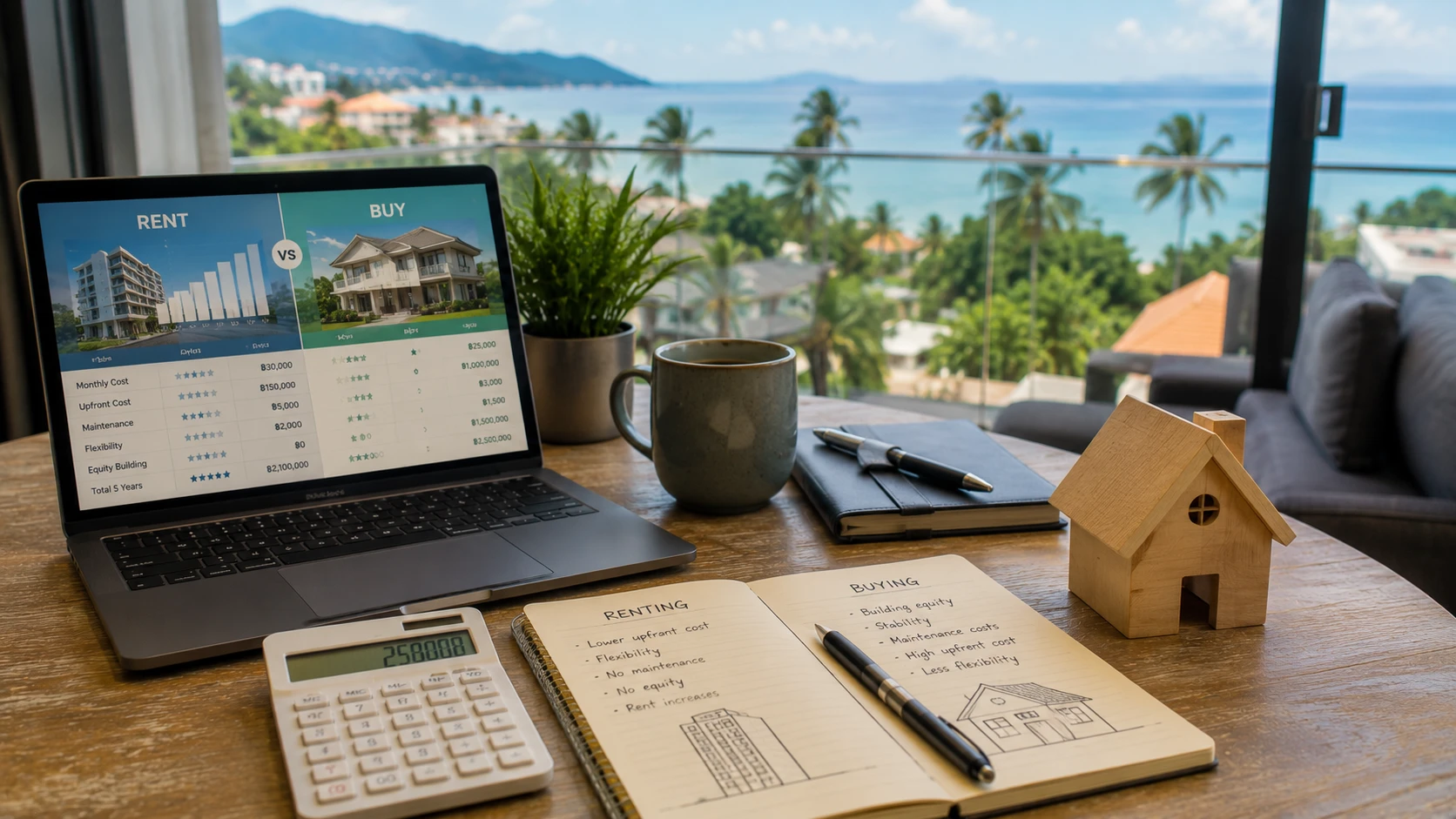
Renting vs Buying in Thailand 2026: The Numbers
66 2 026-1660
day and night
Thailand
EN
$
ft²
Other articles

Renting vs. Buying in Thailand: Financial Comparison for Long-Term Stays

#Blog DDA
19 June 819 views

Most rent-versus-buy comparisons are built for a market where buyers borrow. They compare a monthly rent against a monthly mortgage payment, add property taxes to one side and flexibility to the other, and produce a break-even somewhere around year three. Almost none of that machinery transfers to Thailand, because mortgage financing for foreign buyers is limited, issued under strict conditions, and not widely available — most international purchases here are completed in cash or on developer instalment plans.

That single fact reframes the whole question. If you are not borrowing, you are not comparing rent against interest. You are comparing rent against what your capital would have earned somewhere else. And when that substitution is made honestly, the break-even in Thailand moves a long way out — helped along by a transaction cost structure that treats foreign buyers differently from Thai nationals as of July 2026, and by a resale market where selling takes months rather than weeks.

This article sets out both sides in numbers: what renting costs across the main expatriate cities, what buying costs at entry, during ownership and at exit, and how those combine into a break-even you can apply to your own situation. Figures are current as of July 2026 and sources vary on yields and price growth, so ranges are used throughout and the worked example is clearly marked as illustrative. Tax treatment and eligibility should be confirmed with a Thai lawyer or tax adviser before any commitment.

Why the Standard Comparison Does Not Apply

Financing options for foreign buyers in Thailand are narrower than in most Western markets. Mortgages exist and some banks lend to foreigners, but the conditions are strict: proof of stable income, a clean credit history, age limits typically between 21 and 65, and lending in foreign currency with special arrangements at transfer. The practical result is that cash purchases dominate, in line with regional norms in Malaysia, Vietnam and Indonesia. The specific lending conditions and which institutions currently participate are covered in our overview of mortgages in Thailand for foreigners.

A cash purchase changes the arithmetic in a way that is easy to miss. Buying does not save you a monthly payment — it converts a liquid asset into an illiquid one and gives you accommodation in exchange for the return that capital was generating. If your money earns nothing, buying looks strong. If it earns four or five per cent somewhere safe, most of the apparent saving disappears and the break-even stretches from a few years into most of a decade.

What Renting Actually Costs

Long-term rental in Thailand is inexpensive relative to purchase prices, which is precisely why the comparison is not obvious. Typical monthly rents for a one-bedroom unit in 2026 sit at roughly 8,000–15,000 baht in Chiang Mai, 12,000–20,000 in Pattaya and Hua Hin, 15,000–30,000 in Phuket, and 20,000–40,000 in central Bangkok with 10,000–18,000 in the suburbs.

The costs beyond rent

  • Deposit. Condominiums typically require one to two months as a security deposit, returned at the end subject to condition.
  • Utilities at commercial rates. Some buildings bill electricity at a commercial rate of around 6–8 baht per kilowatt-hour rather than the utility rate of 4–5, which matters considerably for daily air conditioning.
  • Seasonality in resort locations. High season from October to March drives occupancy of 80–90% in places like Pattaya, and low-season rates fall by 10–20%, so annual contracts and monthly ones price very differently.
  • Moving costs. Real but small, and offset by the option value of being able to move at all.

The advantage renting carries that never appears in a spreadsheet is optionality. Thailand's expatriate map has shifted meaningfully in two years, with foreign transaction growth concentrating in Hua Hin and Koh Samui while Chiang Mai's volumes fell. A renter follows that shift at the cost of a deposit; an owner follows it at the cost of a sale.

What Buying Costs at Entry

Purchase costs in Thailand are moderate by international standards but not negligible, and one component changed against foreign buyers this year.

Cost at purchaseTypical levelNotes
Transfer fee2% of appraised or sale value, whichever is higherConventionally split 1% each side; the reduced 0.01% rate does not apply to foreign buyers
Sinking fundTHB 200–1,000 per sqm, one-offCollected at handover for future major repairs
Common area fees in advanceOften 6–12 months prepaidAt THB 40–100 per sqm per month, higher in branded projects
Legal and due diligenceVaries with complexityResales with lease structures cost more than straightforward condo transfers
Utility meter connectionTHB 2,000–10,000Required before occupation
Foreign quota premiumProject-dependentForeign freehold units are often priced above equivalent leasehold units

The transfer fee point deserves emphasis because it is recent. Thailand's stimulus package cutting transfer and mortgage registration fees to 0.01% was renewed on 30 June 2026 and published in the Royal Gazette on 1 July, running to 30 June 2027 — but the announcements describe it as applying to individual buyers who are Thai nationals. Multiple sources covering the renewal state plainly that foreign buyers must budget for the standard rates. Coverage of the fine print is not fully consistent, so confirm your own position with a lawyer rather than assuming either way.

The Five-Year Clock and the Cost of Exit

Exit costs in Thailand are larger than entry costs and are governed by a threshold most buyers only discover late. A transaction triggers either Specific Business Tax or stamp duty, never both. Specific Business Tax runs at 3.3% and applies where the seller has held the property for fewer than five years or sells through a Thai juristic person. Stamp duty of 0.5% applies otherwise.

That is a swing of 2.8% of the sale value, decided entirely by the calendar. Alongside it sits withholding tax, a seller liability calculated on a progressive schedule that reduces with years held, with an effective rate commonly falling between 1% and 5% for individual sellers, and brokerage commission, where 3% is the floor across most of Thailand and 5% is common for resale condominiums in Pattaya.

Adding it up

A seller exiting after five or more years faces roughly 0.5% stamp duty, 1–5% withholding, 1% as their share of the transfer fee, and 3–5% commission: call it 6–12% of the sale value. A seller exiting inside five years replaces the stamp duty with 3.3% Specific Business Tax and lands closer to 8–14%. Add the buyer's own entry costs of roughly 2–3%, and total round-trip friction on a Thai property sits somewhere between 8% and 17% depending on timing and location.

A Break-Even Framework

The comparison then becomes tractable. Owning avoids rent but incurs carrying costs and opportunity cost; the round-trip friction has to be recovered out of the difference before ownership wins.

Consider an illustrative case, using round numbers rather than a specific listing: a 40 square metre condominium in Phuket bought for 4.5 million baht, against renting a comparable unit at 20,000 baht per month, or 240,000 baht a year. Annual carrying costs for the owner run to common area fees of roughly 19,000–48,000 baht plus annual land and buildings tax. Round-trip friction at, say, 12% amounts to 540,000 baht.

  • Ignoring opportunity cost: ownership avoids 240,000 baht of rent and incurs perhaps 40,000 in carrying costs, netting around 200,000 a year. Friction of 540,000 is recovered in under three years, and buying looks clearly better.
  • Including opportunity cost at 4%: the 4.5 million baht would have earned about 180,000 baht a year elsewhere. The net advantage of owning falls to roughly 20,000 a year, and recovering 540,000 of friction takes decades rather than years.
  • Adding capital appreciation: this is what decides the case. At Phuket's rates the asset may add materially each year; at Bangkok's recent flat to slightly negative condominium performance it may add nothing.

The framework is more useful than the numbers. Ownership wins when appreciation plus avoided rent exceeds opportunity cost plus carrying costs plus amortised friction. In a market whose national transfer volumes are forecast to fall for a fourth consecutive year, that inequality holds in some locations and fails in others, which is why a single national answer does not exist.

What Moves the Answer

  • Your holding period. Under five years, Specific Business Tax alone makes the case difficult. Beyond ten, friction amortises to insignificance.
  • Location divergence. Phuket has continued to see foreign transaction growth and price appreciation while Bangkok's suburban condominium segment carries substantial oversupply with flat pricing.
  • What your capital would otherwise do. This is the largest single variable and the one most often left out entirely.
  • Liquidity. Resale timelines in Thailand commonly run three to twelve months. If you may need the capital back at short notice, ownership is the wrong container for it.
  • Currency. Your rent and your asset are both in baht while your income is usually not. Exchange rate movement can outweigh several years of yield in either direction.
  • Rental intent. If the property will earn, the calculation changes entirely — but long-term letting of 30 days or more is the straightforward case, while short stays depend on building rules and licensing.

A practical illustration of how ownership economics differ by city, including yields, appreciation and the running costs that erode them, is set out in our guide to the cost of living in Pattaya.

A Decision Checklist

  • State your realistic horizon first. Not the aspirational one. Then check it against the five-year tax threshold.
  • Price the opportunity cost explicitly. Use whatever your capital actually earns today, not zero.
  • Get the full Land Office cost sheet before committing. Including sinking fund, prepaid common area fees and your share of the transfer fee.
  • Confirm which stimulus measures you qualify for. The current fee relief is described as applying to Thai nationals; verify your own position.
  • Model the exit at both five-year outcomes. The difference between 3.3% and 0.5% is usually larger than a year of yield.
  • Rent first in any new city. A year of rent costs less than one round trip through the transaction costs above.

Further Reading

If the calculation points toward buying, the next question is structure rather than price: freehold within the foreign quota, a registered lease, or a company arrangement each carry different costs, rights and resale implications. Those routes and what each permits are set out in our overview of property investment in Thailand for foreigners.

Frequently Asked Questions

How many years does it take for buying to beat renting in Thailand?

There is no single figure, because the answer depends on what your capital would otherwise earn and on local price growth. Ignoring opportunity cost, round-trip transaction friction is typically recovered within a few years. Counting opportunity cost at realistic rates, the break-even generally depends on capital appreciation, which currently differs sharply between Phuket and Bangkok.

Do foreign buyers get the reduced 0.01% transfer fee?

The measure renewed on 1 July 2026 and running to 30 June 2027 is described as applying to individual buyers who are Thai nationals, and several 2026 guides state directly that foreign buyers must budget for standard rates. Reporting on the detail is not fully consistent, so confirm your specific position with a Thai lawyer.

What are the total costs of selling a condominium?

Roughly 6–12% of sale value for an individual seller holding five years or more: 0.5% stamp duty, 1–5% withholding tax, about 1% as your share of the transfer fee, and 3–5% brokerage. Selling inside five years replaces stamp duty with 3.3% Specific Business Tax and pushes the total higher.

Can foreigners get a mortgage in Thailand?

Sometimes, but conditions are strict and availability is limited: stable documented income, clean credit history, age limits usually between 21 and 65, and lending arranged in foreign currency. Most foreign purchases are completed in cash or through developer instalment plans.

Is renting wasted money in Thailand?

Not in a market with these transaction costs and these resale timelines. Renting buys the ability to change city without a sale, which has had real value while foreign demand has been shifting between locations. It becomes the weaker option mainly over long horizons in appreciating locations.

Does buying help with visa status?

Property ownership can support certain long-stay routes, but the relationship is indirect and depends on the visa category, the value of the property and your personal profile. Treat visa eligibility as a separate question to be confirmed with an immigration adviser rather than as a benefit that comes automatically with a purchase.

Conclusion

The honest comparison in Thailand is not rent against mortgage — it is rent against the return on capital you give up, plus 8–17% of round-trip friction, minus whatever the asset appreciates. Renting wins on flexibility, on short horizons, and anywhere prices are flat. Buying wins over long holds in locations where appreciation is real, and it wins more decisively past the five-year mark when the tax treatment of the exit improves. The single most common mistake is running the comparison with opportunity cost set to zero, which makes every purchase look inevitable. Set it to what your money actually earns, and the answer becomes specific to you rather than to the market.

DDA Real Estate helps you find property in Thailand — from Bangkok condominiums to villas in Phuket and Koh Samui, with full cost breakdowns, developer verification and legal support. Check out our offers in Thailand and leave a request: we'll find options for your budget and goal.

Popular
5 June 4152141 view
Dubai Rent Prices 2025: Average Apartment Rental Costs in Dubai Dubai's rental market continues its upward climb in 2025, driven by population growth and limited new supply, pushing average prices up by 10%
#Blog DDA
2 July 2382282 view
DLD Fees in Dubai: Everything You Need to Know Buying property in Dubai? Don't let hidden fees surprise you! Our essential guide breaks down ALL Dubai Land Department (DLD) fees
#Blog DDA
23 November 1710198 views
How to Buy a SIM Card in Turkey in 2026: Prices, IMEI Registration, eSIM Options, and Best Mobile Operators Overview of mobile operators, available types of SIM cards, and home Internet providers
#Blog DDA
5 July 1702512 views
How Much is the Real Estate Agent Commission in Dubai? Find out how much real estate agent commission costs when buying property in Dubai.
#Blog DDA
5 February 1394568 views
How Foreigners Can Own Property in Bali: Understanding PT PMA (2025) Foreigners can't own freehold land in Bali, but a PT PMA (foreign-owned company) allows secure property ownership under Hak Guna Bangunan (HGB) or Hak Pakai (HP) rights
#Blog DDA
28 August 1145844 view
Oqood vs Title Deed in Dubai: Key Differences You Must Know Buying property off-plan in Dubai? Oqood registration is mandatory to secure your ownership rights.
#Blog DDA