Chanote Land Title in Thailand: A Guide to Thai Property Deeds
971 56 596-5009
day and night
Dubai
EN
$
ft²
Other articles

What Is a “Chanote” Land Title? Understanding Thai Property Deeds

Elizaveta Silakova The author of the article, the Broker
#Blog DDA
23 May 4536 views

Foreign buyers tend to call every Thai land document a “Chanote,” but Thailand issues seven different title documents, and the gap between them decides whether you own property outright or merely hold a claim someone can challenge. People have paid full price for land backed by a tax receipt rather than a deed.

This guide explains what a Chanote actually is, how it sits above the weaker titles, what the Garuda seal colours mean, what it means for foreign buyers, and how to read and verify a deed before you sign. It is general information, not legal advice — always run a formal title check with a licensed Thai lawyer before committing.

What a Chanote actually is

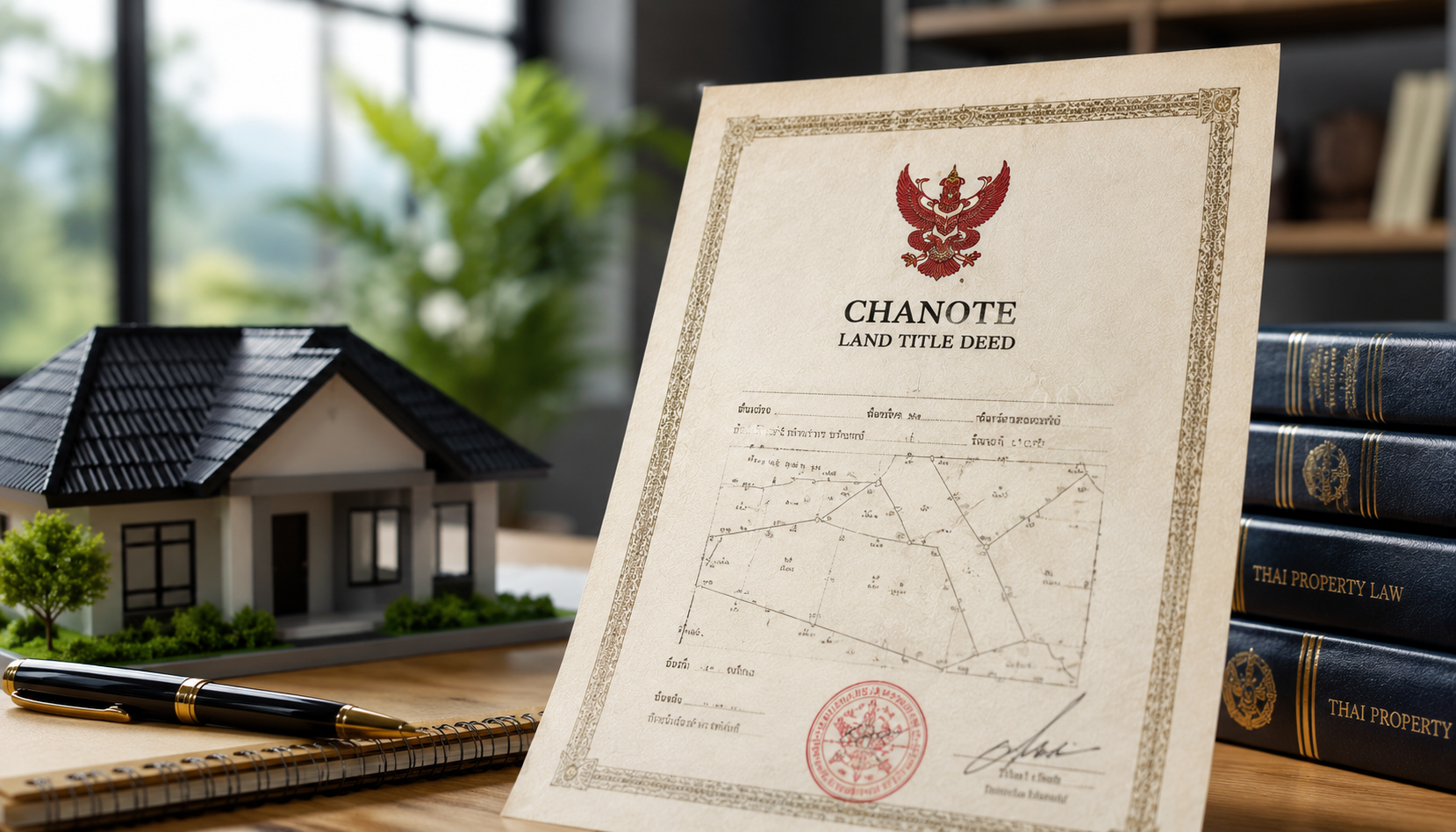
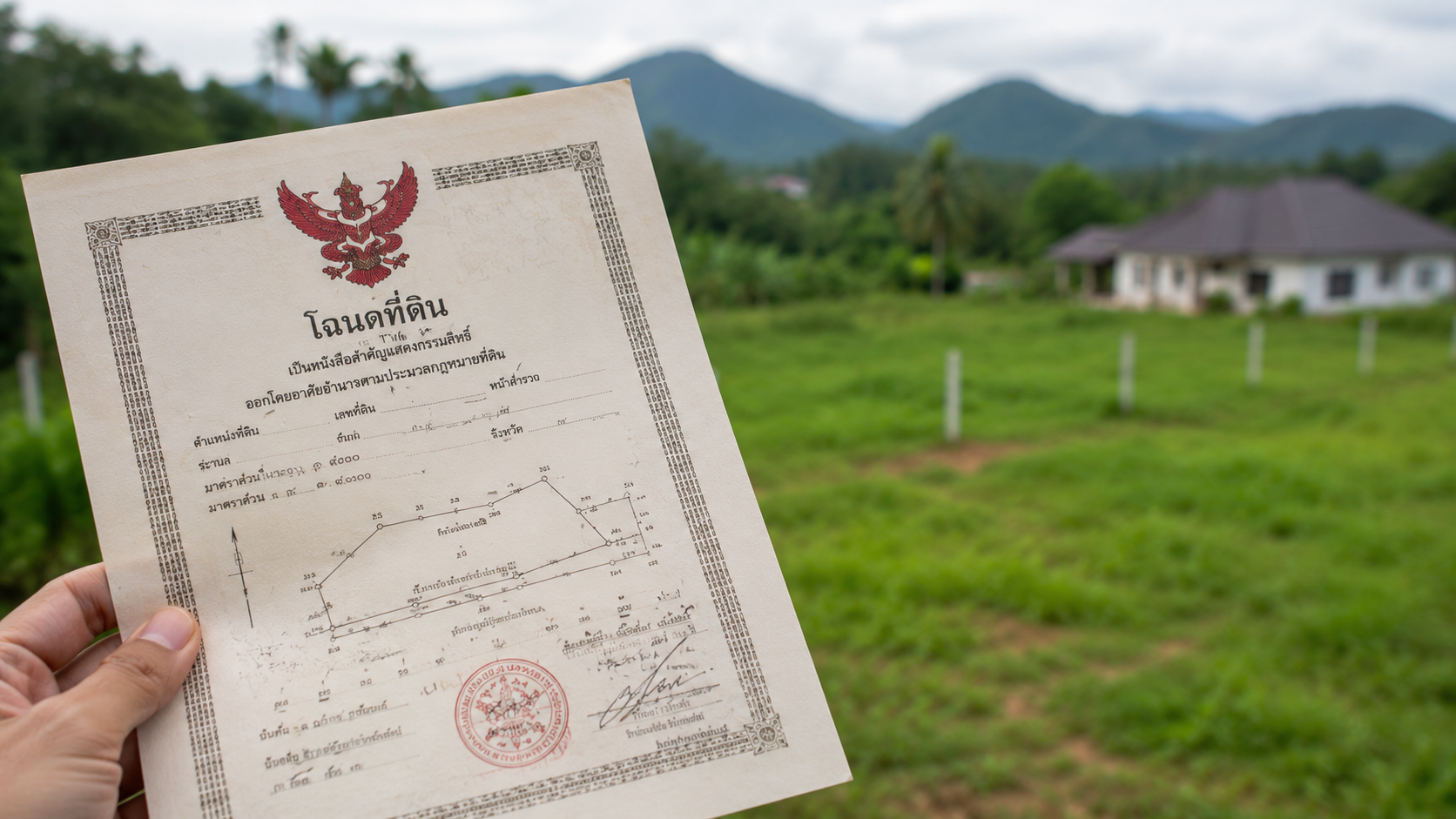
A Chanote (Nor Sor 4 Jor) is the strongest land title deed in Thailand — full, government-guaranteed freehold ownership. Its boundaries are fixed by satellite survey on the national land grid and marked on the ground with numbered concrete posts matching the deed. If your name is on a Chanote, your rights are indisputable: you can build on, subdivide, sell, mortgage, lease or gift the land without a public-notice period.

It is the deed you receive when buying a condo, it is required to register any transfer at the Land Office, it works as loan collateral, and it makes boundary disputes easier to resolve. Fewer than a third of titled plots nationwide are full Chanote, which is why it commands a premium and why banks lend against it far more readily than against lesser titles.

The Thai title hierarchy

Document Garuda What it means Buyer verdict
Por Bor Tor 5Tax-payment receipt, not a titleNever buy on this alone
Sor Kor 1BlueOld use claim; not issued since 1972Avoid; needs court upgrade
Nor Sor 2Temporary use right; not sellableAvoid
Nor Sor 3BlackPossession, vague boundaries, 30-day noticeHigher risk; survey first
Nor Sor 3 GorGreenConfirmed possession, aerial survey, no noticeAcceptable with diligence
Nor Sor 3 KhorBlackLike Gor but boundaries not fully markedExtra caution on borders
Chanote (Nor Sor 4 Jor)RedFull, surveyed, guaranteed freeholdSafest — the deed to want

A Por Bor Tor 5 proves nothing about ownership; Sor Kor 1 and Nor Sor 2 are historical claims with no clean path to sale; Nor Sor 3 can be sold but forces a 30-day public notice and carries boundary-dispute risk. Nor Sor 3 Gor is a genuine step up — aerial-surveyed and upgradeable — but the Chanote is the only document giving full, indisputable ownership.

The Garuda colour code

  • Red Garuda. Nor Sor 4 Jor (Chanote) — full ownership. The one you want.
  • Green Garuda. Nor Sor 3 Gor — confirmed possession, one step below Chanote.
  • Black Garuda. Nor Sor 3 / Nor Sor 3 Khor — possession without precise parcel points.
  • Blue Garuda. Sor Kor 1 and similar older use documents — not full title.

The colour is a signal, not proof. Classifications and shades vary with the age and region of the document, so confirm the deed type in writing and verify it against the master copy at the local Land Office.

How to read a Chanote

A genuine Chanote has two sides that matter. The front carries the red Garuda, deed number, owner’s name, a survey map, and the area in Rai, Ngan and Wah. The back page — the one buyers forget — is the encumbrance register, listing mortgages, leases, usufructs, seizures and any “no-sell” conditions in red. A clean front page means nothing if the back page shows an unpaid mortgage.

Unit In square metres
1 Wah (square wah)4 m²
1 Ngan (100 wah)400 m²
1 Rai (4 ngan)1,600 m²

What a Chanote means for foreign buyers

A Chanote is proof of the strongest ownership Thai law offers — but foreigners cannot hold one over land in their own name, except in narrow cases. For the rules, see our guide to Thai leasehold vs freehold and the types of property ownership in Thailand.

  • Freehold condominium. The one case where a foreigner holds a Chanote directly — a condo unit within the building’s 49% foreign quota.
  • Registered leasehold. Land or villa leased up to 30 years per term, registered on the Chanote; renewals are contractual, not guaranteed.
  • Thai company. Land held through a genuinely Thai-majority company running a real business — never a nominee arrangement.
  • Board of Investment route. Under Section 96 bis, investing 40 million THB in qualifying assets for five years may allow up to 1 rai for residence, subject to approval. Rare.

Whatever the route, confirm the underlying document is a genuine Chanote first. Island markets have quirks — our Koh Samui foreign-ownership guide shows how these structures play out on the ground.

Nominee structures: the 2026 crackdown

The most dangerous shortcut is the “nominee” company — Thai-majority on paper, but funded and controlled by the foreigner. It is illegal under the Foreign Business Act, and enforcement has sharpened: penalties can reach three years’ imprisonment, fines up to 1,000,000 THB and forced sale. Authorities have flagged tens of thousands of suspected nominee companies, and a 2026 Department of Business Development order now requires directors to certify that Thai shareholders used genuine funds. A real Chanote over nominee-held land does not make the ownership safe. We separate fact from fiction in our piece on myths about foreign property ownership in Thailand.

How to verify a deed before you buy

  • Run a Land Office title search. Confirm the deed is registered and the seller is the most recent listed owner.
  • Read the back page. Check for mortgages, leases, usufructs, seizures and red “no-sell” conditions.
  • Test authenticity. Garuda watermark in a double circle, tiny holes at the four corners of the plot image, black-ink signature under a red stamp.
  • Match the master copy. Compare the owner’s deed against the Land Office original — details must match exactly.
  • Check shape and access. Plot outline matches survey/Google Maps, and there is legal road access (a registered right-of-way).
  • Confirm zoning and quota. Setbacks, building permits, and — for a condo — that the 49% foreign quota has room.

For condos, the paperwork and quota checks have their own rhythm — our essential tips for buying an apartment in Thailand cover them step by step.

Frequently Asked Questions

What is a Chanote title deed?

A Chanote (Nor Sor 4 Jor) is Thailand’s strongest land title — full, government-guaranteed freehold, with boundaries fixed by satellite survey and marked by numbered concrete posts. It carries the clearest rights and the lowest dispute risk.

Can a foreigner own a Chanote?

Only for a condominium unit, within the building’s 49% foreign quota. Foreigners cannot hold a Chanote over land in their own name; villa land is held via a registered lease or a genuine Thai company.

Chanote vs Nor Sor 3 Gor — what’s the difference?

A Chanote is fully surveyed on the national grid with numbered posts and gives indisputable ownership. Nor Sor 3 Gor confirms possession by aerial survey and sells without a 30-day notice, but boundaries are less precise. It can usually be upgraded to a Chanote.

What do the Garuda colours mean?

Red marks a Chanote (full ownership), green Nor Sor 3 Gor, black Nor Sor 3 / Khor, blue older Sor Kor 1 documents. Colour is a quick signal, but always confirm the exact deed type at the Land Office.

Is Por Bor Tor 5 a title deed?

No. It is only a tax-payment receipt and proves nothing about ownership. Buying on a Por Bor Tor 5 alone is one of the most common and costly mistakes foreign buyers make.

Are nominee companies legal for holding land?

No. A Thai company funded and controlled by a foreigner is a nominee arrangement, illegal under the Foreign Business Act. Penalties include imprisonment, fines up to 1,000,000 THB and forced sale; 2026 rules require directors to certify genuine Thai funding.

The bottom line

A Chanote is the gold standard of Thai property deeds — but the word alone guarantees nothing until you confirm the document is genuine, read its back page, and hold it through a lawful structure. DDA Real Estate helps foreign buyers verify titles, structure ownership correctly and complete the purchase safely. For the wider picture, see our guide to property investment in Thailand for foreigners, then get in touch.

Popular
5 June 4071564 view
Dubai Rent Prices 2025: Average Apartment Rental Costs in Dubai Dubai's rental market continues its upward climb in 2025, driven by population growth and limited new supply, pushing average prices up by 10%
#Blog DDA
2 July 2358531 view
DLD Fees in Dubai: Everything You Need to Know Buying property in Dubai? Don't let hidden fees surprise you! Our essential guide breaks down ALL Dubai Land Department (DLD) fees
#Blog DDA
5 July 1681470 views
How Much is the Real Estate Agent Commission in Dubai? Find out how much real estate agent commission costs when buying property in Dubai.
#Blog DDA
23 November 1604295 views
How to Buy a SIM Card in Turkey in 2026: Prices, IMEI Registration, eSIM Options, and Best Mobile Operators Overview of mobile operators, available types of SIM cards, and home Internet providers
#Blog DDA
5 February 1384992 view
How Foreigners Can Own Property in Bali: Understanding PT PMA (2025) Foreigners can't own freehold land in Bali, but a PT PMA (foreign-owned company) allows secure property ownership under Hak Guna Bangunan (HGB) or Hak Pakai (HP) rights
#Blog DDA
28 August 1136898 views
Oqood vs Title Deed in Dubai: Key Differences You Must Know Buying property off-plan in Dubai? Oqood registration is mandatory to secure your ownership rights.
#Blog DDA