Security in Thai Condos: Questions Before Buying or Renting
971 56 596-5009
day and night
Dubai
EN
$
ft²
Other articles

Security in Thai Condos: What to Ask Before Buying or Renting

Elizaveta Silakova The author of the article, the Broker
#Blog DDA
25 May 504 view

“24/7 security” appears in almost every Thai condo listing — but the gap between a building that looks secure and one that actually is can be wide. A guard asleep at 2am, dummy cameras, a chained fire escape, or a lobby full of rotating short-stay guests all pass the marketing test and fail the real one. Whether you are buying a unit (freehold, within the 49% foreign quota) or renting, the principle is the same: verify, don’t assume.

This guide gives the exact questions to ask across the six things that determine real security in a Thai condominium — the juristic person, access control, surveillance, staff, fire safety and short-term-rental exposure — plus a one-page checklist. It is general information, not legal advice; for a purchase, have a Thai lawyer run formal due diligence.

Start with the juristic person

Every registered condominium in Thailand has a juristic person — the management body that runs security, finances and building rules under the Condominium Act B.E. 2522. Security is only as good as the organisation funding and running it, so the questions begin here, not at the cameras.

  • Who manages the building — an independent firm or one appointed by the developer? A developer-appointed manager can carry a conflict of interest during the defect-liability period.
  • Can I see the juristic person’s accounts and sinking-fund balance? A transparent, well-funded juristic person is the foundation of real security; an underfunded one cuts guards and defers repairs.
  • What is the common-area fee and what does it cover? Fees typically run 20–70 THB per square metre per month and should cover security, CCTV and common-area upkeep.

Access control: how do people actually get in?

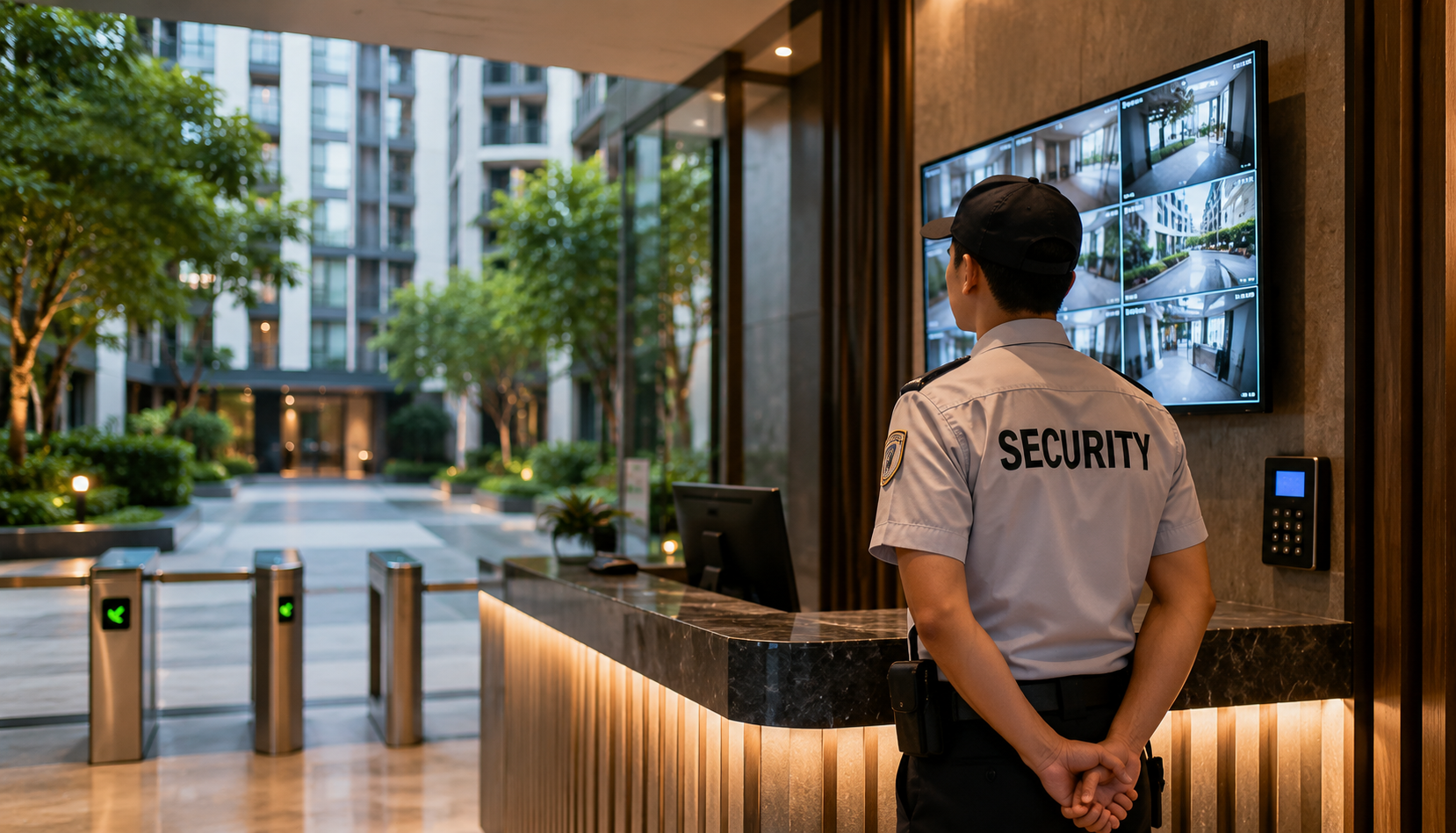
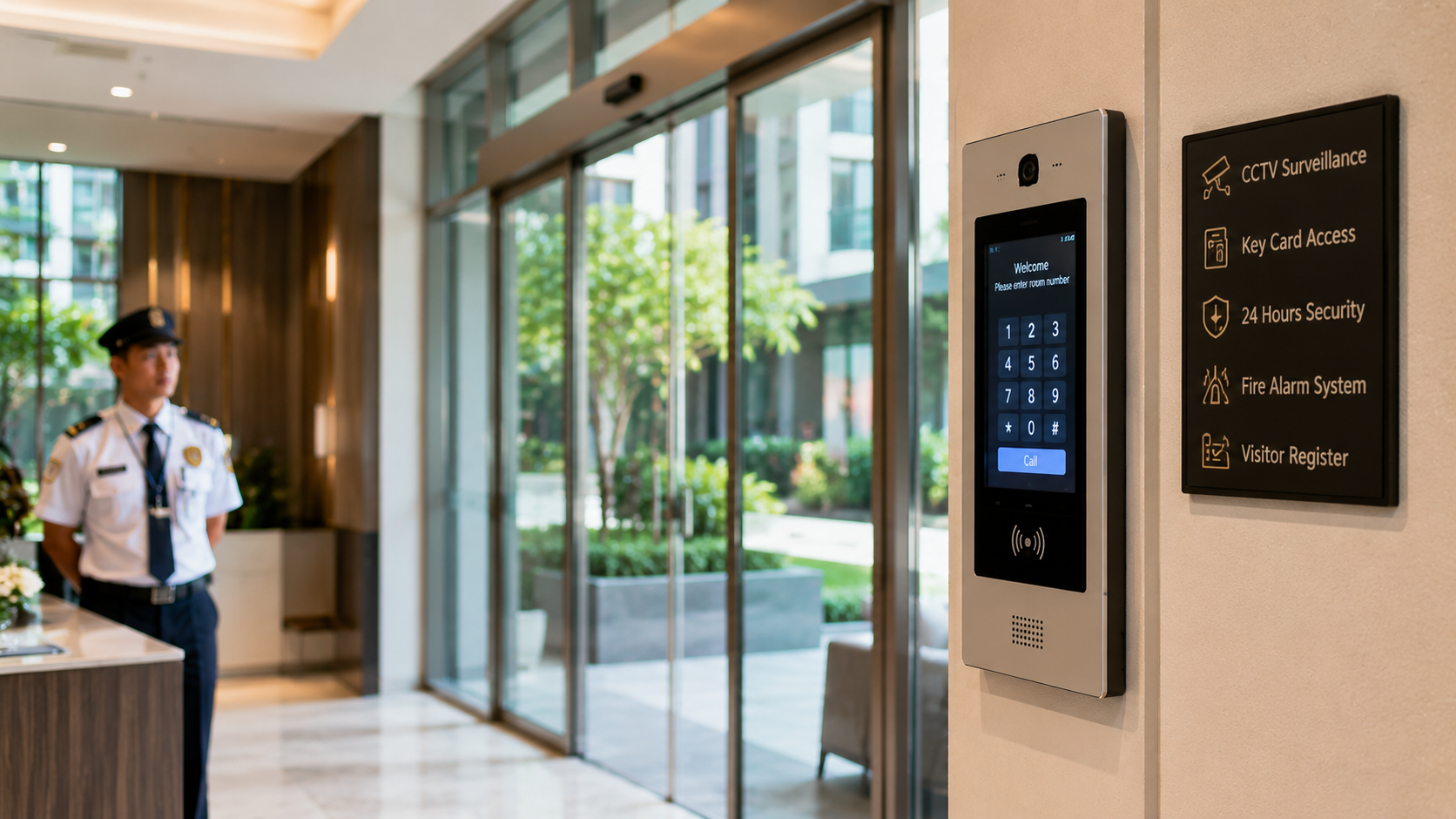
  • How is the main entrance secured — keycard, fob, biometric, code, or a guard? Keycard or fob with a manned lobby is the practical standard.
  • Are visitors and contractors logged, and given temporary access only? A building that waves anyone through has no access control.
  • Does the lift require a keycard to reach residential floors? Floor-restricted lifts stop a stranger from wandering the building.
  • Is the car park gated, and are keycards deactivated when a resident moves out? Old, still-active keycards are a common and overlooked risk.

Surveillance: cameras that actually work

  • What areas are covered — lobby, lifts, car park, perimeter, stairwells? Ask specifically about blind spots.
  • Are the cameras real and recording, and how long is footage kept? Dummy cameras are common; aim for 15–30 days of retention.
  • Who monitors the feed, and when? Recorded-but-unwatched footage only helps after an incident, not during one.

A practical test costs nothing: visit the building late at night and see whether anyone is actually watching.

Security staff: presence versus performance

  • Is it genuinely 24/7, and how many guards are on the night shift? Many buildings staff the day well and thin out overnight, when it matters most.
  • Are guards trained and are patrol rounds logged? A logged patrol is accountable; a chair by the gate is not.
  • What is the response protocol, and can staff assist a foreign resident? Confirm a clear escalation path and at least basic English at reception.

Fire and life safety

  • Are fire alarms, sprinklers and extinguishers installed and serviced? Ask to see service dates.
  • Are the emergency stairwells unlocked and clear? A locked or chained fire stair is both a code violation and a trap — check it yourself.
  • How many lifts are there, and are drills held? A single unreliable lift leaves you exposed when it fails.
  • Has the structure been inspected? After the 2025 Bangkok earthquake, structural inspection became a reasonable thing to request.

Unit-level security

  • What lock is on the door — a digital or smart lock, or a basic latch? Re-key or reset codes on move-in; you rarely know who holds old keys.
  • Do the windows and balcony doors lock, especially on lower floors? Ground and podium-level units carry more access risk.
  • Is there an in-unit safe and a video intercom? Useful for valuables and for screening callers before opening the door.

The transient-guest problem: short-term rentals

A quiet, secure building can be undermined by a steady stream of short-stay guests holding keycards. Many juristic persons ban short-term rentals (under 30 days) in their bylaws, and letting under 30 days generally requires a hotel licence under the Hotel Act, which most condos do not hold. Breaching the Condominium Act’s commercial-use rules can bring fines up to 50,000 THB plus 5,000 THB per day. For a secure, residential feel, confirm the building restricts short-term rentals — and enforces it. The wider due-diligence picture is in our essential tips for buying an apartment in Thailand.

Buyer versus renter: the extra questions

Renters should confirm keycard handover and deactivation, who to call for a security issue, the lease’s deposit and break clauses, and TM30 immigration reporting by the landlord. Buyers go deeper: the juristic person’s finances and any debts, the developer’s reputation, foreign-quota availability (the 49% cap), and any disputes or liens. Whether leasehold or freehold and which ownership structure you use also shapes your rights; on the islands, our Koh Samui ownership guide shows how this plays out.

The one-page checklist

Area Ask this before you sign
Juristic personManager independent? Accounts open? Fee covers security?
AccessKeycard/biometric? Visitors logged? Lift floor-restricted? Old cards deactivated?
CCTVCoverage and blind spots? Real and recording? Retention? Who watches?
Guards24/7 with a night shift? Trained? Patrols logged? English at reception?
Fire safetyAlarms/sprinklers serviced? Stairwells clear? Enough lifts? Structure inspected?
UnitSmart lock re-keyed? Windows/balcony lock? Safe? Video intercom?
Short-term rentalsRestricted and enforced? No revolving Airbnb guests?

Frequently Asked Questions

What is the juristic person in a Thai condo?

It is the management body every registered condominium must have under the Condominium Act B.E. 2522. It runs security, CCTV, common-area upkeep, finances and building rules, funded by the monthly common-area fee. Its financial health largely determines how good the building’s security actually is.

How much are common-area fees, and do they cover security?

Fees typically run 20–70 THB per square metre per month and normally cover security staff, CCTV, cleaning and maintenance. Ask what is included, and whether the juristic person is well funded — an underfunded building cuts guards and defers safety repairs first.

What security should a modern Thai condo have?

The current standard is 24/7 guards, a manned reception, keycard or biometric access, CCTV across lobby, lifts, car park and perimeter, and controlled visitor entry. Better buildings add floor-restricted lifts and logged patrols. Verify these work in practice, not just in the listing.

How do I check the fire safety of a condo?

Ask whether alarms, sprinklers and extinguishers are installed and recently serviced, and check the emergency stairwells yourself — they must be unlocked and clear. A chained fire stair is a code violation and a trap. Ask how many lifts there are and whether drills are held.

Why do short-term rentals affect condo security?

Constant short-stay guests mean a rotating set of strangers holding keycards, which weakens access control. Many juristic persons ban rentals under 30 days, and doing so without a hotel licence can bring fines up to 50,000 THB plus 5,000 THB per day. Confirm the building restricts and enforces this.

What extra checks should a buyer make?

Review the juristic person’s accounts and any debts, the developer’s reputation, foreign-quota availability (the 49% cap), and any disputes or liens. Have a Thai lawyer run formal due diligence on the title, permits and contract before paying a deposit.

The bottom line

Real security in a Thai condo is not the phrase in the listing — it is a funded, transparent juristic person, access control that tells residents from strangers, cameras that record and are watched, guards who patrol at 2am, clear fire escapes, and a building that keeps short-stay guests out. DDA Real Estate helps foreign buyers and renters vet buildings and complete purchases safely, with full legal support. For the wider picture, see our guide to property investment in Thailand for foreigners, then get in touch.

Popular
5 June 4071564 view
Dubai Rent Prices 2025: Average Apartment Rental Costs in Dubai Dubai's rental market continues its upward climb in 2025, driven by population growth and limited new supply, pushing average prices up by 10%
#Blog DDA
2 July 2358531 view
DLD Fees in Dubai: Everything You Need to Know Buying property in Dubai? Don't let hidden fees surprise you! Our essential guide breaks down ALL Dubai Land Department (DLD) fees
#Blog DDA
5 July 1681470 views
How Much is the Real Estate Agent Commission in Dubai? Find out how much real estate agent commission costs when buying property in Dubai.
#Blog DDA
23 November 1604295 views
How to Buy a SIM Card in Turkey in 2026: Prices, IMEI Registration, eSIM Options, and Best Mobile Operators Overview of mobile operators, available types of SIM cards, and home Internet providers
#Blog DDA
5 February 1384992 view
How Foreigners Can Own Property in Bali: Understanding PT PMA (2025) Foreigners can't own freehold land in Bali, but a PT PMA (foreign-owned company) allows secure property ownership under Hak Guna Bangunan (HGB) or Hak Pakai (HP) rights
#Blog DDA
28 August 1136898 views
Oqood vs Title Deed in Dubai: Key Differences You Must Know Buying property off-plan in Dubai? Oqood registration is mandatory to secure your ownership rights.
#Blog DDA