Off-plan properties
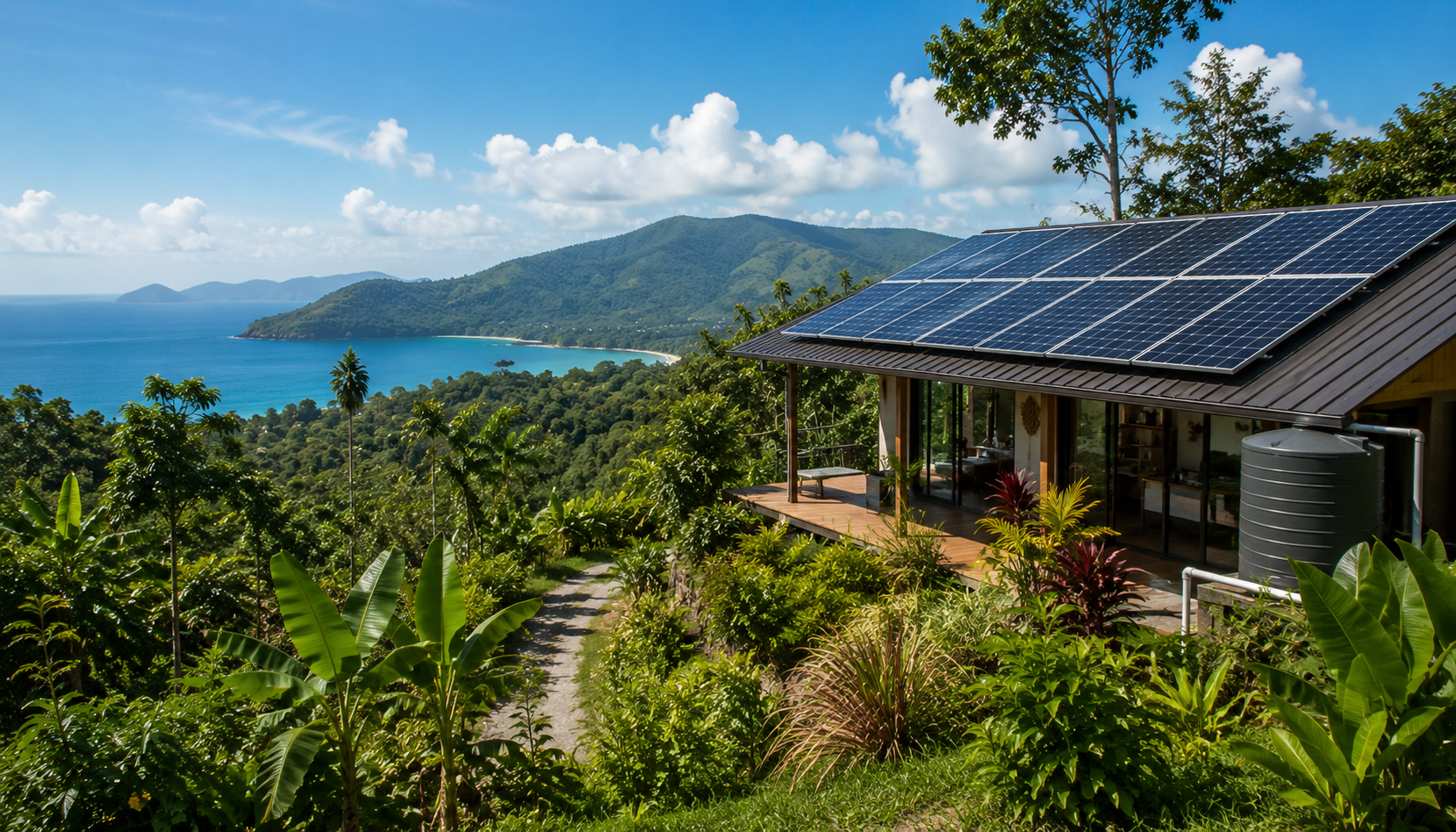
Thailand is one of the more realistic places in Asia to live off-grid. It has among the best sunshine in the region (an average of 5.06 kWh per square metre per day), cheap rural land, and near-nationwide mobile coverage. But going off-grid here still means engineering around a heavy monsoon, a solar buy-back scheme that is currently frozen, and a satellite-internet market in a legal grey area. The dream is achievable; the details decide whether it works.
This guide covers the three pillars of an off-grid home — power, water and internet — plus the land and legal groundwork that comes first, with real 2026 numbers. It is general information, not legal or engineering advice: costs vary, and permits and telecom rules change, so verify the current position before you commit.
Off-grid starts with land you can legally use. Foreigners cannot own land in Thailand outright, so it is held through a registered lease or a Thai company — the structures explained in our guides to leasehold versus freehold and the types of property ownership in Thailand. Rural land runs roughly 490,000 to 1,000,000 THB per acre depending on access, rising near towns and the coast.
Going fully off-grid makes the most financial sense when the property is more than about 5 km from grid infrastructure, where a grid extension can cost 500,000 THB or more. Before buying, confirm the title deed (a Chanote is strongest), legal road access, the water table, and building-permit requirements with a lawyer.
Thailand’s solar resource is excellent — about 5.06 kWh/m²/day on average, peaking at 5.6–6.7 in April and May — so the constraint is storage and the rainy season, not sunlight. Size honestly to consumption:
| System | Indicative cost (2026) |
|---|---|
| 5 kW on-grid (no battery) | 130,000–250,000 THB |
| 5 kW off-grid with battery | 300,000–400,000 THB |
| 10 kW with ~14 kWh battery | ~400,000 THB |
| Grid connection permit (on-grid) | 5,000–15,000 THB |
Two rules change the off-grid economics. The net-billing buy-back quota has been full since late 2024, so new systems cannot sell excess to the grid — the model is self-consumption. And the 2026 tax deduction of up to 200,000 THB applies to grid-connected rooftop systems, so a pure off-grid setup usually does not qualify. Right-size rather than oversize, keep panels clean (dust costs 15–25%, heat at 65°C another 14–16%), and if the grid is within reach, a hybrid system often beats going fully independent.
| Source | How it works and what to watch |
|---|---|
| Rainwater harvesting | Roof catchment into large tanks with a first-flush diverter; abundant in monsoon, must last the dry season |
| Borehole / well | Drilled to the water table and pumped (a solar pump works well); depth and cost vary, yield can drop in dry months |
| Municipal (PWA) | Where a Provincial Waterworks line reaches; least ‘off-grid’ but a useful backup |
The monsoon is your ally: a wet season that soaks the panels also fills the tanks. Size storage for the dry months, not the average. For drinking water, treat at the point of use — sediment and carbon filtration plus UV or reverse osmosis — whatever the source. On the waste side, composting toilets and greywater systems keep a remote home self-contained.
Most people get this wrong by starting with satellite. In Thailand, the practical order is mobile first, satellite last.
| Option | Reality in 2026 |
|---|---|
| 4G / 5G router | The workhorse: 5G reaches ~95% of the population and even remote villages usually have 4G. A router with an external antenna covers most homes; data is cheap (SIMs 299–599 THB) |
| Fibre (AIS, True, 3BB) | In all 77 provinces and reaching smaller towns, but patchy in new or remote developments — a new estate can wait 6–18 months |
| LEO satellite | NT’s OneWeb service is NBTC-licensed and legal; Starlink is popular but its consumer status has been contested — verify current rules and power draw (20–100W) |
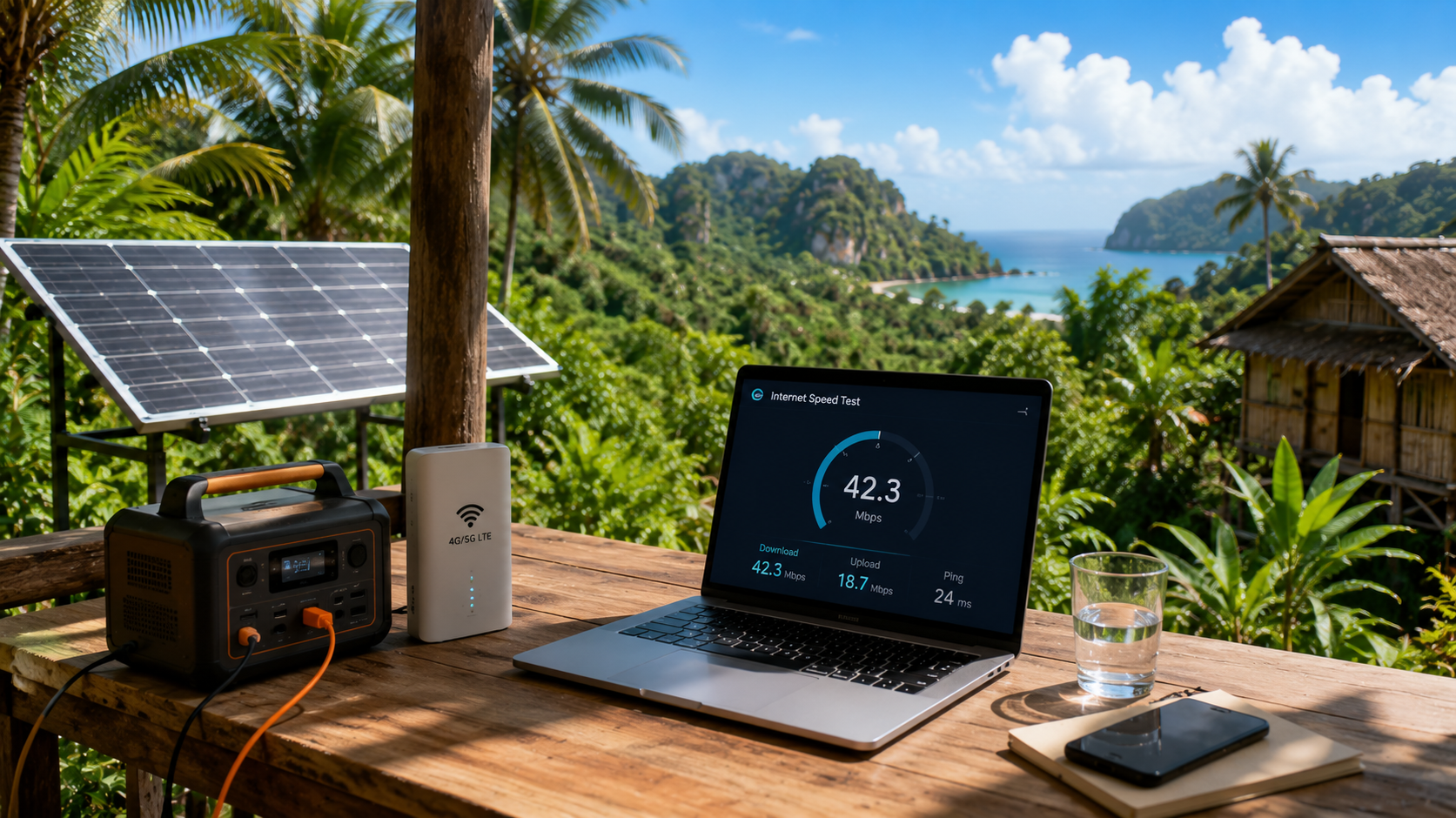
For most off-grid sites, start with a 4G/5G router and a directional antenna aimed at the nearest tower, adding satellite only where there is no usable mobile signal (parts of the smaller islands and remote mountains). If you run satellite on solar, the dish is a constant load — 20–40W for a Mini, 75–100W for a standard unit — so size the battery bank for it.
The same climate that makes Thailand attractive sets the engineering limits. In the rainy season, solar output falls 20–30% and satellite links can lose packets, so oversize panels and storage and keep a fallback connection. In the dry, dusty months, panels lose 15–25% when dirty and 14–16% at 65°C, so cleaning and airflow matter. Heavy rain fills your tanks but demands real drainage and flood-aware siting. Off-grid here rewards planning for the extreme weeks, not the pleasant average.
For a remote two-bedroom house with light air-conditioning, a workable baseline is a roughly 5 kW off-grid solar array with battery (300,000–400,000 THB), rainwater harvesting into large tanks plus a borehole with a solar pump and point-of-use filtration, and a 4G/5G router with an external antenna, keeping a satellite unit as backup. Add the land, a simple structure and permits, and full independence is realistic — provided you accept some limits on heavy, always-on power.
The property decisions matter as much as the hardware. Verify the title, road access, water table and distance to the grid, and choose an ownership structure that is genuinely lawful — we separate fact from fiction in our piece on myths about foreign property ownership in Thailand. Island sites have their own quirks; our Koh Samui ownership guide shows how the rules play out where land, water and connectivity are all more constrained.
Is it realistic to live off-grid in Thailand?
Yes, especially in areas more than about 5 km from the grid, where a grid extension can cost 500,000 THB or more. Strong sunshine, cheap land and wide mobile coverage help; the main constraints are battery cost, the rainy season and disciplined water planning.
How much does an off-grid solar system cost?
Indicatively in 2026, a 5 kW off-grid system with battery runs 300,000–400,000 THB, and a 10 kW system with a ~14 kWh battery about 400,000 THB. Batteries roughly double the cost versus a grid-tied system.
Can I sell excess solar power to the grid?
Not with a new system — the net-billing buy-back quota has been full since late 2024. Off-grid solar is a self-consumption model, and the 2026 tax deduction of up to 200,000 THB applies to grid-connected systems, so pure off-grid usually does not qualify.
How do off-grid homes get water?
Usually a combination: rainwater harvesting into large tanks, a borehole or well with a solar pump, and municipal PWA water as backup where a line reaches. Treat drinking water at the point of use with sediment, carbon and UV or reverse-osmosis filtration.
Is Starlink available in Thailand?
Its consumer status has been contested. NT’s OneWeb LEO service is NBTC-licensed and legal, while Starlink has been widely used but faced regulatory hurdles, and importing hardware without approval has carried risk. Check the current NBTC position and Starlink’s availability map first.
What is the best off-grid internet option?
For most sites, a 4G/5G router with an external antenna — 5G covers about 95% of the population and even remote villages usually have 4G. Use LEO satellite only where there is no usable mobile signal, and size your solar for its 20–100W draw.
Off-grid living in Thailand is genuinely achievable: strong sun, affordable rural land, abundant wet-season water and near-universal mobile coverage. The work is in the engineering — batteries sized for the monsoon, water stored for the dry, internet built on mobile first — and in the land and legal groundwork underneath it. DDA Real Estate helps foreign buyers find and structure rural and island property lawfully, with full due diligence. For the wider picture, see our guide to property investment in Thailand for foreigners, then get in touch.