

Off-plan properties
A Thai bank account is the financial backbone of actually living in Thailand rather than just visiting: it is how you pay rent and utilities without international-transfer fees, receive a salary or pension, and use PromptPay, the QR-code system that now settles everything from a 7-Eleven snack to your electricity bill. But the way you get one has changed sharply, and if your information is a year old, it is probably wrong.
As of 2026, Thailand runs the strictest foreign account-opening regime it has ever had. Tourist stamps and even the five-year Destination Thailand Visa (DTV) are effectively frozen out, biometric checks are now standard, and banks scrutinise where your money comes from. This guide reflects the current rules: what changed and why, which visa you actually need, the documents banks demand today, and the process step by step. One caveat throughout — branch policies still vary, so treat this as your preparation checklist and confirm before you go.
The friction is not random branch behaviour; it is coordinated policy. It traces back to a wave of fraud in 2024–2025, when call-centre scam syndicates recruited transient foreigners to open so-called “mule accounts” for money laundering. In response, the Bank of Thailand rolled out tougher Customer Due Diligence (CDD) rules, and — under pressure from international anti-money-laundering standards — banks are now graded on compliance discipline rather than deposit volume, with managers personally accountable for approving a questionable foreign account.
Two practical consequences follow. First, banks now want proof of genuine, anchored residency, not just identity — which is exactly why tourist-class visas no longer qualify. Second, verification has gone physical: since late 2025 most branches require a biometric face scan and a chip-read of your passport, and they no longer accept photocopies for the initial check. Bangkok Bank formalised much of this from 2025, and the other majors have followed.
This is the decisive factor. To open a new account in 2026 you need a long-stay visa that signals real residency intent: Non-Immigrant B (work, usually with a work permit), O (marriage or family), O-A/O-X (retirement), ED (student), or the LTR visa. Tourist visas, visa-exempt entries and visa-on-arrival stamps are out across all major banks. In practice, retirement and education visas tend to be the smoothest routes for individuals.
Two premium visas act as genuine fast-tracks. LTR (Long-Term Resident) holders get pre-arranged onboarding at Bangkok Bank and Kasikorn — though you typically must notify the Board of Investment (BOI) unit at least four days before your branch visit. The Thailand Privilege (Elite) visa, issued through a Tourism Authority of Thailand subsidiary, comes with a certified letter and membership card that clears most discretionary hurdles and opens both baht and Foreign Currency Deposit accounts. If banking access is your priority and you do not qualify another way, these two are worth serious thought.
The Destination Thailand Visa, launched in July 2024 for digital nomads and remote workers, is the single biggest source of confusion this year. Despite its five-year validity, it is legally classified as a “Tourist” visa under the Immigration Act, so it fails the residency-intent test that banks now apply. As of mid-2026, Bangkok Bank, Kasikorn, SCB, Krungthai and Krungsri have aligned to refuse new accounts for DTV holders — usually a polite decline at the counter, often with no written reason.
It gets sharper: some DTV holders who opened accounts back in late 2024 have had them frozen or flagged during the banks’ periodic compliance audits in 2026. If you hold a DTV and need banking, the reliable path is to obtain a qualifying long-stay visa; in the meantime, services like Wise or Revolut and an offshore multi-currency account cover most day-to-day needs. A handful of smaller Krungsri branches have reportedly made rare exceptions with a residence certificate, but that is not something to plan around.
The majors require a branch visit and broadly similar paperwork; they differ in how foreigner-friendly they are at branch level:
| Bank | App | Notes for foreigners (2026) |
|---|---|---|
| Bangkok Bank | Bualuang mBanking | Biggest overseas network, strong English support; long the default, now stricter |
| Kasikorn (KBank) | K PLUS | Arguably the best app; friendly at expat-area branches |
| SCB | SCB Easy | Stricter for non-residents; smooth for LTR and Privilege holders |
| Krungthai (KTB) | Krungthai NEXT | Government-owned; occasionally flexible for students |
For most renters, retirees and remote professionals, Bangkok Bank or Kasikorn are the safest starting points — but the branch matters more than the brand. A main branch in an expat-heavy district (Silom or Sukhumvit in Bangkok, or the centres of Chiang Mai, Phuket and Pattaya) handles foreign accounts daily and is far likelier to approve you.
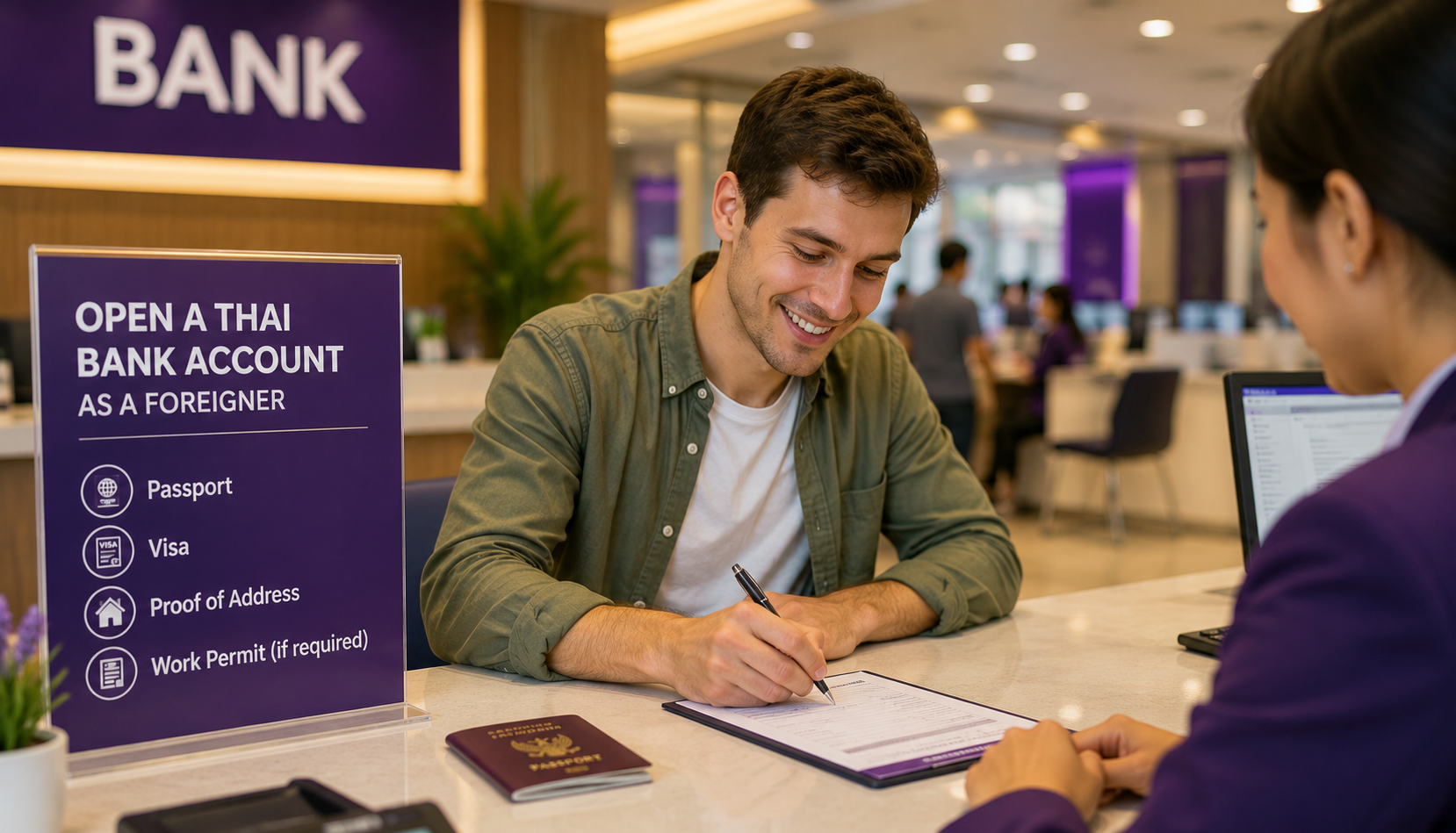
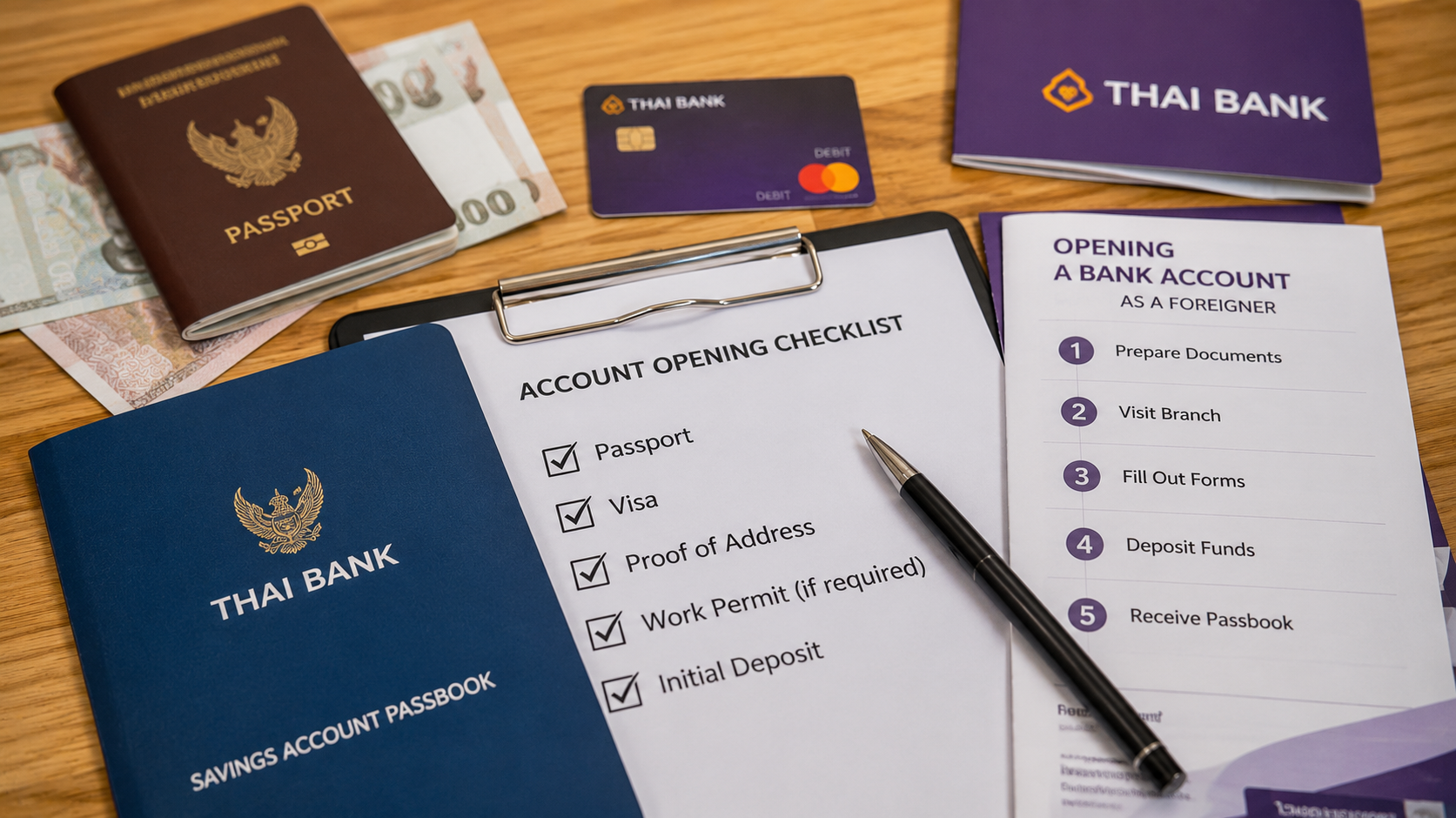
Requirements shift by branch, but the 2026 baseline is heavier than it used to be. Bring originals — copies alone no longer pass the initial check:
With the right visa and paperwork, the visit itself is quick — typically one to two hours:
Approval often comes down to persistence and small details. “Branch shopping” genuinely works: a suburban branch may refuse you while a mall branch in an expat area processes the same application in twenty minutes, so if one says no, walk to the next. Keep your source-of-funds story clean and documented, bring the Residence Certificate, and add an employer or landlord support letter if you can. One more current wrinkle worth knowing: since 2024 anyone in Thailand for 180 days or more in a year is a tax resident, foreign income remitted into the country can be taxable, and banks are increasingly linked to the Revenue Department — which is part of why they scrutinise foreign accounts so closely. Finally, keep your visa current and your passbook updated, as banks can freeze a lapsed account and Immigration may check recent stamps at extension time.
A local account is not just for daily spending — it is central to settling in and, eventually, to buying. When a foreigner purchases a condominium, the funds must be transferred into Thailand in foreign currency and properly documented (the Foreign Exchange Transaction record), and a Thai account sits at the heart of that process. If a longer stay is on the cards, our essential tips for buying an apartment in Thailand, the guide to types of property ownership, and our explainer on leasehold versus freehold walk through what foreign buyers need to know.
Can I open a Thai bank account on a tourist visa in 2026?
No. As of 2026 the major banks — Bangkok Bank, Kasikorn, SCB, Krungsri, Krungthai and UOB — require a long-term visa with genuine residency intent, and tourist stamps, visa-exempt entries and the DTV are refused. This is coordinated policy tied to the Bank of Thailand’s anti-fraud crackdown, not branch-level discretion, so securing a qualifying visa first is the reliable route.
Does the DTV visa work for opening a bank account?
Not reliably. Although the Destination Thailand Visa is valid for five years, it is legally classified as a tourist-category visa, so the major banks refuse new accounts for DTV holders in 2026 — and some accounts opened by DTV holders in 2024 have since been frozen during compliance reviews. The alternatives are a qualifying long-stay visa or non-bank options like Wise, Revolut or an offshore account.
Why has it become so hard for foreigners in 2026?
A wave of “mule account” fraud in 2024–2025 pushed the Bank of Thailand to tighten Customer Due Diligence, and international anti-money-laundering pressure did the rest. Banks are now judged on compliance rather than deposits, biometric verification is standard, and they must confirm the genuine purpose behind every foreign account — which is why tourist-class visas no longer qualify.
Which bank is best for foreigners in Thailand?
Bangkok Bank and Kasikorn (KBank) are the most consistently foreigner-friendly, with English-speaking staff at expat-area branches and strong apps (Bualuang mBanking and K PLUS). SCB tends to be stricter but is smooth for LTR and Thailand Privilege holders. Whichever you choose, opening at a main branch in an expat district matters more than the bank itself.
What documents do I need to open a Thai bank account now?
A passport (valid six months, with a qualifying long-stay visa stamp, expect a chip-read and face scan), the visa itself, government-issued proof of address such as a Residence Certificate from Immigration, a Thai phone number, and often evidence of your source of funds. Budget 500–2,000 THB for the deposit and possibly a small accident-insurance policy.
Is a rental contract enough as proof of address?
Increasingly not. In 2026 many branches want a government-issued document and no longer accept a bare rental contract on its own. The standard solution is a Residence Certificate from your local Thai Immigration office, obtained with your passport, a photo and your lease — bring it to the bank to avoid a wasted trip.
Can I open a Thai bank account online?
No. At every major Thai bank the initial opening must be done in person at a branch, partly because biometric verification and a physical passport check are now required. Once the account is active you can handle almost everything through the mobile app, so it is worth setting up mobile banking and PromptPay during your branch visit.
Do the LTR or Thailand Privilege visas make banking easier?
Yes — they are the clearest fast-tracks in 2026. LTR holders get pre-arranged onboarding at major banks (usually with a few days’ notice to the BOI unit), and Thailand Privilege members receive a certified letter and card that bypasses many discretionary hurdles, opening both baht and foreign-currency accounts. For those who don’t qualify another way, either can be a practical route to reliable Thai banking.
Opening a Thai bank account in 2026 is still entirely doable — but the game has changed. Arrive with a genuine long-stay visa (or an LTR/Privilege fast-track), a Residence Certificate, a clean source-of-funds story and a main branch in an expat area on your list, and the visit itself takes an hour or two. Get it right and PromptPay, easy rent payments and fee-free daily banking transform everyday life. And when a longer stay turns into buying, DDA Real Estate helps foreigners purchase and invest with full legal support — our guide to property investment in Thailand for foreigners is a natural next read. Get in touch and we’ll help you plan the move.