

Off-plan properties
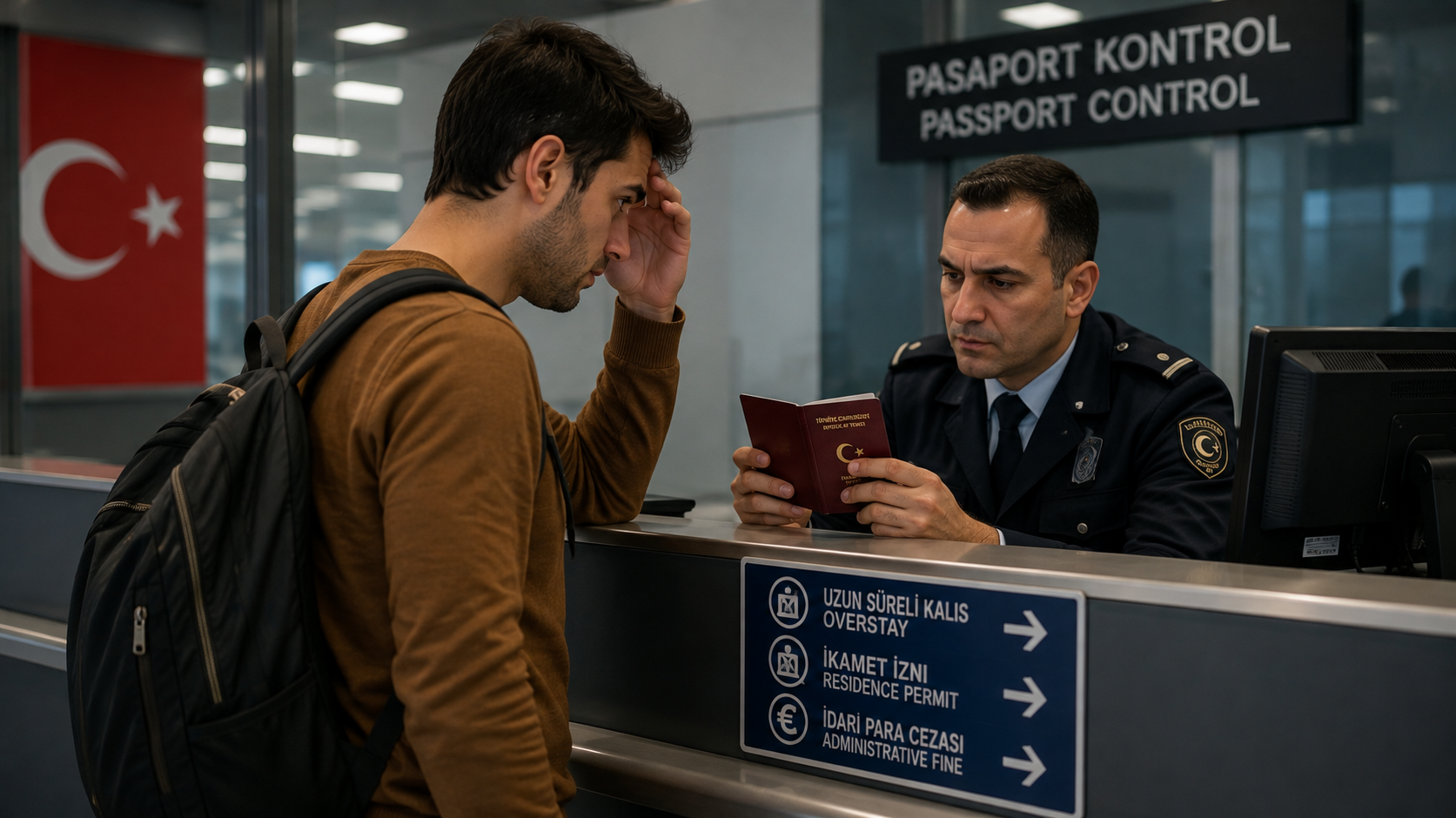
Fifty-four dollars a day, payable in cash before you are allowed to leave. The rate doubled in April 2024 and has held since, which makes a forgotten month cost more than the flight that brought you.
Overstay is a factual violation under Turkish migration law rather than a question of intent — miscounting, illness or a cancelled flight do not excuse it, though they can influence how an officer exercises discretion at the border.
This guide covers what counts as overstay, the current fine structure with worked examples, entry bans by duration, the ten-day grace period, the difference between leaving voluntarily and being removed, and the legal routes that avoid the problem entirely. Figures reflect August 2026 and change — verify before relying on them, and take professional advice for anything beyond a few days.
All three carry the same consequences, and the second is the one that catches people who believed they were compliant.
The rolling window is where most accidental overstays originate. People count each visit rather than the cumulative total, which is exactly the arithmetic the electronic system does not make.
The daily rate is fixed; what varies is what gets added to it.
| Overstay | Daily fine at 54 USD | Additional fees | Realistic total |
|---|---|---|---|
| 5 days | 270 USD | Up to 100 | 270 – 370 USD |
| 15 days | 810 USD | 100 – 200 | 910 – 1,010 USD |
| 30 days | 1,620 USD | 200 – 300 | 1,820 – 1,920 USD |
| 90 days | 4,860 USD | 500 – 700 | 5,360 – 5,560 USD |
| 180 days | 9,720 USD | 700 – 1,000 | 10,420 – 10,720 USD |
| One year | 19,710 USD | 1,000 – 1,500 | 20,710 – 21,210 USD |
Where an expired residence permit is involved, the applicable permit fees are added — the identity card charge alone rose to 964 lira in April 2026 — along with administrative penalties calculated on duration and any previous violations.
One procedural detail matters more than the amounts: payment is cash only. Airports and land crossings take lira, dollars or euros at the official rate and accept nothing else — no cards, no transfers, no mobile payment. Arriving at the desk without enough cash means detention until someone can bring funds, or transfer to a holding facility while the case is processed.
The ban, not the fine, is the consequence that lasts. Duration scales with the length of the overstay.
| Overstay | Typical ban |
|---|---|
| Within the 10-day grace period | Usually none if the fine is paid on exit |
| Up to a month | Three months |
| One to three months | Six months |
| Three to six months | One year |
| Six months to a year | Two years |
| Over a year, or repeat violations | Five years |
Bans are not automatic. Officers exercise discretion based on the circumstances, previous history and how cooperative the departure is, and a first offence with a genuine explanation is frequently resolved without one.
What is not discretionary is the record. Bans are entered in the central passport system and verified at every entry point, and Turkey shares information internationally — a formal removal or an extended overstay can surface in later visa applications elsewhere, including Schengen. That is the part worth avoiding, not the money.
Article 54 of the foreigners law provides ten days during which voluntary departure avoids formal proceedings. It is genuinely useful and widely misunderstood.
It does not suspend the fines. The daily charge accumulates from the first day past your permitted stay and is payable in full on exit. What the grace period affects is the likelihood of a ban and the avoidance of deportation proceedings — not liability.
Past ten days, escalation is largely automatic in the system and officer discretion narrows considerably. Anyone who discovers they have overstayed should therefore treat the ten days as a hard deadline: leave inside it, with cash sufficient for the full amount and a clear account of what happened.
The gap between these three outcomes is far wider than the difference in the fines suggests.
| Outcome | What happens | What it leaves behind |
|---|---|---|
| Voluntary departure | You leave on your own transport, paying the fine at the exit point | A ban record proportionate to duration, no removal record |
| Removal to a designated country | Detention at a removal centre for days or weeks while processing runs | Typically a five-year ban and a formal record |
| Deportation | Formal administrative or court process | Five-year minimum ban, a deportation record with international visibility |
Removal is triggered by extended overstay, refusal to leave, false documentation or security concerns. Deportation adds criminal conduct and repeat violations to that list.
The practical conclusion is uncomfortable but clear: leaving voluntarily with a substantial fine is a far better outcome than staying and hoping. The fine is money; the removal record follows you into every subsequent visa application, and in some cases into family members’ applications too.
One rule complicates legalisation for anyone already in overstay, and it is easy to miss.
Since June 2022, neighbourhoods where foreign residents exceed 20 per cent of the registered population are closed to new residence permit applications, which currently affects more than 1,200 neighbourhoods. Since July 2023, ten Istanbul districts have been closed entirely — existing residents may renew, but new applications are generally refused. Several coastal neighbourhoods in Antalya and along that coast have also passed the threshold.
For someone trying to regularise their status, this can be decisive. An application filed from a restricted district is rejected regardless of merits, which means relocating before applying — an extra step at precisely the moment when time is the scarcest resource. For buyers, it means verifying the district before purchase rather than after, because a property in a closed neighbourhood cannot support a residence application.
The right response differs sharply by scale.
A few days, discovered late
Usually a miscounted allowance or a delayed flight. Leave within the grace period, carry cash for the full amount — under 400 dollars for five days — and explain the circumstances plainly rather than attempting to obscure the dates.
The likely outcome is a fine and no ban, with the ability to return once a new entry is available under the ordinary rules.
One to three months
Usually a residence permit application never filed, or a renewal deadline missed. This is the point at which professional advice stops being optional: consult a Turkish immigration lawyer before departing, carry cash running into thousands, and prepare documentation of the circumstances.
Expect a ban of six months to a year, and a record that makes subsequent applications more involved.
A renewal refused
Refusals commonly follow insufficient income evidence, missing insurance or changed circumstances. An appeal can be filed within 30 days while you remain lawfully present, and preparing an exit plan in parallel is prudent rather than pessimistic.
One tactical point is worth knowing: withdrawing an application that is likely to be refused generally preserves better options than allowing a formal rejection to be recorded. That decision has to be made before the decision, which is why early advice matters.
Over a year
Realistically a five-year ban, a formal record and fines above twenty thousand dollars, with detention possible during processing. Legal representation is essential, and full disclosure to the authorities generally produces better outcomes than concealment at this stage.
Every one of the outcomes above is preventable, and the prevention costs less than the recovery in all cases.
All of them run through the same administrative spine — the full sequence is set out in our expat guide to the Turkish residence permit, and the tax number that gates most of it in our guide to obtaining a VKN.
Six habits prevent nearly every accidental overstay.
What is the current fine?
Fifty-four dollars a day since April 2024, still current in 2026, plus permit fees and administrative penalties where a residence permit was involved. Payable in cash at the exit point.
Is there really a grace period?
Ten days under Article 54, during which voluntary departure usually avoids a ban. It does not suspend the daily fines, and the benefit is applied at the officer’s discretion rather than automatically.
Can I pay by card?
No. Cash only, in lira, dollars or euros. Insufficient cash means detention until funds arrive or transfer to a holding facility.
How long is the ban?
Three months for up to a month of overstay, rising through six months and one year to five years for anything beyond a year or for repeat violations. Officer discretion applies at the shorter end.
Can I renew a tourist stay from inside Turkey?
No. The only routes are a residence permit applied for before expiry, or departure and a new entry under the ordinary rules for your nationality.
Will this affect visas for other countries?
It can. Turkey shares information internationally, and formal removals or extended overstays may be visible to visa officers elsewhere, including in the Schengen area.
I have just found my permit expired — what now?
Act the same day. Within ten days of expiry, leaving with the fine paid is usually the cleanest outcome. If you intend to stay, take legal advice immediately, because the options narrow with every week.
The most expensive version of this problem is not the daily fine — it is a property purchased in a neighbourhood closed to new residence applications by someone who bought it precisely in order to live there. That check takes minutes and is almost never made by buyers acting alone. DDA Real Estate is a real estate agency in Turkey. We work across Istanbul, Antalya, Alanya, Izmir, Bodrum and Mersin, and for buyers whose purpose is residence we verify district eligibility before anything else and plan the permit timeline alongside the transaction.
Explore our listings in Turkey and get in touch: we will confirm that the property you are considering supports the status you want, sequence the paperwork so the permit is filed well inside your entry period, and tell you plainly if a district that suits your budget will not support your plans.