

Thai Post Offices 2026: Mail and Parcels
971 56 596-5009
day and night
Dubai
EN
$
ft²
Other articles

How to Navigate Thai Post Offices: Sending Mail, Receiving Packages & PO Boxes

Nikita Sokolov The author of the article, the Broker
#Blog DDA
19 July 945 views

Most problems foreigners have with post in Thailand come from a single wrong assumption: that there is one postal system. There are three, they overlap far less than you would expect, and choosing the wrong one is what turns a simple errand into three weeks of waiting.

The state post handles documents, official correspondence, international letters and post office boxes. Private courier networks handle almost everything bought online domestically. And customs governs anything arriving from abroad, which means the service you chose at the other end often matters less than what the parcel contains and how it was described.

What follows is how the three fit together, why a Thai address fails more often than a Thai courier does, what happens when something is held, and who actually needs a post office box. Procedures and thresholds change and branches differ in what they offer, so confirm anything specific at the branch you will actually use.

Three systems that barely overlap

Treating these as interchangeable is the root of most complaints. Each has a domain where it is clearly the right answer and domains where it will simply frustrate you:

  • The state post — letters, documents, official notices, anything international leaving the country, registered mail with a tracking number, and post office boxes; slower for parcels than the alternatives but the only option for several of these
  • Private courier networks — the backbone of domestic e-commerce, faster and with denser pickup points, but with coverage and service standards that vary by network and by area
  • Customs — not a delivery service at all, yet it decides the timeline for every inbound international parcel regardless of who carried it

The practical rule is to pick by destination and content, not by habit. A document going abroad belongs with the state post. A phone charger bought online arrives by whichever network the seller uses and you have no say in it. And a parcel from home is a customs question wearing a courier's uniform.

What the state post is genuinely best at

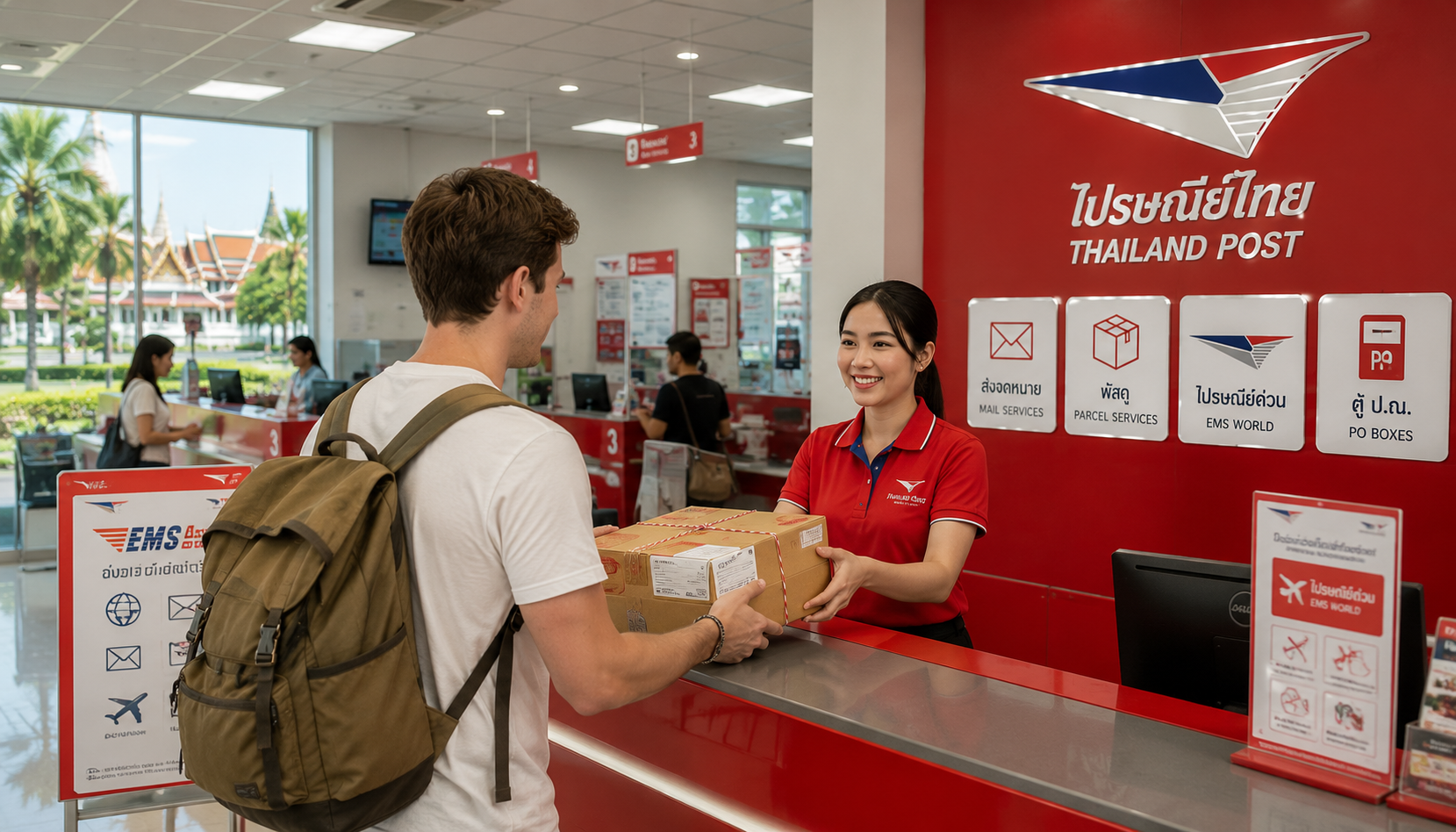
Thailand Post is dense, cheap and better than its reputation among newcomers, who mostly encounter it once and compare it to a courier. Branches reach into small towns where private networks thin out, and the express service is fast on major routes. Registered mail produces a tracking number and a signature on delivery, which is what matters for anything you may later need to prove was sent.

It is also the only route for several things that come up in a foreigner's first year: sending original documents abroad, receiving official correspondence from government offices and banks, and holding a post office box. Official mail in Thailand still arrives on paper, which is exactly why the address you registered has to be one where paper actually reaches you.

Your address is where it fails

Deliveries here fail on addresses far more often than on services. A Thai address is a hierarchy that narrows from province down to house number, and each level does real work: the province, the district, the subdistrict, the road, the lane, the village number in rural areas, and finally the building and unit. Romanisation of the middle levels is inconsistent, which is why the same street appears three ways across three websites.

The postcode is the field that does the routing, so a correct five-digit postcode rescues a badly transliterated street more often than a beautifully spelled street rescues a wrong postcode. What to have ready before you order anything:

  • Your address written out in Thai script, saved as a screenshot you can show or paste
  • The postcode confirmed against the actual subdistrict, not copied from a neighbouring listing
  • The building or village name as locals say it, which is often not what appears on the paperwork
  • A nearby landmark, because lane numbering confuses Thai drivers too
  • A working phone number on every order, since couriers call rather than search

Where a parcel actually lands

This surprises people more than anything else on the list. In a condominium, parcels do not come to your door — they go to the juristic person office or the reception desk, which signs for them and holds them until you collect. That office is a small institution with its own hours, its own rules about how long it stores things and its own attitude to bulky items.

Which makes it worth knowing how your building is actually run, since how a condominium's management office operates governs far more than deliveries. In a standalone house the position is different and usually worse: a parcel is left, handed to a neighbour, or returned. Gated estates route through the guardhouse. Establish this on day one rather than after the first missing item, because the answer changes what you can safely have sent to you.

Sending within Thailand

Domestic sending is the easy part and rarely goes wrong. You bring the item unsealed or ready to seal, the counter weighs it, you choose between ordinary, registered and express, and you pay at the counter. Registered and express both produce tracking; ordinary post does not, and for anything you would mind losing that difference is the whole decision.

Keep the receipt with the tracking number until the item is confirmed delivered. It is the only proof that exists, counter staff cannot reconstruct it later, and it is also what a private courier's pickup point will ask for if you are collecting rather than sending. Branch hours run on a weekday schedule with limited weekend service at some locations, so check the specific branch rather than assuming.

Sending abroad

Outbound international post divides sharply into documents and goods, and the paperwork differs. Documents are straightforward. Goods require a customs declaration describing the contents and their value, and that declaration is read at the destination as well as here, so a vague description or an understated value creates problems at the other end rather than at this one.

The prohibited list is the same one that governs what you can carry, and it applies in the post too. Vaping devices and their components cannot be posted any more than they can be carried, and controlled medication needs the same authorisations it would need in a suitcase. Practical points for anything going out:

  • Describe contents specifically — «gift» and «sample» invite inspection rather than avoiding it
  • State a realistic value, since an understated one causes delays and can create liability for the recipient
  • Keep packaging simple and secure; the counter may ask to see the contents before sealing
  • Check the destination country's own restrictions, which are frequently the binding ones
  • Use a tracked service for anything irreplaceable, and photograph the item and the receipt

Receiving from abroad: customs decides

Everything arriving from outside Thailand is assessed, whether it came by post or by an international courier. Duty and value-added tax may apply depending on the declared value and the category of goods, and the low-value threshold has been revised in recent years, so the current position is worth checking rather than assuming from an older guide or from what a friend paid last year.

The declared value and description do most of the work. A parcel described accurately and valued honestly usually moves through; one that looks commercial, or whose paperwork does not match its contents, attracts attention. Anything that looks like stock for resale is treated as an import rather than a personal item, and that changes both the process and the cost.

When something is held

Being held is routine rather than a sign of trouble, and the process is predictable. You receive a notification telling you the parcel is at customs or at a postal facility and what to do; from there the item is either released on payment or requires you to attend in person. Attending is more common with the state post than with international couriers, who usually handle clearance and bill you afterwards.

What decides how long the visit takes is what you arrive with:

  • Your passport, since collection is registered against identity documents
  • The notification slip itself, or the tracking number if the slip never reached you
  • Proof of value — an invoice, order confirmation or screenshot of the purchase
  • A written authorisation and a copy of your passport if someone is collecting on your behalf
  • Time and patience: these facilities work on their own hours and rarely reward arriving late in the day

Notification slips get lost between the sender and you far more often than parcels do, especially in buildings where mail is sorted at a desk. If tracking says an item arrived in the country weeks ago and nothing has followed, the slip is the likelier casualty.

PO boxes: who actually needs one

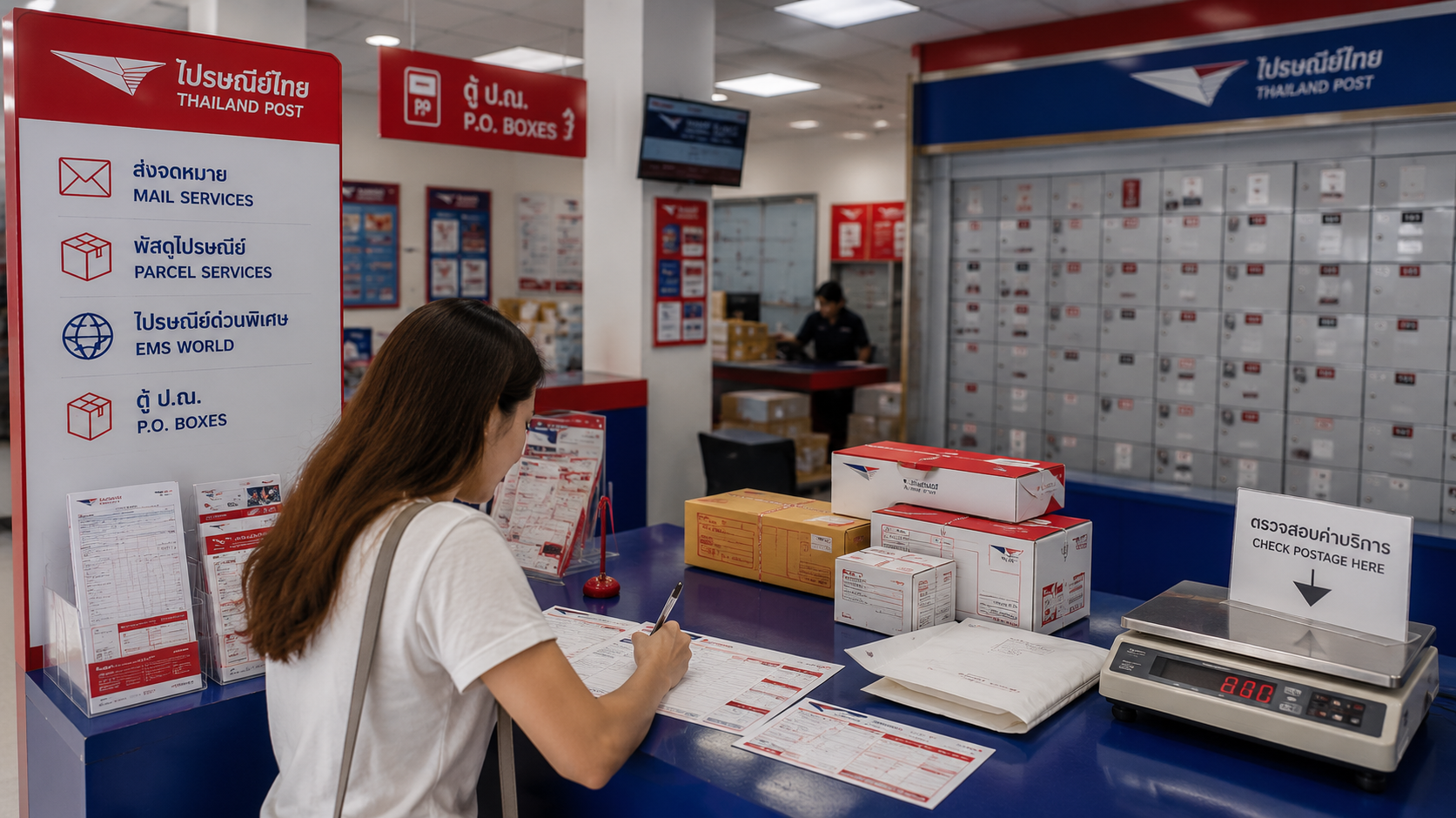
Post office boxes are available at branches on application with identification and an annual fee. They solve one specific problem well — an unreliable or changing residential address — and are genuinely useful for people who move between rentals, live somewhere deliveries struggle to reach, or want official correspondence to land somewhere consistent.

They also create a problem worth knowing about in advance: some senders and services will not deliver to a box, and courier networks generally cannot. So a box is a supplement to a physical address rather than a replacement for one, which is the opposite of how newcomers usually imagine it. Availability differs by branch, and boxes at busy central branches are not always free when you want one.

What not to have sent

Some things are simply not worth putting in the post to Thailand, either because they are prohibited or because the cost and risk exceed buying locally. The second category is larger than people expect:

  • Vaping devices, liquids and parts — prohibited outright, and a parcel is not a loophole
  • Controlled medication — needs the same permissions as carrying it, and a home prescription alone is not enough
  • Anything perishable — clearance times and the climate combine badly
  • Everyday goods available here — clothing, small appliances, kitchen equipment and toiletries almost always cost less locally once shipping and duty are counted, which is worth weighing against what things actually cost month to month
  • High-value electronics without documentation — assessment is likelier and the paperwork burden falls on you

Habits that prevent most problems

Almost everything above is avoidable with a few standing arrangements rather than with effort in the moment. These take one afternoon to set up:

  • Keep one canonical address in Thai script and paste it everywhere rather than retyping
  • Register the same address with the bank, immigration and your landlord so official mail follows one path
  • Learn the collection hours of your building's office before you need them
  • Track everything, and screenshot the tracking page when it shows arrival in the country
  • Tell senders abroad how to describe and value contents before they post, not after
  • Ask the seller which network they use if the address is rural, since coverage differs by network

Questions we hear most

Is the state post reliable?

For domestic mail and documents, yes. Its weakness against private networks is speed and pickup convenience for parcels, not loss. For anything you would mind losing, use a tracked service and keep the receipt, which is sound advice in any country.

Do I need to speak Thai at the counter?

Not usually in tourist and urban areas, and rarely a problem anywhere if you arrive with the address written in Thai and the item ready. Counter transactions are short and follow a fixed sequence; showing a screen works better than explaining.

Why has my parcel from home not moved for two weeks?

Most often it is waiting on customs or on a notification you never received. Check the tracking for arrival in the country, then follow up with the carrier's local arm rather than the sender, who cannot see anything you cannot see.

Can someone else collect a parcel for me?

Generally yes with a written authorisation and a copy of your identification, though requirements vary by facility. Confirm what that specific office wants before sending someone across town, because being turned away is the common outcome of assuming.

Is a PO box worth it for a long stay?

It depends on how stable your address is. For someone settled in one condominium with a functioning management office, probably not. For someone moving between rentals or living where deliveries struggle, it makes official correspondence far less fragile.

Key takeaways

  • Three systems, not one — state post, private networks and customs, each right for different things
  • The address fails before the service does — Thai script, the right postcode and a phone number solve most of it
  • Parcels land at the building office — not at your door, and its hours and rules become yours
  • Customs sets the timeline for anything from abroad — the declared value and description matter more than the carrier
  • A PO box supplements an address — it does not replace one, since couriers generally cannot deliver to it

Further reading

A reliable address is one of the quiet markers that a stay has turned into a life, and the questions change at that point. Property investment in Thailand for foreigners covers what shifts once you stop renting and start holding.

Is your address working for you?

DDA Real Estate is a real estate agency working in Thailand, and the practical layer of an address is something we look at alongside price and view, because it is what residents actually live with. Whether the building keeps a management office that receives parcels properly, whether the lane is one couriers find without a phone call, how official correspondence will reach you once immigration and the bank hold the address, and whether a rural location that looks idyllic is one deliveries reliably serve.

Look at our offers in Thailand and leave a request: we will shortlist properties that match your budget and how you actually live, tell you what the access and delivery picture looks like at each address, and be straightforward about the ones where daily logistics would work against you.

Popular
5 June 4152078 views
Dubai Rent Prices 2025: Average Apartment Rental Costs in Dubai Dubai's rental market continues its upward climb in 2025, driven by population growth and limited new supply, pushing average prices up by 10%

#Blog DDA
2 July 2382282 view
DLD Fees in Dubai: Everything You Need to Know Buying property in Dubai? Don't let hidden fees surprise you! Our essential guide breaks down ALL Dubai Land Department (DLD) fees
#Blog DDA
23 November 1710135 views
How to Buy a SIM Card in Turkey in 2026: Prices, IMEI Registration, eSIM Options, and Best Mobile Operators Overview of mobile operators, available types of SIM cards, and home Internet providers
#Blog DDA
5 July 1702512 views
How Much is the Real Estate Agent Commission in Dubai? Find out how much real estate agent commission costs when buying property in Dubai.
#Blog DDA
5 February 1394505 views
How Foreigners Can Own Property in Bali: Understanding PT PMA (2025) Foreigners can't own freehold land in Bali, but a PT PMA (foreign-owned company) allows secure property ownership under Hak Guna Bangunan (HGB) or Hak Pakai (HP) rights
#Blog DDA
28 August 1145844 view
Oqood vs Title Deed in Dubai: Key Differences You Must Know Buying property off-plan in Dubai? Oqood registration is mandatory to secure your ownership rights.
#Blog DDA