Off-plan properties
Guides to weekends out of Bangkok usually rank destinations. That is the wrong variable. What decides whether a weekend works is the exit, not the distance — which direction you leave in, when you leave, and how long the return takes on a Sunday evening.
Two places the same distance apart on a map can differ by two hours in practice, because one sits on a motorway and the other behind the worst of the Friday outbound traffic. The same trip that is pleasant leaving at six in the morning is punishing leaving at six in the evening.
So what follows is organised by direction and by how you get out, with what each one actually offers. Journey times shift with traffic, season and roadworks, and services change, so treat everything here as a shape rather than a schedule and check current details before booking.
Bangkok's geography pushes you into one of a few corridors, and each has its own rhythm. Understanding that is worth more than any list of attractions, because it determines whether you spend the weekend at the destination or in a vehicle. What actually governs the trip:
Reduced to the decision you are actually making, the options group like this. Time in transit is indicative and depends heavily on when you set out:
| Direction | What you go for | Best suited to |
|---|---|---|
| West | River landscapes, waterfalls, wartime history | A full weekend with an early Saturday start |
| Southwest | Canal markets, salt flats, day-trip culture | An overnight or even a long day trip |
| North | Ruined capitals and temple complexes | A day trip by rail, or an unhurried overnight |
| Northeast | National park, hills, cooler air, vineyards | A full weekend, ideally leaving early |
| Southeast | Beaches and islands reachable by road and ferry | A weekend, with ferry timings driving the plan |
| South | Long coastline, quieter resorts, national park | A weekend by rail or road, the most relaxed run |
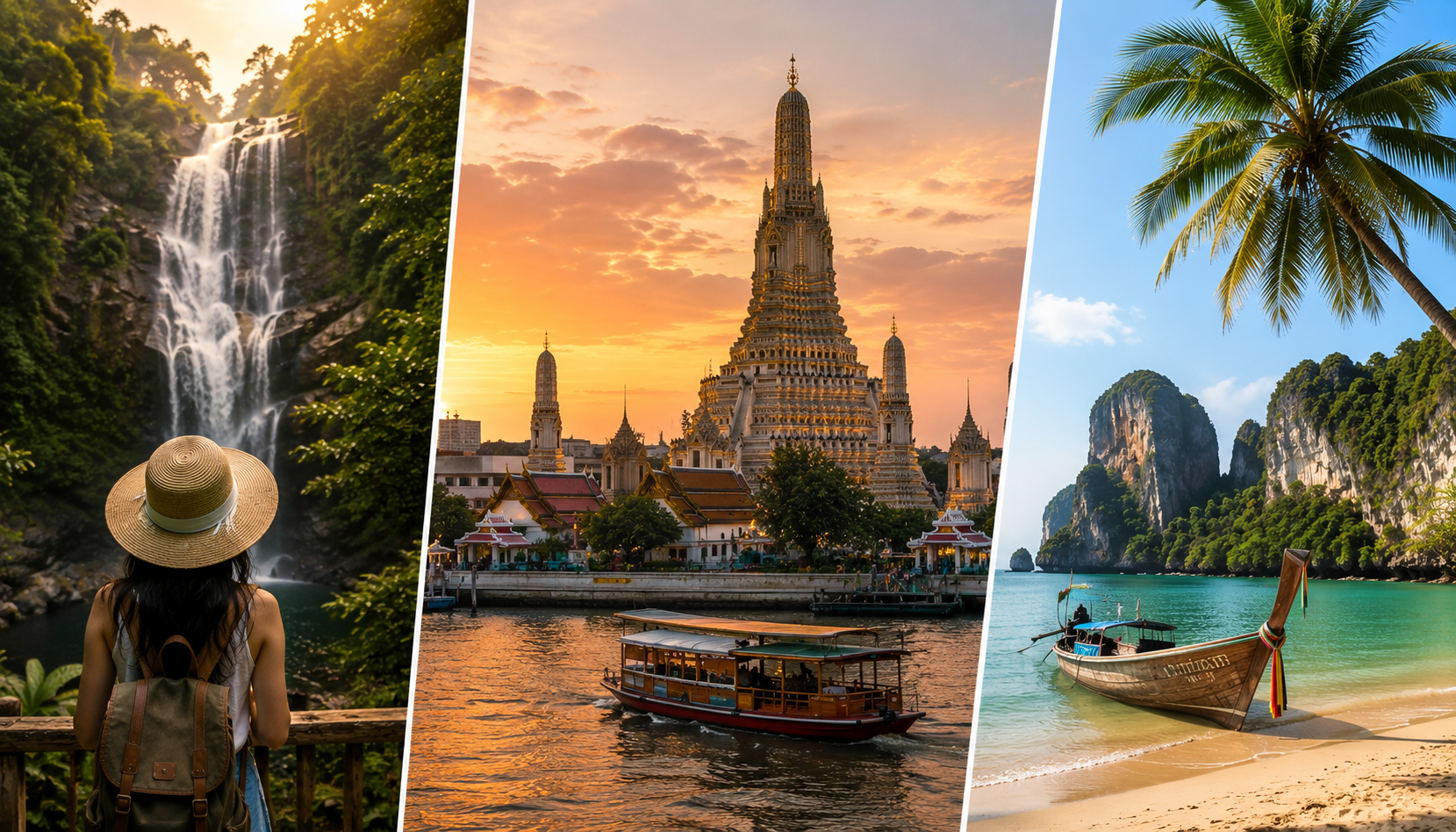
Kanchanaburi province is the classic full-weekend trip: a river landscape that changes character as you go upstream, waterfalls in national park land, and a dense layer of wartime history around the railway and its bridges. It is close enough to reach in a morning and varied enough to fill two days without repeating itself.
It rewards going further than the town. The stretch of river above the provincial centre is where the raft houses and the quieter accommodation sit, and the difference between staying in town and staying upstream is the difference between a busy weekend and a restful one. Waterfall visits are seasonal in the honest sense: at the end of the dry months there is markedly less water.
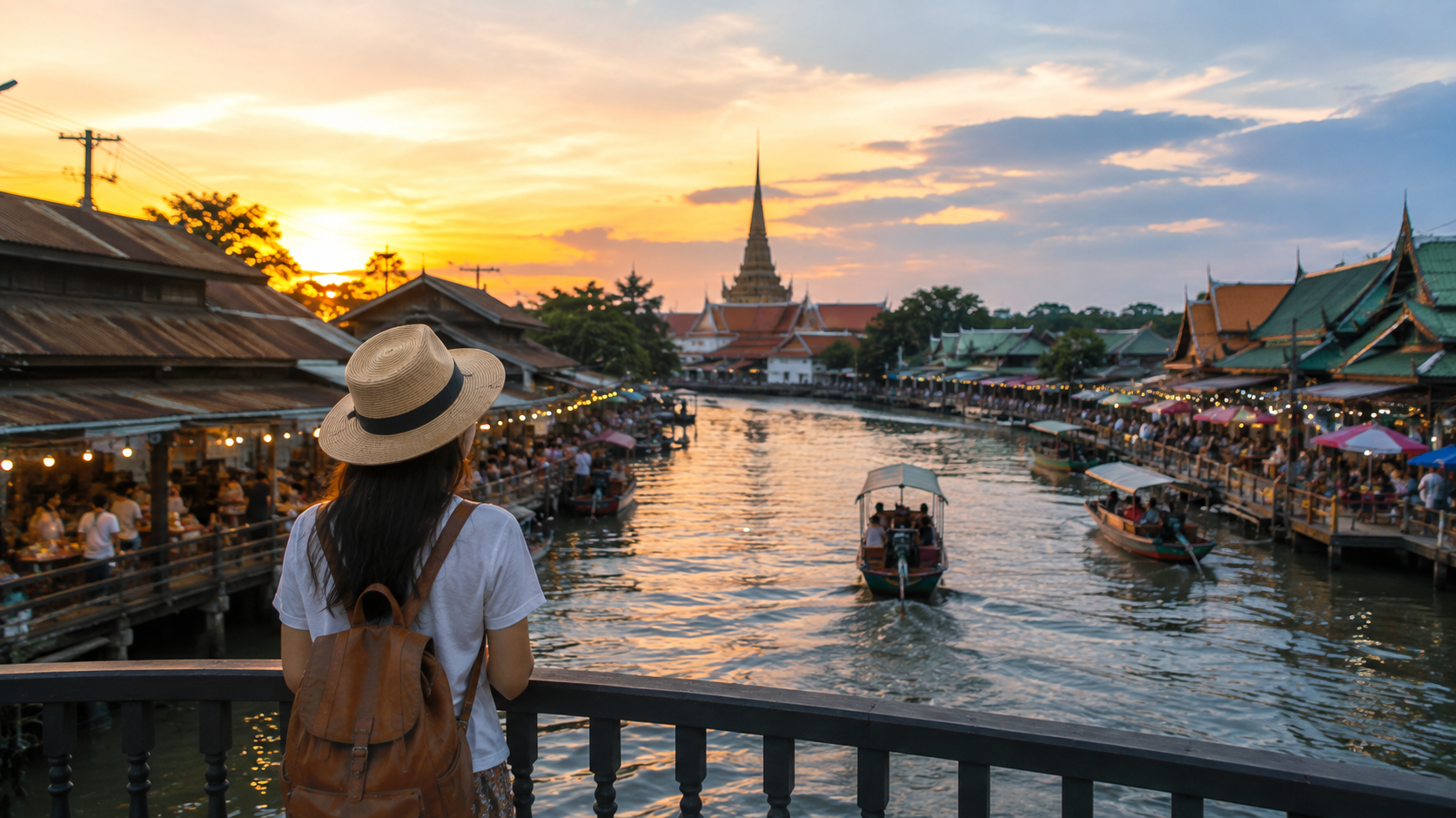
The shortest genuine escape lies southwest, in the canal country toward the Gulf. Floating markets, a famous market built along a working railway track, and the salt flats that stretch along the coastal road make this the easiest direction to do without committing a whole weekend.
Timing matters more here than anywhere else, because markets run to their own hours and the best of them are early-morning or evening affairs rather than midday ones. An overnight turns this from a rushed tick-list into something worth doing — the evening markets and the pre-dawn ones are the good ones, and both are impossible on a day trip from the city.
Ayutthaya is the obvious northern trip and the one best served by rail: a former capital whose ruined temple complexes sit within a compact area that can be covered by bicycle. Further north, Lopburi offers a smaller version of the same idea with an unusual resident monkey population that has become the town's signature and its nuisance in equal measure.
The north is the direction where rail beats road most clearly. The trip is short, the station sits near what you came to see, and you avoid the whole question of Friday traffic. It also works as a genuine day trip in a way most other directions do not, which makes it the sensible first weekend for someone newly arrived in the city.
The northeast corridor climbs toward the national park country, and the temperature drop is the point. This is the direction people go for forest, viewpoints, wildlife and air that feels different, and it has developed a second reputation for vineyards and hillside resorts along the approach roads.
It needs a full weekend and an early start, because the park itself is large and the distances inside it are real. Two practical notes worth knowing in advance:
The southeast corridor carries the fastest road out of the city and the densest concentration of weekend beach options. Pattaya anchors it: a large, developed resort city that people either dismiss or use, and which is more varied than its reputation suggests once you look beyond the central strip. From it, a short boat ride reaches a smaller island with the beaches the mainland lacks.
Further along the coast, the island off Rayong is the classic Bangkok weekend beach: close enough for two nights, small enough to cover on foot and by songthaew. Ferry timetables, not road distance, control the plan here — a late start on Saturday can cost the whole first day. Pattaya is also the corridor's practical base for anyone weighing a longer stay, and what living there actually costs month to month looks quite different from what a weekend suggests.
The southern corridor runs down the Gulf coast toward Hua Hin, a resort town with a long royal association, a calmer atmosphere than the southeast, and a coastline that keeps going past it into quieter territory. Beyond the town there are quieter beaches, a national park with limestone hills and caves, and small coastal settlements that see far fewer weekend visitors.
This is the most relaxed run of the six, partly because rail serves it and partly because the destination does not demand an itinerary. It is also the direction that most often turns from a weekend habit into something longer, which is why it appears so regularly in conversations about where to settle.
Thailand's weather does not treat these corridors equally, and the same weekend that is perfect in one direction is a poor use of two days in another. Planning by season rather than by preference is the single biggest improvement most people can make. What shifts:
Worth naming because it solves a specific problem: the weekend when you want out but not the journey. The river bend south of the centre holds an area of protected green that has stayed semi-rural inside the metropolitan area, reached by a short boat crossing and covered by bicycle on raised walkways.
It is a half-day rather than a weekend, and it does not replace leaving. But it costs no travel time at all, which makes it the right answer on a weekend that is already crowded, or when the alternative is spending five hours in traffic to reach somewhere for one night.
Almost every bad weekend out of Bangkok comes down to the same handful of avoidable mistakes. These take no planning skill, only the decision to do them:
Which direction is best for a first weekend?
North, for the practical reason that rail removes the traffic question entirely and the destination is compact enough to enjoy without planning. It also works as a day trip, so a bad forecast costs you an afternoon rather than a booking.
Is a car necessary?
It depends entirely on direction. For the northern and southern corridors, rail plus local transport covers most of what you came for. For the national park country a vehicle is close to essential, because distances inside the park are not walkable and services are sparse.
How far ahead should I book?
On an ordinary weekend, a few days is usually enough outside peak season. On a public holiday weekend, weeks rather than days, particularly for anywhere with limited accommodation such as the smaller islands and the park approaches.
Are the beaches near Bangkok worth it?
The mainland beaches closest to the city are not why anyone comes to Thailand. The islands reachable from the southeast corridor are a different matter, and the coast south of Hua Hin has genuinely quiet stretches. Manage the expectation and the weekend works.
Can these trips be done without Thai?
Comfortably in the main destinations, where tourism infrastructure is established. Away from those, having your destination written in Thai on your phone solves most of it, exactly as it does in the city.
A weekend habit turning into a purchase is common enough to be a pattern rather than an anecdote, and the questions change completely at that point. Property investment in Thailand for foreigners covers what shifts once a favourite destination becomes an asset.
DDA Real Estate is a real estate agency working in Thailand, and a fair share of our buyers describe the same arc: a place they kept returning to at weekends became the place they wanted a base. A weekend habit is a genuinely good test of a location, because it shows you the traffic, the season and the practical texture that a viewing trip hides — and which parts of the country suit which buyer looks different once you have been somewhere a dozen times rather than once.
Look at our offers in Thailand and leave a request: we will shortlist properties in the areas you already know from visiting, tell you how each one behaves outside the season you have seen it in, and be straightforward about where a good weekend destination makes a poor permanent address.