Off-plan properties
Guides to Thai nightlife are written for people staying four nights. This one is written for people who might end up living nearby, because for a resident a nightlife district is not a destination but a property variable — one that decides sleep, rental profile and resale in roughly that order.
The country's scenes are also far less uniform than the reputation suggests. Bangkok alone holds several unrelated ones, and on Phuket the difference between an unbearable address and a perfectly quiet one is often a few hundred metres rather than a different town.
Below is where the scenes actually are, what each is like, how far the noise carries, and what to check before renting or buying anywhere near one. Opening hours and licensing rules change and enforcement varies by area, so confirm current conditions locally rather than relying on any published figure.
The capital's nightlife is spread across districts with almost nothing in common. The lower Sukhumvit strip is the one that appears in every travel article — dense, commercial and aimed squarely at visitors. Further out along the same line, Thonglor and Ekkamai are a different world: restaurant-led, expensive, popular with young Thai professionals and long-term foreign residents.
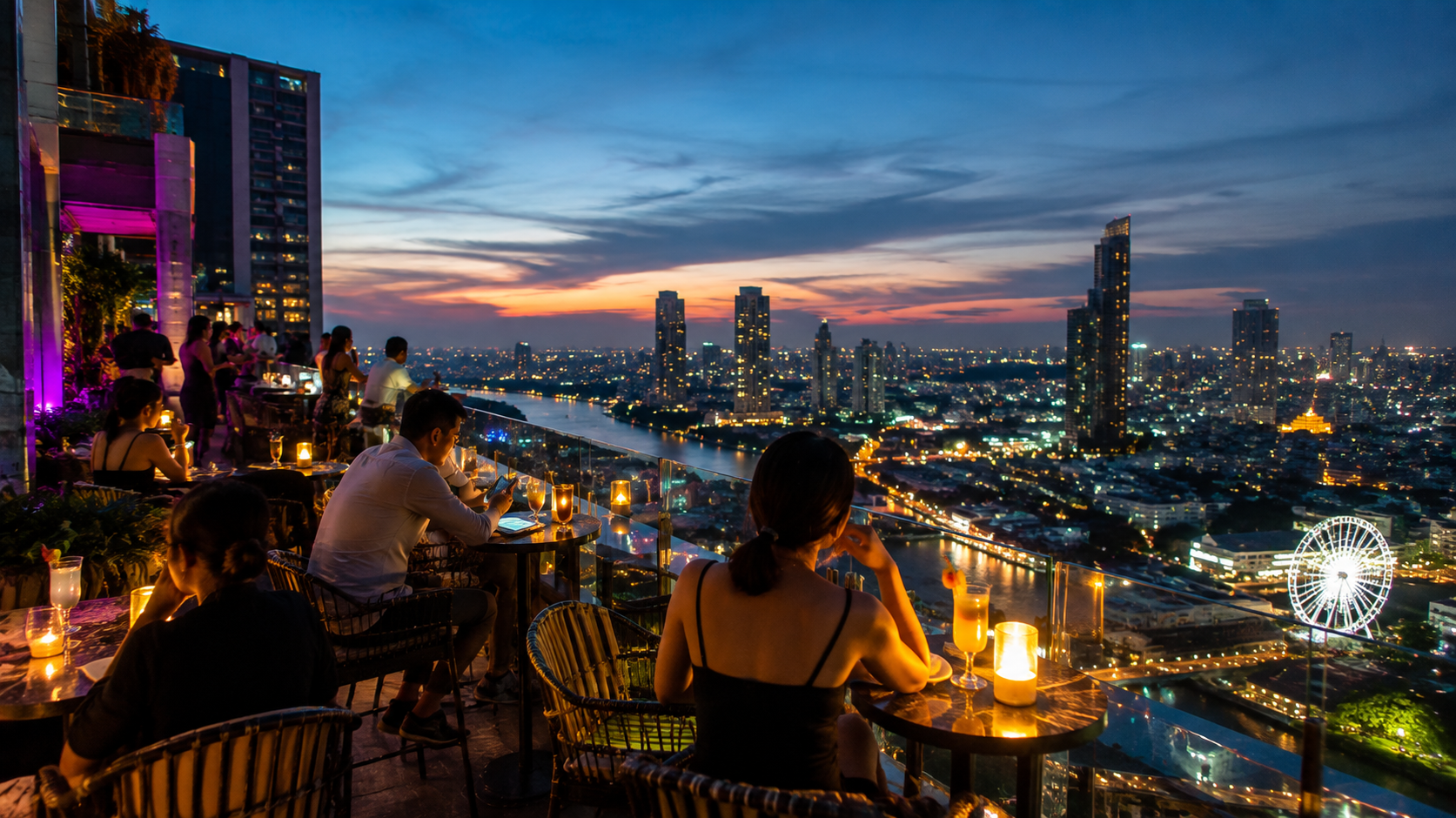
Silom mixes an after-work bar culture with a well-established scene of its own, the club district off Rama IX draws a mostly domestic crowd, and the backpacker street near the old city keeps its own late rhythm. Riverside rooftops sit apart from all of it. For a resident the distinction matters enormously: living near a restaurant district is pleasant, living above a strip of bars is not — and the residential areas of Bangkok that suit expats overlap with the first group far more than the second.
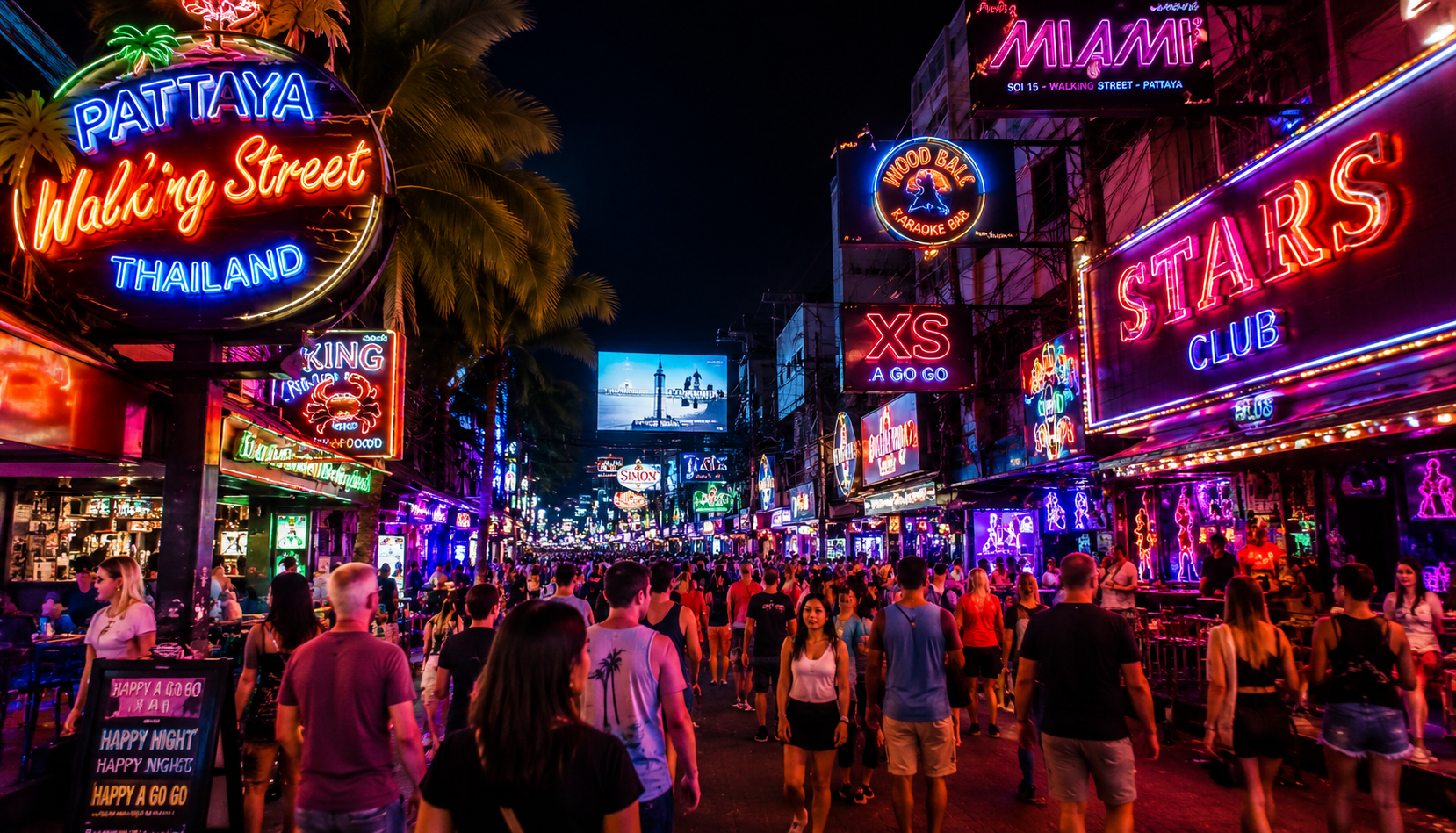
Pattaya has the country's most concentrated entertainment core, and it is genuinely concentrated — one street and the lanes immediately behind it carry most of it. The city's reputation is built almost entirely on that small area, which is why people who know only the reputation are surprised by the rest.
Jomtien to the south is largely residential with a beachfront of its own. Naklua to the north is quieter still and holds much of the upmarket stock. Pratumnak sits between the two and is mostly housing. These are not suburbs of the strip, they are separate places with their own character, and the practical differences between them are set out in the guide to neighbourhoods to live in around Pattaya.
On Phuket the pattern is even sharper. Patong holds the island's nightlife almost entirely, and within Patong it concentrates on a single pedestrian street and its immediate surroundings. Kata and Karon to the south have a mild version — bars, live music, nothing that runs late. Kamala and the Bang Tao area lean toward beach clubs rather than late bars.
The south and east of the island have no strip at all: Rawai and Chalong have resident bars serving people who live there, and the old town has a small, distinctive scene built around the Sino-Portuguese streets. Phuket is the clearest case in the country of nightlife being a district question rather than a city one — you can live twenty minutes from Patong and never hear it.
Samui concentrates its nightlife on one main beach strip, with a secondary one nearby and a calmer village further round the coast that draws people who want dinner rather than a night out. What that means for someone staying rather than visiting is covered in the honest account of full-time living on Koh Samui.
Chiang Mai runs on a different model entirely — bar and café culture rather than strips, concentrated in the university-adjacent district and around the old city, and it closes earlier. And a large part of the coast has no nightlife worth the name, which for many buyers is the point rather than a drawback; the beach towns suited to quiet living are a deliberate counterweight to everything above.
Reduced to what a resident needs to know rather than what a visitor wants:
| Area | Character | Living nearby |
|---|---|---|
| Lower Sukhumvit, Bangkok | Dense, commercial, visitor-facing | Convenient and loud; buy above the noise or away from it |
| Thonglor and Ekkamai | Restaurants and bars, upmarket | Genuinely liveable; the premium reflects it |
| Walking Street, Pattaya | The country's most concentrated core | Not a residential proposition |
| Jomtien and Naklua | Residential with their own beachfronts | Quiet, with the strip available when wanted |
| Patong, Phuket | Island's nightlife in one street | Loud in the centre, ordinary a few streets back |
| Rawai and Chalong | Resident bars, no strip | Year-round normality rather than season |
| Nimman, Chiang Mai | Cafés and bars, early close | Among the easiest to live in |
This is the part buyers get wrong most often, usually because they viewed at two in the afternoon. Sound behaves unpredictably in tropical cities: open buildings, hard surfaces and sea air carry bass much further than voices, and a strip that is inaudible at street level three blocks away can be perfectly clear on a twelfth-floor balcony.
The only reliable test is to be there at midnight on a Saturday, and if that is impossible, to ask people who were. What decides how much reaches you:
Venue hours are regulated, and the rules have been revised in recent years with extended hours permitted in designated areas and for certain categories of venue. Enforcement varies between districts and over time, and a rule on paper is not always the rule on the street.
For a resident the practical question is not the legal hour but the observed one, and they are not always the same. Ask neighbours rather than authorities, and ask about the last hour of the night rather than the busiest — the difference between a district that empties at one and one that trickles on until dawn is what you will actually live with.
Two rules surprise visitors and matter to residents. Retail alcohol sales are restricted to certain hours of the day, so a supermarket will decline a sale outside them regardless of how obvious your intentions are. And on several Buddhist holidays and around elections, sales stop entirely for the day.
Those days are announced in advance and observed to varying degrees by different venue types. Cannabis is a separate matter and the position changed in 2025, when it was brought back under control and restricted to prescription use for defined conditions — the dispensaries that appeared near nightlife districts in the preceding years are not the guide to current rules that they appear to be.
There is a real argument for it, and it is not the one people assume. Property near an established entertainment district rarely lacks short-term tenants, the location is legible to every future buyer, and the infrastructure around it — transport, food, services at odd hours — is dense.
Against that sit narrower resale, a tenant profile that turns over fast and treats a property accordingly, and a value that is exposed to anything that changes the district's character. The honest summary is that proximity to nightlife is a yield play rather than a lifestyle one, and buyers who confuse the two are the ones who sell within two years.
Renting gives you the chance to test what a purchase would commit you to, provided you check the right things before signing rather than after the first weekend:
The overnight side of building management deserves its own attention, and the questions worth asking about security in a Thai condominium are sharper near a nightlife district than anywhere else.
Which city has the best nightlife?
It depends entirely on what you mean by it. Bangkok has the most variety by a wide margin, Pattaya the most concentrated core, Phuket a single dominant street, and Chiang Mai a bar-and-café culture that closes early. There is no single ranking that survives contact with what an individual actually wants.
Can I live near a strip and still sleep?
Often yes, and the variable is orientation and line of sight rather than distance. A few hundred metres with a building in between is usually enough. A direct sightline from a high floor is not, whatever the map suggests.
Does nightlife proximity help rental yield?
For short-term letting it generally does, where the building and the law permit it. For long-term letting it often works against you, because the tenants who stay a year mostly want quiet. Decide which market you are in before you buy for the other one.
Are these areas safe?
Broadly yes, with the ordinary caveats that apply to crowded entertainment districts anywhere: watch your belongings, watch your drink, and be careful with unmetered transport late at night. The risks are the familiar ones rather than anything peculiar to Thailand.
Do the quiet coastal towns get boring?
Some people find them so within a season, others never look back. The reliable predictor is not the town but whether you have a reason to be there beyond the view — work, a community, a routine. Renting first answers this better than any article can.
It is one of the few property questions where the map genuinely misleads, because what matters is what stands between you and the noise rather than how far away it is. DDA Real Estate is a real estate agency working in Thailand, and this is something we check on foot rather than on a plan: which way the unit faces, what sits between it and the source, what the building does about access after midnight, and what the neighbours say about the hour things actually stop. Buyers who saw a district on holiday and buyers who have slept in it want different addresses.
Look at our offers in Thailand and leave a request: we will shortlist properties that match how you intend to use the place, tell you honestly what each address sounds like at night, and point out the ones where a convenient location would cost you your sleep.