
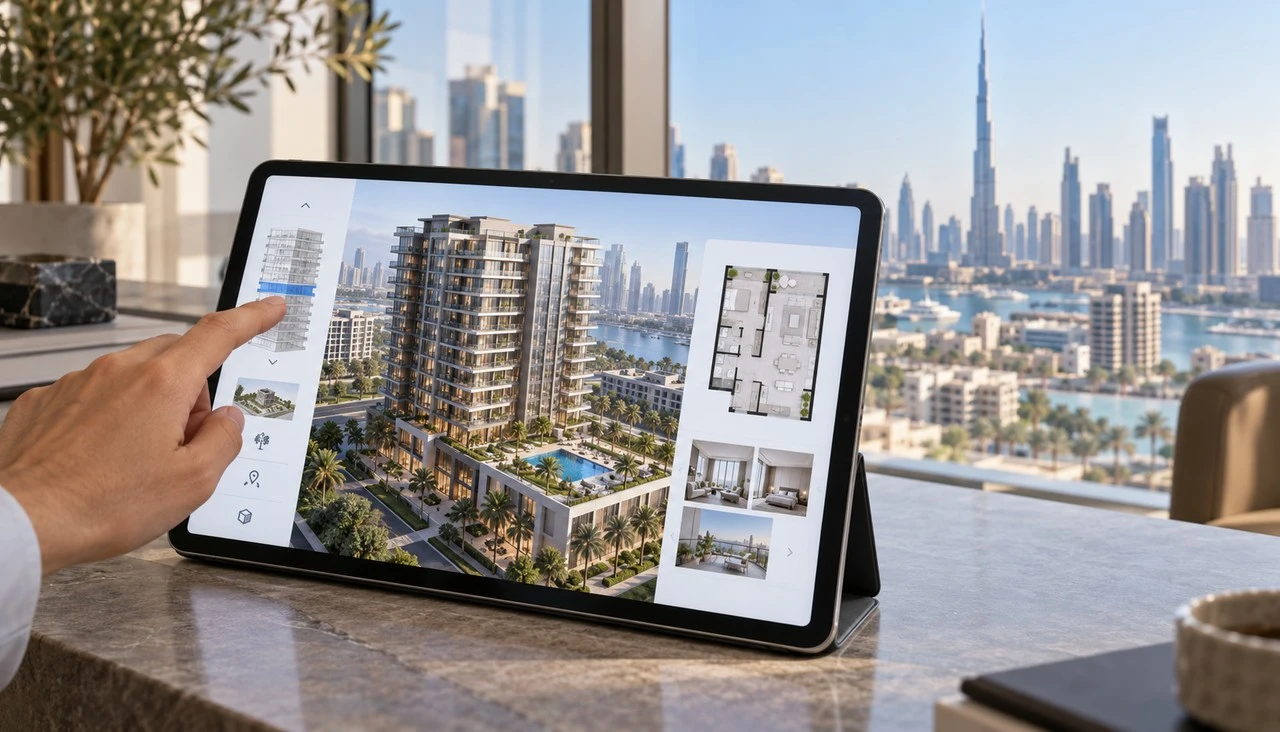


Off-plan properties
The interesting part of digitisation in UAE property is not that things move faster. It is that the buyer can now check things that used to require someone else’s word.
Ten years ago the broker held the information. Whether a project was registered, whether an agent was licensed, what similar units actually sold for, what the service charge was. Today most of that sits behind a login on your phone.
This guide sets out what you can verify yourself, in what order, and what the technology has not solved. Systems and services change, so confirm current procedures with the relevant authority.
The practical shift, in one table.
| Question | Where it is answered |
|---|---|
| Is this project registered? | The land department’s project register |
| Is this agent licensed? | Broker registration number and permit lookup |
| Is this listing authorised? | The advertising permit number on the listing |
| What is the property actually worth? | Published transaction data and price indices |
| What can my rent be increased to? | The official rental index calculator |
| What is the service charge? | Published per-building charge data |
| Is my tenancy registered? | The tenancy registration system |
Every row used to be a question you asked and hoped was answered honestly. Now each is a lookup. The broker’s role shifts from gatekeeper of facts to adviser on what the facts mean.
The single most useful habit for anyone browsing listings here.
Property advertisements in Dubai carry a permit number. The listing is registered, tied to a licensed broker and linked to a real property. A listing without one is not compliant, whatever it shows.
Check the number before the photographs. It takes seconds and removes the entire category of fake listings, which is the fraud newcomers meet first.
The same applies to the agent. Licensed brokers hold a registration number that can be looked up, and their status is visible to anyone. What else separates a solid agency from a weak one is set out in the guide to choosing a real estate agency in Dubai.
Most of these services sit behind one national digital identity, and that single login is what makes the rest usable.
With it a resident signs documents electronically and accesses government portals. Property records and transactions that once needed a counter visit are handled the same way.
Set it up in your first week. Almost every administrative step afterwards depends on it, and the moment you need it urgently is the worst time to be registering. How this feeds into daily life more broadly is covered in the overview of innovation in Dubai.
Digital registration of tenancies and transactions is treated as bureaucracy by newcomers. It is closer to insurance.
A registered tenancy establishes the terms in an official record. It is required for utilities and other services, and it is what a dispute body looks at if the relationship goes wrong.
An unregistered arrangement leaves you relying on goodwill. For the small cost involved, registration converts a private agreement into something the system recognises.
The same principle applies to off-plan purchases, where interim registration records your claim to a specific unit before the title exists. The mechanics are set out in the guide to off-plan deals in the UAE.
Published transaction data is the part that changed negotiation most.
Completed sales are recorded, and summary data is published. That means the gap between asking prices and achieved prices is visible rather than a matter of belief. Four habits make it useful:
This is also why negotiation here is less emotional than in many markets. Both sides can see roughly the same numbers, which narrows the argument to the specifics of the unit. Where the market is heading is covered in the overview of Dubai market trends.
A smaller change with disproportionate value for buyers.
Charges for buildings are published rather than disclosed at the owner’s discretion. You can compare two towers before viewing either, and a high charge stops being a surprise that arrives after handover.
Compare the charge per square foot alongside the purchase price. Two apartments at the same price can differ substantially in what they cost to hold. How these charges are set is explained in the guide to service charges in Dubai buildings.
The same shift lands differently depending on where you sit.
For buyers
You arrive informed. Price range, service charge, developer record and project status can all be established before the first viewing, which changes what you ask about in the room.
The developer check is the one worth doing carefully, and the method is set out in the guide to verifying a developer’s reputation.
For sellers
Overpricing is harder to sustain. Buyers see the transacted comparisons, and a property priced well above them simply sits.
The counterpart is that a correctly priced property sells faster. Visibility cuts both ways, and it rewards accuracy.
For landlords and tenants
Rent increases are governed by a published calculation rather than by negotiation strength. Both sides can run the same figure before the conversation starts.
For agents
The job moved from holding information to interpreting it. Anyone can read a price index; fewer people can say why one tower rents faster than the identical one beside it.
A quick map of which tool answers which stage of a purchase.
| Stage | What to verify digitally | What it prevents |
|---|---|---|
| Browsing | Listing permit, agent registration | Fake listings and unlicensed intermediaries |
| Shortlisting | Transacted prices, service charges | Overpaying and surprise holding costs |
| Off-plan interest | Project registration, construction progress | Buying into a stalled or unregistered project |
| Negotiation | Comparable sales in the same building | Arguing from listings rather than facts |
| Renting | Official rent index, tenancy registration | Unlawful increases and unrecorded terms |
| After purchase | Title record, charge account status | Inherited arrears and registration errors |
The last row is the one owners forget. Checking that the title reflects what you bought, and that the charge account is clear, takes minutes and is easiest immediately after handover.
The development that attracts the most attention and the most confusion.
Work is underway on recording and trading property ownership in digital form. That is a change to how ownership is registered and transferred, not a payment method and not a cryptocurrency.
If you are offered a tokenised interest, establish exactly what you own. A registered title, a share in a company holding title, and a contractual claim are three different positions with three different protections. This area is developing quickly, so verify the current legal status of any structure rather than relying on how it is described.
Worth stating plainly, because the tools create a sense of completeness they do not deserve. Six things stay offline:
The first and second are the reasons viewings still happen. The things that ruin a purchase are physical, and the things that are digitised are documentary. Both matter, and only one of them has been solved. The rest of what catches buyers out is covered in the overview of hidden challenges when buying in Dubai.
A sequence that saves time and filters out most problems:
The order matters because each step removes candidates. By the time you are viewing, the properties in front of you have passed the documentary checks. The visit is then spent on condition, noise and feel.
What is the single most useful digital check?
The listing permit number. Advertisements are registered and tied to a licensed broker, so checking it removes the fake-listing problem in seconds.
Can I see what similar properties actually sold for?
Yes. Completed transactions are recorded and summary data is published, so asking prices can be compared against achieved ones.
Do I need the national digital identity?
Effectively yes. Most government and property services run through it, and setting it up early saves delays later.
Is registering a tenancy really necessary?
Yes. It establishes the terms officially, is required for utilities and other services, and is what a dispute body relies on.
How do I check service charges before buying?
Charges are published per building. Compare the figure per square foot alongside the purchase price, because two similar apartments can cost very different amounts to hold.
What is property tokenisation?
A change in how ownership is recorded and transferred, not a payment method. If offered a tokenised interest, establish precisely what you own and verify its current legal status.
Do I still need to view in person?
Yes. Condition, noise, neighbours and build quality are not in any database. The documentary side is digitised; the physical side is not.
The documentary side of a purchase here now takes an evening with a phone. Permits, registrations, prices and charges are all open to you, and that is a real change. What remains is the part no portal covers. Whether the building is well run, how the street behaves after dark, and whether this unit is worth what the data says the category is worth. DDA Real Estate is a real estate agency in the UAE. We work across Dubai, Abu Dhabi, Sharjah and the northern emirates, and we spend our time on the half that is not in the database.
Look at our offers in the UAE and leave a request: run the digital checks yourself and send us the shortlist. We will tell you what the data does not show about each building and arrange viewings at times when you can see it for yourself.