Off-plan properties
A good place to spend a holiday can be an awkward place to live. You notice it when the shopping bags are heavy, the lift is out of service or your first work call starts before the neighbours have finished their evening. These are useful things to find out during a viewing.
For a permanent move to Turkey, start with the week you will actually spend there. Where will the children go to school? Can you work with the bedroom door shut? What does the apartment cost to run in January? The answers help you decide whether a higher purchase price buys something you will use.
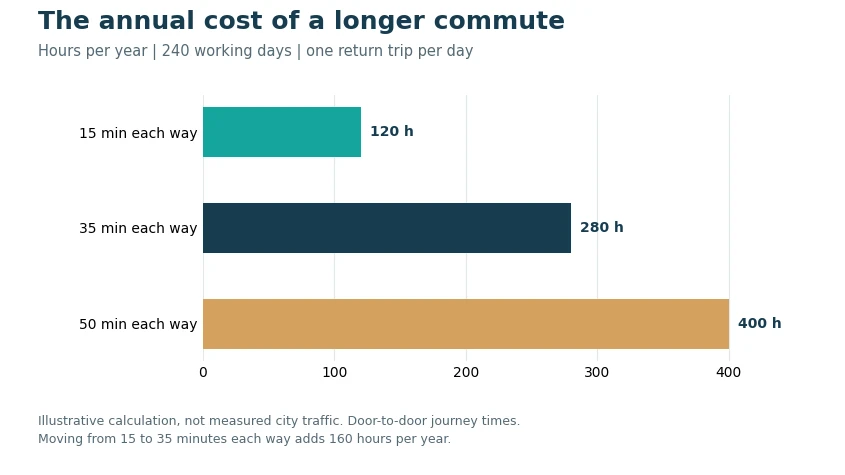
Some differences are easy to put into numbers. Adding 20 minutes each way to a commute takes another 160 hours a year at 240 working days. An extra TRY 3,000 in monthly building fees costs TRY 36,000 a year. Below, we use official Turkish sources alongside worked examples to compare those trade-offs. The example budgets are assumptions, not average living costs. Sources checked: October 2026.
Before opening another listing, make a short list of requirements that would rule a property out. A parent may need a manageable school run. Someone with limited mobility needs a continuous route from the street to the apartment, including the entrance steps. If two adults work from home, one desk in the living room may be insufficient.
Be specific. “Close to transport” is hard to assess; “a bus I can use to reach work by 8.30” gives you something to test. For each home, keep a note of the task you tried and what happened.
| Household | Priority to verify | Useful viewing test |
|---|---|---|
| Family with children | School access, bedrooms, storage and a safe daily route | Travel to the actual school at arrival and collection times |
| Remote worker | A separate workspace, connection quality and quiet rooms | Run a video call and test upload speed inside the apartment |
| Retired couple | Lift access, walkable services and healthcare arrangements | Walk from the entrance to shops and check the complete step-free route |
| Household without a car | Year-round transport and essential services on foot | Complete a shopping trip carrying bags and check the return journey |
| Part-time resident planning a permanent move | Winter services, utilities and sufficient storage | Ask what remains operational outside the holiday season |
Three to five homes are usually enough for a useful comparison. Keep the bedroom requirement and approximate usable area similar. Include any work needed before you can move in: a cheaper apartment that needs six weeks of repairs also needs a temporary accommodation budget.
DDA Real Estate can use this list to narrow the search before arranging viewings. A household that needs a quiet workroom should be shown apartments with a suitable room, rather than being left to work out where a desk might fit after the viewing.
Start with the unit itself. The floor, apartment number and parcel on the documents should identify the home in front of you. If a balcony has become part of a room, or a wall has moved, ask your lawyer to compare the layout with the approved plan.
| Document or check | What the buyer should establish |
|---|---|
| Title deed and current registry record | Identity of the unit, registered owner, property description and any registered restrictions |
| Condominium status | Whether the title records condominium ownership or construction servitude, and what remains to be completed |
| Occupancy permit | Whether the relevant building or section has the required permission for use |
| Approved architectural plan | Whether the rooms, enclosed balcony and other alterations match the approved plan |
| Management plan and latest accounts | Rules, shared costs, existing arrears and approved works |
| Personal residence route | Whether the intended applicant and address meet the current requirements for the relevant permit category |
Invest in Türkiye states that ownership transfers through registration at the land registry. A preliminary sale contract does not transfer the title. Its guidance also calls for checks on mortgages, liens and other restrictions. Use the current registry record for this review; an online parcel search serves a more limited purpose.
The title may record condominium ownership or construction servitude. These are distinct arrangements under Law No. 634. The occupancy permit is relevant to the conversion process, so have the lawyer explain what has been completed and what remains outstanding for that building. Ask for the answer in writing before committing.
Your right to own the apartment and your permission to live in Turkey need separate attention. The Presidency of Migration Management lists property ownership among the short-term residence permit categories, with conditions concerning residential use. Confirm the current value requirements, the eligibility of the exact address and the position of each family member. A property selection should fit the residence route you can use.
Working adds another question. The Ministry of Labour and Social Security explains that an ordinary residence permit does not by itself give permission to work. If you intend to work remotely, get advice on your own immigration and tax position before planning the move around that arrangement.
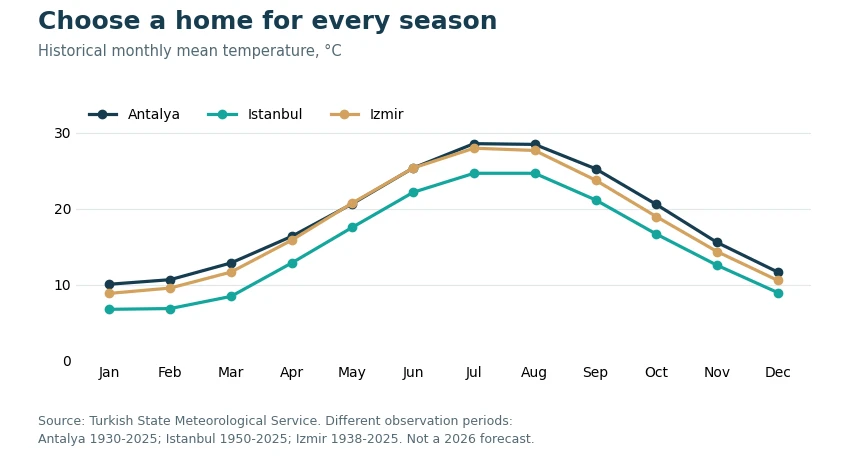
A warm afternoon tells you little about winter heating or a bedroom in August. The official city figures below give a starting point. Antalya’s historical January mean is 10.1°C, yet its January rainfall averages 225.5 mm in the published series. You will want to know where that water goes around the apartment and building.
| Official city series | January mean | July mean | January rainfall |
|---|---|---|---|
| Antalya, 1930-2025 | 10.1°C | 28.6°C | 225.5 mm |
| Istanbul, 1950-2025 | 6.8°C | 24.7°C | 88.8 mm |
| Izmir, 1938-2025 | 8.9°C | 28.0°C | 134.5 mm |
Source: Turkish State Meteorological Service data for Antalya, Istanbul and Izmir. The observation periods differ. These figures describe historical city series, not expected temperatures in 2026 or conditions at every address.
At the viewing, spend time by the windows and balcony doors. Look for staining around seals, marks on the ceiling and damp behind fitted cupboards. If something has been repaired, ask what caused it and what work was done. Unexplained recurring moisture needs an assessment.
For summer, find out whether each bedroom can be cooled with its door closed. Stand where the bed would be and check the position of the air-conditioning unit. For winter, establish how the home is heated and whether the system serves every room you expect to use.
Twelve months of bills help, provided you know how the apartment was occupied. A low winter electricity bill from an empty flat says little about the cost of keeping a family comfortable. Ask for the energy performance certificate as well and verify it through the official service. Read the bills and certificate together.
A fresh kitchen is easy to inspect. The roof, lift and shared water supply require a conversation with the manager and, where appropriate, an independent engineer. Find out which records are available and arrange the technical assessment before the purchase decision.
| Check | Evidence to request | Practical relevance |
|---|---|---|
| Structural condition | Available engineering records and an independent assessment | Supports an informed decision about the particular building |
| Roof and external envelope | Repair history, inspection and approved maintenance works | Helps assess leaks, weather exposure and future spending |
| Lift and access | Maintenance records and an actual entrance-to-apartment test | Matters for pushchairs, shopping, mobility and daily convenience |
| Water and drainage | Supply arrangements, pressure test and drainage inspection | Shows whether daily use is practical at the chosen floor |
| Shared equipment | Service records, operating rules and replacement plans | Clarifies reliability and possible shared expenditure |
| Insurance | Current DASK policy and any additional home cover | Shows the insured property, coverage limits and exclusions |
For earthquake information, AFAD distinguishes its hazard map from a risk map. The map does not assess the particular building you are buying into. A construction date or a city name cannot replace a professional review of the building and site.
Insurance answers a different question. DASK coverage concerns specified earthquake-related damage to the building within policy limits. Review the policy and any extra home cover you need; contents, for example, require separate attention. A policy is not evidence of an engineering inspection.
Then try the ordinary things. Walk from the pavement to the lift with a pushchair or mobility aid if your household uses one. With permission, test water pressure and hot water. Ask the manager which equipment works during a power cut. If there is a generator, establish what it actually supplies.
Time a trip from the apartment door, including the lift, gate, crossings and parking. A journey described as “ten minutes away” may leave all of those out. Visit the school you plan to use at arrival or collection time, and confirm admissions, language and fees directly with it. Do the same for the healthcare services and insurance arrangements you will need.
If you want groceries and a pharmacy within a 10-15 minute walk, walk there and back. That is a practical preference, not an official planning standard. Consider the return journey with bags, the gradient and the crossings. In a coastal area, check the winter timetable and which shops stay open outside the holiday season.
| One-way commute | Daily return journey | 240 working days | Difference from 15 minutes |
|---|---|---|---|
| 15 minutes | 30 minutes | 120 hours a year | Baseline |
| 35 minutes | 70 minutes | 280 hours a year | 160 extra hours |
| 50 minutes | 100 minutes | 400 hours a year | 280 extra hours |
The difference between 15 and 35 minutes each way is 160 hours a year: twenty eight-hour days. Over five years with the same routine, it becomes 800 hours. You do not need to assign an hourly wage to that time to decide whether a shorter commute matters to you.
School journeys can add up differently. A parent who drives home after drop-off and returns for collection makes four one-way trips. Increasing each trip from 20 to 35 minutes adds an hour a school day. With an assumed 180 school days, that is another 180 hours a year.
Inside the home, ask what the advertised floor area includes. Record usable internal space and balconies separately. At an assumed price of TRY 6 million, 72 usable square metres cost about TRY 83,333 per square metre. With 85 usable square metres at the same price, the figure falls to about TRY 70,588. The comparison only works if both areas were measured on the same basis.
Put your furniture on the measured plan. Can someone walk past the dining table when the chairs are occupied? Will the bedroom door open beside the bed? In a 2+1 listing, the label generally means two bedrooms and a living room; it does not tell you how comfortably those rooms will hold your belongings.
A home office needs an internet check at the exact address. Get a fixed-line provider to confirm availability and installation, then test a call in the room you intend to use. Include upload speed and indoor mobile reception. BTK’s mobile coverage service is useful for mobile coverage information, but it cannot establish whether your apartment has fixed fibre service. For more on the surrounding area, see DDA’s guide to living without a car and healthcare access guide.
Get the latest management budget and recent meeting decisions. The monthly building fee, or aidat, needs an explanation: what is included, what is billed separately and which major works have already been approved? If water or heating is in the fee, avoid counting it twice in your own budget.
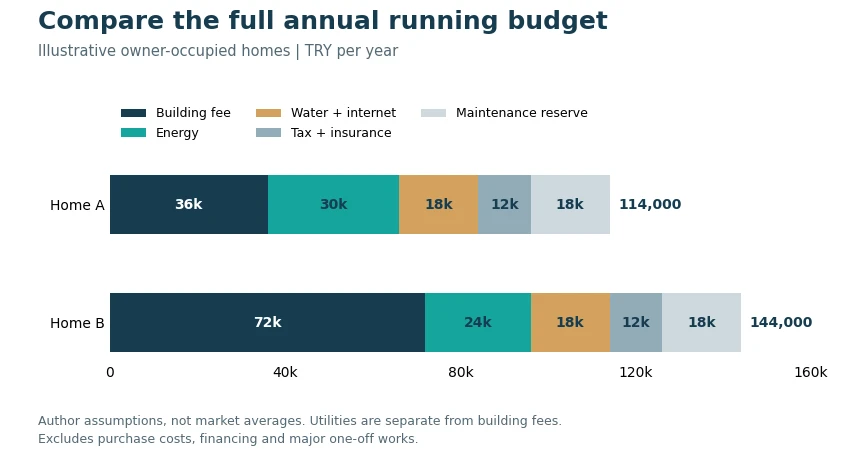
Here are two fictional owner-occupied homes. Home B has a higher building fee and lower energy costs. All amounts are in Turkish lira; the figures illustrate the comparison and are not local tariffs or average household bills.
| Illustrative annual amount, TRY | Home A | Home B |
|---|---|---|
| Building fee | 36,000 | 72,000 |
| Heating, cooling and other electricity | 30,000 | 24,000 |
| Water and internet | 18,000 | 18,000 |
| Property tax and insurance allowance | 12,000 | 12,000 |
| Maintenance allowance | 18,000 | 18,000 |
| Annual total | 114,000 | 144,000 |
| Monthly equivalent | 9,500 | 12,000 |
Home B saves TRY 6,000 on energy but charges TRY 36,000 more in building fees. You would therefore budget another TRY 30,000 a year, or TRY 2,500 a month, to live there. Over five years at unchanged costs, the extra amount is TRY 150,000. Decide whether you would use the facilities enough to justify that cost.
Replace the property tax and insurance allowance with the assessed tax liability and actual insurance quotes. The maintenance allowance is money set aside; it may remain unspent in a particular year. Keep purchase fees, furnishing, borrowing and major repairs in a separate initial budget. Groceries, school fees, transport and healthcare belong in your wider household budget.
It also helps to change the largest costs and see what happens. In the table below, energy and building fees increase independently before both increases are applied together. These are assumptions for testing affordability, not inflation forecasts.
| Annual sensitivity test | Home A, TRY | Home B, TRY |
|---|---|---|
| Base assumptions | 114,000 | 144,000 |
| Energy costs 50% higher, other rows unchanged | 129,000 | 156,000 |
| Building fees 30% higher, other rows unchanged | 124,800 | 165,600 |
| Both changes together | 139,800 | 177,600 |
With both changes, the annual gap grows to TRY 37,800. Home B is more exposed to a building-fee increase because that fee already forms a larger part of its budget. Home A is more exposed to energy costs. This tells you which bills deserve the closest examination before you choose.
If your income is in another currency, keep the lira budget and convert it at a stated exchange rate. Suppose local costs rise 30% and the number of lira per dollar rises 20%. The dollar cost still increases by about 8.3%: 1.30 ÷ 1.20 - 1. Currency movement would offset part of the rise in that example, not all of it.
By this stage, the legal position, technical assessment and relevant residence arrangements should be clear. Keep unresolved essentials off the scorecard. Otherwise a high mark for a view or swimming pool could conceal a problem that should have stopped the comparison.
For the remaining homes, the following example gives each category a weight. Score it from zero to five: zero fails your needs, three meets them and five works especially well. Multiply the rating by the weight and divide by five. The weights add up to 100; set them to suit your household before scoring.
| Lifestyle category | Weight | Home A rating | Home B rating |
|---|---|---|---|
| Daily routes and essential services | 25 | 5 | 3 |
| Winter and summer comfort | 20 | 4 | 5 |
| Room layout and usable space | 20 | 4 | 5 |
| Annual cost against your budget | 15 | 5 | 3 |
| Management and service provision | 10 | 3 | 5 |
| Accessibility for your household | 10 | 4 | 5 |
| Weighted result out of 100 | 100 | 86 | 84 |
Home A finishes on 86 and Home B on 84. Home B scores better on comfort, space, management and access, but Home A gains more from the daily routes and budget categories. A two-point lead is close enough to revisit those priorities.
For someone working from home, moving ten points of weight from daily routes to layout changes the result. Without altering any ratings, Home A falls to 84 and Home B rises to 88. Neither apartment has changed. The second set of weights simply describes a different household.
DDA Real Estate can organise the final viewings around the same questions for each home, so you have comparable answers from owners and managers. Keep the notes short enough to use: measured room sizes, verified bills, the journey you tried and anything still awaiting confirmation.
If possible, return on a weekday evening as well as during the day. Stand in the bedrooms with the windows open, then closed. Walk back from the nearest useful transport stop. See whether the entrance and route home feel practical at the time you expect to use them.
A short stay in the same neighbourhood can help you test shopping, noise and transport before moving permanently. It complements the document and building checks. You are finding out whether you like the daily routine at that address.
Before signing, have agreed repairs, included furniture and handover arrangements recorded in the appropriate documents with legal assistance. Keep a separate list of unanswered questions and who will resolve each one. Once you can explain where you will work, how you will get around and what the home costs to run, the decision becomes much easier to make.
What should I check first for a long-term move?
Write down the things your household cannot do without, such as a usable school route, lift access or a separate workroom. Then confirm the property documents and your residence arrangements. This keeps the search focused on homes you can actually use.
Does buying property automatically give me the right to live in Turkey?
Treat ownership and residence permission as separate matters. Property ownership is a recognised short-term residence permit category, subject to the applicable requirements. Confirm the exact address, documentation and family circumstances with Migration Management before relying on that route.
Is a complex with more facilities worth the higher fee?
It can be, if you will use the facilities and they operate when you need them. Ask for the annual management budget and year-round opening arrangements. In our example, Home B costs another TRY 30,000 a year after allowing for its lower energy bill.
How can I compare the size of two apartments?
Establish what each advertised area includes, then compare measured usable internal space. Record balconies separately. A measured plan with your furniture on it will reveal more than the bedroom label alone.
Should I choose a city neighbourhood or a coastal area?
Test the addresses against the same weekly routine. Check winter transport and opening hours, the school and healthcare arrangements you need, seasonal comfort and running costs. A short stay nearby can help you judge the everyday experience.
Planning to make Turkey your home? Contact DDA Real Estate with your budget, preferred location, move-in date and the journeys you need to make. We can build a property shortlist around those requirements and help you compare the homes before you decide.