Off-plan properties
People moving to Dubai ask whether it is safe. The honest answer makes the question less useful than it sounds.
Violent crime is rare here, and street safety is one of the reasons families choose the city. So the practical question becomes a different one: if the usual risks are low, which risks are left?
This guide covers what Dubai’s safety record rests on, where the real exposure sits, how to read a neighbourhood and what to check in a building. Rules and services change, so verify anything specific with the relevant authority.
Safety here is not accidental. It rests on five deliberate choices, all visible once you live with them:
The last point is underrated and explains a lot. In a city where residence depends on good standing, the cost of misbehaviour is far higher than a fine. That changes the baseline more than any single policy.
Once street crime falls away, the risk profile reorders. These are the categories that actually matter here.
| Risk | How significant | What reduces it |
|---|---|---|
| Road traffic | The highest practical risk | Defensive driving, avoiding peak hours |
| Heat and sun | Serious in summer | Hydration, timing outdoor activity |
| Sea and pools | Underestimated | Swim at patrolled beaches, supervise children |
| Fraud and scams | Real and growing | Verify counterparties, never pay individuals |
| Legal missteps | Common among newcomers | Learn the rules that differ from home |
| Petty theft | Low | Ordinary care, no special measures needed |
| Violent crime | Rare | Little to plan around |
The first row deserves the attention people give to the last. Traffic is the everyday risk in Dubai, and it is the one a resident can actually influence through their own choices.
Most trouble foreigners encounter here is legal rather than criminal in the usual sense. The behaviour is ordinary at home and regulated here. The main areas:
None of these are obscure, and all of them are avoidable. The residents who get into difficulty are usually those who assumed the rules matched the ones they grew up with.
The three physical risks, and each has a straightforward answer.
On the road
Multi-lane highways, high speeds and a wide mix of driving styles. The roads are excellent, which is part of why speeds are high.
Choose where you live with the commute in mind. Fewer kilometres on a highway at peak hour is the most effective safety decision a resident makes. It is taken at the point of signing a tenancy, not behind the wheel.
In the heat
Summer conditions are genuinely demanding, and heat exhaustion arrives faster than newcomers expect. Outdoor activity moves to early morning and evening for several months of the year.
How the year divides by season is set out in the guide to UAE weather by month, and planning around it matters for anyone arriving in the warm season.
In the water
The sea looks calm and produces strong currents on certain days. Flags on patrolled beaches are meaningful and worth obeying, and unsupervised swimming is where most incidents happen.
Beaches with lifeguards and facilities are the sensible default with children, and the family-friendly options are covered in the guide to beaches and parks in Dubai.
As physical crime stays low, financial and digital fraud takes its place as the risk residents actually meet.
The common patterns are recognisable once described:
One rule prevents most of them: never pay before verification, and never to a person. Legitimate transactions here run through registered companies, official accounts and documented processes. A request to depart from that is the signal, whatever the explanation.
Housing fraud is the version of this that newcomers meet first, usually within weeks of arriving.
Protect yourself with four habits. View before paying, verify the person renting to you has the right to do so, register the tenancy properly, and keep every payment traceable.
A registered tenancy is protection as well as paperwork. It establishes your rights and it is required for utilities and other services. How the rental process works is set out in the guide to renting in Dubai as an expat.
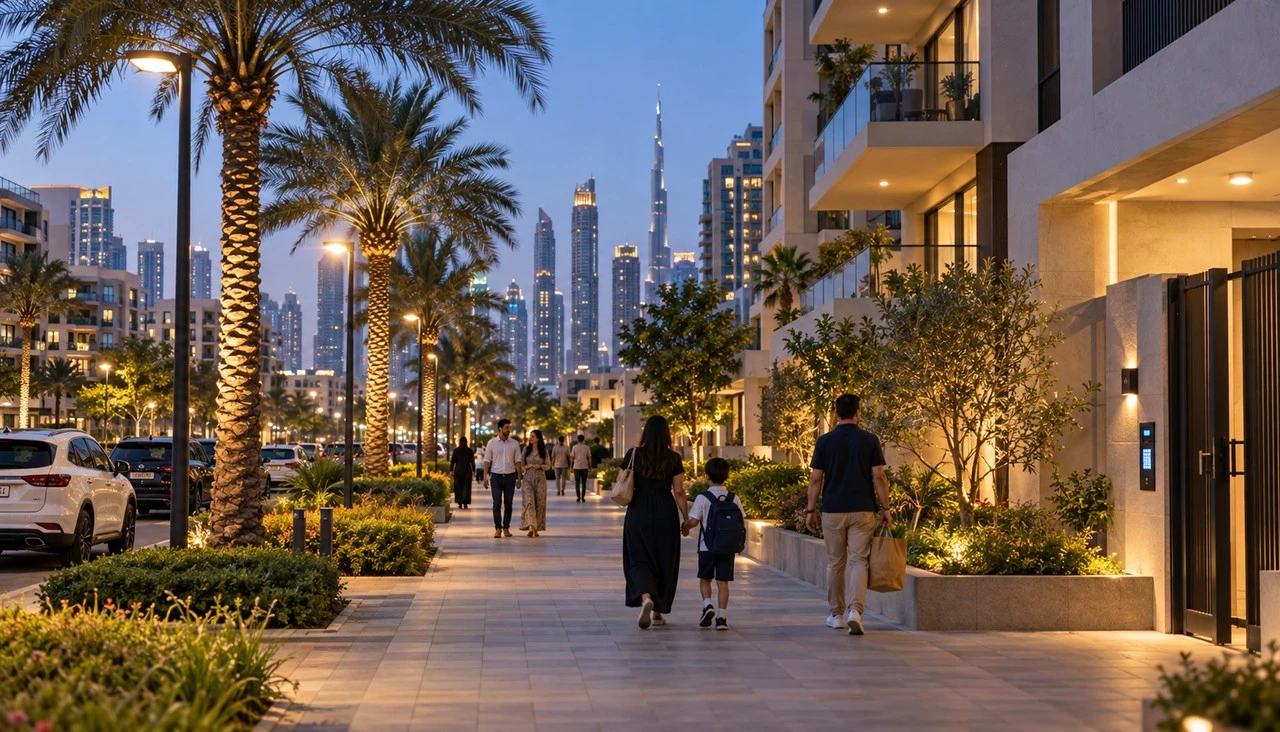
At city level Dubai is uniformly safe by international standards. At street level, districts still differ in how they feel and function.
| What to look at | What it tells you |
|---|---|
| Street lighting after dark | Whether walking home is comfortable |
| People outside in the evening | Active streets are self-policing |
| Condition of shared areas | How well the community is managed |
| Pavements and crossings | Whether the district was built for walking |
| Mix of residents | Family districts behave differently from transient ones |
| Distance to daily services | How often you will need to drive |
The fourth row matters more than it sounds. Districts designed around cars put pedestrians in awkward positions, and that is a practical safety issue rather than an aesthetic one. Why proximity shapes daily living is set out in the overview of the fifteen-minute city in Dubai.
Location affects far more than safety, of course, and the full set of reasons is covered in the guide to why location matters.
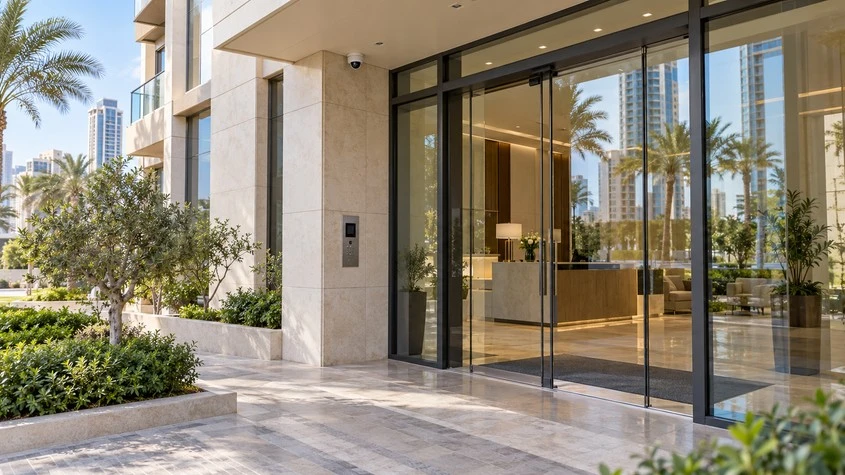
Most of what determines your daily sense of security is decided by the building rather than the city.
Eight things to check on a viewing:
The car park is the most revealing of these. It is the part of a building most often neglected, and its lighting and camera coverage tell you how seriously the management takes everything else.
Three practical areas where parents ask specific questions.
Children have unusual freedom here by international standards, and most families find the city comfortable in that respect. The constraints that do apply are physical: heat, traffic and water rather than strangers.
Vet anyone who will be alone with your children. Documentation, references and proper employment arrangements. The rules for employing household staff are set out in the guide to hiring a nanny in Dubai.
For school runs and daily routines, the district decides more than anything else. A walkable neighbourhood with short journeys removes most of the risk that a car-dependent one creates.
Reporting works, and residents use it more readily than they expect.
The emergency number across the UAE is 999 for police, with separate numbers for ambulance and fire. Dubai Police also operate an app and online services for non-urgent reports, and both work in English.
Report fraud attempts even when nothing was lost. Patterns get tracked, and the report costs you ten minutes. Many residents skip this on the assumption that nothing will come of it, which is what keeps the patterns running.
Keep copies of your documents, your tenancy registration and your emergency contacts somewhere reachable from another device. That single habit resolves most situations faster than anything else.
Safety is consistent across the country, and daily life is not.
The northern emirates are quieter and more conservative in character, with a different pace and a different social atmosphere. Some residents prefer that, and others find Dubai’s energy is exactly why they came.
This is a lifestyle choice rather than a safety one. What the quieter emirates offer is set out in the guide to living beyond Dubai and Abu Dhabi.
Is Dubai safe for families?
Yes, and it is one of the main reasons families relocate here. The constraints that do apply are physical rather than criminal: heat, traffic and water.
Is it safe to walk at night?
In populated districts, generally yes, and many residents do so routinely. Judge the individual street by lighting and whether people are out rather than by the city as a whole.
What is the biggest everyday risk?
Road traffic. It is also the risk you influence most, largely through where you choose to live and how far you drive at peak hours.
Are scams common?
Financial and digital fraud is the category that grows as physical crime stays low. Rental fraud is the version newcomers meet first.
What rules catch foreigners out?
Public conduct, alcohol rules, photographing people, zero tolerance on drugs, unpaid financial obligations and what you post online. All are avoidable once known.
Do I need private security at home?
No. Standard building security is sufficient in most developments. Check that it is actually staffed and that cameras cover the car park and lifts.
Who do I call in an emergency?
999 for police, with separate numbers for ambulance and fire. Dubai Police also run an app and online reporting for non-urgent matters, in English.
Parents arriving in Dubai usually research the city and then pick an apartment from photographs. The order that serves them better is reversed. The district decides the school run, the walk to the shops and how much highway the family covers each week. Those are the things that shape daily safety here. DDA Real Estate is a real estate agency in the UAE. We work across Dubai, Abu Dhabi, Sharjah and the northern emirates, and we assess districts by how they function on an ordinary weekday.
Look at our offers in the UAE and leave a request: tell us where you will work and study. We will shortlist districts with short journeys and walkable daily routes, and show you what the streets look like after dark.