
UAE Taxes in 2026: Is the UAE Really Tax-Free? A Complete Guide
Your salary, a payment from a freelance client and rent from a flat may all reach the same UAE bank account. For tax purposes, they need separate assessments. Employment earnings face no UAE personal income tax, while a business activity can bring Corporate Tax obligations and a property transaction can generate VAT or registration charges.
Ownership and the source of income determine which rules to examine. Here is how those decisions affect UAE taxpayers in 2026. The purchase figures are hypothetical; treaty positions and specialist industries require separate review.
Start with what you are being paid for
The government’s explanation of UAE taxation describes several taxes operating alongside the absence of personal income tax. The following questions help identify which part of the system you need to examine.
Your situation | The relevant rule | Your next calculation |
|---|---|---|
You receive employment pay | No UAE personal income tax on salary | Check whether another country can still tax you |
You earn business profits | Ordinary Corporate Tax uses a 0% band, then 9% | Work out taxable income and any available relief |
You purchase goods or services | VAT is normally charged at 5% unless a different treatment applies | Read the VAT-inclusive invoice |
You buy certain drinks or tobacco products | Excise depends on the product classification | Use the applicable rate or amount per litre |
You import goods | The usual customs duty is 5%, subject to exceptions | Establish the customs value and origin |
You acquire or occupy property | Transaction fees and local charges may arise | Prepare a cost schedule for that emirate |
Separate employment from an individual business
Receiving AED 30,000 a month as an employee does not create a UAE income-tax bill on that salary. A self-employed person should first establish whether the receipts belong to a business. The FTA’s test for an individual carrying on business brings the person within Corporate Tax when UAE business turnover exceeds AED 1 million during a calendar year.
Turnover determines whether the individual enters the regime; taxable profit determines the bill. The AED 1 million threshold is not a profit deduction.
Keep wages separate from the business-turnover total. Qualifying personal investment returns and qualifying real estate investment income are also excluded from that total.
Review property income by reference to the activity actually carried out. A portfolio containing several flats does not, by itself, establish a taxable rental business.
Assess residence independently. A visa and a property title do not resolve every residency question. The documents needed for a UAE Tax Residency Certificate and the relevant treaty help establish which tests apply; obligations abroad may continue.
Understand what the 9% business rate applies to
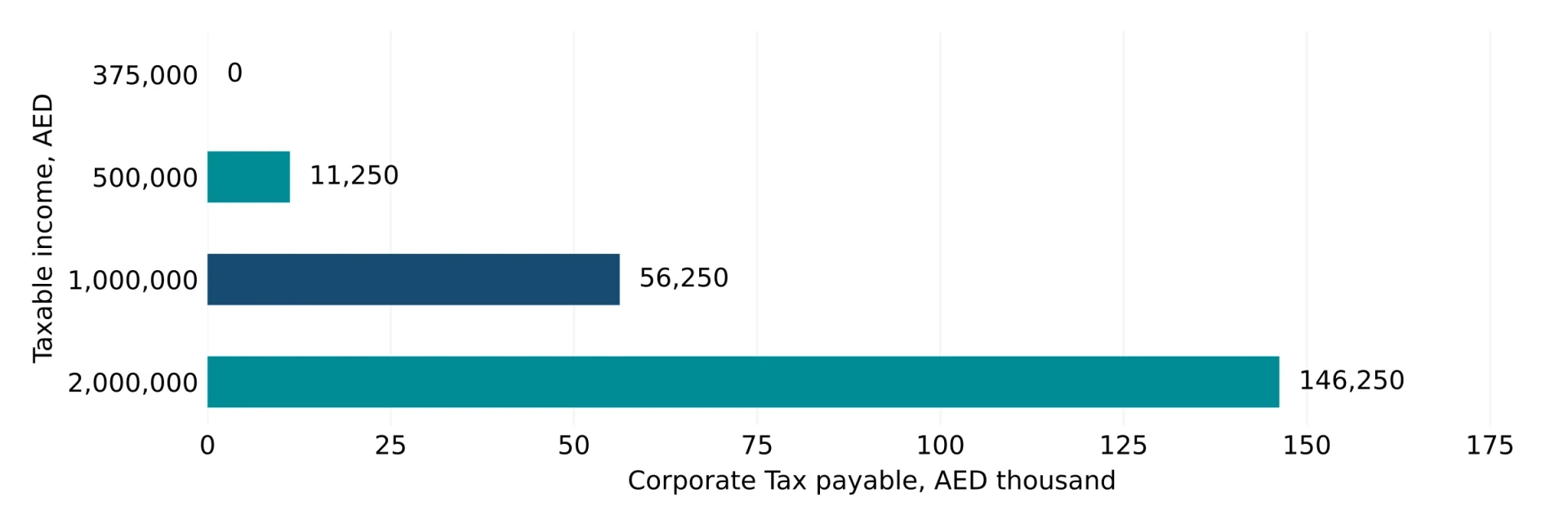
For an ordinary taxable business, AED 375,000 of taxable income carries 0%; the excess carries 9%. At AED 1 million, the taxable portion above the band is AED 625,000, producing AED 56,250 of tax. Apply the required tax adjustments first: sales and bank balances cannot replace taxable income.