Off-plan properties
Two imported assumptions cause most of the awkwardness foreigners experience at a Thai table, and both are about tools rather than manners. The first is that the fork does the eating. It does not — the spoon is the primary utensil and the only one that goes to your mouth, while the fork pushes food onto it. The second is that chopsticks are the Asian default. In Thailand they belong to one narrow category of dish, and reaching for them with rice marks you out immediately.
The third and largest assumption concerns money. Tipping in Thailand is not a percentage system, and applying a Western percentage produces two problems at once: it over-tips substantially in ordinary places and it misses the point in the ones where a tip is genuinely appropriate. Published guidance disagrees sharply on the numbers, which is itself informative — the honest answer depends on the venue tier rather than on the bill.
This article covers how a Thai table is actually organised, what changes between a street stall, a neighbourhood restaurant and a hotel dining room, and what to do about tipping in each. Practices and figures are current as of August 2026, sources conflict on tipping levels and that conflict is set out rather than resolved, and local variation is real — expectations in a provincial town differ from those in a tourist district.
Thai cutlery has a clear division of labour, and it maps onto Western habits differently than people expect. The spoon is held in the dominant hand and is the utensil that reaches your mouth. The fork sits in the other hand and exists to push food onto the spoon; it should not go between your lips. There is no knife on the table at all, because food arrives already cut to bite size — if something needs dividing, the fork and spoon do it together.
This is not an ancient arrangement, which surprises people. Western cutlery arrived in the nineteenth century under King Rama V as part of a broader modernisation; before that, eating was done by hand.
When chopsticks apply
Almost never, in practice. Chopsticks belong to standalone noodle dishes — particularly noodle soups — and to restaurants serving Chinese-style food. They are not used for rice-based dishes, which is most of the Thai repertoire. Asking for chopsticks with a rice dish is the single most common visible error, and it is the sort of mistake that is politely accommodated rather than corrected.
The exception that uses hands
Northern and northeastern meals often include sticky rice served in small baskets. It is eaten with the fingers: compress a small amount into a ball and use it to pick up food and sauce. Doing this correctly reads as familiarity rather than as informality.
The structural difference from a Western meal is that dishes are communal and rice is the anchor. Nobody has a plate of their own food in the Western sense; everyone has rice, and the shared dishes sit in the middle to be drawn from a little at a time.
Most confusion comes from applying one set of expectations across settings that work quite differently.
| Setting | How it works | Tipping |
|---|---|---|
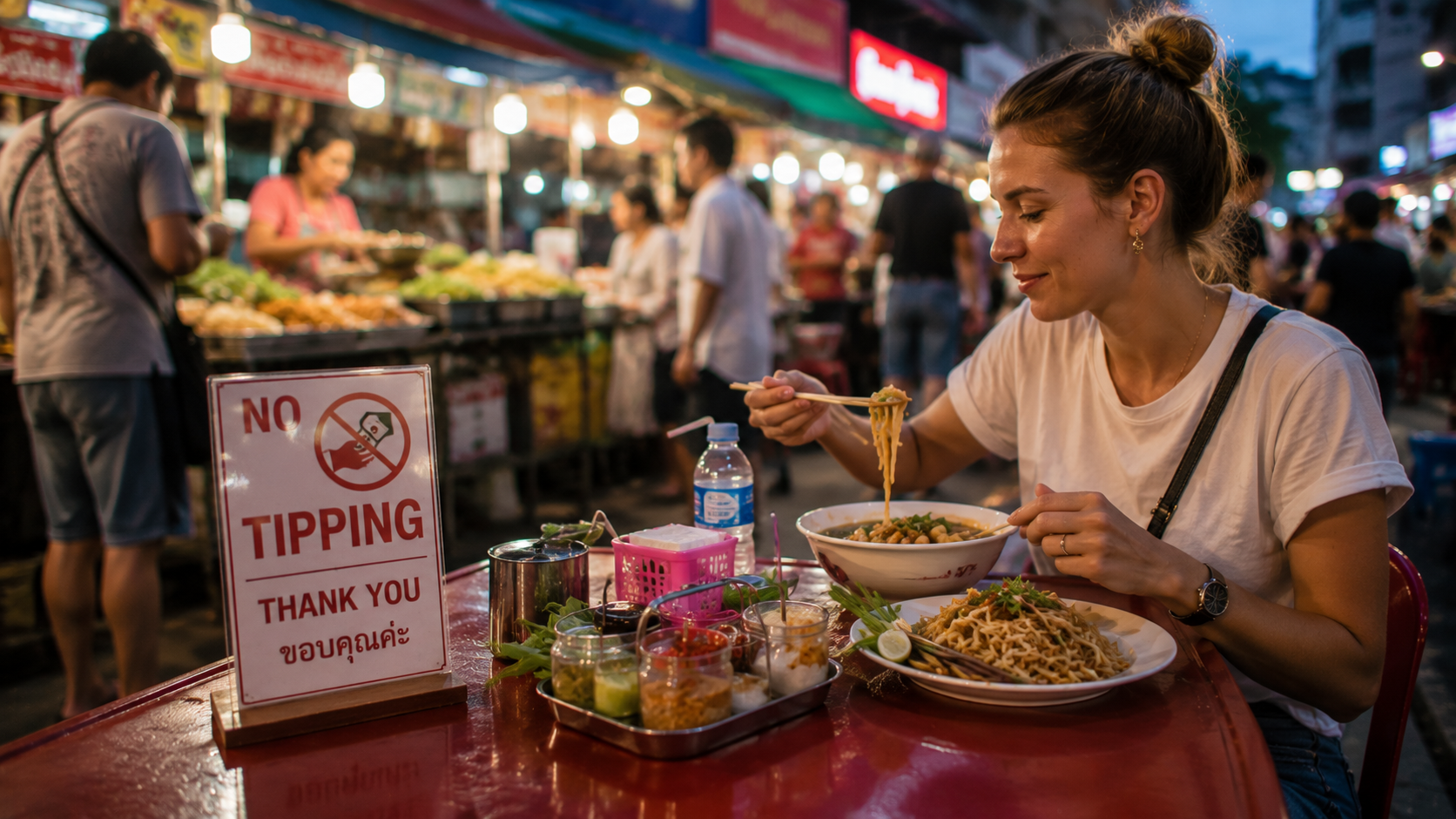
| Street stall | No written bill, total calculated mentally, change from an apron pocket, cash only | Not expected; locals often leave the smallest coins |
| Food court and fast food | Order, pay, carry, clear your own tray | Not part of the system |
| Neighbourhood restaurant | Table service, cash usually preferred, informal | Not necessary; rounding up is a normal gesture |
| Mid-range and tourist-area restaurant | Table service, card often accepted | Rounding up or a modest amount; percentages are a foreign import |
| Hotel and fine dining | Smart casual dress, formal service | Check the bill for a 10% service charge — if present, nothing further is required |
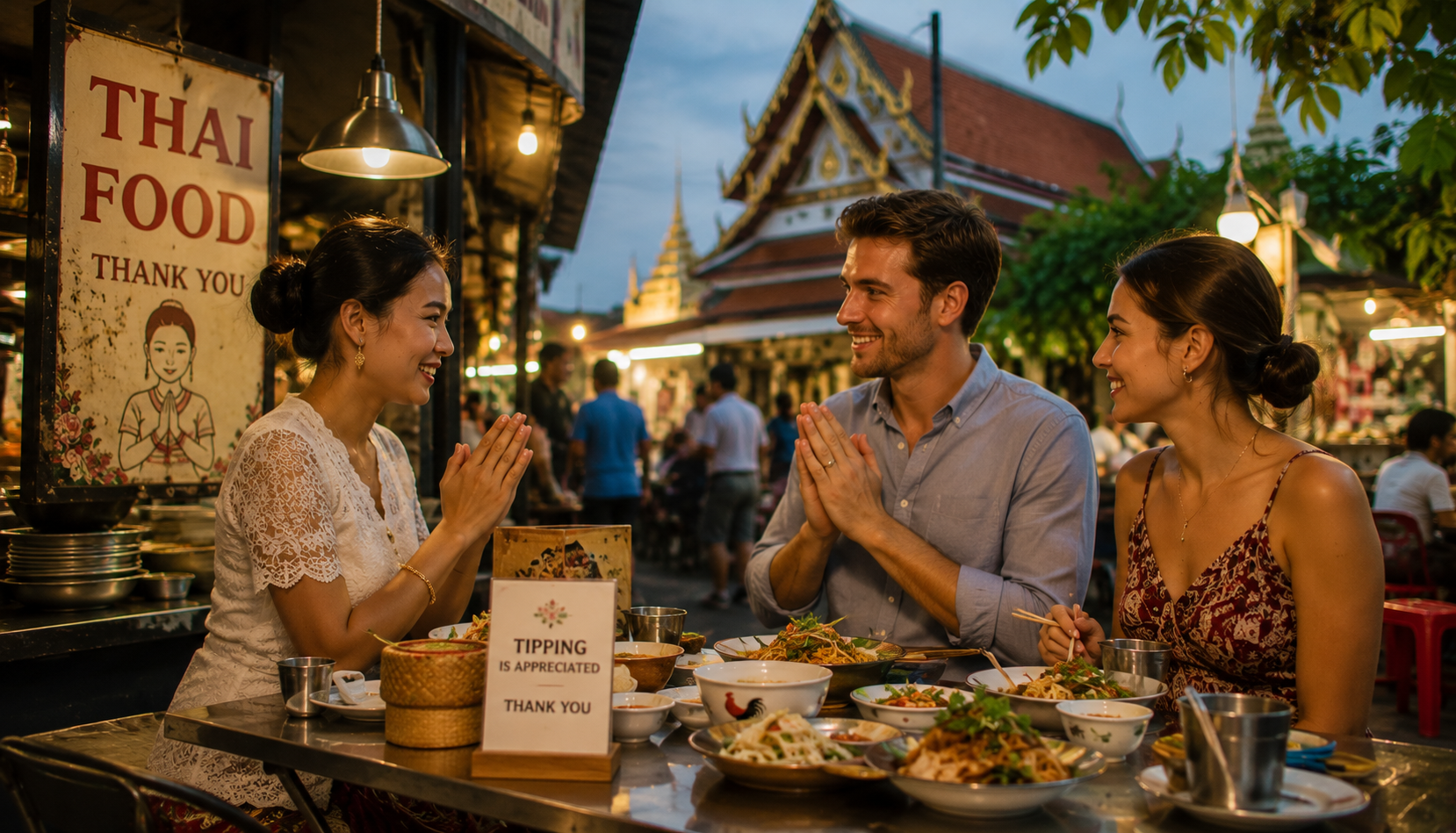
One detail specific to upper-tier venues: staff will often greet you with a wai. The appropriate response is a polite nod and a smile rather than returning it. Returning a wai to service staff is not expected and reads as awkward rather than respectful — a point that catches out visitors who have learned that the gesture signals politeness.
This is the part where published guidance genuinely disagrees, and pretending otherwise would not help anyone.
Some sources state that tipping in Thai restaurants runs at 10–15% of the bill. Others state plainly that tipping is not expected and that a service charge covers it. A 2026 guide is blunter still, describing 15–20% as over-tipping by roughly double, and noting that street stalls, food courts and convenience stores need no tip at all. Another observes that outside urban and tourist areas even a 40-baht tip can look excessive.
These are not contradictions so much as different venues being described. The reconciliation is that Thailand has no percentage convention. What exists is a tier system: nothing at the bottom, a rounding gesture in the middle, and a service charge doing the work at the top. The rule of thumb that actually travels is that the more formal the setting, the more a tip is expected — and that this tracks the venue rather than the size of the bill.
Mid-range and upmarket restaurants and hotel dining rooms commonly add 10% to the bill automatically. Where it appears, no further tip is required or expected, though a small additional amount is received warmly. The practical habit worth forming is simply reading the bill before deciding — an extra ten per cent added on top of an existing ten per cent is a common and entirely avoidable overpayment.
Where a tip is given, cash into the hand is the norm, and cash generally remains the default at smaller establishments and street stalls regardless of what cards the tourist areas accept. What eating out actually costs across the tiers, alongside the rest of a monthly budget, is set out in our guide to the cost of living in Pattaya.
Street food is not a lesser tier of restaurant — it is the mainstream of Thai eating, and judging a stall is a skill worth twenty minutes of attention.
Where you live changes how much of this you encounter: the density and character of street dining differs considerably between Bangkok, the islands and the northern cities, as do the restaurant scenes layered above it. How the main destinations compare on the practicalities of daily life is covered in our overview of where it is better to buy real estate in Thailand.
Eating well and cheaply is one of the practical arguments people cite for a longer stay, and it usually appears in the same conversation as whether to make that stay permanent. For anyone at that point, the ownership routes available to foreigners and what each involves are set out in our overview of property investment in Thailand for foreigners.
How much should I tip in a Thai restaurant?
There is no percentage convention, and sources disagree precisely because they describe different venues. Nothing is expected at street stalls, food courts or casual local eateries; rounding up is a normal gesture in mid-range places; and mid-to-upmarket restaurants and hotels commonly add a 10% service charge that covers it. The more formal the setting, the more a tip is expected.
Should I use chopsticks?
Only for standalone noodle dishes, particularly noodle soups, and in Chinese-style restaurants. Rice-based dishes — most of the Thai repertoire — are eaten with a spoon and fork. Asking for chopsticks with rice is the most common visible error visitors make.
Why is there no knife on the table?
Because food is cut into bite-sized pieces in the kitchen before it reaches you. If something still needs dividing, the fork and spoon do it together. Western cutlery itself only arrived in the nineteenth century, introduced under King Rama V.
What is the rule for sharing dishes?
Dishes are communal and rice is the anchor. Always transfer food with the serving utensil provided rather than your own spoon, take modest portions and refresh them as you go rather than filling your plate, serve those around you first, and wait for the most senior person at the table to begin.
Should I wai the waiter?
No. In upper-tier restaurants staff often greet guests with a wai, and the appropriate response is a polite nod and a smile. Returning it to service staff is not expected and reads as awkward rather than respectful.
Is street food safe?
Judged sensibly, yes — it is the mainstream of Thai eating rather than a lesser option. Favour busy stalls with high turnover and food cooked to order in front of you over pristine but empty ones with pre-prepared dishes standing at ambient temperature. A weekday queue of local workers is the most reliable signal available.
Almost everything that goes wrong at a Thai table comes from importing a frame that does not fit. The spoon does the eating and the fork assists; chopsticks belong to noodles and nowhere else; the dishes in the middle are shared and the serving utensil is not the one in your hand. And tipping is not a percentage of anything — it is a tier system where the bottom expects nothing, the middle appreciates a rounding, and the top has usually added ten per cent already. Read the bill, follow the table, and the rest is straightforward: this is a food culture that is generous to people making an obvious effort and forgiving of people who are not.
DDA Real Estate helps you find property in Thailand — from Bangkok condominiums to villas in Phuket and Koh Samui, with document verification and full legal support. Check out our offers in Thailand and leave a request: we'll find options for your budget and goal.