Turkish Property for Remote Work: How to Choose
Turkey
EN
$
ft²
Other articles

How to Choose a Turkish Property for Remote Work

Sergey Dubinets The author of the article, the Broker
#Blog DDA
20 November 2205 views

Remote work turns a Turkish home into an office, so the purchase has to pass two tests at once: it must be pleasant to live in and reliable enough for eight hours of video calls a day. In 2025, foreigners bought 21,534 homes in Turkey, and most of them chose between the same few cities. The difference between a good and a weak choice for remote work usually shows up later, in the internet line, the working hours and the right to stay.

This guide compares the cities foreign buyers prefer, the cost of an extra room for an office, internet checks before signing, working hours with clients abroad and the stay options. Data is given as of November 2026.

Where foreign buyers concentrate

Istanbul and Antalya account for 70% of all homes sold to foreigners. In 2025, Istanbul recorded 7,989 such sales and Antalya 7,118, while Mersin, the third city, had only 1,800.
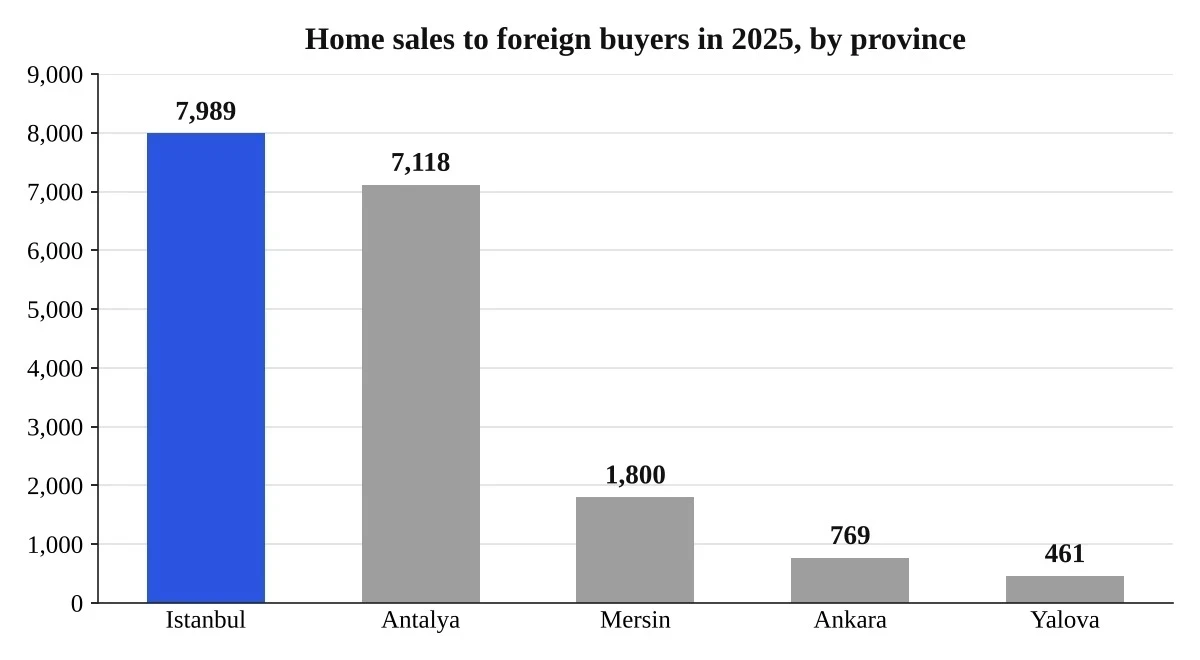
Number of homes sold to foreign citizens in 2025, units, five leading provinces

A large foreign market means English-speaking services and a deeper pool of future buyers. Smaller markets such as Yalova, with 461 sales in 2025, have fewer buyers at exit. The more foreign sales a city records, the easier it usually is to resell a remote-work apartment later.

What a home office adds to the price

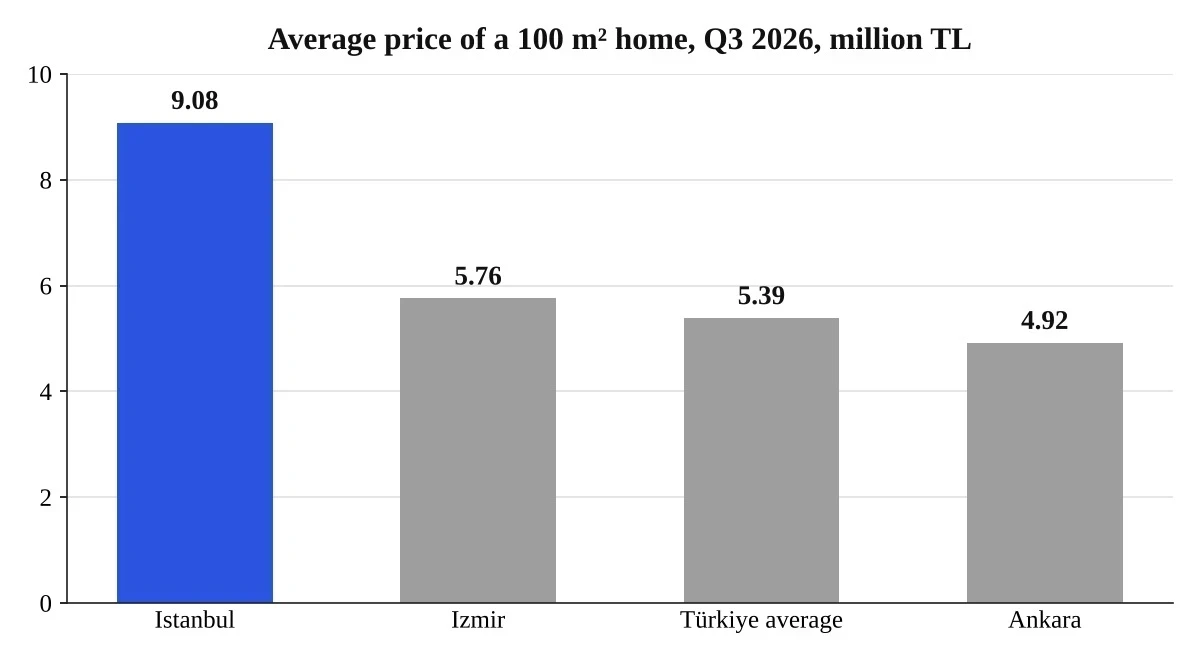
A separate room for work costs roughly twice as much in Istanbul as in Ankara. In the third quarter of 2026, an average 100 m² home was valued at 9.08 million TL in Istanbul, 5.76 million TL in Izmir and 4.92 million TL in Ankara, against a national average of 5.39 million TL.

Average value of a 100 m² dwelling in the third quarter of 2026, million Turkish lira

Our own calculation from these averages gives about 90,800 TL per m² in Istanbul, 57,600 TL in Izmir and 49,200 TL in Ankara. A 12 m² study therefore adds around 1.09 million TL to the price in Istanbul, 0.69 million TL in Izmir and 0.59 million TL in Ankara. Turkish listings describe this as the step from a 1+1 to a 2+1 layout. The higher the price per m² in a city, the more it pays to look for a layout with a usable corner or a glazed balcony instead of a full extra room.

How prices move in lira and in real terms

Turkish home prices keep rising in lira but fall after inflation. In September 2026, the national house price index was 22.3% higher than a year earlier in nominal terms and 5.7% lower in real terms. The Istanbul region showed the strongest nominal growth at 26.8%, while the Edirne, Kırklareli and Tekirdağ region had the weakest at 15.3%.

For a buyer earning in dollars or euros, the price in hard currency depends more on the exchange rate than on the lira index. Compare the asking price with recent sales of similar flats in the same building. When nominal growth runs below inflation, negotiating on price matters more than waiting for the market to rise.

Internet: what to check before signing

Fibre is still not the default connection in Turkey. At the end of 2025, the country had about 21.0 million fixed broadband lines, and 9.85 million of them, or 46.9%, were fibre to the home or building. Only 41.6% of subscribers had packages of 50 Mbps and above, while an average line used 319 GB a month. Before reserving a flat, run these checks for the exact address:

  1. Line type – ask the seller or the building manager which operators serve the address and whether the connection is fibre or copper VDSL.

  2. Upload speed – request a screenshot of a speed test from a resident, because video calls depend on upload as much as on download.

  3. Backup channel – check 4.5G or 5G coverage inside the flat, so a mobile hotspot can cover an outage.

  4. Installation time – in a new building, confirm when operators will connect the block, since this can lag behind handover.

Prices, packages and operator coverage differ by city, and choosing an internet provider in Turkey is a separate step after the purchase. A flat with confirmed fibre is worth more to a remote worker than a better view with a copper line.

Layout and building for focused work

A home office needs a door that closes, a window and a stable temperature. In Antalya and Mersin, the study should face away from the afternoon sun or have its own air conditioner. A room facing an inner courtyard is usually quieter for calls than one facing the street.

Gated complexes often add a co-working room, a gym and on-site staff, which helps with deliveries and repairs during the working day. These services are funded by the monthly fee, so the cost of a site, Turkey's gated residential complex, has to be included in the budget alongside the 12 m² premium calculated above. The quieter the side of the building, the more hours of the day the study can actually be used.


Time zone and client hours

Turkey stays on UTC+3 all year and has not changed its clocks since 2016. As a result, the overlap with clients shifts twice a year when Europe and the US switch to summer time. The table shows how many hours of a standard 9:00–18:00 client day fall inside a 9:00–18:00 working day in Turkey.

Client location

Client 9:00 in Turkey, winter

Overlap in winter

Overlap in summer

London

12:00

6 hours

7 hours

Berlin

11:00

7 hours

8 hours

Dubai

8:00

8 hours

8 hours

New York

17:00

1 hour

2 hours


The calculation assumes a fixed 9:00–18:00 schedule on both sides. Work for Dubai and Central Europe fits a normal Turkish day, while work for the US East Coast moves most calls into the Turkish evening. The further west the clients, the more important a quiet bedroom away from the study becomes, because work ends late.

Staying legally: visa, nomad status or residence permit

The right stay option depends on how many months a year you plan to spend in Turkey and on the value of the property. Since 16 October 2023, a residence permit based on owning a home requires a property worth at least 200,000 US dollars at the time of purchase. Since April 2024, remote workers can also apply for digital nomad status with a monthly income of 3,000 US dollars or 36,000 US dollars a year.

Situation

Option

Key condition

Up to 90 days in 180

Visa-free entry or tourist visa

Depends on nationality; no work permit or residence status

Long stays, home under 200,000 USD

Digital nomad status

3,000 USD a month or 36,000 USD a year, university degree, employer or clients outside Turkey

Long stays, home from 200,000 USD

Residence permit based on property

Value at purchase of at least 200,000 USD, new applications since 16 October 2023

Citizenship

Investment in real estate

From 400,000 USD with a three-year restriction on resale


The conditions for remote workers, including the list of eligible nationalities, are covered in the guide to Turkey's digital nomad visa. Renewal rules and documents for each status are compared among the types of residence permits in Turkey. The 200,000 USD threshold often decides the city: in Istanbul it buys less space than in Ankara or Mersin.

Foreign demand in 2026 and resale prospects

Foreign demand has stabilised at a lower level. From January to October 2026, foreigners bought 17,567 homes, 3.6% fewer than a year earlier, while October alone showed 2,259 sales, 0.9% more than in October 2025. Foreign buyers made up 1.7% of all home sales in that month.

With a small share of foreign buyers, a remote-work flat is usually resold to local buyers. A separate room, fibre and parking suit both groups and keep the home liquid. The narrower the target buyer of a flat, the longer the sale usually takes.

Questions to ask the seller

Five written answers before the deposit save weeks of lost work after the move. Ask the seller or the developer to confirm:

  • Which operators serve the address? – a written answer on fibre or copper avoids a slow line after the move.

  • Which windows face the street? – a study on the courtyard side stays quieter during calls.

  • What does the monthly fee include? – a co-working room or meeting space in the complex can replace a rented desk.

  • Does the price reach 200,000 US dollars? – this matters only if a residence permit based on property is the goal.

  • When will a new building get fibre? – the connection date can come later than the handover of keys.

Frequently asked questions

Which Turkish city is best for remote work?

Istanbul and Antalya have the largest foreign communities, with 7,989 and 7,118 homes sold to foreigners in 2025. Istanbul offers the widest choice of services and the deepest resale market, while Antalya suits buyers who want a resort lifestyle.

How fast is home internet in Turkey?

At the end of 2025, 46.9% of fixed broadband lines were fibre and 41.6% of subscribers used packages of 50 Mbps and above. Speed depends on the building, so it should be checked for each address.

Does buying a home give the right to live in Turkey?

A home worth at least 200,000 US dollars at purchase allows an application for a residence permit, for applications made since 16 October 2023. A cheaper home does not give this right on its own.

Can I work remotely from Turkey on digital nomad status?

Yes, if your employer or clients are outside Turkey and you earn 3,000 US dollars a month or 36,000 US dollars a year. A university degree is also required.

How much does an extra room for an office cost?

By our calculation from third-quarter 2026 averages, a 12 m² room adds about 1.09 million TL in Istanbul, 0.69 million TL in Izmir and 0.59 million TL in Ankara.

If you plan to work online from Turkey

DDA Real Estate selects apartments in Istanbul, Antalya, Mersin and other Turkish cities, compares them by layout, price per m², building type and the location of the flat in the complex, and helps you choose the area that fits your working hours and lifestyle.

Explore our properties in Turkey and leave an inquiry: we will send a shortlist of homes with a room for an office, a quiet side of the building and a budget that matches your stay plans.

Popular
5 June 4377807 views
Dubai Rent Prices 2025: Average Apartment Rental Costs in Dubai Dubai's rental market continues its upward climb in 2025, driven by population growth and limited new supply, pushing average prices up by 10%
#Blog DDA
2 July 2519559 views
DLD Fees in Dubai: Everything You Need to Know Buying property in Dubai? Don't let hidden fees surprise you! Our essential guide breaks down ALL Dubai Land Department (DLD) fees
#Blog DDA
23 November 2000502 view
How to Buy a SIM Card in Turkey in 2026: Prices, IMEI Registration, eSIM Options, and Best Mobile Operators Overview of mobile operators, available types of SIM cards, and home Internet providers
#Blog DDA
5 July 1858878 views
How Much is the Real Estate Agent Commission in Dubai? Find out how much real estate agent commission costs when buying property in Dubai.
#Blog DDA
5 February 1505511 views
How Foreigners Can Own Property in Bali: Understanding PT PMA (2025) Foreigners can't own freehold land in Bali, but a PT PMA (foreign-owned company) allows secure property ownership under Hak Guna Bangunan (HGB) or Hak Pakai (HP) rights
#Blog DDA
28 August 1273671 view
Oqood vs Title Deed in Dubai: Key Differences You Must Know Buying property off-plan in Dubai? Oqood registration is mandatory to secure your ownership rights.
#Blog DDA