
Off-plan properties
The same Turkish apartment carries four official area figures, and the gap between the largest and the smallest runs to 20 per cent or more. None of this is concealment — it is how Turkish property accounting works.
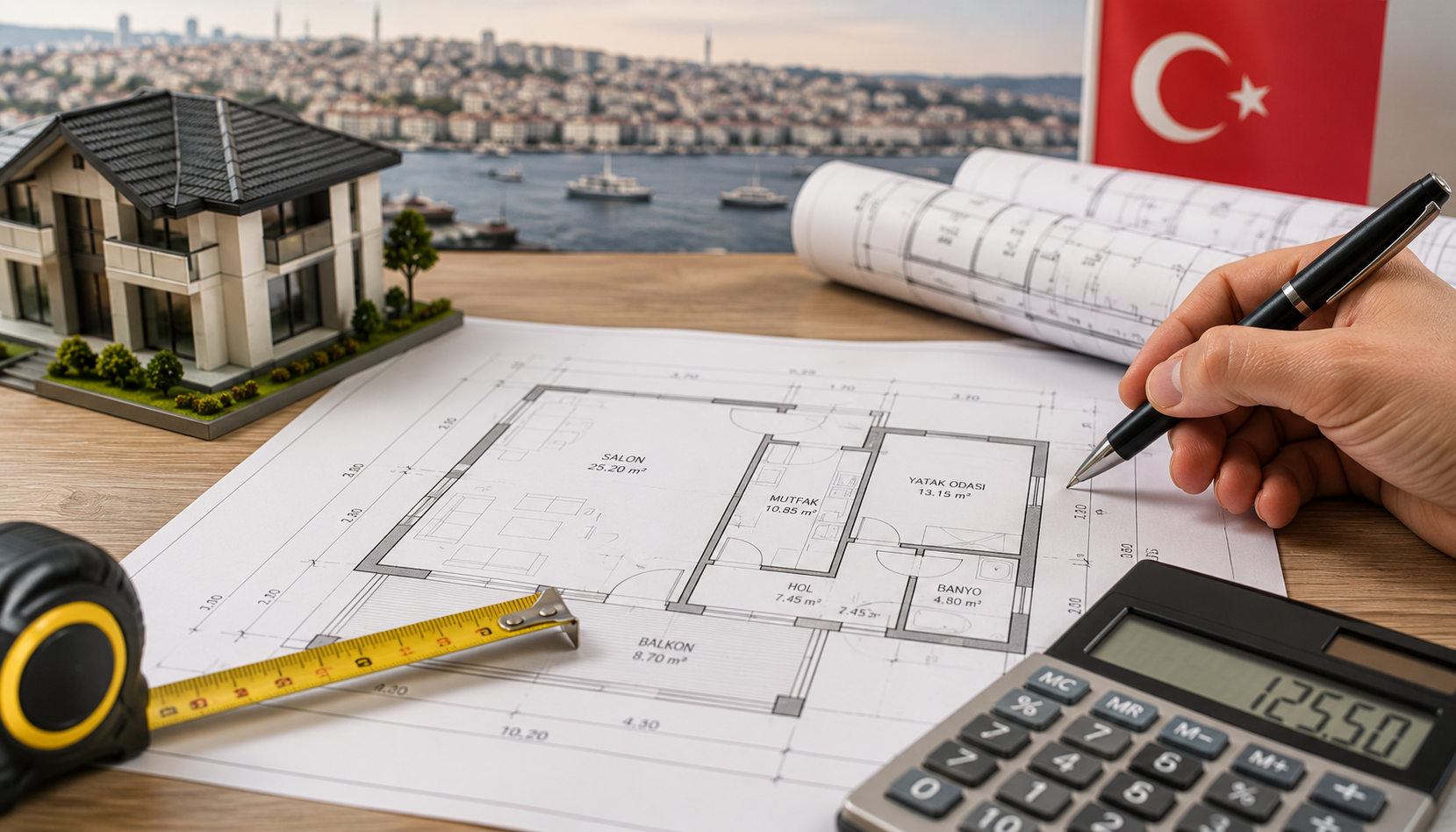
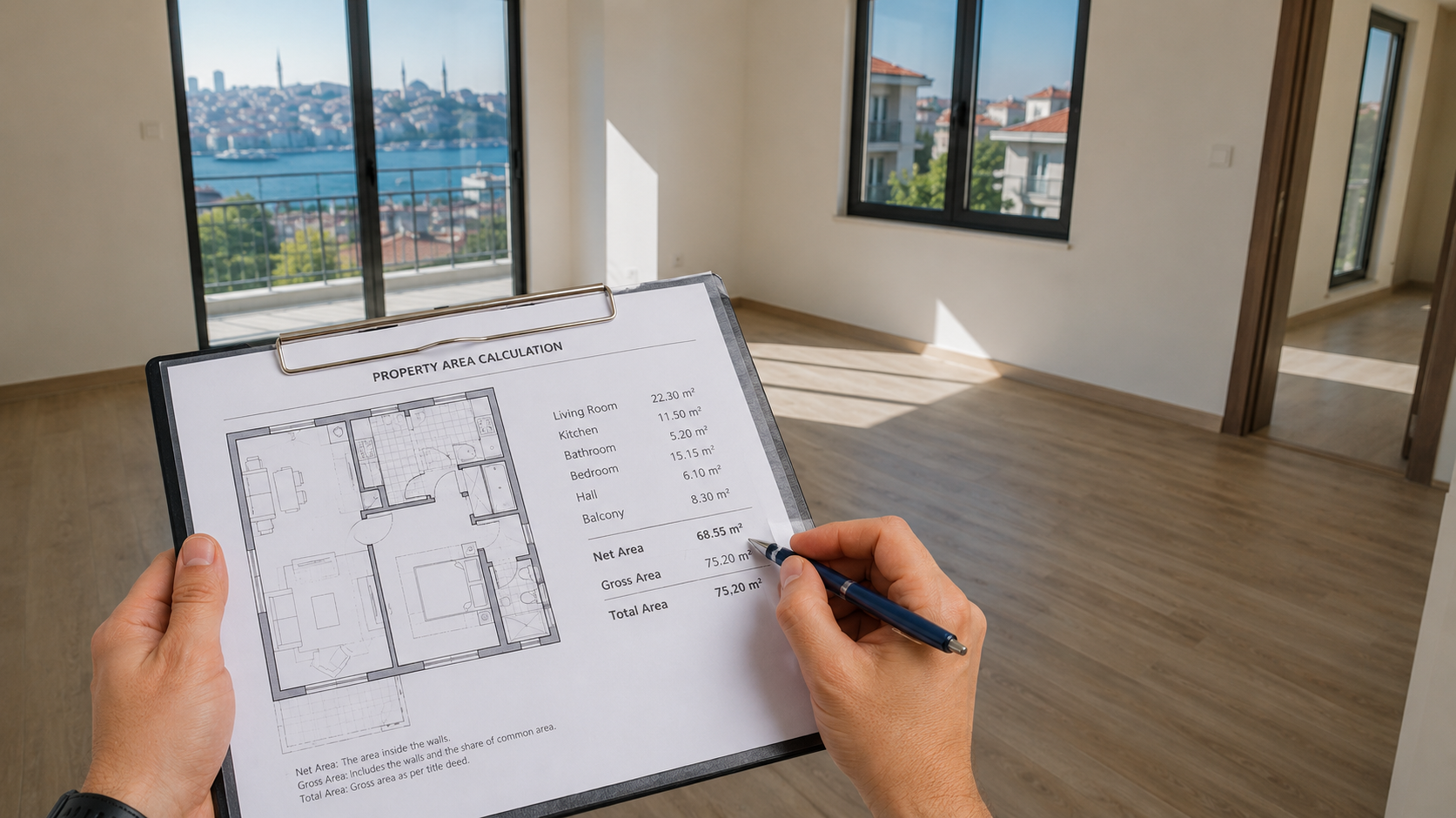
A flat marketed as 140 square metres will typically show around 125 on the title deed, around 118 on the habitation certificate, and about 112 when you measure the rooms. Every one of those numbers is correct for its own purpose, and each governs a different cost.
This guide sets out what the four measurements mean, where the gaps come from, the marketing practices that widen them, and how to establish the real figure before signing. Ranges reflect August 2026 and vary by building age and layout — measure the specific property rather than relying on typical values.
Each is produced by a different party for a different reason, which is why they never quite agree.
| Measurement | What it includes | Typical for a three-bedroom flat | Where you see it |
|---|---|---|---|
| Gross (brüt) | Walls, columns, balconies, allocated shared space | 140 – 150 m² | Brochures and listings |
| Title deed | Cadastral measurement for legal purposes | 120 – 135 m² | The title deed |
| Habitation certificate | Municipal measurement at completion | 115 – 130 m² | The İskan document |
| Net | Interior floor area you can actually furnish | 110 – 125 m² | Nowhere — you measure it yourself |
The one figure that governs your daily life appears in no document. Net area is what you live in, and no authority publishes it — which is precisely why it is the number that gets omitted from the conversation.
The title deed and the habitation certificate come from two different government bodies using different protocols, so a divergence of 5 to 15 per cent between them is normal rather than alarming. Both are legally valid; they simply answer different questions. The deed governs ownership and property tax, the certificate governs utilities and insurance.
The distance between the marketed figure and the usable one is 15 to 20 per cent in a modern building and 20 to 30 in an older one.
Structural walls, partitions, columns and internal circulation account for most of it. Older stock loses more because walls are thicker and layouts less efficient — a hundred square metres gross in a forty-year-old Istanbul block can leave 75 to 80 usable.
The practical consequence is a pricing one. Two flats advertised at the same price per gross metre are not the same price if one is 15 per cent more efficient — the efficient one is 15 per cent cheaper per metre you can actually use, and nothing in either listing says so.
Every unit carries a documented share of the building’s common areas — corridors, stairs, lobby, lifts, technical rooms and sometimes grounds.
That share typically runs 5 to 15 per cent of the unit’s gross figure, so a 140-square-metre flat might carry 10 to 20 metres of allocation. It is recorded in the ownership documentation, and it determines your proportion of the monthly building charge as well as appearing in some gross calculations.
The question to ask is short and rarely asked: does the advertised gross figure include the common-area share or not? Where it does, the advertised size is inflated by 10 to 15 per cent before any balcony is counted. In extreme cases at the luxury end, pool and gym areas are allocated into unit figures — producing a 130-square-metre listing for a flat of around 90.
Take a flat advertised at 140 square metres gross in a modern complex with a balcony counted at full value and a common-area share included in the headline figure.
| Figure | Square metres | What it reflects |
|---|---|---|
| Advertised gross | 140 | Walls, balcony in full, shared allocation |
| Less shared allocation | −12 | Corridors, lobby, technical space |
| Title deed | 125 | Cadastral measurement |
| Habitation certificate | 118 | Municipal measurement at completion |
| Less walls and half the balcony | −6 | Structure and unusable outdoor share |
| Net, measured room by room | 112 | What you can furnish |
Twenty-eight square metres separate the brochure from the floor, and every step in between is legitimate. The figure a buyer should compare against another property is the last row, and it is the only one that never appears in writing anywhere.
None of these are illegal. All of them widen the gap between what is advertised and what is delivered.
Establishing the real number is a viewing-stage task, not a contract-stage one — by the time the contract is drafted, the price has been anchored to the advertised figure.
Everything below can be done before signing, and most of it before making an offer.
One check costs nothing and settles most disputes: get the definition into the contract. «140 square metres gross including common-area share» is a binding description; «140 square metres» is an argument waiting to happen.
This is the part that turns an abstract distinction into money.
| Decision | Which measurement applies | Why it matters |
|---|---|---|
| Comparing prices between flats | Net | The only basis on which two properties are genuinely comparable |
| Annual property tax | Title deed | Assessment runs from the registered area |
| Earthquake insurance premium | Habitation certificate | Premium is tied to the certified unit area |
| Monthly building charge | Common-area share | Your proportion of shared costs follows the allocation |
| Rental income | Net, whatever the advert says | Tenants pay for space they can use |
| Resale | Net | The next buyer measures it themselves |
Worked through on a real purchase: three million lira for 140 gross metres reads as 21,400 per metre. The same purchase against 115 net metres is 26,100 — a difference of nearly 22 per cent in what you are actually paying, invisible in every listing.
For investors the correction matters more, not less. Yield calculated against the advertised figure overstates the return, because rent follows usable space while the denominator followed the brochure. How the insurance premium tracks the certified area is set out in our guide to property insurance in Turkey, and the tax side in our guide to taxes in Turkey.
One category deserves separate mention because the distortion runs larger there than anywhere else.
Seaside apartments are built with generous balconies and terraces, which is a genuine amenity and also the single largest inflator of gross area. The gap between advertised and usable commonly reaches 25 per cent, and the practical value of that outdoor space depends entirely on orientation and season — a north-facing balcony in a resort town earns its square metres for a narrower window than the listing implies.
The correction is the same as everywhere else, applied more carefully: measure the interior, price against that, and treat the balcony as an amenity rather than as floor area. The wider picture of buying on that coast is covered in our guide to Alanya.
What if the deed and the certificate disagree?
A difference of 5 to 10 per cent is normal, since two departments measure differently. Beyond 15 per cent it warrants investigation — unauthorised modification, a measurement error or a documentation problem are the usual explanations.
Are developers obliged to state net area?
Not in marketing material. It must appear in the sale contract and the ownership documentation, so the practical answer is to request it in writing before you are at the signing stage.
Are balconies in the deed figure?
Usually partially, commonly at half. Enclosed balconies may count at a higher proportion. It varies by project, which is why the question has to be asked about the specific property.
Which figure applies to the citizenship threshold?
None directly — the threshold is a valuation, established by official appraisal. Area feeds into that valuation alongside condition and comparable sales, but the number that counts is the appraised value.
Can I challenge the area after buying?
Only where the delivered property differs materially from what the contract described. If the contract said gross including common-area share, that definition binds — which is the argument for settling definitions before signature rather than after.
How much does the gap matter on a resort apartment?
More than average. Larger balconies push the difference between advertised and usable towards 25 per cent, and the outdoor space delivers value for part of the year rather than all of it.
Two apartments at the same advertised price per square metre can differ by a fifth in what you can furnish, and nothing in either listing reveals it. The correction takes a laser measure, two documents and one question about balconies — and it changes which property is the better buy more often than location does at the margin. DDA Real Estate is a real estate agency in Turkey. We work across Istanbul, Antalya, Alanya, Izmir, Bodrum and Mersin, and we pull the title deed and habitation certificate figures before viewings so the comparison starts from the real numbers.
Explore our listings in Turkey and get in touch: we will give you net and gross side by side for anything you are considering, flag where an advertised figure leans on balconies or shared space, and put the definition into the contract so it holds.