Antalya Walking Guide 2026: 6 Best Areas
Turkey
EN
$
ft²
Other articles

Best Places for Walks in Antalya: Exploring the City's Beauty

Dmitry Zykov The author of the article, the Broker
#Blog DDA
22 July 1323 view

Antalya is not one place but six, and all of them sit within a five to eight kilometre radius. Roman streets, a seven-kilometre beach promenade, a waterfall dropping straight into the sea, a clifftop park, a working harbour and a long eastern sand coast.

Each has its own hour of the day and its own season. Getting that wrong is the difference between a walk that stays with you and one spent looking for shade — and in July the difference is not aesthetic but medical.

This guide covers the six areas with routes, timings and seasonal notes, plus itineraries from half an hour to several days. Temperatures and prices reflect August 2026 and vary — check locally before planning around them.

Kaleiçi: The Old Town

The original walled city, roughly a square kilometre of cobbled lanes, Ottoman houses turned into small hotels, and Roman fabric visible in the walls themselves.

  • Hadrian’s Gate. Built in 130 for the emperor’s visit — three arches and Corinthian columns still functioning as the main pedestrian entrance eighteen centuries later.
  • The fluted minaret. Thirty-eight metres of brick from 1373 and the city’s most recognisable outline. Interior open outside prayer times, free.
  • The Broken Minaret. A second-century Roman temple that became a Byzantine church, then an Ottoman mosque, now a partial ruin — eighteen hundred years of religious history in one compact site.
  • Hıdırlık Tower. A Roman tower on the cliff edge, originally lighthouse and mausoleum, now one of the better sunset positions.

The route that works: in through Hadrian’s Gate, wander the lanes without a plan, emerge at the marina, come back past the minaret and out through Republic Square. Two to three hours at an unhurried pace, and the wandering is the point rather than a failure of navigation.

Go early, between seven and ten, or late, from five to eight. From June to September the middle of the day in these lanes is genuinely unpleasant.

Konyaaltı: The Beach Promenade

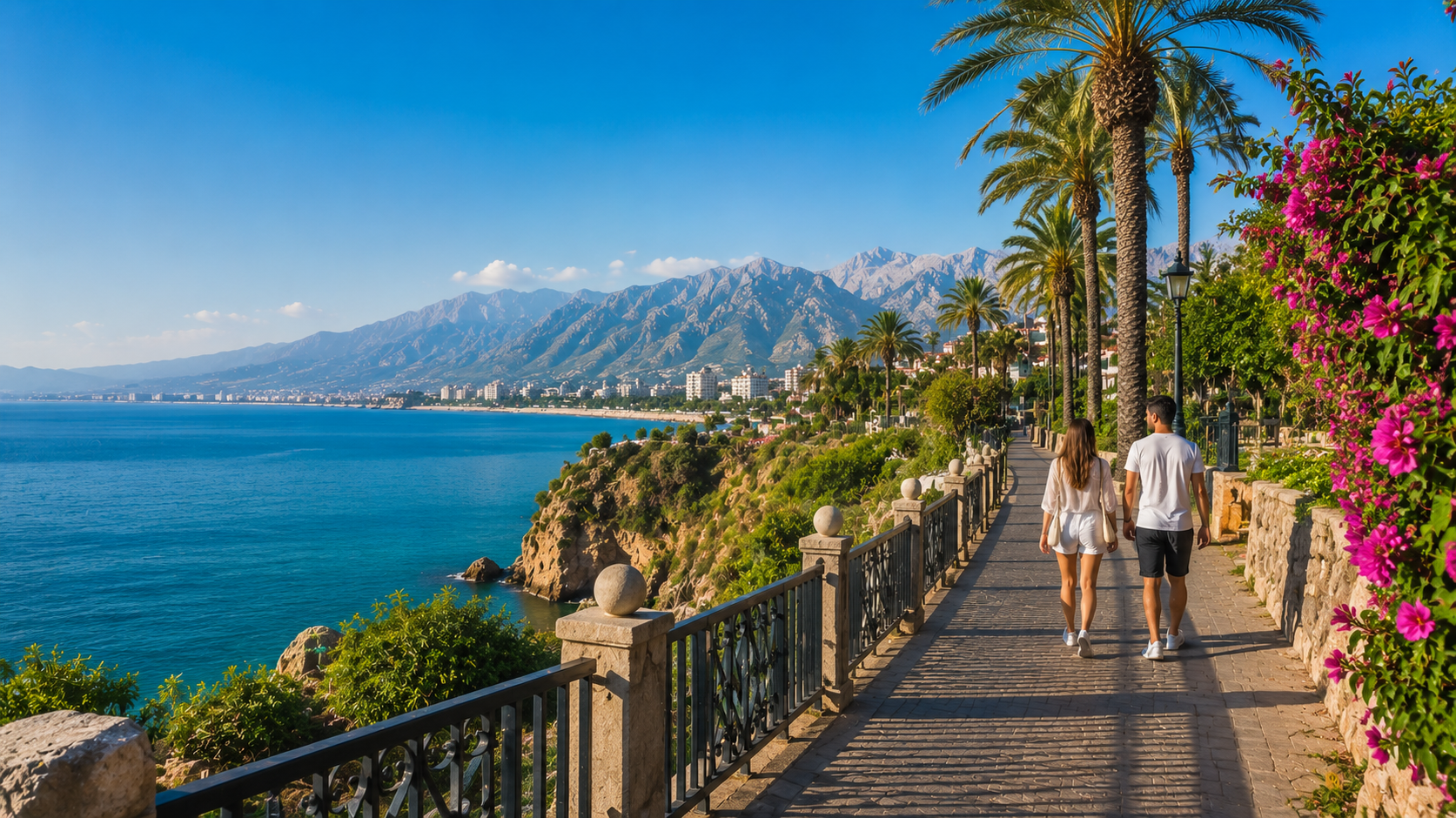
Seven kilometres of landscaped waterfront running west from the beach park, with palms, cafés and enough width that it never feels crowded outside August evenings.

The beach itself is sand and shingle, and the water stays notably cool year-round because an underground creek feeds into the sea here. Blue Flag certification covers the water quality; some stretches are free public beach and others operate as clubs with loungers.

The reason to walk this one is the geometry. The Mediterranean sits to the south, the Taurus range rises directly behind you to the north, the Kaleiçi cliffs close the view east and the Beydağları peaks anchor the west. Few city promenades anywhere put mountains and sea in the same frame this way.

Two to four kilometres out from the beach park and back is the comfortable version; the full seven one way takes ninety minutes to two hours, and the tram runs alongside for the return. Early morning has the sea breeze, late afternoon has the sunset, and winter middays sit at a pleasant eighteen to twenty-two degrees.

Düden: The Waterfalls

Two separate sites with the same name and entirely different characters, and most visitors see only one of them.

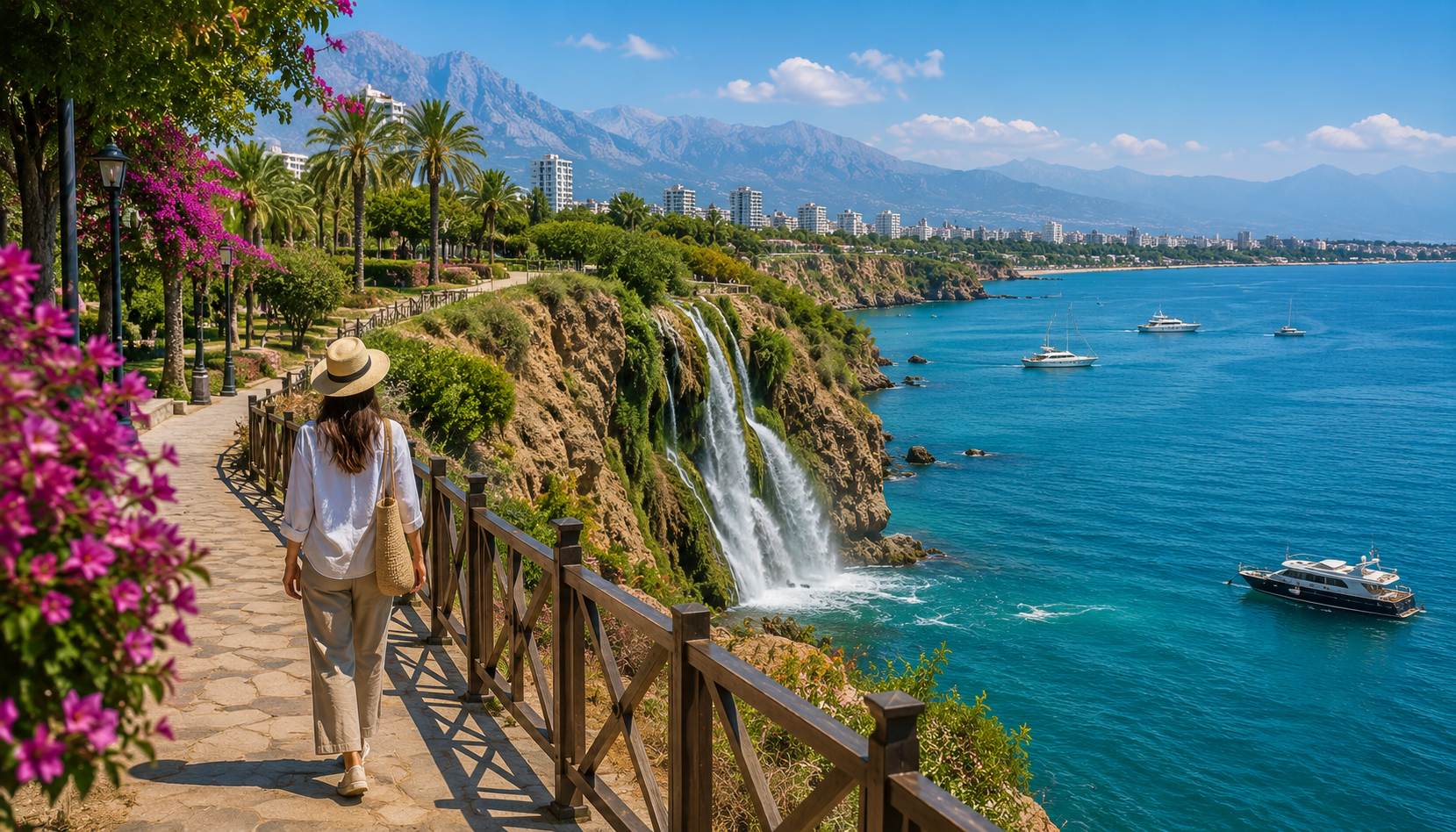
Lower DüdenUpper Düden
WhereLara district, coastal12 km north-east, Kepez district
What happensRiver drops 40 m straight into the seaFalls carve a gorge through rock
The experienceClifftop viewing park, free entryPath leads behind the water through a cave
Time needed30 – 60 minutes1.5 – 2 hours
Getting thereTaxi or bus from centreBus 35 – 50 min, taxi 100 – 150 TRY, entry 30 TRY

The walk-behind cave at the upper site is the one people remember. Standing on a path with a sheet of water falling past you is uncommon anywhere, and it is a fifteen-minute detour from a road most visitors never take.

Water volume peaks in spring after the mountain snow melts. Summer visits work as heat relief, winter ones bring the site almost to yourself. Combining both sites in one trip is worth a hire car.

Karaalıoğlu Park: The Sunset

A clifftop park on the southern edge of the old town, laid out with benches and paths, looking straight out over the Mediterranean with the mountains behind.

It is the best sunset position in the city and it costs nothing. The golden hour thirty to sixty minutes before the sun actually goes down is the part worth arriving for; the sun itself sets over open water with the Taurus range in silhouette.

The park also keeps a substantial community of cats, fed and looked after by locals, which is either a feature or a warning depending on your disposition.

The natural combination is the reason to plan around it: the old town from four until six, the park for sunset, dinner back in Kaleiçi afterwards. Three of the six atmospheres in one evening, entirely on foot, with a light jacket in winter because the clifftop wind is real.

The Marina and Republic Square

The historic harbour still works — fishing boats alongside yachts, preserved harbour walls you can walk along, and waterfront terraces above.

Boat trips leave from here: an hour of coastline for 300 to 500 lira, four hours with swimming for 600 to 1,000, or an evening dinner cruise for rather more. Seeing the cliffs and Lower Düden from the water is a genuinely different view of the city.

Above the harbour, Republic Square is the modern counterpart — fountains, wide paving, the Atatürk statue, and the junction point for the tram to Konyaaltı and buses east. Golden hour is the time for the harbour; mornings are quiet enough for coffee without company.

Lara: The Long Coast

Fifteen kilometres of sand running east from the lower waterfall towards Belek, and a different proposition from Konyaaltı in almost every respect.

It is pure sand rather than shingle, it sits ten to fifteen kilometres from the old town, and it is lined with resort hotels rather than city. Local walking traffic is thinner and the atmosphere more visitor-oriented.

It has one thing nowhere else in Antalya has: an eastern aspect, and therefore sunrise over the Mediterranean. Between half past five and seven, depending on season, the promenade is cool, empty and looking at something the rest of the city cannot see.

The best sections are the stretch near the waterfall and the public beach area, and a walkway generally runs behind the hotel beaches even where those are private.

When to Walk

Antalya has more than three hundred sunny days, which is a benefit for eight months of the year and a hazard for the other four.

SeasonTemperatureWhen to walkNotes
December – February10 – 18°C10:00 – 16:00All-day walking; occasional rainy spells
March – April15 – 25°C09:00 – 18:00The best season — wildflowers, falls at full volume
May20 – 28°CBefore 10:00, after 17:00Middays getting difficult
June – August25 – 40°CBefore 09:00, after 19:00Midday walking genuinely dangerous
September22 – 32°CBefore 10:00, after 18:00Still hot; sea at its warmest
October – November15 – 24°C09:00 – 18:00Excellent, and far fewer people

The summer warning is not a stylistic caution. Locals do not walk between noon and four in July and August, and neither should you. Heat stroke on a coastal promenade with no shade is a real outcome rather than a theoretical one.

The corollary is that winter is Antalya’s underrated season. Fifteen to eighteen degrees and sunshine through December and January makes for better walking than most European destinations manage at any point in the year, which is the same reason the city fills with long-stay visitors from northern Europe over those months.

Routes by Time Available

Five itineraries, each built around not repeating ground.

  • Thirty minutes. Hadrian’s Gate, the minaret, Karaalıoğlu Park for the view, out at Republic Square. The essence of the old town at speed.
  • Two hours. The same but properly — the full Kaleiçi wander, down to the marina, back up for sunset at the park.
  • Half a day. Kaleiçi from seven to ten, tram to the beach park, lunch on the seafront, three or four kilometres of promenade, tram back.
  • A full day. Morning old town, coffee at the harbour, two hours on the Konyaaltı promenade, lunch, taxi to the lower waterfall, sunset at the clifftop park, dinner back in Kaleiçi. Five of the six in one day.
  • Several days. Add the upper waterfall and its cave, a boat trip, Lara at sunrise, and day trips inland to the ancient sites at Perge, Aspendos and Termessos.

Walkability as a Living Consideration

For visitors this is a matter of enjoyment. For anyone weighing Antalya as somewhere to spend part or all of the year, it is something more concrete.

The walkable core is real but bounded. Kaleiçi, the marina, the clifftop park and the Konyaaltı promenade interconnect across five to eight kilometres entirely on foot, with a tram along the seafront. Beyond that radius, distances need transport — this is a walkable core inside a city of 2.7 million rather than a walkable city in the northern European sense.

Within that core, the daily arithmetic compares well with Mediterranean Europe: sea, mountains, historic centre and a functioning promenade all reachable without a car, in a climate that permits it for eight months and rewards it for four more. That combination is a substantial part of why the region draws long-stay residents, and the wider picture of what living here involves is set out in our analysis of Turkey as a retirement destination.

For comparison along the same coast, Alanya offers a different balance — smaller, cheaper, more compressed, with its own trade-offs, and our guide to Alanya covers them. Anyone moving from visiting to buying will want to understand what the title deed does and does not establish, which is set out in our guide to obtaining a tapu.

Frequently Asked Questions

Is Antalya a walkable city?

The core is — roughly five to eight kilometres linking the old town, the marina, the clifftop park and the beach promenade. Beyond that, tram, bus or taxi. It is a walkable core within a large city rather than a walkable city throughout.

How safe is walking there?

Very, in all the areas covered here, day and evening. Ordinary precautions apply — pickpockets in the busier old town lanes, and some care near unfenced clifftops after dark.

Can I walk between the areas or do I need transport?

Kaleiçi, the park and the marina are all within one or two kilometres of each other. The old town to Konyaaltı is a thirty to forty minute walk or a fifteen minute tram ride. Both waterfalls need transport.

Where should I stay for walking?

Kaleiçi and its immediate surroundings, which put the old town, harbour and clifftop park within minutes. Konyaaltı suits beach walking; Lara has the sand but a long journey back to the historic centre.

Are there guided walks?

Yes, both scheduled group tours of three to four hours and private guides for half a day, bookable through hotels or the usual platforms. Tip-based free walking tours also operate.

Will English be enough?

In the old town, the hotels and the seafront cafés, yes. Less so in residential neighbourhoods and around the upper waterfall, though nothing in this guide requires Turkish.

Key Points to Remember

  • Six atmospheres, one radius. Roman streets, a beach promenade, two waterfalls, a clifftop sunset, a working harbour and a long eastern coast, all within five to eight kilometres.
  • The hour matters more than the route. Early morning or after six from June to September; all day from November to March.
  • Do not walk at midday in summer. Locals stay in between noon and four in July and August for a reason.
  • Lara faces east. The only place in the city with sunrise over the sea, and empty when it happens.
  • Winter is the underrated season. Fifteen to eighteen degrees and sunshine, with the falls at volume and the streets to yourself.

The Walkable Radius Is the Thing Worth Buying Into

Visitors judge Antalya by its beaches and long-stay residents judge it by whether the day works without a car. Those are different questions, and the second one has a fairly precise answer: inside the five to eight kilometre core, it works; outside it, the city behaves like any other city of two and a half million. DDA Real Estate is a real estate agency in Turkey. We work across Antalya and the wider coast, from Kaleiçi and Konyaaltı to Alanya and Mersin, and for buyers weighing a district we start from how far the daily routine actually reaches on foot.

Explore our listings in Turkey and get in touch: we will match properties to the way you intend to use the city, tell you plainly where the walkable radius ends, and arrange viewings at the hours when a neighbourhood shows what it is really like.

Popular
5 June 4152456 views
Dubai Rent Prices 2025: Average Apartment Rental Costs in Dubai Dubai's rental market continues its upward climb in 2025, driven by population growth and limited new supply, pushing average prices up by 10%
#Blog DDA
2 July 2382408 views
DLD Fees in Dubai: Everything You Need to Know Buying property in Dubai? Don't let hidden fees surprise you! Our essential guide breaks down ALL Dubai Land Department (DLD) fees
#Blog DDA
23 November 1710576 views
How to Buy a SIM Card in Turkey in 2026: Prices, IMEI Registration, eSIM Options, and Best Mobile Operators Overview of mobile operators, available types of SIM cards, and home Internet providers
#Blog DDA
5 July 1702575 views
How Much is the Real Estate Agent Commission in Dubai? Find out how much real estate agent commission costs when buying property in Dubai.
#Blog DDA
5 February 1394694 view
How Foreigners Can Own Property in Bali: Understanding PT PMA (2025) Foreigners can't own freehold land in Bali, but a PT PMA (foreign-owned company) allows secure property ownership under Hak Guna Bangunan (HGB) or Hak Pakai (HP) rights
#Blog DDA
28 August 1145844 view
Oqood vs Title Deed in Dubai: Key Differences You Must Know Buying property off-plan in Dubai? Oqood registration is mandatory to secure your ownership rights.
#Blog DDA