Off-plan properties
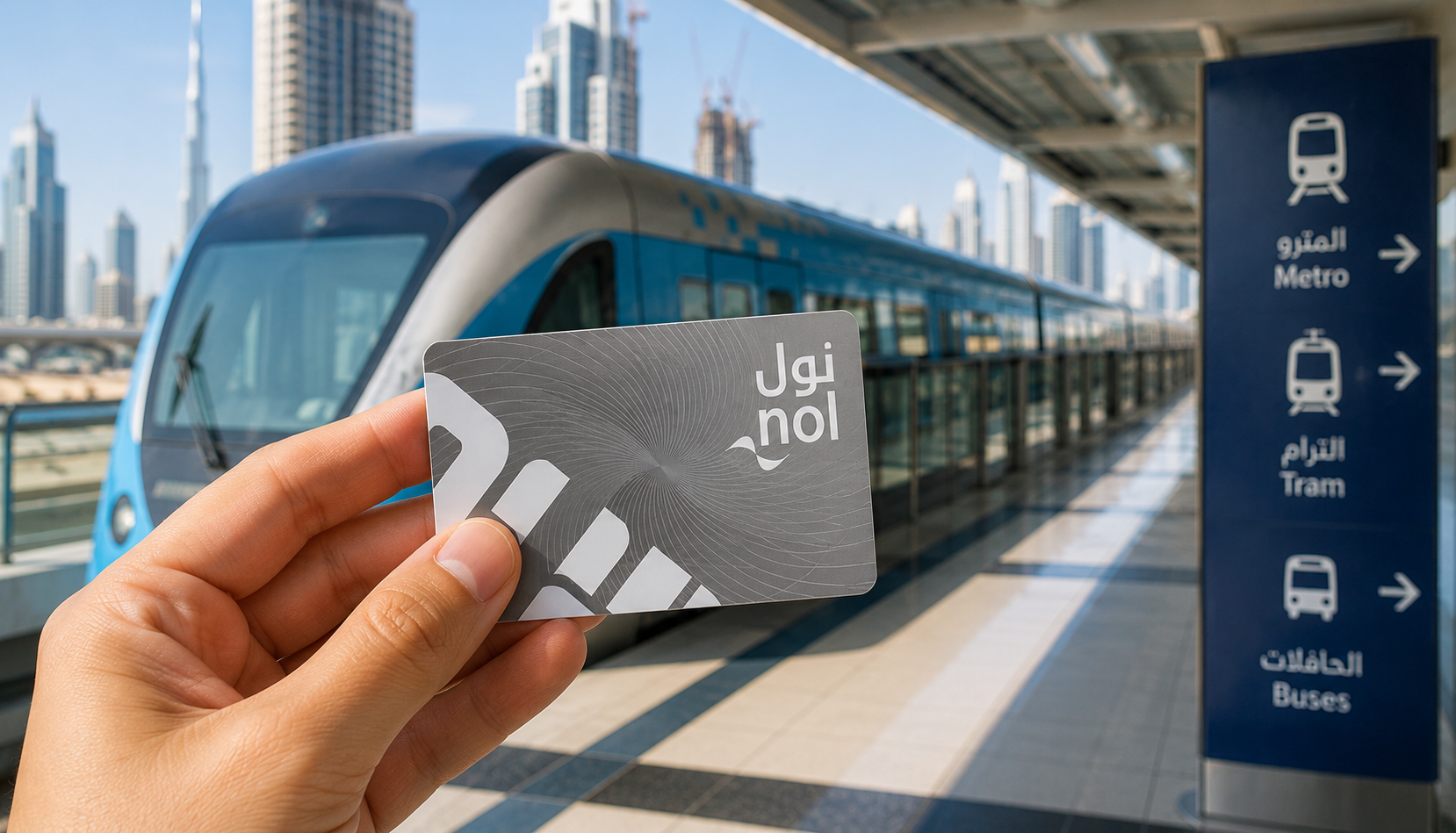
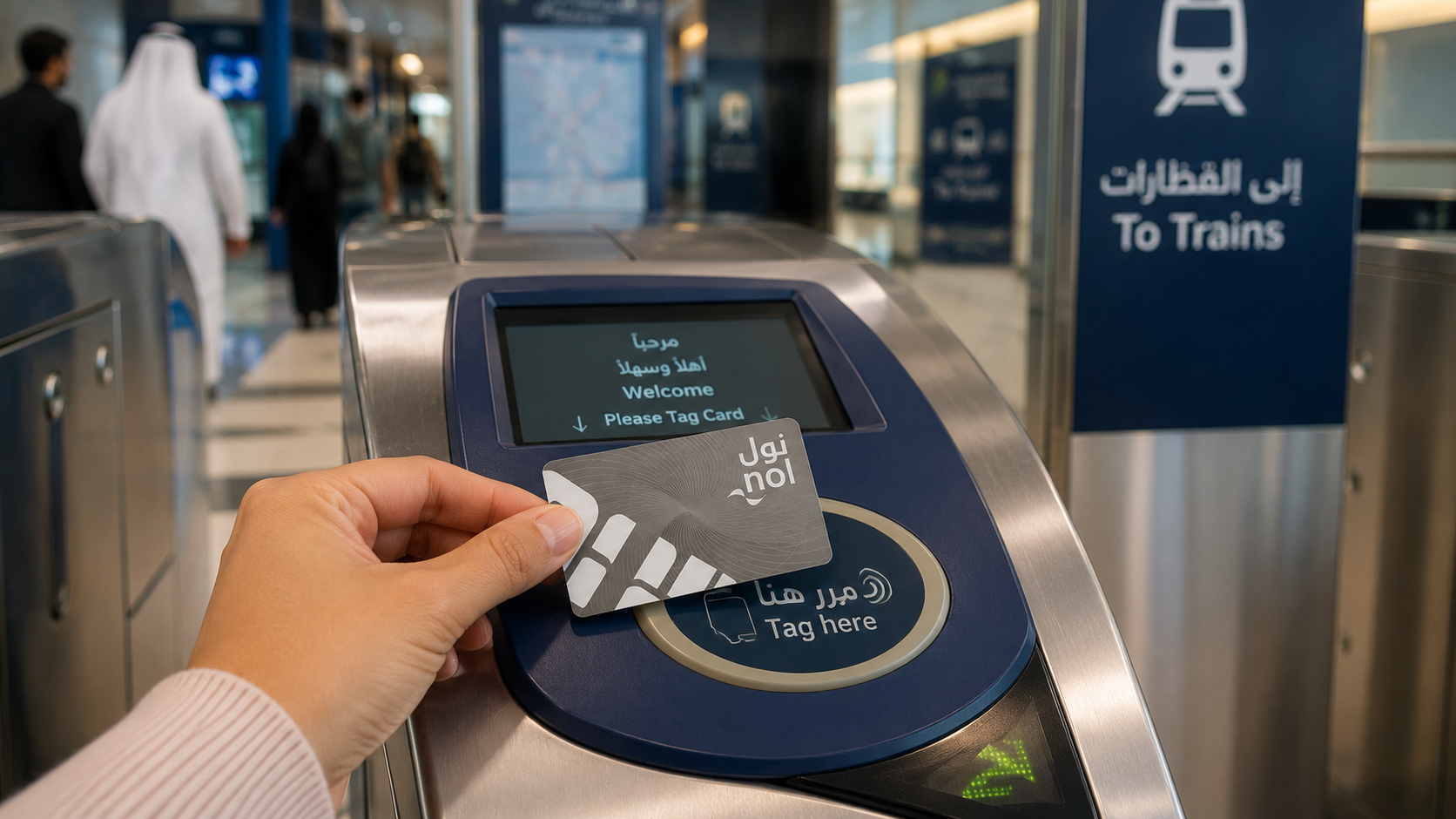
Cash is not accepted on any public transport in Dubai. Without a Nol card you do not board the metro, the tram, a bus or an abra — which makes it the first thing most new arrivals need and the first thing most of them buy incorrectly.
There are five card types priced between AED 2 and AED 70, and the right one depends entirely on how you travel rather than on which sounds better. A three-day visitor and a daily commuter from Jumeirah Village Circle to the financial district need genuinely different cards, and choosing wrong costs a few hundred dirhams over the card’s five-year life.
This guide sets out the five types with current prices, the 2026 fare structure and its daily cap, which card suits which travel pattern, where to buy and top up, how tapping works across each transport mode, and what to do when something goes wrong. Fares and prices reflect August 2026 and are periodically revised — check before relying on a specific figure.
Two of these are the practical answer for almost everyone; the other three exist for specific circumstances.
| Card | Price | Includes | Validity | Suits |
|---|---|---|---|---|
| Silver | AED 25 | AED 19 credit | 5 years | Most users — residents and visitors staying four days or more |
| Gold | AED 25 | AED 19 credit | 5 years | Gold Class cabin access, at double the fare |
| Blue, personal | AED 70 | AED 20 credit | 5 years, registered | Students, over-60s and People of Determination |
| Red ticket | AED 2 | Pay per trip | 90 days | Visitors staying one to three days |
| Nol Travel | From AED 20 | Varies | 5 years | Attraction-focused tourism |
The Silver card is the default, and the pricing is less imposing than it looks: AED 19 of the AED 25 is travel credit, so the card itself effectively costs AED 6. It works across every mode at standard fares and remains valid for five years, which makes it the right answer for any stay beyond a long weekend.
Gold costs the same to buy but charges double per journey in exchange for access to a dedicated, less crowded carriage on the metro and tram. Whether that is worth it is a question about peak-hour tolerance rather than economics — for a daily commuter on a busy line it often is; for occasional use it rarely is.
The Blue card is the one that repays its higher price fastest for those eligible. The AED 70 breaks down as AED 50 for the card and AED 20 of credit, and it unlocks a 50 per cent discount on every fare for students aged 5 to 18, residents over 60 and People of Determination. It is registered to a named person, which has a second advantage: if it is lost, the balance can be recovered. Anonymous cards hold up to AED 1,000; registered ones up to AED 5,000.
Dubai is divided into seven zones and fares depend on how many you cross, with one zone covering roughly three kilometres.
| Card | One zone | Two zones | Three or more |
|---|---|---|---|
| Silver | AED 3.00 | AED 5.00 | AED 7.50 |
| Gold | AED 6.00 | AED 10.00 | AED 15.00 |
| Blue | AED 1.50 | AED 2.50 | AED 3.75 |
| Red ticket | AED 4.00 | AED 6.00 | AED 8.50 |
The single most useful thing to know is the daily cap: once a Silver or Blue card has spent AED 14 in one day, everything further is free until midnight. That turns a day of heavy cross-city travel into a fixed cost and makes the metro considerably cheaper than most visitors expect.
Matching the card to an actual travel pattern is the whole decision, and five patterns cover almost everyone.
A visitor staying one to three days
The red ticket, at AED 2, is designed for exactly this. Across six to ten journeys the total transport spend for a short trip lands somewhere around AED 40 to 60, and there is no plastic card left over afterwards. Buy them at any station vending machine, which operate around the clock. If the itinerary is heavy on paid attractions rather than transport, the Nol Travel card is worth comparing.
A visitor staying four days or more
Silver takes over here. Because AED 19 of the purchase price is credit, the real cost of the card is AED 6, and the lower per-journey fares recover that within a handful of trips. Top up in AED 20 to 50 increments rather than small amounts, and the card can be passed on to someone else afterwards rather than discarded.
A daily commuter
Silver covers everything a commuter needs, with the daily cap doing the heavy lifting: AED 14 a day across 22 working days sets a theoretical ceiling of about AED 308 a month, and most commuters land nearer AED 200 to 250 because not every day hits the cap. Gold is the upgrade to consider if your line is genuinely uncomfortable at peak hours — the premium buys space rather than speed. It is also worth asking your employer whether transport is covered; some do.
A student, senior or Person of Determination
Blue wins on arithmetic every time for anyone eligible. A student commuting daily pays roughly AED 6 to 10 on Silver against AED 3 to 5 on Blue, saving AED 60 to 100 a month and recovering the card fee within one or two. Registration requires valid identification and proof of eligibility, and the card cannot be transferred to anyone else — which is also what makes the balance recoverable if it is lost.
A family
Every passenger needs their own card; a single card cannot be tapped twice at a gate. Children under five travel free and need nothing. For a family of four with two school-age children, the sensible combination is two Silver cards and two Blue cards, an initial outlay of around AED 190 that the Blue discounts recover within two or three months. A full weekend of family metro travel, with adults capped at AED 14 and children at half that, comes to roughly AED 126 across three days.
Availability is not a constraint — the card is sold in more places than almost anything else in the city.
Documentation is only required for the Blue card, which needs valid identification plus proof of eligibility. Silver, Gold and red tickets are sold anonymously with no paperwork at all.
Topping up works through the same channels plus two worth knowing about. The official app credits a card within seconds from AED 10 and shows the balance in real time, which makes it the practical default for residents. And automatic top-up can be linked to a bank card so the balance replenishes when it falls below a threshold — the single best way to avoid the barrier-refusal problem. One caution: top-ups made through the website can take a few minutes to activate, and the card usually needs to be tapped at a gate or parking machine to finalise them.
One card covers every mode, but the tapping rules differ slightly and getting them wrong costs money.
| Mode | How it works | Note |
|---|---|---|
| Metro | Tap in at entry, tap out at exit | Fare calculated from zones travelled; lines interchange at two stations |
| Tram | Tap in and out at the platform gate | Connects with the metro at two interchange stations |
| Bus | Tap on boarding, tap again on leaving | The second tap matters when crossing into another zone |
| Water bus and abra | Tap at the boarding gate | Typically AED 2 to 3 per crossing |
| Public parking | Tap at the meter | Works at parking managed by the transport authority |
| Retail | Tap to pay | Accepted for small purchases at participating outlets |
Metro and tram run from around five in the morning until midnight, with variations at weekends and on holidays. The rule that catches people out is the exit tap: forget it and the system charges the maximum zone fare of AED 7.50, and that charge cannot be reversed.
The card is only as useful as the network behind it, and that network is narrower than a map suggests — excellent along two corridors and largely absent elsewhere. Knowing which side of that line a neighbourhood falls on matters more than the fare table.
That last point is the practical one for anyone choosing where to live. More than 55 stations sounds comprehensive, but the coverage follows two lines rather than spreading across the city, and a neighbourhood that looks central on a map can be entirely car-dependent in practice.
Most problems are minor and resolvable at a station; two are not, and both relate to whether the card is registered.
For residents, the Nol card and the housing decision are connected more tightly than most people realise when they arrive.
Property within about ten minutes’ walk of a metro station typically commands 10 to 20 per cent higher rent than comparable stock further out. That premium looks like a straightforward cost until it is set against what it replaces: for a household that would otherwise run a car for commuting, the fuel, tolls, parking and insurance frequently exceed the rental difference, and the daily time saved is on top of that. It is one of the clearest cases where a location premium is genuinely bought rather than merely paid, and it sits alongside the other factors we cover in our note on why location matters in real estate.
The calculation flips for households that need a car regardless — for school runs, for work outside the metro corridor, or simply for the shape of the week. In those cases paying the station premium buys something you will not use, and the money is better spent on space. This is worth working through before signing rather than after, and it belongs in the same conversation as the other lease decisions in our guide to renting an apartment in Dubai as an expat.
For visitors, the practical value of the card is that most of what you came to see sits on or near the two metro lines — the malls, the marina, the beach district and the old creek quarters are all reachable without ever hailing a taxi. Where to point yourself once you are there is covered in our guide to the best areas in Dubai for dining and entertainment.
Can two people share one card?
No. Fares are charged per person, and a gate will not accept the same card twice in succession. Every traveller needs their own.
Do children need a card?
Under-fives travel free with no card. Children aged 5 to 18 qualify for the registered Blue card at half fare, or can travel on a Silver card at the full rate.
What happens if I do not use the card for months?
Nothing. There are no monthly fees, the balance remains intact and the card stays valid for five years from purchase.
Does it work in Abu Dhabi or Sharjah?
No. It is specific to Dubai’s transport network. The other emirates run separate systems with their own cards.
How do I check the balance?
Fastest through the official app. Otherwise the gate display shows it as you tap, and station machines and counters will read the card.
Is Gold worth double the fare?
Only if you travel at peak hours on a busy line and value the space. The cabin is less crowded with better seating, but it does not travel faster and the premium applies to every single journey.
Can I use my phone instead of a card?
On supported devices, yes — the card can be added to a digital wallet and used directly at the gates without the physical card.
Ten minutes from a metro station costs 10 to 20 per cent more in rent. Whether that is money well spent depends on a household’s actual routine — for a car-free commuter it is usually a saving, and for a family that drives anyway it is usually not. DDA Real Estate is a real estate agency in the UAE. We work across Dubai and the wider Emirates, and we price the commute into the shortlist: what a property costs, what getting to work from it costs, and how those two numbers combine over a year.
Explore our UAE listings and get in touch: we will compare options on total cost rather than rent alone, show you what the same budget buys inside and outside the metro corridor, and set out which trade-off fits the way your household actually moves around the city.