Waste and Recycling in Thailand: How It Works
66 2 026-1660
day and night
Bangkok
EN
$
ft²
Other articles

Waste and Recycling in Thailand: Who Actually Sorts It

Nikita Sokolov The author of the article, the Broker
#Blog DDA
23 September 3339 views

Arrivals look for the recycling bins and conclude there is no recycling here. There is a great deal of it, but almost none of it happens in bins — it is done by people who make a living from what has value in your rubbish.

Municipal collection is largely mixed. The sorting happens before and after it: collectors on carts, building staff, and buy-back shops that weigh material and pay cash for it.

So recycling properly here does not mean finding the right bin. It means making your waste easy for that system to use. Below is what has value, what does not, and how the arrangements differ between a condominium, a house and a village. Practices vary by municipality, so check what applies locally.

What has value and what does not

This is the whole practical core. Material that a buy-back shop will weigh gets recycled; material that will not gets buried:

MaterialValue to collectorsWhat to do
Aluminium cansHighest by weightRinse, keep separate, never crush flat
PET bottlesGood, if clean and dryEmpty, dry, caps off
Cardboard and paperModest, by weightKeep dry, flatten and tie
Glass bottlesVaries, some are returnableKeep whole, not broken
Mixed and soft plasticsLittle or noneReduce these at source
Food-soiled packagingNoneOrdinary rubbish

Contamination is what kills value. A rinsed bottle is recycled and the same bottle with sauce in it is not, which makes rinsing the single most useful habit.

The informal system and how to help it

Collectors work fixed rounds, often early in the morning, and they take what they can sell. Building cleaners do the same with what passes through their hands.

If you put valuable material into a separate bag beside the bin rather than inside it, it is taken within hours and never reaches landfill. A clear bag of clean cans set beside the rubbish is a complete recycling system, and it costs you nothing.

Buy-back shops

Most neighbourhoods have a yard that buys recyclable material by weight. Anyone can sell to them, including households.

For a household the money is negligible, but the shop is useful for the things ordinary collection does not take: quantities of cardboard after a move, metal, old appliances. For a house move or a renovation, a buy-back yard solves the disposal problem for free and often collects.

What a condominium arrangement looks like

In a building the waste is handled for you, which is convenient and also the reason most residents never think about it.

There is usually a chute or a room per floor, staff who consolidate, and a contract managed by the building. Whether any separation happens depends entirely on that building's practice. The service sits inside the monthly charges described in the breakdown of electricity, water and internet bills. Ask whether the building separates anything, because many do it well and some do not at all.

A house is a different arrangement

With a house you deal with the municipality directly. Collection days are fixed, a bin or bag goes out at a set point, and a modest fee is paid to the local office.

New arrivals sometimes discover that the previous occupant never registered, so nothing is collected. That difference between building living and house living runs through many everyday arrangements, as the comparison of a condominium and a villa sets out. Ask the neighbours which day the truck comes and where the bin goes — that is faster than any office.

Rural areas may have no collection

Outside towns there may be no municipal service at all. Households burn what burns and bury or dump the rest, and this is normal rather than exceptional.

Anyone taking a rural property should ask what happens to waste before signing, along with the other self-provided services covered in the account of living off-grid in Thailand. Private collection can usually be arranged for a monthly fee, and it is worth arranging rather than adopting the local habit.

Burning is a neighbourhood issue

Garden waste and household rubbish are burned widely, especially in the dry months, and the smoke sits low in the evening.

For a buyer this is worth noticing at a viewing, because a lane where everyone burns in the evening is a different place to live from one where nobody does. Visit a shortlisted address at dusk, not only at midday. It is also when you learn what the neighbours cook and how the dogs behave.

The bottled water problem

Most households here drink bottled water, and for a family that is a large volume of plastic every week. It is the single biggest waste stream a foreign resident generates.

Two alternatives cut it almost entirely: the large returnable jugs delivered to the door, and a home filter. The trade-offs are set out in the guide to drinking water in Thailand. Switching to returnable jugs removes more plastic than any amount of careful sorting adds.

Reducing what arrives in the first place

Thai retail is generous with packaging, and refusing it is easy once you know the habit rather than the phrase:

  • Carry a cloth bag — shops give one plastic bag per few items otherwise
  • Refuse the extra bag for a single drink or a single item
  • Bring a container to a market stall or a food shop
  • Say no to the straw and the plastic spoon with takeaway
  • Buy from markets rather than convenience stores where you can
  • Use a refillable bottle and the water machines on most streets

Bag charges at larger chains have already changed habits considerably, and nobody is surprised when a customer declines one.

Markets and street food

Eating out is normal here and cheap, and it is also where most household plastic comes from. A single takeaway meal can arrive in a bag, a box, a sauce cup, a spoon and another bag.

Bringing a container to a familiar stall works and is common enough that vendors are not surprised. Eating in rather than taking away removes the packaging entirely, which is the simplest change available and costs nothing.

Moving out

Leaving a property generates more waste in a week than the previous year did, and ordinary collection will not absorb it.

Furniture and appliances are worth giving away or selling locally, and a buy-back yard will usually collect metal and cardboard. Arrange removal a week before you leave, not on the last day, because the cost of leaving a pile behind is usually taken from your deposit.

Things that need special handling

A few categories should not go into ordinary rubbish, and each has its own route:

  • Batteries and electronics, which some shops and chains collect
  • Fluorescent tubes and bulbs, handled separately by municipalities
  • Paint, solvents and engine oil, taken back by garages and hardware shops
  • Medicines, which pharmacies and hospitals will usually accept
  • Large appliances, which buy-back yards take for their metal
  • Construction debris, which needs a paid removal service

Construction debris is the one that catches owners out, because a renovation produces more of it than any normal collection will take.

Food waste

It is heavy, it smells within hours in this climate, and it attracts animals and insects faster than anywhere temperate.

Keep food waste in a sealed bag and put it out on collection day, not before. In a house, a bin with a latching lid is not a refinement but a requirement, because dogs and monitor lizards open the others.

Composting in this climate

For a house with a garden, composting works quickly here — heat and humidity break material down in weeks rather than months.

It also attracts wildlife if it is open and unmanaged. Use a closed composter rather than a heap, keep meat and fish out of it, and the garden benefits from the result within a season.

Where it all goes

Most mixed waste ends in landfill, and some regions incinerate. Capacity is under pressure, particularly on islands where everything has to be shipped or buried in a small area.

On a small island, reducing volume matters far more than sorting it, because there is nowhere for the residue to go and the cost of moving it is real.

Questions we hear most

Is there recycling in Thailand?

A great deal, but it happens through collectors and buy-back shops rather than through bins. Municipal collection is largely mixed, and material with resale value is extracted by people who sell it by weight. Your job is to make that material easy to take.

What should I separate?

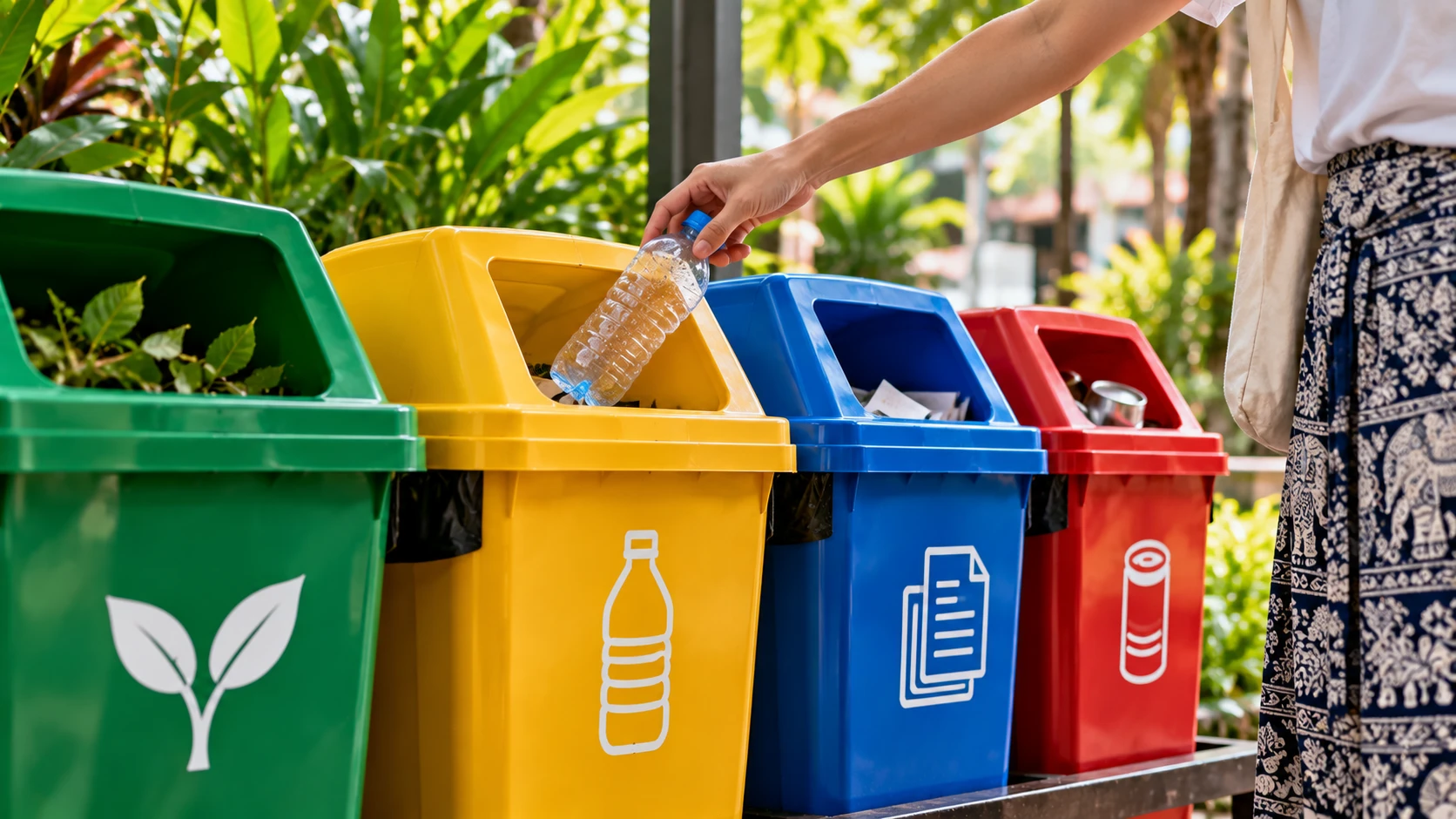
Aluminium cans first, then clean dry PET bottles, then cardboard kept dry. Rinse anything that held food or drink, because contamination is what removes the value. Put it in a clear bag beside the bin rather than inside it.

Who collects household waste?

In a building, the management arranges it and the cost sits in your monthly charges. In a house, the municipality collects on fixed days for a modest fee, and you may need to register. Some rural areas have no service at all.

What do I do with electronics and batteries?

Not the ordinary bin. Some shops and chains collect batteries and small electronics, municipalities handle bulbs and tubes, garages take engine oil, and buy-back yards will take large appliances for the metal.

How do I cut the plastic from drinking water?

Switch to the large returnable jugs delivered to the door, or install a home filter. For most households this removes more plastic than any amount of careful sorting adds, because bottled water is the largest waste stream.

Key takeaways

  • Recycling happens through people — collectors and buy-back shops, not bins
  • Rinsing is the key habit — contamination removes the value
  • A bag beside the bin works — valuable material is taken within hours
  • Arrangements differ by property type — building, house or no service at all
  • Returnable water jugs beat sorting — they remove the biggest stream

Ask what happens to the rubbish before you sign

It is a small question that reveals how an address is actually run, and nobody asks it at a viewing. DDA Real Estate is a real estate agency working in Thailand, and this belongs to the practical list we check with water, power and access: who collects, on which days, whether the building separates anything, and whether a rural address has a service at all or the neighbours simply burn.

Look at our offers in Thailand and leave a request: we will set out how each property handles the everyday things, and be straightforward about the addresses where you would be arranging the basics yourself.

Popular
5 June 4322367 views
Dubai Rent Prices 2025: Average Apartment Rental Costs in Dubai Dubai's rental market continues its upward climb in 2025, driven by population growth and limited new supply, pushing average prices up by 10%
#Blog DDA
2 July 2485224 view
DLD Fees in Dubai: Everything You Need to Know Buying property in Dubai? Don't let hidden fees surprise you! Our essential guide breaks down ALL Dubai Land Department (DLD) fees
#Blog DDA
23 November 1947267 views
How to Buy a SIM Card in Turkey in 2026: Prices, IMEI Registration, eSIM Options, and Best Mobile Operators Overview of mobile operators, available types of SIM cards, and home Internet providers
#Blog DDA
5 July 1816605 views
How Much is the Real Estate Agent Commission in Dubai? Find out how much real estate agent commission costs when buying property in Dubai.
#Blog DDA
5 February 1474074 view
How Foreigners Can Own Property in Bali: Understanding PT PMA (2025) Foreigners can't own freehold land in Bali, but a PT PMA (foreign-owned company) allows secure property ownership under Hak Guna Bangunan (HGB) or Hak Pakai (HP) rights
#Blog DDA
28 August 1239273 view
Oqood vs Title Deed in Dubai: Key Differences You Must Know Buying property off-plan in Dubai? Oqood registration is mandatory to secure your ownership rights.
#Blog DDA