

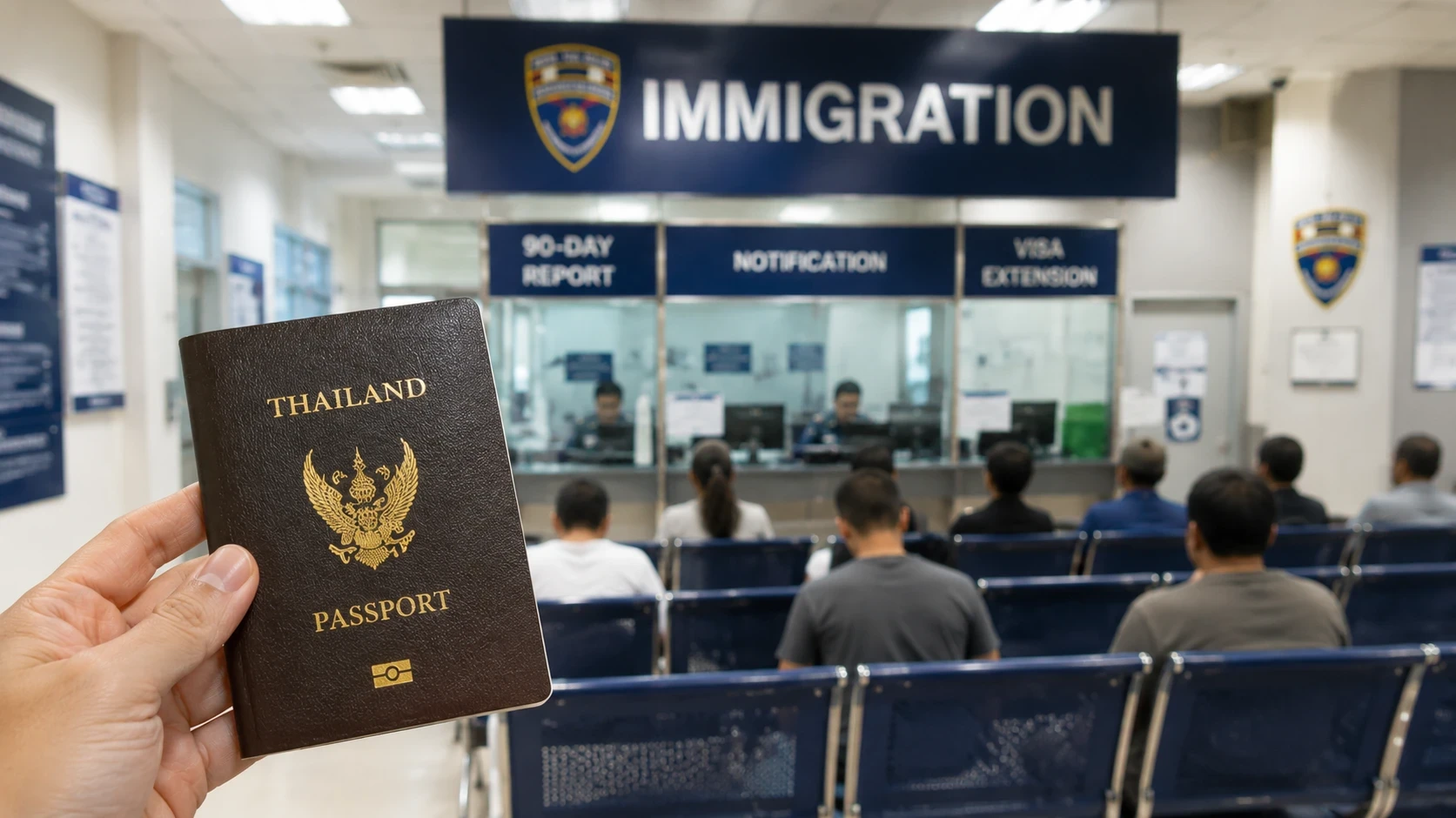

90-Day Reporting in Thailand: A Clear Guide
66 2 026-1660
day and night
Pattaya
EN
$
ft²
Other articles

What Is the “90-Day Reporting” Rule? A Clear Guide for Long-Term Residents

Maxim Shramko The author of the article, the Broker
#Blog DDA
28 August 3213 views

Start with what it does not do. The ninety-day report extends nothing and permits nothing. It tells immigration where you are living. That is the whole purpose of it.

The confusion is common and expensive. People file every ninety days, feel compliant, and let their permission to stay expire — because the report and the extension are separate obligations that happen to sit at the same office.

Below is who has to file, how the ninety days are counted, what happens when you leave the country, the ways to submit and what a missed report actually costs. Procedures and online systems change, so confirm the current position with your own immigration office.

Three obligations people merge

Separating them is most of the battle, because each has its own form, its own trigger and its own consequence:

ObligationWhat it doesWho files
Extension of stayAdds days to your permissionYou, before it expires
90-day reportConfirms your current addressYou, every 90 days of continuous stay
Address notificationReports that a foreigner is staying at an addressThe landlord or hotel, within 24 hours

Filing the report does not renew your stay, and renewing your stay does not replace the report. They run on separate clocks and are checked separately.

Who has to file

The rule applies to foreigners staying in Thailand continuously for more than ninety days on a long-stay permission — retirement, marriage, work, education, and similar categories.

Tourists almost never reach it, because a tourist stay rarely runs ninety continuous days without a departure. If you are on a short-stay category and have not left the country in three months, check whether it now applies to you.

How the ninety days are counted

This is where people slip. The clock does not run from a calendar quarter or from the date your visa was issued.

It runs from your last entry into Thailand, or from your last accepted report, whichever is more recent. Every departure and re-entry resets it to zero. Fly to Singapore for a weekend and your next report is due ninety days after you come back, not ninety days after the last one.

The window for filing

You cannot file whenever you like. There is a window around the due date, opening some days before and closing a few days after.

Arriving too early means being sent away; arriving too late means a fine. Put the due date in a calendar with a reminder two weeks ahead, because nothing in daily life will remind you and the interval is long enough to forget entirely.

Ways to file

Several routes exist and they are not equally reliable, so most residents end up using more than one over time:

  • In person — always works, takes a morning, and gives you a stamped receipt on the spot
  • Online — convenient when it works, but the system has a history of rejecting valid submissions
  • By post — send in advance and keep proof of posting, since delivery time counts against your window
  • By an authorised representative — with a signed authorisation and copies of your documents
  • Through an agent — costs a fee and saves a morning

Treat the online route as an attempt rather than a completion. Check that it was accepted, and if there is no confirmation, go in person rather than assuming it went through.

What to bring

The set is small, and an incomplete one means a second visit on another day:

  • Passport with the current permission to stay
  • Copies of the photo page, current visa and entry stamp
  • The departure card if you still hold one
  • The completed report form
  • The receipt slip from your previous report
  • Proof of your address if the office asks for it

Sign every copy, and keep the previous receipt somewhere permanent. It is the document that proves the last report happened.

The receipt is the point

You leave with a small slip stapled into your passport showing the date of the next report. That slip is your evidence and your reminder in one.

Photograph it the moment you receive it. If the passport is replaced, the slip goes with it, and reconstructing the history afterwards is tedious — which is one of several reasons the process around a lost passport reaches further than people expect. Keep the last two receipts, not just the current one.

What a missed report costs

Missing it is an administrative matter rather than a status problem. A fine applies, and it is charged when you next appear — at your late report, at an extension, or at the airport.

A missed report does not make you an overstayer. Your permission to stay is unaffected, and the two are not connected. Repeatedly missing it is a different matter, because a pattern of non-compliance sits in your file and gets noticed when you apply for something else.

If you realise you are late

Go and file it. Do not wait for the next cycle and do not hope it will be missed.

Filing late costs a fine and closes the matter. Not filing at all leaves an open gap that surfaces at the worst possible moment, usually during an extension application. Bring the fine in cash and expect the visit to take longer than a routine one.

The address notification is not yours

A separate obligation sits on the person housing you: a hotel, a landlord or a house owner must notify immigration that a foreigner is staying at their address, within a day of arrival.

Hotels do it automatically. Private landlords often do not, and the gap surfaces when you need a document tied to your address. How that residence notification works is worth understanding even though it is not your form to file. Ask your landlord on the first day whether they have filed it, and again after any trip abroad.

Travelling and the reset

Because departure resets the count, frequent travellers rarely file at all. Someone leaving the country every couple of months may never reach ninety continuous days.

But the reset only helps if you actually left, and the record of entries is what counts rather than your memory of them. If you are unsure when your last entry was, the stamp in the passport settles it before the office does.

Changing address between reports

If you move house, the address on file is no longer correct, and the report exists precisely to keep it current. A move is normally notified rather than waited on.

In practice this often means a new address notification from the new landlord and a mention at your next report. Who handles that notification differs between a managed building and a private house, which is one of the quieter differences between a condominium and a villa. Do not let a move sit unreported until the next cycle — an address mismatch is the sort of small inconsistency that complicates a later application.

Keeping track without thinking about it

The interval is long enough that memory will not do the work. A small system prevents almost every late filing:

  • Calendar entry on the due date, with a reminder two weeks before
  • A second reminder on the day the window opens
  • Photographs of every receipt, stored where you can find them
  • A note of your last entry date, updated after each trip
  • Copies of the passport pages kept ready, so the visit needs no preparation

The first report is the awkward one

Nobody tells you it is coming. There is no letter, no message and no reminder from anyone official. New residents typically discover the obligation from another foreigner, often after the window has already opened.

Work out your first due date on the day you receive a long-stay permission. Count ninety days from your entry, put it in the calendar, and the rest of the cycles look after themselves. The first one is the only one you have to catch without a receipt telling you when.

What it is not evidence of

The receipt gets used as an all-purpose document by people who need to prove something about their residence. It rarely works for that.

It is not proof of address for a bank, not a residence certificate for a driving licence or a vehicle registration, and not evidence of your right to be here. Those are separate documents issued for separate purposes. The slip proves that a report was filed, and nothing beyond that.

Why offices differ

Two residents in different provinces will describe different procedures, and both will be right. Offices vary in whether they use appointments, which documents they ask for and how they handle the online system.

The rule is national; the practice is local. Ask people who file at your office rather than reading forums about someone else's. The general rhythm of dealing with these offices is set out in the survival guide to Thai bureaucracy.

Questions we hear most

Does the report extend my stay?

No. It confirms your address and nothing more. Your permission to stay expires on its own date regardless of how faithfully you report, and letting that happen while filing on time is a common and avoidable mistake.

Do I still report if I leave the country?

Leaving resets the count, so the next report falls ninety days after your return. Frequent travellers often never reach the threshold. What matters is the record of entries, not your recollection of them.

What if I file late?

A fine applies and the matter closes. It does not affect your permission to stay and does not make you an overstayer. Go and file rather than waiting for the next cycle, since an open gap surfaces during your next application.

Can someone file for me?

Yes, with a signed authorisation and copies of your documents, or through an agent for a fee. Post is also possible if sent early enough. Whichever route you use, make sure a receipt comes back to you.

Is the online system reliable?

It works for many people and rejects valid submissions for others without a clear reason. Treat it as an attempt, verify that it was accepted, and go in person if no confirmation arrives before your window closes.

Key takeaways

  • It extends nothing — the report confirms your address and only that
  • The clock runs from your last entry — every departure resets it to zero
  • There is a window, not a deadline — too early is turned away, too late is fined
  • The receipt is the evidence — photograph it and keep the previous one
  • A missed report is not an overstay — a fine, not a status problem

Filing on time and still losing your status is the classic mistake

It happens because the report feels like the obligation and the extension is the one nobody reminds you about. DDA Real Estate is a real estate agency working in Thailand, and the reason this reaches us is that the paperwork of living here and the paperwork of owning here overlap: the address on your report is the address on your lease, and a landlord who never files the notification creates a problem you discover at the immigration counter.

Look at our offers in Thailand and leave a request: we will tell you what a building's management actually handles and what falls to you, and be straightforward about the landlords who treat the paperwork as the tenant's problem.

Popular
5 June 4209282 view
Dubai Rent Prices 2025: Average Apartment Rental Costs in Dubai Dubai's rental market continues its upward climb in 2025, driven by population growth and limited new supply, pushing average prices up by 10%

#Blog DDA
2 July 2410947 views
DLD Fees in Dubai: Everything You Need to Know Buying property in Dubai? Don't let hidden fees surprise you! Our essential guide breaks down ALL Dubai Land Department (DLD) fees
#Blog DDA
23 November 1787625 views
How to Buy a SIM Card in Turkey in 2026: Prices, IMEI Registration, eSIM Options, and Best Mobile Operators Overview of mobile operators, available types of SIM cards, and home Internet providers
#Blog DDA
5 July 1733634 view
How Much is the Real Estate Agent Commission in Dubai? Find out how much real estate agent commission costs when buying property in Dubai.
#Blog DDA
5 February 1416744 view
How Foreigners Can Own Property in Bali: Understanding PT PMA (2025) Foreigners can't own freehold land in Bali, but a PT PMA (foreign-owned company) allows secure property ownership under Hak Guna Bangunan (HGB) or Hak Pakai (HP) rights
#Blog DDA
28 August 1173564 view
Oqood vs Title Deed in Dubai: Key Differences You Must Know Buying property off-plan in Dubai? Oqood registration is mandatory to secure your ownership rights.
#Blog DDA