Off-plan properties
Complaints about water in Thailand almost always name the country when they should name the building. Municipal supply is treated and usually arrives at the property in reasonable condition — what happens between the street and your tap is where the trouble is.
Between those two points sit a ground tank, a pump, a run of pipe and, in most buildings, a second tank on the roof. Each is a place where water sits, warms and picks up whatever the tank has accumulated since it was last opened.
Below is that chain in order, what each symptom at the tap actually indicates, which filters belong where, and what a tenant can fix versus what only the building can. Whether the water is drinkable is a separate question with its own answer — this article is about the system that delivers it.
Knowing the order matters, because a problem is always located at one point in it, and treating the wrong point is the usual reason a filter changes nothing:
| Stage | What happens there | What goes wrong |
|---|---|---|
| Municipal main | Treated supply arrives at the property boundary | Pressure drops, occasional interruptions |
| Ground tank | Water is stored before pumping | Sediment, algae, contamination if the lid seals badly |
| Pump | Lifts water to the roof or pressurises the system | Failure, noise, cycling, air in the lines |
| Roof tank | Gravity feed and buffer against outages | Heat, sediment, biofilm; the most neglected point |
| Pipework | Distribution through the building or house | Corrosion, scale, taste and colour |
| Point of use | Taps, showers, heaters, filters | Scale on heaters, blocked aerators |
Almost every complaint traces to the two tanks, which is why the first question about any property is not what filter it has but when the tanks were last cleaned.
Tanks need periodic cleaning — draining, scrubbing and refilling — and in a great many buildings it simply does not happen on any schedule. Sediment settles, the inside of the tank develops a film, and on a roof under tropical sun the water sits warm for hours at a time.
The result reaches the tap as a faint smell, a colour that only shows against a white basin, or nothing visible at all. Ask when the tanks were last cleaned and how often it is scheduled — of the juristic office in a condominium, of the owner in a house. An answer of «I don't know» is itself the answer, and in a villa the job becomes yours the day you take the keys.
Water problems announce themselves in ordinary ways, and each points at a different stage of the chain rather than at «bad water» in general:
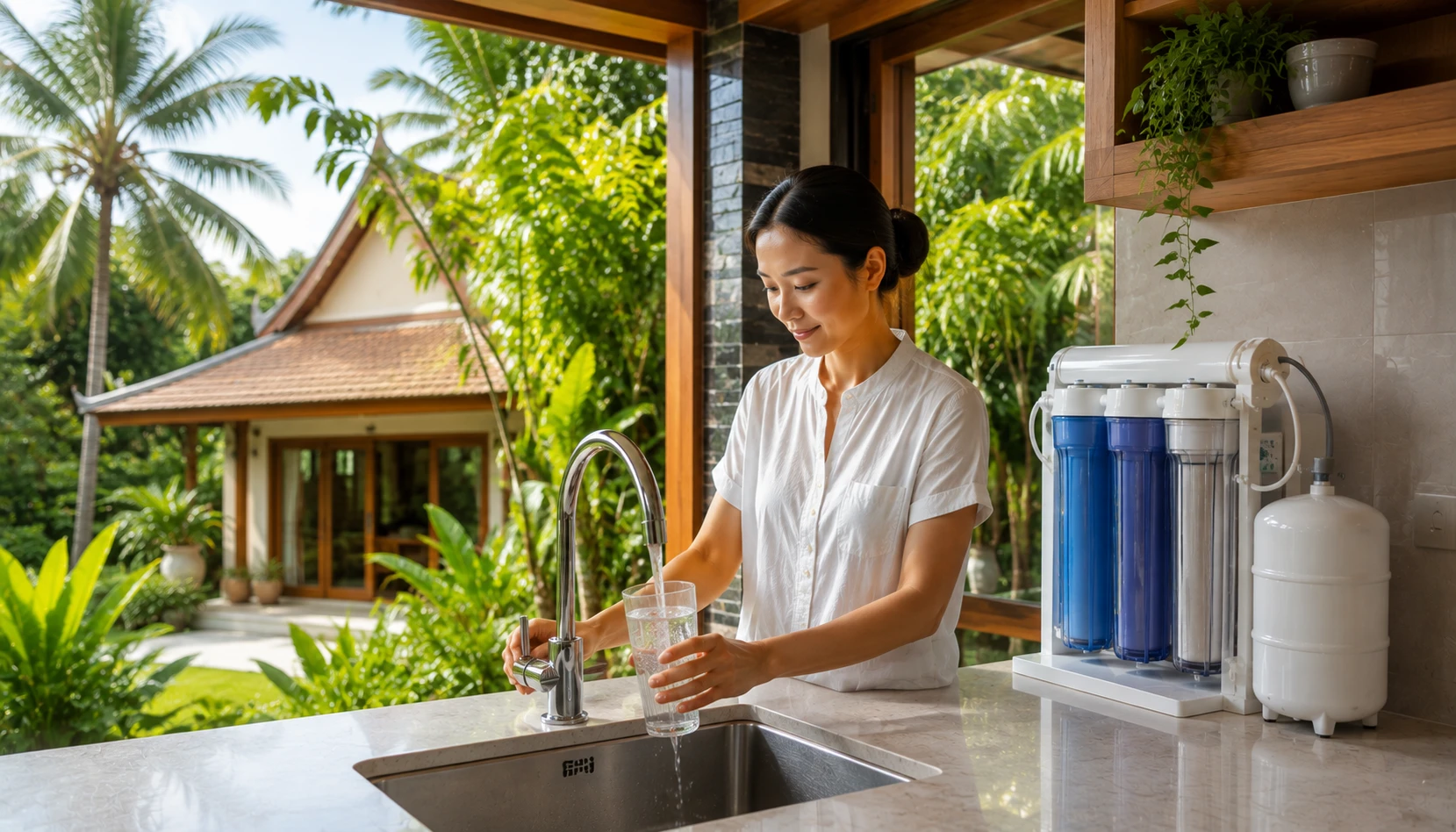
This is the decision that determines what you spend. A whole-house system treats everything entering the property and protects the plumbing, the heaters and the washing machine as well as you. Point-of-use units treat water at one tap, usually the kitchen, and do nothing for the rest.
The sensible arrangement in most homes is both, at different grades: coarse treatment at the inlet to protect the house, and fine treatment at the kitchen for what you drink. Which of the two you can even install depends on the format — an owner of a house controls the whole chain, while an apartment resident controls only what is inside the unit, one of the quieter differences between a condominium and a villa.
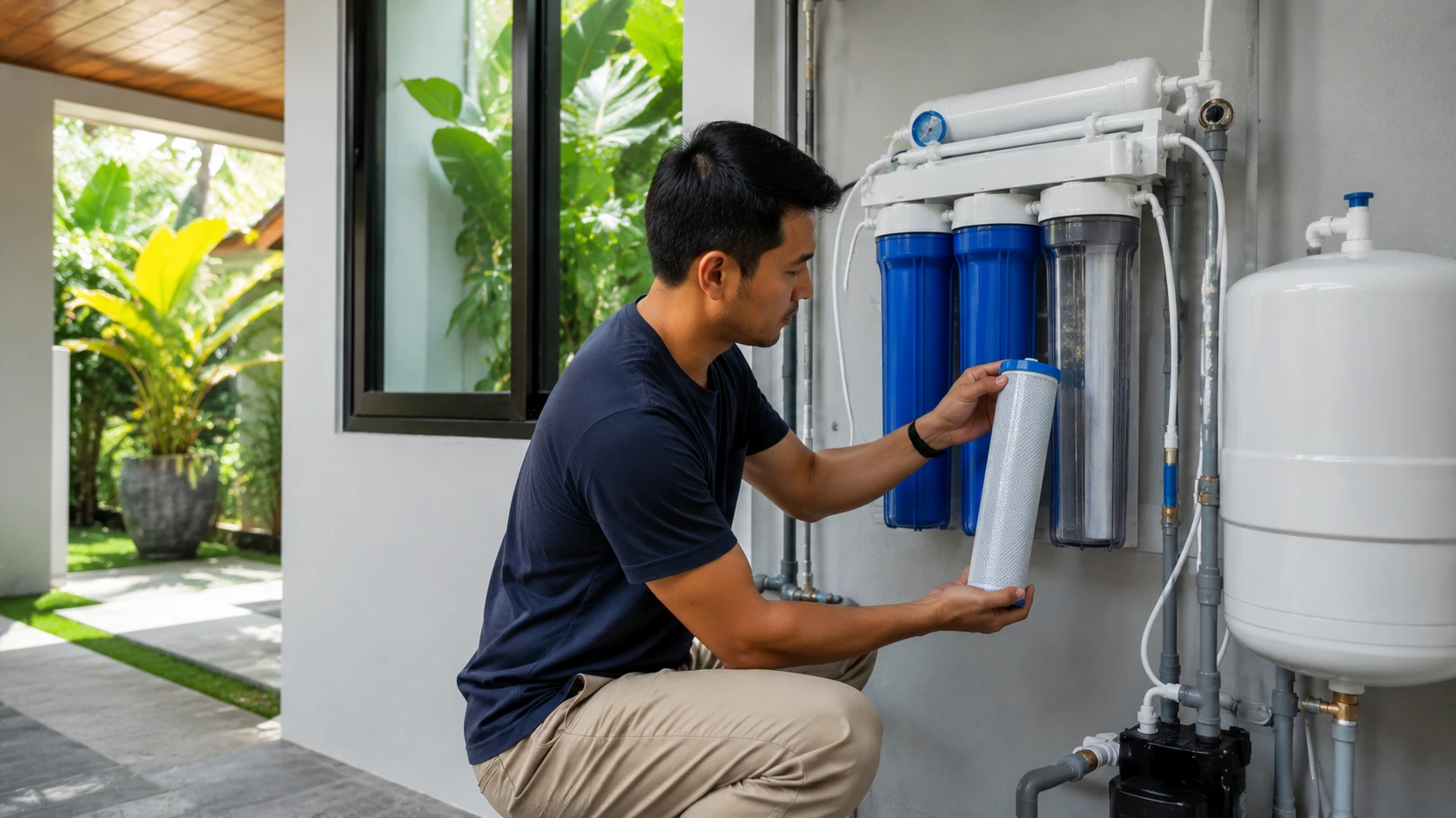
Equipment is sold as a bewildering range of boxes, but functionally there are only a few things a filter can do, and they stack in a fixed order:
A filter that is never serviced becomes the problem it was installed to solve. Cartridges have lives measured in months, and a saturated carbon filter is worse than none at all — which is why the maintenance schedule matters more than the brand on the housing.
Households here rarely drink straight from the tap regardless of what the system delivers, and two habits dominate: large returnable bottles delivered to the door, and coin-operated purification machines on residential streets where you fill your own container for a few baht.
Both are cheap, both are normal, and the choice between them and an under-sink unit is mostly about volume and convenience rather than safety. Whether the tap water itself is drinkable is answered directly in the guide to tap water in Thailand and the bottled-versus-filtered choice — the point for this article is that the household system and the drinking-water arrangement are two separate decisions that people habitually merge.
Hardness varies by area and is a mineral matter rather than a hygiene one, but it is expensive in a quiet way. Scale coats the elements of instant water heaters — the standard fitting in Thai bathrooms — and shortens their life considerably. It does the same to kettles, washing machines and the coils of air-conditioning condensate systems.
Treating hardness is maintenance economics rather than a comfort purchase, and in a hard-water area it pays for itself in appliances that stop failing every eighteen months. Water is also a line on the monthly bill, and what to expect from the utility side of a home is set out in the breakdown of electricity, water and internet bills in Thai condominiums.
Away from municipal networks the picture changes entirely. Many villas draw from a borehole, some islands rely on delivered water during the dry months, and coastal groundwater can turn brackish as the dry season progresses — a problem no ordinary filter solves.
Independent supply is its own discipline, covered in the account of living off-grid in Thailand and its water solutions. For a buyer the source is a purchase-decision variable rather than a detail: ask what the property is connected to, what happens in March, and what the neighbours do when the well runs low.
Heavy rain does not improve supply — it disturbs it. Turbidity rises after storms, treatment plants work harder, and interruptions are more likely when infrastructure is under load or when flooding affects pumping.
Which is exactly why buildings keep storage tanks, and why a household without one notices every outage. If you are choosing between properties, ask how long the building's storage lasts without supply — a few hours and a full day are very different answers on a bad afternoon.
Renters have less control than they assume, and the boundary runs at the front door. Inside it, you can install point-of-use equipment; outside it, everything belongs to the building or the landlord.
So the useful questions are asked before signing rather than after moving in:
For a purchase, and particularly for a build, water deserves a place in the specification rather than an afterthought once someone complains. Tank capacity, a coarse filter at the inlet, accessible service points and a sensible location for the equipment are cheap at construction and awkward to retrofit.
In a resale, treat the water system as part of the inspection: look at the tanks, ask about the pump's age, run a tap for a minute and check the aerator. None of it takes long, and it is one of the few property faults that shows itself in five minutes if you know where to look.
Is Thai tap water dangerous?
Municipal supply is treated and generally sound at the plant; the doubt concerns what happens in storage and pipework afterwards. Most households drink bottled or filtered water as a matter of habit, and the separate guide to tap water covers that question directly.
Do I need a whole-house filter?
In a house, usually a coarse one at least, because it protects the plumbing and the heaters as much as you. In an apartment it is often impossible and rarely necessary — a point-of-use unit at the kitchen plus a shower filter covers most of what residents actually notice.
How often do cartridges need changing?
Months rather than years, and sooner in sediment-heavy supply. A saturated filter is worse than no filter, so the replacement schedule is the part that matters — buy the equipment you will actually maintain rather than the most elaborate available.
Why is my skin worse here?
Usually hardness or chlorine rather than anything alarming, and a shower filter or scale treatment resolves most cases. It is the commonest water complaint from new arrivals and among the cheapest to fix.
Who pays to clean the tanks in a condominium?
It is a common-area responsibility funded from the maintenance charge, which means it is already paid for and simply needs to happen. Raising it with the juristic office is reasonable and usually effective, particularly if several residents ask together.
It is the single most useful question at a viewing and almost nobody asks it. DDA Real Estate is a real estate agency working in Thailand, and the practical systems behind a property are part of what we check alongside the price and the view: what the building stores and how long that lasts in an outage, whether any filtration exists at building level, what a villa is actually connected to and what happens to that source at the end of the dry season. These are five-minute questions that decide how a home feels every single day.
Look at our offers in Thailand and leave a request: we will shortlist properties that suit how you plan to live, tell you what each one's water arrangement really is rather than what the listing says, and be straightforward about the ones where fixing it would mean work the building has to agree to.