
Pattaya vs Hua Hin vs Cha-Am 2026: Families
971 56 596-5009
day and night
Dubai
EN
$
ft²
Other articles

How to Choose Between Pattaya, Hua Hin, and Cha-Am for Family Living

Alexandra Mitrofanova The author of the article, the Broker
#Blog DDA
13 August 252 view

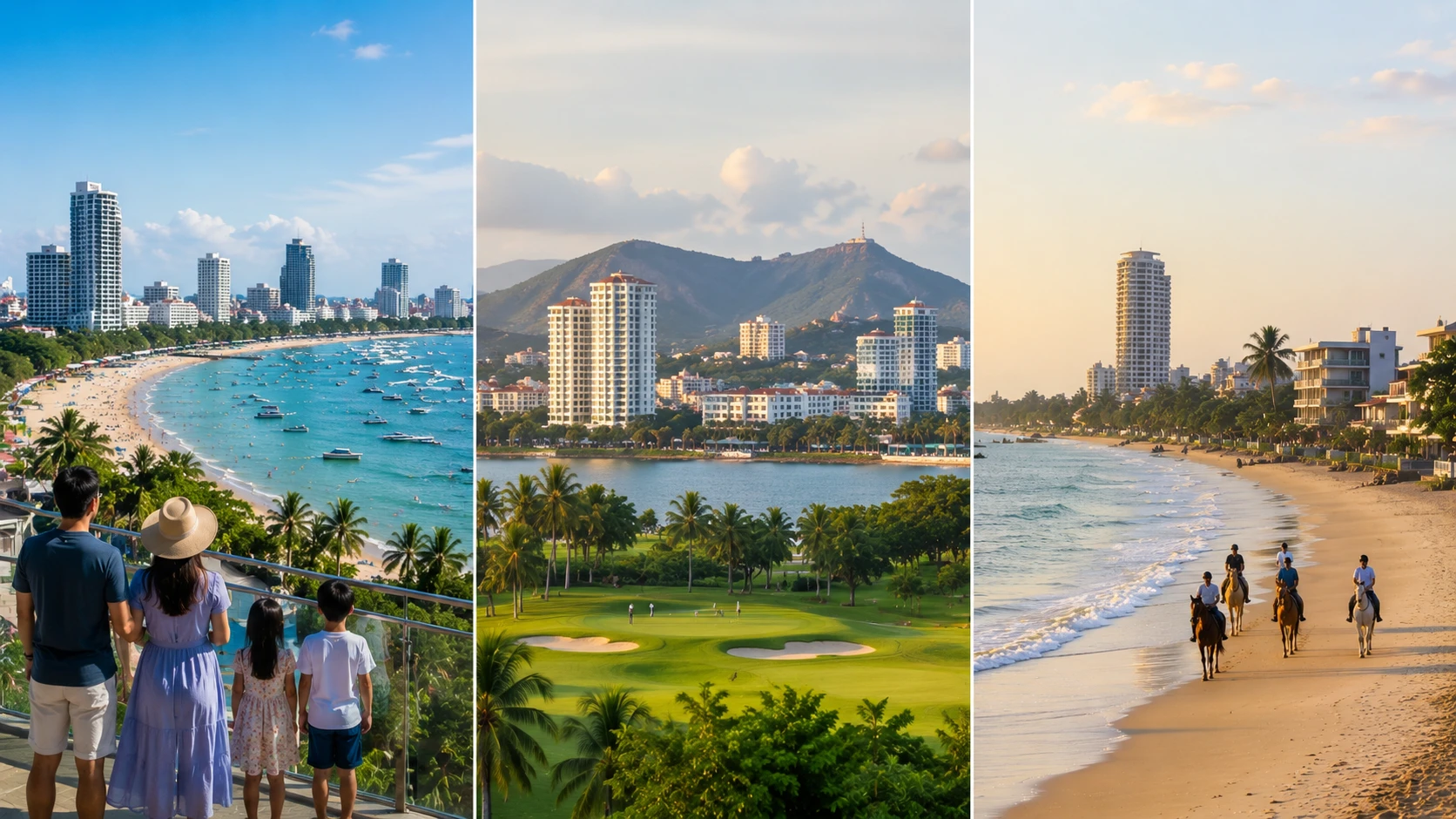
These three towns get compared as though they were three points on one scale. They are not. Cha-Am is not a third peer but a cheaper address inside Hua Hin's service catchment — its schools, its hospitals and much of its everyday infrastructure belong to the town next door.

That single correction reframes the choice. The real decision is between a city with depth and a resort town with enough, and then, if the second wins, between paying Hua Hin prices or commuting into Hua Hin from Cha-Am.

Below is what each town actually offers a family, where the schools and hospitals are, what the price gap buys, and how to test all three properly before committing. Provision changes and school places move year to year, so verify anything specific with the institutions themselves.

Pattaya

The largest of the three by a wide margin, and the one with the most of everything: schools, hospitals, shopping, international food, sports facilities and an established foreign community that includes a lot of families rather than only retirees.

It also carries a reputation built on a small central area that most resident families never use, and the practical consequence is that in Pattaya the district choice matters more than the town choice. The southern and northern residential areas are separate places with their own beaches and their own character. Its other structural advantage is proximity: the main international airport is a manageable drive, which matters for a family that flies regularly.

Hua Hin

A calmer, mid-sized town with a long-standing domestic following — Thai families have holidayed here for generations, and that shapes the atmosphere more than foreign tourism does. The beach is long, the pace is slow, and the town is walkable in a way the other two are not.

For families it offers a genuine middle position: enough international schooling and private medical care to function, without the scale or the intensity of a city. The trade is depth — fewer school options means less room to change your mind, and specialist medical care means a journey. It is also the option where the weekend rhythm is most noticeable, since it fills with visitors from the capital on Fridays.

Cha-Am

Smaller, quieter, cheaper, and predominantly a Thai domestic holiday town rather than an expatriate destination. The beachfront is long and unpretentious, the prices are visibly lower, and the foreign population is thin.

For a family the honest description is a satellite: you live here and use Hua Hin for schooling, medical care and most services, which works well when the drive is short and badly when it becomes a twice-daily school run. Cha-Am makes sense as an address, not as a self-contained answer — and it makes most sense for families whose children are not yet school age, or who have already tested the commute.

The three side by side

Reduced to what a family weighs rather than what a brochure highlights:

PattayaHua HinCha-Am
ScaleCityMid-sized townSmall town
SchoolsThe widest choice of the threeLimited but workableEffectively Hua Hin's
MedicalSeveral private hospitalsAdequate, specialists travelHua Hin's
Airport accessClosest to a major airportA longer road journeySlightly further again
CostWide range by districtMiddleLowest of the three
CharacterDepends entirely on the districtCalm, domestic, walkableQuiet, local, thin on services

Schools decide the shortlist

For a family with school-age children, this section outranks everything else in the article. The number of international schools differs sharply between the three, and it determines not only quality of choice but resilience: if the school does not suit your child, what else is within a reasonable drive?

That question is the strongest argument for the larger town and the strongest argument against the smallest. Programme availability matters as much as the number of schools, and the picture of international schools in Thailand, their curricula and locations is where to start. Confirm places in your child's specific year group before shortlisting towns, because an excellent school with no vacancy is not an option.

Medical depth and the road to Bangkok

All three have private hospitals that handle ordinary family medicine competently — the difference is what happens beyond ordinary. Serious or specialist cases in this part of the country tend to travel toward the capital, and how far that is differs materially between the three.

That distance is also the airport distance, which for many families is the deciding practical factor. What to establish for each town:

  • Which private hospital would handle a routine paediatric emergency, and how far it is from the districts you are considering
  • Whether your insurer settles directly with it, which matters more with children than without
  • Where a serious case would be referred, and what that journey looks like
  • How long the drive to a major international airport takes at a realistic hour
  • Whether rail or bus is a usable alternative for that route, and how often it runs

What the price gap buys

The three sit at visibly different price levels, and the temptation is to read the gap as a saving. Often it is a transfer: the money not spent on rent reappears as a car, fuel, school transport and time in it.

A useful reference point is how these coastal towns compare with the country's other centres — the cost-of-living comparison across Phuket, Chiang Mai and Pattaya sets the scale. For a family the honest metric is the total monthly outlay including school, transport and insurance, not the rent, and on that measure the three are closer together than their headline prices suggest.

Who else lives there

The composition of the foreign community differs and it matters more than people expect, because it determines whether your children find friends and whether you find anyone in the same situation.

All three have substantial retired populations — these are among the country's established retirement destinations, and the reasons are set out in the account of why people retire in Thailand. The family share is largest in the biggest town and thinnest in the smallest, which is a quiet argument for scale that rarely appears on a comparison chart and shows up sharply in a child's second month.

The weekend effect

All three fill up at weekends with visitors from the capital, and the effect is strongest in the two southern towns because the drive is manageable for a two-night trip. Traffic thickens, beaches fill and restaurants take bookings.

For a resident family this is a weekly rhythm rather than a seasonal one, and it is worth experiencing before deciding. A Tuesday visit shows an empty, calm town; a Saturday shows the version you will share with everyone else. Both are real, and the second is the one that shapes your weekends.

Seasonality

The Gulf coast does not follow the same pattern as the Andaman side, and these three sit in a part of the country generally regarded as drier than much of Thailand — one reason the domestic holiday tradition developed here. That does not make it dry, and rain still arrives in quantity in the wetter months.

What matters for a family is that the school year runs through whatever the local wet season is. So visit in the least appealing month rather than the best one, and ask residents what changes: which roads flood, what closes, and whether the beach is usable when you would actually be using it.

How to test all three

A comparison made from abroad on paper is almost always wrong, and the corrective is cheap relative to the decision. A structured trip settles it in a fortnight:

  • Spend at least three nights in each rather than day-tripping between them
  • Book school visits in advance and go to all of them, including the ones you think you have ruled out
  • Drive the school run at eight in the morning on a weekday, in each town
  • Include a weekend in at least one of them to see the busy version
  • Visit a supermarket and a clinic in each — mundane places show a town honestly
  • Talk to two families in each who have been there more than a year

Then rent before buying, in the town that wins. The financial case for that sequence is set out in the comparison of renting against buying for long stays, and for a family the argument is stronger still, because the school is the variable that can change everything within a year.

Questions we hear most

Is Pattaya suitable for children?

The residential districts are, and a great many foreign families live there precisely because of the schools and hospitals. The city's reputation rests on one small central area that resident families rarely enter. Choose the district carefully and the question largely answers itself.

Can we live in Cha-Am and school in Hua Hin?

Many families do, and it works if you have driven the route at the actual hour rather than estimated it. It stops working when there are two children at different schools or when activities scatter across the week. Test the commute before committing to the address.

Which is best for a family that flies often?

Pattaya, by distance to a major international airport. For families flying several times a year that advantage compounds, and it is one of the few differences between the three that cannot be offset by choosing a better district.

Are the schools comparable in quality?

Quality varies within each town as much as between them, so the more useful comparison is choice and resilience: how many alternatives exist within a reasonable drive if the first does not suit. On that measure the largest town has a clear advantage.

How long before we know we chose right?

One school term. By then the commute, the weekend rhythm and whether the child has found friends are all visible. Which is exactly why the first lease should not be a long one, whichever town wins.

Key takeaways

  • Cha-Am is an address, not an answer — its schools and hospitals are effectively Hua Hin's
  • In Pattaya the district decides everything — the reputation belongs to an area residents rarely use
  • School resilience favours scale — the question is what else is within reach if the first school fails
  • The price gap is often a transfer — cheaper rent reappears as a car, fuel and time
  • Visit at the worst time, not the best — a Saturday in the wet season is the version you will live in

Which of the three have you spent a rainy week in?

Almost nobody has, and it is the single comparison that would settle the question fastest. DDA Real Estate is a real estate agency working in Thailand, and family enquiries about these three towns follow a pattern: the shortlist is made from photographs and rental prices, and the deciding factors turn out to be the school run, the hospital and what the town feels like on a wet Saturday. We work the other way round — school and route first, town second, property last. We cover Phuket, Bangkok, Pattaya, Hua Hin and Samui.

Look at our offers in Thailand and leave a request: we will shortlist inside whichever school corridor you settle on, check the commute at a real hour rather than on a map, and be straightforward about which of the three actually fits the way your family lives.

Popular
5 June 4152078 views
Dubai Rent Prices 2025: Average Apartment Rental Costs in Dubai Dubai's rental market continues its upward climb in 2025, driven by population growth and limited new supply, pushing average prices up by 10%
#Blog DDA
2 July 2382282 view
DLD Fees in Dubai: Everything You Need to Know Buying property in Dubai? Don't let hidden fees surprise you! Our essential guide breaks down ALL Dubai Land Department (DLD) fees
#Blog DDA
23 November 1710135 views
How to Buy a SIM Card in Turkey in 2026: Prices, IMEI Registration, eSIM Options, and Best Mobile Operators Overview of mobile operators, available types of SIM cards, and home Internet providers
#Blog DDA
5 July 1702512 views
How Much is the Real Estate Agent Commission in Dubai? Find out how much real estate agent commission costs when buying property in Dubai.
#Blog DDA
5 February 1394505 views
How Foreigners Can Own Property in Bali: Understanding PT PMA (2025) Foreigners can't own freehold land in Bali, but a PT PMA (foreign-owned company) allows secure property ownership under Hak Guna Bangunan (HGB) or Hak Pakai (HP) rights
#Blog DDA
28 August 1145844 view
Oqood vs Title Deed in Dubai: Key Differences You Must Know Buying property off-plan in Dubai? Oqood registration is mandatory to secure your ownership rights.
#Blog DDA